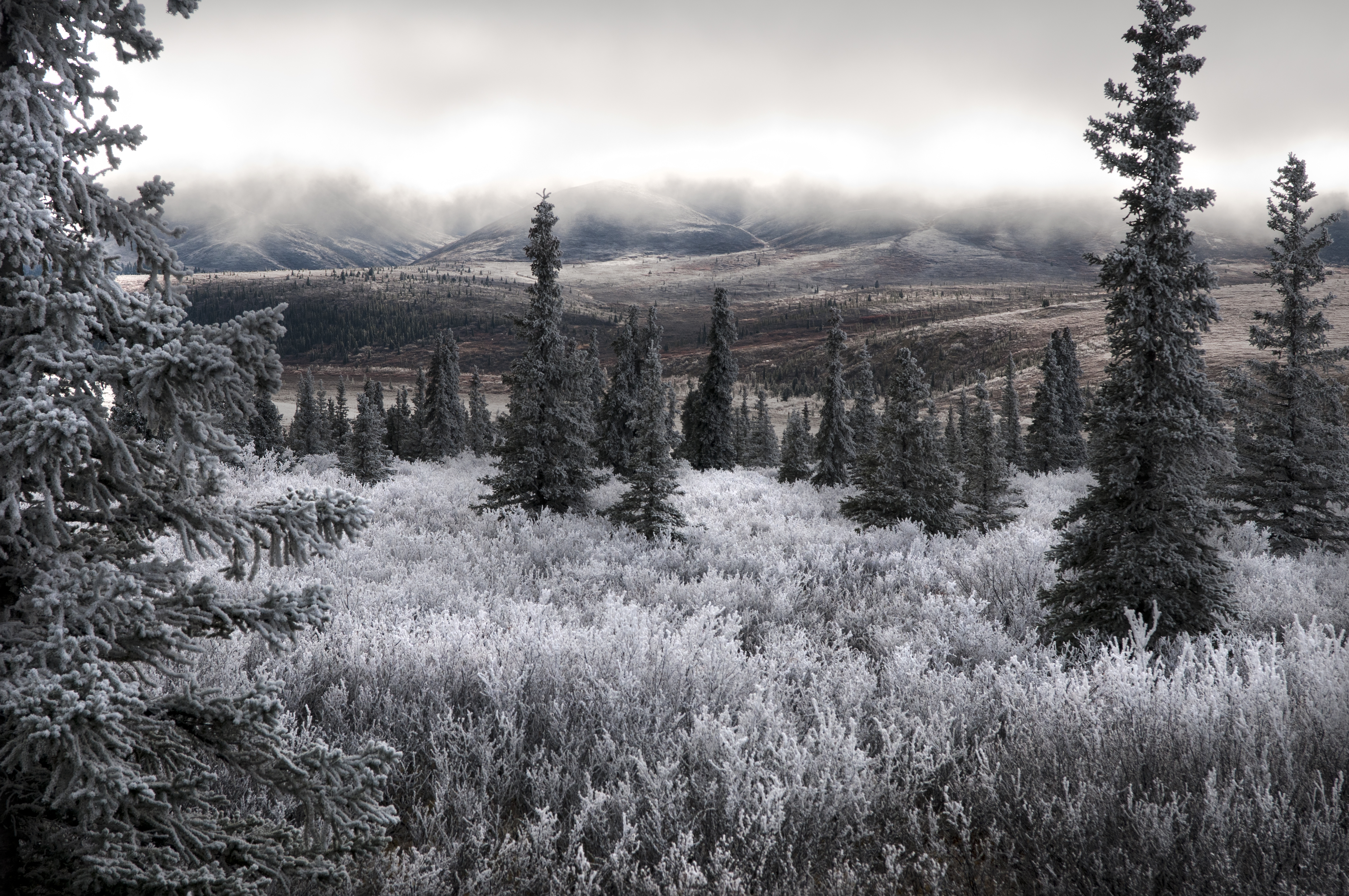
There's a moment, on the road between Anchorage and Seward, when the car is squeezed between a mountain wall and a grey arm of the sea with chunks of ice floating in it, and you realise Alaska isn't just another US destination: it's a different scale. The state has more coastline than all the others put together, more than three thousand glaciers in a single park alone, bears that cross the road as if they owned it and a 6,190-metre mountain that, with luck, shows itself one day in three. Nothing here is designed for people who come to snap the photo and head home.
What defines the trip isn't money or the itinerary: it's the calendar. Alaska runs at full steam four months a year. Between late May and mid-September the trains run, the Denali Park buses leave, the boats sail into the fjords and the visitor centres open; in October almost everything switches off and the state is left to the people who live there. Choosing the right week matters more than choosing the right hotel. And if what you're after is the northern lights, the rule flips: the Fairbanks sky only gets dark enough around 21 August and stops being so around 21 April.
This guide covers the whole state: how to put the route together, what each leg costs at official 2026 prices, what you need to get in (a US visa: Alaska is the United States) and why a rental car here isn't a convenience but a requirement. The four big chapters —Denali National Park, Anchorage, Juneau and the glaciers— each have their own page on the site and are linked below; here is what ties them together.
Alaska was inhabited for millennia by Iñupiat, Yupik, Athabascan, Tlingit, Haida and Unangax peoples before any European laid eyes on it. Contact came in 1741, with the Russian expedition of Vitus Bering and Aleksei Chirikov; after them came the sea otter hunters and, in 1799, the Russian-American Company, with its capital at Novo-Arkhangelsk, today Sitka. On 30 March 1867 Russia sold the territory to the United States for 7.2 million dollars, a purchase the press of the day dubbed 'Seward's Folly' after the Secretary of State who signed it. The mockery didn't last long: the Klondike gold rush (1897-1898) and the Nome rush (1899) filled the north with prospectors. Alaska became an organised territory in 1912, and during the Second World War it turned strategic: the Japanese occupied the islands of Attu and Kiska in 1942 and that same year the ALCAN highway opened, the first overland link with the rest of the continent. On 3 January 1959 it became the 49th state. On 27 March 1964 it was shaken by the Good Friday earthquake, magnitude 9.2, the strongest ever recorded in North America. The Prudhoe Bay oil (1968) and the trans-Alaska pipeline (1977) changed the economy, and in 1980 the ANILCA act doubled the country's protected land: that's where Kenai Fjords, Wrangell-St. Elias and the expansion of Denali and Glacier Bay came from.
No exact prices: a scale from $ (budget) to $$$$$ (luxury), with 2-3 options per category.