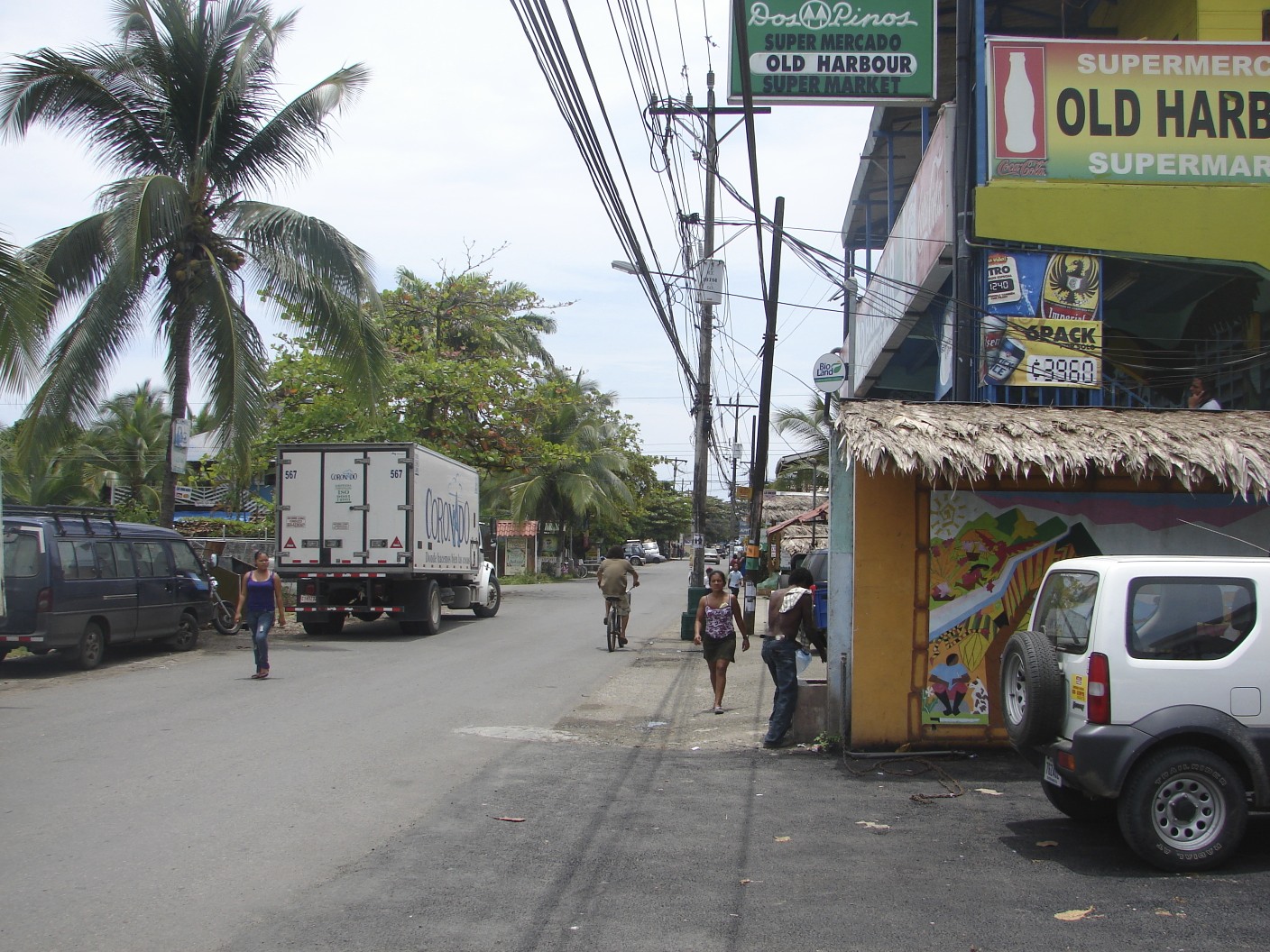
Arriving in Puerto Viejo de Talamanca means stepping into another Costa Rica. In this corner of the Southern Caribbean the pace is set by reggae and calypso, by the smell of coconut and spices from the Caribbean kitchen, by the bicycles coming and going between the jungle and the sea, and by a cultural mix in which Afro-Caribbean roots, the Bribri and Cabécar Indigenous peoples and travelers from all over the world who came and stayed are woven together.
Puerto Viejo is a byword for a bohemian, laid-back atmosphere, but also for overwhelming nature. Its beaches —from urban Playa Negra to the paradise-like Cocles, Punta Uva and Manzanillo— combine sand, palms, reefs and jungle that reaches the shore. A few kilometers away, the Gandoca-Manzanillo Refuge and Cahuita National Park protect enormously rich biodiversity, with sloths, monkeys, brightly colored frogs and birds everywhere.
This guide covers the essentials of Puerto Viejo and the Southern Caribbean with a practical, warm eye: which beaches to choose, how to ride the coast by bike as far as Manzanillo, which reserves and wildlife sanctuaries to visit, how to get close to Afro-Caribbean and Indigenous culture, where to eat rice and beans and how to get there from San José. It's a destination with an overpowering personality, ideal for anyone after beach, nature, culture and a good dose of Caribbean 'pura vida'.
The Talamanca region, on the Southern Caribbean, is one of the most strongly Indigenous territories in Costa Rica: the Bribri and Cabécar peoples live here, keeping their languages, traditions and territories and a deep relationship with the forest, in one of the country's most biodiverse and least accessible mountain ranges (the Talamanca range, a UNESCO World Heritage site along with La Amistad International Park). The Caribbean coast was historically different from the rest of the country: isolated from the Central Valley, it was settled and developed in its own way. A key part of its identity is Afro-Caribbean culture: in the late 19th and early 20th centuries many Afro-descendant workers came to the province of Limón, mostly from Jamaica and other Caribbean islands, hired to build the Atlantic railway and to work the banana plantations of companies such as United Fruit. That Afro-Caribbean population, speaking creole English (mekatelyu) and largely Protestant, gave the Limón Caribbean its language, its music (calypso, reggae), its food (rice and beans in coconut milk, rondón) and its unmistakable character. Puerto Viejo, an old, quiet village of fishermen and farmers, spent decades relatively isolated, until better roads and surfing turned it, from the last decades of the 20th century on, into one of the country's most popular destinations and one of those with the most personality. The full story is on our history page.
Read the full history ↓The Costa Rican Caribbean: the province of the railway and the banana, cradle of Afro-Caribbean culture and of the Bribri and Cabécar peoples, land of Tortuguero and its turtles, of coral reefs and of an atmosphere of reggae, calypso and 'rice and beans' that looks like no other Costa Rica.
Read the history of Limón →If you book from here we earn a commission and you pay no more. Prices and availability come from Civitatis.
No exact prices: a scale from $ (budget) to $$$$$ (luxury), with 2-3 options per category.
Origins, formation and what the sources say.
In Puerto Viejo people speak creole English, cook with coconut milk and play calypso, but the history of this corner of the Caribbean starts much earlier: with the peoples who have been in these mountains for thousands of years. The Talamanca region is one of the country's most strongly and visibly Indigenous territories: the Bribri and Cabécar live here, peoples who keep their languages, their traditions, their territories and a deep spiritual and practical relationship with the forest of the Talamanca range, one of the most biodiverse and least accessible in Central America.
The Bribri and Cabécar managed to keep their autonomy and identity partly thanks to the steepness and inaccessibility of their mountain territory, which made Spanish and colonial penetration difficult. The Talamanca range and the valleys around it were, for centuries, a stronghold where these cultures could carry on their way of life, their social organization (with a system of matrilineal clans), their worldview and their ancestral knowledge of plants, cacao and nature.
Today the Talamanca range and La Amistad International Park (shared with Panama) are a UNESCO World Heritage site, in recognition both of their extraordinary biodiversity and of the presence of these Indigenous cultures. The Bribri and Cabécar territories are still alive in the mountains behind Puerto Viejo, and the chance to get to know them —through respectful community projects— is one of the deepest and most rewarding dimensions of visiting the Southern Caribbean.
For much of Costa Rica's history, the Caribbean (Atlantic) coast developed very differently from the rest of the country. While power and population concentrated in the Central Valley, separated from the Caribbean by mountains and jungle, the Atlantic side stayed isolated, thinly populated and outside national life. That geographic separation and the lack of communications made the Caribbean a world apart.
The coast, humid and covered in jungle, was inhabited by the Indigenous peoples of the interior, by fishermen and by a few scattered settlers. The region lacked the roads and infrastructure that connected other areas, and its ties were often closer to the island Caribbean and to the sea than to the distant, hard-to-reach capital.
This historic isolation was decisive in shaping the particular identity of the Costa Rican Caribbean. Far from the influence of the country's center, the Atlantic coast would develop, above all from the late 19th century, a culture of its own, marked by the arrival of a new and decisive human component —the Afro-Caribbean population— that would change its face forever and give it the unmistakable personality you can feel today in Puerto Viejo and across the province of Limón.
The component that would define the identity of the Costa Rican Caribbean arrived in the late 19th and early 20th centuries, tied to two great undertakings: the building of the Atlantic railway and the banana boom. To build the railway that would join the Central Valley with the port of Limón —a titanic project through jungle and mountains— and to work the plantations, large numbers of Afro-descendant workers were hired, mostly from Jamaica and other English-speaking Caribbean islands.
These workers and their families settled in the province of Limón and formed a large Afro-Caribbean community with a culture of its own, distinct from that of the rest of the country. They spoke creole English (known as mekatelyu or Limón patois), largely practiced Protestant religions, and brought with them their music, their food and their customs. The powerful United Fruit Company and other banana companies dominated the region's economy for decades.
The Afro-Caribbean population lived for a long time under marginalization and restrictions (there were even periods when they faced limits on traveling to the Central Valley). Only over the course of the 20th century were they fully integrated as citizens. Despite those difficulties, their culture put down deep roots and gave the Limón Caribbean —and Puerto Viejo in particular— its language, its music (calypso, and later the influence of reggae), its cooking of coconut and spices and its cheerful, relaxed character, today one of the great cultural treasures of Costa Rica.
For much of the 20th century, Puerto Viejo de Talamanca was a small, quiet village on the Southern Caribbean, living off fishing and farming (cacao among other crops, which mattered a great deal economically until a blight hit it hard). Isolated, with poor roads and far from the tourist circuits, it kept an unhurried pace of life and a strong Afro-Caribbean and Indigenous identity, apart from the development other parts of the country were seeing.
Puerto Viejo's transformation into a tourist destination came relatively late, and above all from the last decades of the 20th century. Better roads that finally improved access to the area, together with surfers discovering its waves, drew the first travelers. The famous wave known as 'Salsa Brava', one of the most powerful and respected in the country, put Puerto Viejo on the surfing map, and the relaxed atmosphere, the beaches and the local culture did the rest.
Little by little, Puerto Viejo became one of the most popular destinations in Costa Rica and one of those with the most personality, drawing a cosmopolitan mix of surfers, backpackers, long-stay travelers and foreign residents who joined the local Afro-Caribbean and Indigenous population. The village developed a lively range of lodging, food and nightlife, with its characteristic bohemian air, without losing —at least largely— the Caribbean essence that makes it unique.
Today's Southern Caribbean combines, as few places do, lush nature with an extremely rich culture. The region holds protected areas of great value: Cahuita National Park, with its coral reef and its accessible wildlife; the Gandoca-Manzanillo National Wildlife Refuge, with its jungle, mangroves, reefs and untouched beaches; and, inland, the imposing Talamanca range and La Amistad International Park. It is one of the most biodiverse corners of the country, home to sloths, monkeys, brightly colored poison frogs, birds and much more.
To that natural wealth is added a cultural one: the Afro-Caribbean heritage alive in the music (calypso, reggae), the language, the food (rice and beans, rondón, pan bon) and the character of the village; and the presence of the Bribri and Cabécar Indigenous peoples, with their ancestral knowledge, their cacao and their traditions. This combination of nature and multiculturalism is the destination's real signature.
Like anywhere that goes from quiet to tourist success, the Southern Caribbean faces the challenge of growing without losing its soul or degrading its surroundings: protecting the reefs and the wildlife, respecting local cultures, managing development and sharing the benefits of tourism among the Afro-Caribbean and Indigenous communities. The history of Puerto Viejo de Talamanca is, at bottom, that of a meeting of peoples —Indigenous, Afro-Caribbean and travelers from around the world— against a backdrop of jungle and sea, which gave rise to one of the places with the most personality and flavor in all of Costa Rica.