Viajá con Gus
HomeCosta RicaRío Celeste and Tenorio Volcano
Río Celeste and Tenorio Volcano
🇨🇷 Costa Rica · Northern volcanoes and mountains

Río Celeste and Tenorio Volcano

Jump to what you need
📌Province
The Río Celeste and Tenorio Volcano are in Tenorio Volcano National Park, on the border between the provinces of Guanacaste and Alajuela, in the Guanacaste range, in northern Costa Rica. The reference village is Bijagua de Upala. The park protects the Tenorio massif and its rainforest, and its great draw is the Río Celeste, a river of an incredible turquoise blue produced by a unique natural phenomenon
📌Service city
The village of Bijagua is the closest base, with hotels, lodges, sodas, basic services and tour operators. La Fortuna, a little over an hour away, works as a larger base and the starting point for many day trips to the Río Celeste. The nearest international airport and main gateway is Juan Santamaría (SJO) in Alajuela, some 3.5 to 4.5 hours by car. There are also connections with Liberia (LIR) in Guanacaste and with Arenal Volcano
📌Best time to go
The best time is the dry season (December to April), when the trails are firmer (they can get very muddy) and the water tends to show its sharpest blue. In the rainy season (May to November) the jungle looks lush and the river runs fuller, but after very heavy rain the color can turn murky for a while, since the phenomenon depends on the amount of suspended sediment. This is rainforest country, so come ready for mud and rain in any month; mornings are usually better
📌Suggested days
The Río Celeste can be visited as a full-day trip from La Fortuna or from Liberia, or given a whole day if you stay in Bijagua. The hike through the park (to the waterfall, the blue lagoon, the bubbling springs and the Teñideros) takes several hours. With one night in Bijagua you can do the visit at a calmer pace early in the morning, add sloth and bird watching in nearby reserves, and get a feel for the rural life of the area. One or two days are enough to enjoy it properly
📌Hours and booking
The park opens every day, with entry from 8:00 to 14:00 and exit until 16:00. Tickets are bought online in advance on the SINAC site (serviciosenlinea.sinac.go.cr), since the daily quota is capped at 1,200 people and 500 at a time on the trail, spread across time slots; book several days ahead in high season. You can enter up to about 40 minutes after your booked time. Check hours and availability when you plan
💱 CRC exchange rate
Loading rate…
🌤️ Weather in Río Celeste and Tenorio Volcano
Loading weather…

Some landscapes look retouched, impossible, until you see them with your own eyes. The Río Celeste is one of them: deep in the rainforest, on the flanks of Tenorio Volcano, a river runs in a turquoise blue so intense that it is hard to believe it is natural. And yet it is: the result of a curious optical phenomenon that happens when two clear rivers meet.

Tenorio Volcano National Park protects this wonder and the volcanic massif around it, a world of rainforest, mist, hot springs, pools that bubble with the heat of the earth and wildlife hidden in the vegetation. The hike through the park, which leads to the spectacular Río Celeste waterfall, to the blue lagoon and to the point where the color is born (the Teñideros), is one of the most memorable nature experiences in Costa Rica.

This guide covers the essentials of the Río Celeste and Tenorio Volcano with a practical, warm eye: what the hike through the park is like, what to see along the way, when the water looks bluest, how to get around, where to stay in Bijagua and how to get there from La Fortuna, Liberia or San José. It is a destination that rewards anyone who shows up with good footwear, patience and a willingness to get a little muddy in exchange for one of the most astonishing natural spectacles in the country.

📖 History of Río Celeste and Tenorio Volcano

Tenorio Volcano and its surroundings were part, in pre-Columbian times, of the territories of Indigenous peoples of the northern zone and Guanacaste, and the region still has a strong rural stamp. The Río Celeste was known and revered by locals long before tourism arrived: there are popular legends that explain its color, the most famous of which says that when God finished painting the sky, he washed his brushes in this river and gave it its blue tone. The scientific reality is just as fascinating: the color does not come from dissolved minerals staining the water, but from an optical phenomenon. At the spot called 'Los Teñideros' two rivers of clear water meet (the Buenavista and the Sour); when they join, certain mineral particles —rich in aluminosilicates, tied to volcanic activity— cluster together and reach exactly the right size to scatter sunlight in a way that the human eye perceives as blue water. It is, in essence, the same physical principle (light scattering) that makes the sky look blue. Tenorio Volcano National Park was created in 1995 to protect the massif, its forests and this unique phenomenon, and since then the Río Celeste has become one of the great natural attractions of Costa Rica. The full story and the science are on our history page.

Read the full history ↓

🏛️ Río Celeste and Tenorio Volcano is in Guanacaste

The North Pacific province that in 1824 voted to be Costa Rican: land of the sabanero and of tropical dry forest, cradle of the national folklore, home to steaming volcanoes and founding battles, and to the great sun, surf and longevity beaches of the Nicoya Peninsula.

Read the history of Guanacaste →

🗺️ What to see

1
Río Celeste waterfall
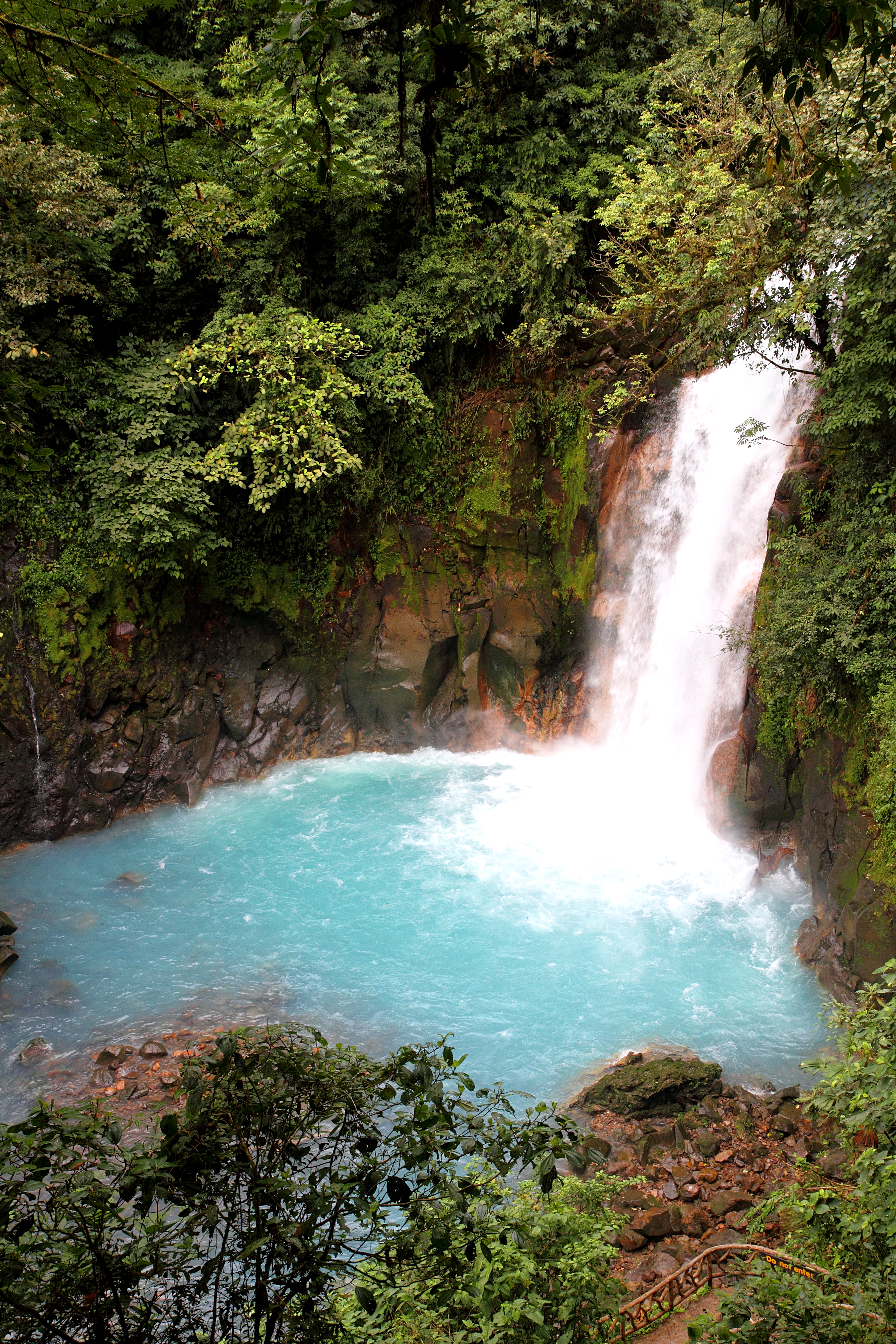
The park's most famous image: a waterfall dropping into a pool of incredible turquoise blue.
The Río Celeste waterfall is the star image of the park and one of the most photographed falls in Costa Rica. The water, that impossible turquoise blue, drops over a rock ledge in the middle of lush jungle and lands in an equally turquoise pool, ringed by tropical vegetation. The contrast between the color of the water, the deep green of the jungle and the dark rock is simply overwhelming. To reach the waterfall viewpoint you have to go down a long stairway of about 250 steps from the main trail. The way down is easy but the climb back up is demanding, so take it slowly and drink plenty of water. From the viewpoint, off to one side, you see the fall and the pool in all their glory. To protect the ecosystem, swimming in the river or the pool inside the park is not allowed. The intensity of the color varies with the weather and the volume of water: on dry, sunny days it usually looks sharper, while after very heavy rain the river can turn murky for a time. That is why the dry season and the first hours of the morning give you the best chance of seeing it at its peak. Getting there: the waterfall is inside Tenorio Volcano National Park (Pilón sector); you walk in from the main entrance, which you reach by car or on a tour from Bijagua or La Fortuna. Best time: dry season and early morning for the sharpest color and fewer people. Tips: bring footwear with good grip (the stairway can be slippery), water and a camera.
ℹ️ Distance: Inside Tenorio Volcano NP (Pilón sector); ~1.5 km on foot from the entrance · Best time: Dry season and early morning (sharpest color) · Entry: Included in the park ticket: US$ 13.56 foreigners / ₡904 nationals and residents (source: SINAC, verified July 2026) · Duration: Part of the full park hike (3 to 4 h)
2
Los Teñideros (where the color is born)
The magic point where two clear rivers meet and the water suddenly turns turquoise blue.
Los Teñideros is perhaps the most fascinating point of the whole walk, because it is where the color of the Río Celeste is literally born. Here, in the middle of the jungle, two small rivers of perfectly clear water meet (the Buenavista river and a tributary known as the Sour river, with acidic water). And then the magic happens: right at the confluence, the water turns an intense turquoise blue, as if someone had poured paint into it. The phenomenon is not caused by dissolved minerals staining the water, but by an optical process. When the two waters join, certain suspended mineral particles (rich in aluminosilicates, linked to Tenorio's volcanic activity) cluster together and reach a size that scatters sunlight in such a way that the human eye perceives the water as blue. It is the same physical principle that makes the sky look blue. Seeing it in person, with colorless water 'transforming' before your eyes, is a moment you do not forget. Los Teñideros lies at the far end of the park's main trail, so getting there means completing most of the hike. A wooden walkway lets you watch the exact point where the rivers meet. Getting there: it is the end point of the main trail in Tenorio Volcano National Park; you reach it on foot. Best time: dry season and sunny days, when the optical phenomenon shows best (it needs sunlight). Tips: for something this unique it is worth doing the full hike; bring water, footwear for mud and a rain jacket.
ℹ️ Distance: Far end of the main trail in Tenorio Volcano NP (~3 km from the entrance) · Best time: Dry season and sunny days (the phenomenon needs light) · Entry: Included in the park ticket (source: SINAC, verified July 2026) · Duration: Part of the full hike (3 to 4 h)
3
Laguna Azul and the bubbling springs
A lagoon of blue water and a spot where the river bubbles from the volcano's geothermal heat.
Along the Río Celeste trail, besides the waterfall and the Teñideros, there are two stops that round out the experience and show different sides of this magical river. The Laguna Azul is a still, blue pool in the river, surrounded by jungle, where you can take in the color calmly and watch the vegetation reflected in it. It is a serene, beautiful spot, ideal for stopping and looking. The borbollones (bubbling springs) are another highlight: at one point in the river, the water visibly bubbles up from the bottom, as if boiling, because of Tenorio Volcano's geothermal activity. Volcanic gases (sulfurous vapors) are released there and rise to the surface, and you can sometimes catch the characteristic smell of sulfur. It is a tangible reminder that this whole phenomenon is tied to the volcano and to the heat of the earth. These points are spread along the park's main trail, between the entrance, the waterfall and the Teñideros, so you see them on the same walk. Walkways and well-signed trails let you look at them safely without entering the water. Getting there: they are part of the main trail in Tenorio Volcano National Park; you see them on the same hike. Best time: dry season for less muddy trails. Tips: stay on the walkways and respect the swimming ban; the gases at the borbollones are a sign this is no place to get in. Bring water and good footwear.
ℹ️ Distance: Along the main trail of Tenorio Volcano NP (hike) · Best time: Dry season (less muddy trails) · Entry: Included in the park ticket (source: SINAC, verified July 2026) · Duration: Part of the full hike (3 to 4 h)
4
Tenorio Volcano National Park trail
The full hike linking every highlight through the rainforest of the Tenorio massif.
Tenorio Volcano National Park is explored mainly along its main trail, a hike of about 6 km round trip that crosses beautiful rainforest and connects every highlight: the waterfall, the blue lagoon, the bubbling springs and the Teñideros. It is an immersive experience in one of the best-preserved forests of the Guanacaste range. Parts of the trail are fitted with wooden walkways and steps, but much of it is dirt and, in the rainy season, it can get very muddy and slippery. In fact, many visitors rent rubber boots at the entrance or at nearby lodges. The full hike takes 3 to 4 hours (counting stops and the descent to the waterfall) and has demanding stretches, above all the waterfall stairway, but it is doable for anyone in reasonable shape. Along the way, besides the famous spots, you get to enjoy the forest: huge trees, ferns, the sound of the river and, with luck and attention, wildlife such as birds, frogs, insects and, occasionally, mammals. The Tenorio massif holds remarkable biodiversity. The park limits entry times (no one is let in after 14:00) to make sure everyone finishes the walk in daylight, so it is best to arrive early. Getting there: the main entrance (Pilón sector) is near Bijagua; you get there by car or on a tour from Bijagua or La Fortuna. Best time: dry season and early morning. Tips: bring boots or footwear for mud (or rent boots), a rain jacket, water, snacks and repellent. Set out early to beat the entry cutoff and the heat.
ℹ️ Distance: ~6 km round trip; main entrance (Pilón sector) near Bijagua · Best time: Dry season and early morning (entry only until 14:00) · Entry: US$ 13.56 foreigners / ₡904 nationals and residents (source: SINAC, verified July 2026) · Duration: 3 to 4 h (full hike)
5
Bijagua and nearby wildlife reserves
The rural base village, with private reserves that are ideal for seeing sloths, frogs and birds near the park.
Bijagua de Upala is the rural village that serves as a base for visiting the Río Celeste, a quiet, genuine place that keeps the feel of the Costa Rican countryside, among farms, dairies and jungle. Beyond its logistical role (hotels, lodges, sodas, operators), Bijagua and its surroundings have become a good place to round out the park visit with more relaxed nature experiences. The area has several private reserves and farms devoted to wildlife watching, especially sloths, which are often seen here in the trees. They are also excellent for birding (the region is rich in species), frogs —including the famous red-eyed tree frog on night tours— and other forest animals. These reserves offer guided walks by day and night, well worth it for nature and photography lovers. Staying one night in Bijagua lets you visit the Río Celeste early in the morning (fewer people, better color) and spend the rest of your time on these wildlife experiences, as well as enjoying the rural landscape and local hospitality. It is a way to take the destination in more calmly than on a lightning day trip. Getting there: Bijagua sits on the road between Cañas/Liberia and Upala, near the park; you get there by car, shuttle or bus. Best time: year-round; wildlife is always around, with night tours for amphibians. Tips: combine the park visit with a sloth tour or a night walk; book lodging ahead in high season.
ℹ️ Distance: Village of Bijagua, about 10 km from the park entrance (car, shuttle or bus) · Best time: Year-round; night tours for frogs · Entry: Private reserves: sloth and bird tours from US$ 25 to 45 per person (source: Bijagua reserves, verified July 2026) · Duration: 2 to 3 h (reserves and guided tours)
6
Hot springs and the river outside the park
Stretches of the Río Celeste outside the park where swimming is allowed, and Tenorio's natural hot springs.
Since swimming is banned inside the national park, many visitors look for the stretches of the Río Celeste beyond the boundaries of the protected area, where the water still shows its blue tones and, on authorized properties or sectors, you are allowed to cool off. One of the best-known spots is the area around the river bridge in La Unión / Río Celeste de Guatuso, where the blue water runs under the forest and there are natural pools, free or low-cost, managed by the community. Tenorio's geothermal activity also feeds hot springs in the surrounding area. Some lodges and farms nearby have natural or built thermal pools where you can relax after the hike, a different experience from the big commercial hot springs of La Fortuna: more rustic and quieter. These places are ideal as a complement to the park: the classic hike in the morning and, in the afternoon, a dip in the river or the hot springs to rest your legs. Ask locally which sectors are open and what condition the water is in, since it depends on the flow and the weather. Getting there: in the Río Celeste de Guatuso area (Alajuela) and around Bijagua, by car or with a local guide. Best time: dry season, when the river runs cleaner and the pools are safer. Tips: respect local instructions and private property; some access points charge a small fee. Bring a swimsuit, sandals and a towel.
ℹ️ Distance: Sectors in La Unión and Río Celeste de Guatuso, outside the NP (car or guide) · Best time: Dry season (cleaner river and safer for swimming) · Entry: Community pools: free or a token fee (~US$ 2 to 8); private hot springs vary (source: community managers and lodges, verified July 2026) · Duration: 1 to 2 h
Advertisements
What nobody tells you

💵 Prices

Tickets

TypePrice
Tenorio Volcano National Park (Río Celeste) — foreigners, adultUS$ 13.56 per person (bought online in advance; daily quota capped at 1,200 people and 500 at a time on the trail) (source: SINAC / entry fees, verified July 2026)
Tenorio Volcano National Park — foreigners, children (2 to 12 years)US$ 5.65 per child; under 2, free (source: SINAC, verified July 2026)
Tenorio Volcano National Park — nationals and residents, adult₡904 (approx. US$ 1.75) per person; children ₡565. National seniors, free (source: SINAC, verified July 2026)
Parking at the park entranceApprox. ₡2,000 (US$ 4) per car (source: SINAC / park guides, verified July 2026)
Rubber boot rental (entrance or lodges)Approx. US$ 2 to 5 per pair; some lodges lend them to guests (source: local operators, verified July 2026)
Private wildlife reserves (sloths, birds) in BijaguaUS$ 25 to 45 per person depending on the reserve and length (source: Bijagua reserves, verified July 2026)
Night tour for frogs and wildlifeUS$ 25 to 40 per person; usually includes a guide and flashlights (source: local guides, verified July 2026)
🔄 updated monthlyOfficial / reference values · double-check when buying

Activities and tours

ActivityPriceDurationOperator
Guided hike in Tenorio Volcano National Park (local guide)US$ 25 to 50 per person for the guide, plus the park ticket (verified July 2026)3 to 4 hoursLocal naturalist guides from Bijagua
Full-day trip to the Río Celeste from La FortunaUS$ 80 to 135 per person (includes transport, entry, guide and sometimes lunch) (source: La Fortuna operators, verified July 2026)Full day (about 8 h)La Fortuna tour operators (Mistico, Río Celeste Aventuras and others)
Sloth and bird tour in a private reserveUS$ 25 to 45 per person (verified July 2026)2 to 3 hPrivate reserves in Bijagua (Bijagua Rainforest, Tenorio Lodge and others)
Night walk for frogs and wildlifeUS$ 25 to 40 per person (verified July 2026)2 hLocal guides from Bijagua
Tubing or floating on nearby rivers (outside the park)US$ 45 to 70 per person (verified July 2026)Half dayLocal operators of the northern zone
Farm and rural production tour (cheese, coffee, cacao)US$ 20 to 45 per person (verified July 2026)2 to 3 hFamily farms around Bijagua
🔄 updated monthlyOfficial / reference values · double-check when buying
Advertisements

🚌 How to get there and distances

Getting around

ModePriceDurationNotes
Rental car (4x4 recommended)US$ 45 to 90 a day depending on category and insurance (verified July 2026)VariableThe most comfortable way to reach the park from Bijagua or La Fortuna and to explore the rural area; some access roads are dirt
Tour with transport includedUS$ 80 to 135 per person from La Fortuna (verified July 2026)Full dayThe simplest option if you are not driving: the full-day trip includes transfer, entry and guide
Local taxi in BijaguaApprox. US$ 10 to 20 per trip to the park entrance (verified July 2026)15 to 20 minTaxis in Bijagua for getting to the park entrance and the reserves. Agree on the fare beforehand and arrange the return
Tourist shuttle (shared vans)US$ 50 to 75 per person between La Fortuna/Liberia and Bijagua (verified July 2026)1.5 to 2.5 hVans connecting the area with La Fortuna, Liberia and other destinations; comfortable and door to door
Intercity public busApprox. US$ 3 to 7 per leg; cash only, paid to the driver (source: bus operators / Moovit, verified July 2026)VariableBuses on the San José–Upala and Cañas–Upala routes pass through Bijagua (several departures a day from San José: ~6:00, 10:15, 15:00, 15:45 and 17:15). You pay in cash (colones) to the driver: no cards, QR or app are accepted, and Costa Rica has no single transport card like Argentina's SUBE. IMPORTANT: there is no public transport from Bijagua to the park entrance (about 10 km), so you have to cover that last stretch by taxi, with your hotel or on a tour.
App for checking bus timesFree (Moovit / Google Maps / Yo Viajo)Moovit covers the Bijagua stops (with times and arrivals for the routes to and from Upala and San José) and is usually more accurate than Google or Apple Maps in Costa Rica; the local website Yo Viajo also works. No app lets you pay for the bus (payment is always cash to the driver). There is no Uber in the area.
🔄 updated monthlyOfficial / reference values · double-check when buying

How to get there

RouteAirlines / operatorsAvg. priceDuration
La Fortuna → Río Celeste/Bijagua by car or tourRental car or tour operatorCar: fuel and tolls; tour US$ 80 to 135 per person (verified July 2026)A little over 1 hour (car); full day on a tour
San José (SJO) → Bijagua/Río Celeste by carRental car or private transferRental car US$ 45 to 90/day; private transfer US$ 180 to 280 (verified July 2026)3.5 to 4.5 hours
Liberia (LIR) → Río Celeste/BijaguaRental car, shuttle or tourShuttle US$ 50 to 75 per person; car from US$ 45/day (verified July 2026)About 1.5 to 2 hours
San José → Bijagua by public busTransportes Upala (Terminal 12, San José)Approx. US$ 6 to 9 per person (verified July 2026)5 to 6 hours (plus arranging the last stretch to the park)
Tourist shuttle from La Fortuna or LiberiaInterbus, Caribe Shuttle and other companiesUS$ 50 to 75 per person, door to door (verified July 2026)Depending on where you start, 1.5 to 2.5 h
🔄 updated monthlyOfficial / reference values · double-check when buying

🏨 Where to stay

No exact prices: a scale from $ (budget) to $$$$$ (luxury), with 2-3 options per category.

CategoryPriceRecommended options
High-end nature lodges / resort$$$$$US$ 280 to 550 a night; e.g. Río Celeste Hideaway (luxury bungalows in the jungle with pools and hot springs), premium options with full comfort and forest views
Charming lodges and boutique hotels$$$$$US$ 120 to 200 a night; e.g. Celeste Mountain Lodge (US$ 122–170, volcano views and chef-driven cooking) and Tenorio Lodge, with sloths on its grounds and guided walks
Cabinas, mid-range lodges and hotels in Bijagua$$$$$US$ 75 to 152 a night; e.g. Kakao Lodge & Garden Río Celeste (US$ 88–152) and Finca Verde Lodge (US$ 75–110 with breakfast), practical for getting into the park early
Budget / simple cabinas and guesthouses$$$$$US$ 40 to 70 a night; family cabinas and hostels in the village of Bijagua and the surrounding countryside, friendly and well priced for early risers

🍴 Where to eat

TypePriceOptions / signature dish
Typical sodas in Bijagua$$$$$US$ 5 to 12 a dish; casados, gallo pinto, soups and fresh fruit drinks in family-run diners, ideal before or after the hike
Lodge restaurants (Costa Rican and international)$$$$$US$ 12 to 30 a dish; many lodges have a restaurant with Costa Rican and international dishes, sometimes with views of the jungle or the volcano
Fine dining / chef-driven restaurant$$$$$US$ 25 to 45 a dish; e.g. the restaurant at Celeste Mountain Lodge, with set menus of creative cooking and local produce (book ahead)
Stands and diners near the park$$$$$US$ 4 to 9 a dish; simple, quick options near the entrance to refuel; it is also worth carrying water and snacks for the hike
Advertisements

📖 History of Río Celeste and Tenorio Volcano

Origins, formation and what the sources say.

Tenorio Volcano and the region in ancient times

Legend has it that when God finished painting the sky, he washed his brushes in a river running down from Tenorio Volcano, and that is why its water was left stained that impossible blue. For generations, the farmers of this corner of northern Costa Rica had no better explanation —nor did they need one— for the wonder they saw every day: a river of bright turquoise running through the jungle. Long before the tourists, the guides and the cameras arrived, the Río Celeste was already a story passed from mouth to mouth at the foot of the volcano.

Tenorio Volcano rises in the Guanacaste range, part of the chain of volcanoes that crosses the country from northwest to southeast, formed by the subduction of the Cocos plate under the Caribbean plate. Tenorio is a volcanic massif with several craters and cones, covered in rainforest and, on its upper slopes, cloud forest, and surrounded by areas of geothermal activity that show up as hot springs, fumaroles and bubbling pools.

In pre-Columbian times, the lands of northern Costa Rica and Guanacaste were inhabited by Indigenous peoples of different cultural traditions, who made use of the rivers, the forests and the slopes of the volcanoes. The Tenorio region, with its abundant water and its jungle, was part of that world, though the higher, wetter parts of the massif remained largely wild and little traveled.

For centuries the area stayed a remote, rural territory. With the agricultural settlement of the northern zone, above all through the 20th century, villages such as Bijagua appeared, living off cattle, dairy and farming. Locals knew the blue river coming down from the volcano well, and legends grew around it trying to explain that astonishing color long before science did.

The region's volcanic origin
Tenorio Volcano is part of the Guanacaste volcanic range, formed by the subduction of the Cocos plate under the Caribbean plate. Its geothermal activity (hot springs, fumaroles and bubbling pools) underlies the Río Celeste phenomenon. The dating and the precise historical activity of Tenorio are the subject of geological study.
Source: https://es.wikipedia.org/wiki/Volc%C3%A1n_Tenorio

The legend of God's paintbrush and the folklore of the river

Before there was a scientific explanation, the people of the region made sense of the Río Celeste's incredible color through legends and folk tales that are still told to visitors today. The most famous and best loved is that of 'God's paintbrush': according to this tradition, when God finished painting the sky he washed his brushes in this river, and ever since the water has been stained that unmistakable blue.

This simple, poetic legend reflects the awe the phenomenon inspired in those who saw it and the human need to explain the extraordinary through stories. The name 'Río Celeste' itself comes from that direct observation of its color, and the place keeps an almost magical atmosphere that invites this kind of tale.

Local folklore, as in much of rural Costa Rica, mixes Indigenous roots, Spanish heritage and country imagination, and striking natural features —rivers, waterfalls, volcanoes— tend to be wrapped in stories. The legend of God's paintbrush lives on today alongside the scientific explanation, and many guides tell it precisely to contrast the poetry of the people with the fascinating physics that actually produces the color. Far from taking the magic away, understanding the phenomenon multiplies it.

The legend as intangible heritage
The legend that God washed his brushes in the Río Celeste after painting the sky is a folk tale widely told in the area and picked up by guides and tourist material. It has no scientific basis, but it is part of the region's intangible cultural heritage and of the experience of visiting the place.
Source: https://es.wikipedia.org/wiki/R%C3%ADo_Celeste

The science behind the color: optics, not dissolved minerals

For a long time it was believed that the Río Celeste's color came from dissolved minerals —copper or sulfur— staining the water. Scientific research (including studies by the University of Costa Rica and the Costa Rica Institute of Technology) revealed that the explanation is subtler and more fascinating: the color comes not from pigments or dissolved minerals, but from a physical optical phenomenon.

The mechanism happens at the spot called Los Teñideros, where two clear watercourses meet: the Buenavista river and an acidic tributary (sometimes called the Sour river or quebrada Agria). Each one on its own carries colorless water. But when they mix, the change in chemical conditions (especially pH) makes certain suspended mineral particles —rich in aluminosilicates, linked to Tenorio's volcanic activity— cluster and grow until they reach a specific size, on the order of several hundred nanometers.

That size is exactly what makes the particles scatter sunlight selectively (a light-scattering process, related to the one that makes the sky blue and the deep sea blue). As a result, the human eye perceives the water as turquoise blue. That is why the phenomenon needs sunlight to be fully appreciated, why it 'switches on' right at the mixing point and not before, and why, after very heavy rain that alters the concentration of particles, the color can fade or turn murky for a time. Nature, once again, turns out to be a better 'painter' than any legend.

Mie scattering and the size of the particles
Scientific studies attribute the color of the Río Celeste to light scattering (related to Mie scattering) caused by aluminosilicate particles which, when the waters mix and the pH changes, reach a size of around a few hundred nanometers, exactly right for scattering light and making the water look blue. It is not caused by dissolved minerals staining the water.
Source: https://en.wikipedia.org/wiki/R%C3%ADo_Celeste

The creation of Tenorio Volcano National Park (1995)

As interest in the Río Celeste and the Tenorio massif grew, the need to formally protect this region of extraordinary natural value became clear. Costa Rica, a world pioneer in conservation with its broad network of national parks and protected areas, took the step in 1995 with the creation of Tenorio Volcano National Park, part of the Arenal-Tempisque Conservation Area.

The park protects the Tenorio volcanic massif, its rainforests and cloud forests, its water sources and, of course, the unique phenomenon of the Río Celeste. Its creation sought to safeguard both biodiversity —Tenorio holds numerous species of flora and fauna, including mammals, birds, amphibians and reptiles— and the fragile balance that makes the river's color possible, which depends on very specific chemical and physical conditions.

The park's protection made it possible to develop orderly nature tourism, with marked trails, visitor control, a ban on swimming in the river inside the protected area and limited entry hours, all aimed at conserving the ecosystem. Over time, the Río Celeste went from being a secret known mostly to locals and adventurous travelers to becoming one of the great natural icons of Costa Rica, drawing visitors from all over the world.

The year the park was created
The sources agree that Tenorio Volcano National Park was created in 1995, within the Arenal-Tempisque Conservation Area, to protect the Tenorio massif, its forests and the Río Celeste phenomenon. It is part of the National System of Conservation Areas (SINAC).
Source: https://es.wikipedia.org/wiki/Parque_nacional_Volc%C3%A1n_Tenorio

The Río Celeste today: an ecotourism icon and its conservation challenges

In recent decades the Río Celeste has become one of the most coveted natural destinations in Costa Rica, driven by images of its turquoise water, the waterfall and the Teñideros spreading on social media. That popularity has been a blessing for the local economy —bringing life to Bijagua and its surroundings with lodges, tours, guides and services— but it has also raised conservation challenges.

The rise in visitors has led the SINAC authorities to take measures to protect the fragile ecosystem: limits on the number of people, trails marked out with walkways, a strict ban on swimming in the river inside the park and set entry hours, all to prevent erosion, pollution and disruption of the color phenomenon. The sustainability of the destination depends on respecting these rules.

Around the park, the community of Bijagua has developed a model of rural and nature tourism that goes beyond the river itself: private reserves for seeing sloths and birds, night walks, farms and community projects that aim to bring the benefits of tourism to local people and strengthen the protection of the forest. The Río Celeste and Tenorio Volcano thus represent, in miniature, the spirit of Costa Rica: a country that has made the conservation of its extraordinary nature a mark of identity and a form of development, finding the balance between showing off its wonders and protecting them for the future.

Tourism and conservation in balance
Authorities and operators agree that the growing popularity of the Río Celeste calls for management measures (visitor control, walkways, the swimming ban, set hours) to conserve the phenomenon and the ecosystem. Bijagua's rural tourism model seeks to involve the local community in protecting the area and using it sustainably.
Source: https://www.sinac.go.cr/

📚 Bibliography

  • Wikipedia (ES) — «Río Celeste»: https://es.wikipedia.org/wiki/R%C3%ADo_Celeste
  • Wikipedia (EN) — «Río Celeste»: https://en.wikipedia.org/wiki/R%C3%ADo_Celeste
  • Wikipedia (ES) — «Parque nacional Volcán Tenorio»: https://es.wikipedia.org/wiki/Parque_nacional_Volc%C3%A1n_Tenorio
  • Wikipedia (EN) — «Tenorio Volcano National Park»: https://en.wikipedia.org/wiki/Tenorio_Volcano_National_Park
  • Wikipedia (ES) — «Volcán Tenorio»: https://es.wikipedia.org/wiki/Volc%C3%A1n_Tenorio
  • SINAC — Sistema Nacional de Áreas de Conservación: https://www.sinac.go.cr/
  • Visit Costa Rica (ICT) — sitio oficial de turismo: https://www.visitcostarica.com/

❓ Frequently asked questions

How much does entry to Tenorio Volcano National Park (Río Celeste) cost and how do you pay?+
Entry for foreigners is US$ 13.56 per adult and US$ 5.65 per child (2 to 12 years); for nationals and residents it is ₡904 for adults and ₡565 for children. Under-2s and national seniors get in free (SINAC rates verified in July 2026). Tickets are bought online in advance on the SINAC site and paid by CREDIT or debit CARD: Costa Rica's national parks have gone cashless, so you cannot pay for entry in cash. The daily quota is capped at 1,200 people (and 500 at a time on the trail) and entry runs from 8:00 to 14:00, so book several days ahead in high season. Parking costs about ₡2,000 (US$ 4) per car on top of that.
Why does the Río Celeste have that blue color?+
It is not from minerals staining the water, but from an optical phenomenon. At the spot called Los Teñideros two clear rivers meet; when they join, certain mineral particles (aluminosilicates, linked to the volcano) cluster together and reach exactly the right size to scatter sunlight so that the eye perceives the water as blue. It is the same physical principle that makes the sky look blue.
Can you swim in the Río Celeste?+
Not inside Tenorio Volcano National Park: swimming in the river and in the waterfall pool is banned to protect the ecosystem and the color phenomenon. There are stretches of the river outside the park boundaries (the Guatuso area and around it), on authorized properties or sectors, where swimming is sometimes allowed; ask locally.
When is the best time to see the water at its bluest?+
The dry season (December to April) and sunny days usually give the sharpest color, since the optical phenomenon needs sunlight and shows best when the water is clean. After very heavy rain the river can turn murky for a while. Early morning is ideal: better light, fewer people and somewhat quieter trails.
Is the Río Celeste hike hard?+
It is moderate. The full trail (about 6 km round trip) takes 3 to 4 hours, crosses jungle and can get very muddy and slippery in the rainy season; the most demanding stretch is the long stairway (about 250 steps) down to the waterfall. It is doable for anyone in reasonable shape, but bring good footwear or rubber boots and water, and take it slowly.
Do I need to book my ticket in advance?+
Yes. For some years now tickets have been bought online in advance on the SINAC site (serviciosenlinea.sinac.go.cr), because the daily visitor quota is limited. In high season it can sell out, so book several days ahead. Entry is only allowed until 14:00.
Is it better as a day trip or should I stay in Bijagua?+
Both work. The full-day trip from La Fortuna or Liberia (US$ 80 to 135 per person) is very popular and practical if you do not want to move your base. Staying one night in Bijagua lets you enter the park early (better color, fewer people) and add sloth tours and night walks, taking the destination in more calmly.
How do I get to the Río Celeste without a car and how do I pay for the bus?+
Without a car, the simplest option is a full-day trip from La Fortuna or Liberia (US$ 80 to 135 with transport, entry and guide) or a door-to-door shuttle to Bijagua (US$ 50 to 75). If you take the public bus, the San José–Upala and Cañas–Upala routes pass through Bijagua and are paid IN CASH to the driver (colones): no cards, QR or payment app, and no single transport card like Argentina's SUBE. Watch out: from Bijagua there is NO bus to the park entrance (about 10 km), so you cover that last stretch by taxi (~US$ 10-20) or arrange it with your hotel. Moovit or Yo Viajo are useful for checking times, but they do not let you pay the fare. Remember too that the park ticket is paid by card (the parks are cashless).
Sources consulted (13)
Still planning?
Explore more destinations in Costa Rica
See all destinations →
Advertisements
Image credits
Photos from Wikimedia Commons, each under its own licence (CC BY, CC BY-SA or public domain). Open each file to see its author and licence.
Rio celeste Fall 1