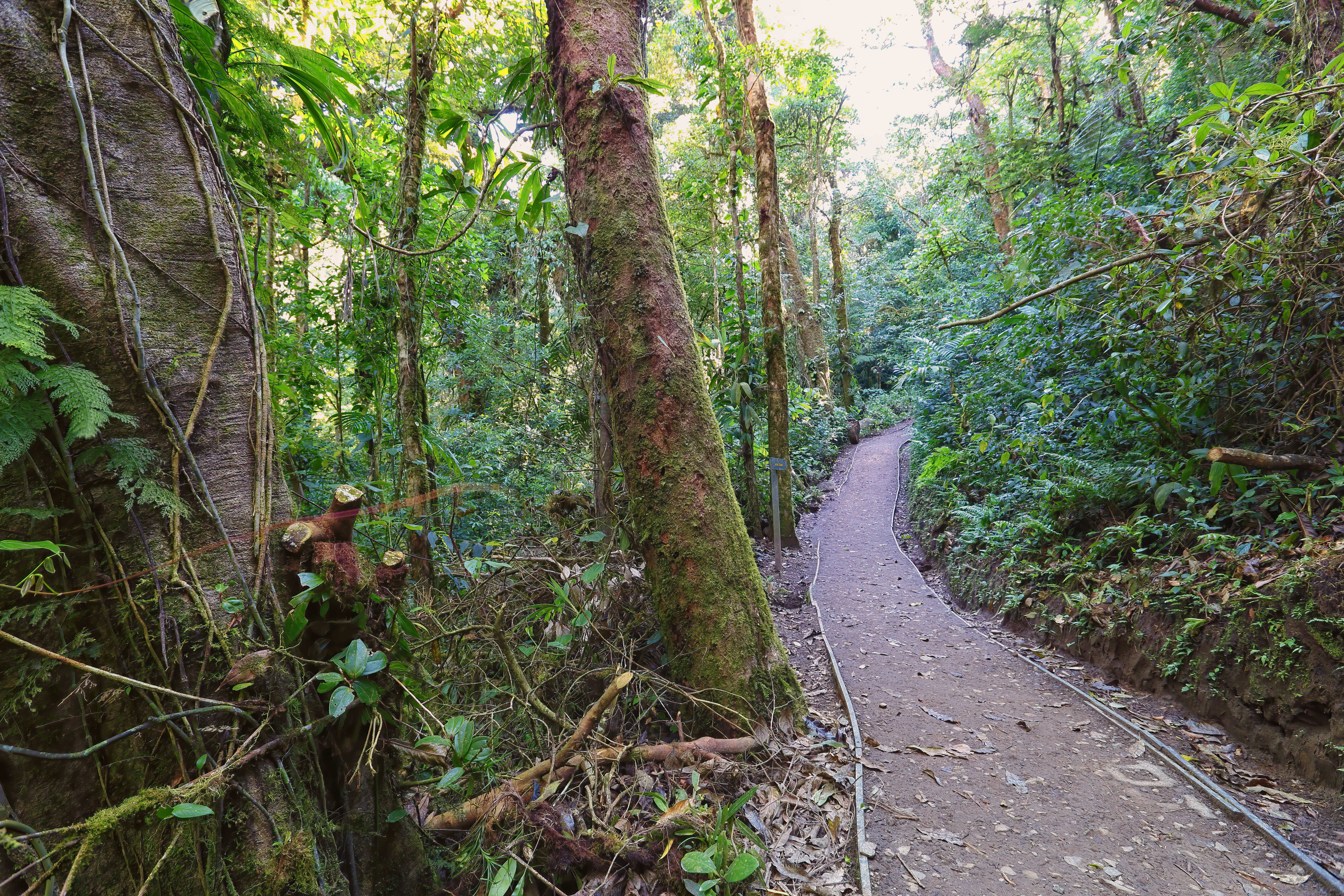
Some places look like they came out of a storybook, and Monteverde is one of them. High in the Cordillera de Tilarán, where the clouds tangle permanently in the treetops, lies one of the most fascinating ecosystems on the planet: the cloud forest. Here the trunks are coated in mosses, ferns and orchids, the air is cool and damp, and life bursts out of every corner in an explosion of green and sound.
Monteverde is a byword for biodiversity and for pioneering conservation. Its reserves protect thousands of plant species, hundreds of birds —including the legendary resplendent quetzal, with its long emerald tail—, mammals, amphibians and insects. It was also the cradle of some of Costa Rica's first experiments in nature tourism and private conservation, driven in large part by a community of Quakers who settled in these mountains in the middle of the 20th century.
This guide covers the essentials of Monteverde with a practical, warm eye: how to visit the cloud forest reserves, which adventure activities to choose —from the famous hanging bridges to the zip-lines over the canopy—, where to see wildlife, how to get around and how to arrive from San José or from La Fortuna. It is a destination that combines the magic of nature with the warmth of a mountain village, and it leaves a mark that is hard to forget.
The mountains of Monteverde were inhabited and travelled by Indigenous peoples in pre-Columbian times, and for centuries they remained a remote territory of forest and mist. The modern history of the region began in 1951, when a group of Quakers (members of the Religious Society of Friends) from the United States, many of them conscientious objectors who refused military service, decided to emigrate to Costa Rica, drawn by the abolition of the army the country had decreed in 1948. They settled in these mountains to take up dairy farming and cheese making, and named the place 'Monteverde' for its green slopes. The Quakers made one key decision: they set aside a large portion of the forest at the headwaters of their water sources in order to protect it, laying the groundwork for the conservation to come. In the following decades, scientists drawn by the richness of the cloud forest pushed for the creation of reserves: the Monteverde Cloud Forest Biological Reserve was established in 1972, run by the Centro Científico Tropical. The area's international fame grew hand in hand with nature tourism and conservation, turning Monteverde into a global model of ecotourism. The full story is on our history page.
Read the full history ↓The country's longest coastal province, from the Central Pacific to the deep south: from the historic coffee port of Puntarenas to the cloud forests of Monteverde, from the beaches of Manuel Antonio to the wild jewel of the Osa Peninsula and Corcovado, 'the most biologically intense place on Earth'.
Read the history of Puntarenas →If you book from here we earn a commission and you pay no more. Prices and availability come from Civitatis.
No exact prices: a scale from $ (budget) to $$$$$ (luxury), with 2-3 options per category.
Origins, formation and what the sources say.
Long before the name 'Monteverde' existed, these mountains of the Cordillera de Tilarán were a remote territory of forest permanently wrapped in mist, hard to live in and hard to cross. In pre-Columbian times, the northern and central Pacific region of Costa Rica was peopled by Indigenous groups linked to the cultures of Guanacaste and of the Gulf of Nicoya side, who travelled and used these highland territories, although the heart of the cloud forest stayed largely wild.
Through the colonial period and the early years of independent Costa Rica, these highlands remained on the margins of the main population centers, which were concentrated in the Central Valley. The difficulty of access, the cold, damp climate and the thickness of the forest kept the area relatively isolated and thinly populated well into the 20th century.
In the early 20th century some Costa Rican settlers began to arrive, establishing themselves on the flanks of the range to farm and raise cattle, opening clearings in the forest. But the real modern history of Monteverde, the one that would give it its character and its worldwide fame, was about to begin with the arrival, in the middle of the century, of a very particular group of immigrants.
The story that defines Monteverde begins in 1951, when a group of Quakers —members of the Religious Society of Friends— from the United States, most of them from Alabama, decided to emigrate to Costa Rica. They were committed pacifists, and several of the men in the group had been jailed for refusing to register for compulsory military service back home. They were looking for a place to live in line with their principles of peace, far from militarism.
Costa Rica appealed to them for one remarkable historical reason: in 1948, after a civil war, the country had abolished its army, a decision almost unique in the world. For a pacifist group, settling in a nation without armed forces carried deep symbolic and practical meaning. So several Quaker families moved to these mountains in the Cordillera de Tilarán, drawn by a cool climate suited to dairy farming and by the availability of land.
The Quakers named the place 'Monteverde', for the permanent green of its slopes, and took up dairy farming and cheese making, founding a processing plant that would become an emblematic brand of the region (the famous Monteverde cheeses). They built a community based on work, simplicity and Quaker values, and put down roots in these mountains, transforming their own fate and that of Costa Rican tourism.
Although the Quakers came to Monteverde to raise dairy cattle, they made an early decision that would prove visionary. Aware that the cloud forest on the upper slopes was the source of the water feeding their farms and streams, they decided to set aside a large portion of that forest and not cut it, protecting it as a watershed. Without entirely meaning to, they were planting the seed of the conservation that would make the region famous.
Over the following decades, the extraordinary biological richness of that forest began to draw the attention of scientists, biologists and naturalists from around the world. Researchers realized that these cloud forests held exceptional biodiversity —thousands of plant species, hundreds of birds, an immensely rich fauna— and that they deserved to be formally studied and protected.
That meeting between the conservation-minded Quaker community and the international scientific community was decisive. Protecting the forest stopped being just a matter of safeguarding water and became a project of conserving nature for its own sake. Out of that convergence came the reserves that would put Monteverde on the world map of ecotourism and science.
The conservation drive took concrete form in 1972 with the creation of the Monteverde Cloud Forest Biological Reserve, run by the Centro Científico Tropical, an organization devoted to research and conservation. The reserve protected a large stretch of cloud forest on both sides of the continental divide, taking in a striking variety of habitats and one of the highest levels of biodiversity in the country.
Creating the reserve was possible thanks to a combination of donated land, land purchases and the support of national and international scientific and conservation organizations. Over the years the reserve was expanded, and other protected areas appeared in the region, such as the Santa Elena Cloud Forest Reserve (community-run, tied to local education) and various private reserves. The Bosque Eterno de los Niños (Children's Eternal Rainforest), born of an international fundraising campaign driven by children in many countries, became one of the largest private reserves in the country.
Monteverde thus became a global model of conservation combining nature protection, scientific research and responsible tourism. Ecotourism —guided walks, birdwatching, and later the hanging bridges and the zip-lines— developed as a way to fund conservation and generate income for the community, proving that a forest left standing could be worth more than a forest cut down.
Over the decades, Monteverde established itself as one of the best-known ecotourism destinations in the world and as a laboratory of innovation in nature tourism. Some of the first tourist canopy tours were developed here —sliding along zip-lines between the treetops—, an activity that began partly as a scientific tool for studying the forest canopy and later caught on as an attraction, spreading from Costa Rica to the rest of the planet. Today the zip-lines and hanging bridges of Monteverde are famous among travelers.
Monteverde is also the setting for one of the most moving and cautionary environmental stories: that of the golden toad (Incilius periglenes), a small, bright orange amphibian that was endemic to these forests. Abundant until the 1980s, it vanished abruptly and has been considered extinct since the end of that decade or the beginning of the 1990s. Its disappearance, attributed to a combination of environmental factors (among them climate change and amphibian diseases), became a worldwide symbol of the amphibian extinction crisis and of the fragility of mountain ecosystems in the face of global change.
Today Monteverde keeps its double identity: on one side, a vibrant tourist destination, with reserves, adventure parks, hummingbird gardens and butterfly houses; on the other, a community deeply committed to conservation and research, heir to the spirit of those Quakers who decided, more than half a century ago, to leave part of the forest standing. That combination of nature, science and community is what makes Monteverde unique.