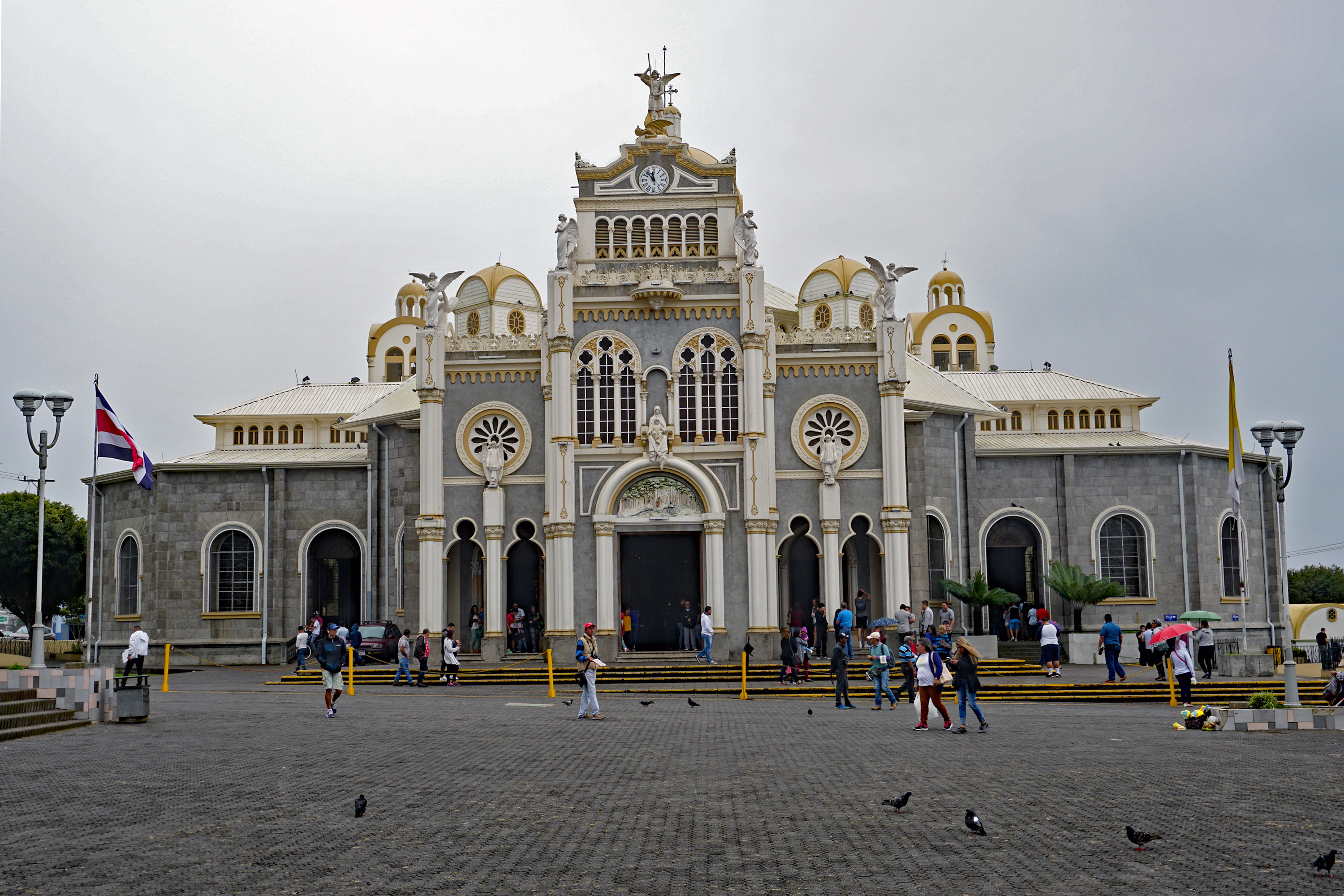
Cartago is the cradle of Costa Rica: it was its first and only capital throughout the colonial period, from its founding in 1563 until 1823, when the title passed to San José. Today it's a cool, devout city at the foot of Irazú Volcano, at the eastern end of the Central Valley, whose streets and monuments hold the memory of the country's origins. But above all, Cartago is the religious heart of Costa Rica: this is where the Basilica of Our Lady of the Angels stands, home to 'La Negrita', the national patron saint.
The story of the small stone image of the Virgin, found according to tradition by a young woman in 1635, is at the center of Costa Rican spiritual identity. Every August 2, her feast day, hundreds of thousands of people walk in pilgrimage from San José and from every corner of the country in the 'romería', one of the most impressive expressions of faith in Central America. Many cover the final stretch on their knees to the Virgin's altar.
This guide covers Cartago with a practical and respectful eye: the imposing Basilica and its devotion, the romantic ruins of the old parish church, the historic center, and how to use the city as a gateway to Irazú Volcano and the Orosi Valley. Cartago is an essential stop for understanding where Costa Rica comes from and what moves it.
Cartago was founded in 1563 by the conquistador Juan Vázquez de Coronado in the fertile Guarco Valley, at the foot of Irazú, and became the capital of the colonial province of Costa Rica, a role it held for more than two and a half centuries. It was the political, religious and social center of a poor, isolated province of the Spanish Empire. The founding episode of its devotion took place in 1635 when, according to tradition, a young mestiza named Juana Pereira found on a stone a small image of the Virgin carved in dark rock; each time she took it home, the image reappeared in the same spot, which was read as the Virgin's wish to be venerated there. On that site a church was raised that would in time become the Basilica of Our Lady of the Angels, and the image, affectionately known as 'La Negrita', was declared patron saint of Costa Rica. After independence in 1821, conservative-leaning Cartago lost the capital to San José at the battle of Ochomogo (1823). The city also suffered devastating earthquakes, above all the one in 1910, which destroyed much of its buildings, including the parish church of Santiago Apóstol, whose 'Ruinas' remained as its most romantic monument. The current Basilica was rebuilt after the earthquakes in Byzantine style. The full story is on our history page.
Read the full history ↓The first capital of Costa Rica, founded in 1563: the country's colonial cradle and the heart of its faith, home to the Basilica of the Virgin of Los Ángeles —the 'Negrita'—, a land of giant volcanoes, coffee valleys and of the pre-Columbian monument of Guayabo, the oldest stone city in the country.
Read the history of Cartago →A local guide tells you in half an hour what no sign at the site will ever explain. We look ours up on Civitatis: guided in Spanish and booked online with no fuss. They have 17 activities in San Jose. And there are free tours here: you book without paying and tip the guide whatever you think at the end, so trying one costs you nothing. Three are below so you get the idea: tap any of them and they all open.
They depart from San Jose, 20 km away. If you book from this link we earn a commission and you pay no more.
No exact prices: a scale from $ (budget) to $$$$$ (luxury), with 2-3 options per category.
Origins, formation and what the sources say.
Cartago was founded in 1563 by the Spanish conquistador Juan Vázquez de Coronado in the fertile Guarco Valley, at the foot of Irazú Volcano, at the eastern end of the Central Valley. Its name recalls the ancient Mediterranean city of Carthage, following a common colonial habit of renaming new lands with classical or peninsular names. From its birth, the town became the capital of the colonial province of Costa Rica, a status it held without interruption for more than two and a half centuries.
Colonial Costa Rica was one of the poorest, most isolated and thinly populated provinces of the Spanish Empire in the Americas. With no large gold deposits and no abundant Indigenous labor, its colonists lived off subsistence farming, often working the land themselves. Cartago, as the capital, concentrated the province's scant political, religious and administrative power, but it was a long way from the splendor of other colonial capitals on the continent.
Cartago's location, in a fertile valley but at the foot of an active volcano and in a seismic zone, would shape its destiny. Over the centuries the city would go through eruptions, tremors and rebuildings, in a constant contest between the faith of its people and the force of the nature around them.
The episode that would leave the deepest mark on Cartago took place in 1635. According to tradition, a young mestiza —called Juana Pereira in the story— was gathering firewood or water near a stone on the outskirts of the city when she found a small image of the Virgin Mary, carved in dark stone and barely a few centimeters tall. She took it home, but the next day the image had vanished and reappeared on the same stone where she had found it. This happened several times, even after the priest locked it away.
The people read these events as a sign of the Virgin's wish to be venerated in that exact place. A chapel was then raised on the site of the stone, the seed of the church that over the centuries would become the Basilica of Our Lady of the Angels. The small image, affectionately known as 'La Negrita' for the dark color of the stone, became the center of Costa Rican faith.
Over time the devotion grew to embrace the whole country. Our Lady of the Angels was proclaimed patron saint of Costa Rica, and her shrine in Cartago the country's main place of pilgrimage. The story of the finding, with its message of humility —a small, dark image found by a poor young mestiza—, fits remarkably well the identity of a country that sees itself in the simple and the egalitarian.
After Central America's independence from Spain in 1821, Costa Rica entered a period of political definition in which the main cities of the Central Valley fought to steer the direction of the new country. Cartago, as the old colonial capital, embodied the most conservative position, in favor of annexation to Agustín de Iturbide's Mexican Empire. San José and Alajuela, by contrast, defended a more liberal and republican project.
The conflict was settled by arms at the battle of Ochomogo, in 1823, fought on the heights that separate the Cartago valley from that of San José. The forces of San José and Alajuela defeated those of Cartago and Heredia. As a direct consequence of that victory, the capital of Costa Rica moved definitively from Cartago to San José, which has kept it ever since.
Cartago thus lost the political rank it had held throughout the colonial period, but it kept its historical prestige and, above all, its religious weight as the home of 'La Negrita'. The old capital turned into a devout, traditional provincial city, marked by its past and by its faith, while San José rose as the new center of national power.
Cartago's history runs through the seismic and volcanic activity of the area where it sits, at the foot of Irazú and on active faults. Over the centuries, the city suffered numerous tremors that destroyed its colonial buildings. The most devastating was the Cartago earthquake of 1910, which flattened much of the town center and caused many deaths, wiping out almost entirely the colonial architecture of the old capital.
One of the most eloquent testimonies to that struggle against earthquakes are the famous 'Ruinas' of Cartago: the walls of the parish church of Santiago Apóstol, a building people tried to construct and rebuild several times over the course of history, only for earthquakes to bring it down again and again. In the end the project was left unfinished, and the surviving walls were kept as a romantic ruin, today turned into a garden and a symbol of the city.
The Basilica of the Angels itself was damaged by the quakes, and the present church is the result of a later rebuilding in Byzantine style, with its characteristic domes and towers. Each rebuilding reaffirmed the determination of Cartago's people to stay in their valley and keep the devotion to 'La Negrita' alive, despite the instability of the ground beneath them.
Over the centuries, the devotion to Our Lady of the Angels established itself as the most important religious phenomenon in Costa Rica, and its culminating expression is the romería of August 2. On that date, the Virgin's feast day, hundreds of thousands of pilgrims walk from San José —about 22 kilometers— and from every corner of the country to the Basilica of Cartago, in one of the largest expressions of faith in Central America.
The romería is a deeply popular event: whole families, young and old, walk the highways, many of them through the night, to reach the shrine. Once at the Basilica, many of the faithful cover the last meters to the altar on their knees, fulfilling promises or as an act of devotion and thanks. In the church's crypt, beside the stone of the finding, a spring flows whose water pilgrims consider miraculous and take home with them.
Beyond the religious side, the romería has become a national rite that brings believers and non-believers together around a shared tradition, an expression of Costa Rican identity. Our Lady of the Angels, 'La Negrita', is felt by many Costa Ricans as the country's 'mother', and her small dark image as the symbol of a people that sees itself as humble and supportive of one another.
Today Cartago is a cool, traditional city in the eastern Central Valley that lives between the memory of its past as capital and its present as Costa Rica's great spiritual center. Although the earthquakes took away much of its colonial architecture, it keeps its historical identity in the layout of the center, in the Ruinas of Santiago Apóstol and, above all, in the Basilica of the Angels, which still draws worshippers all year and which every August 2 becomes the destination of the country's largest pilgrimage.
The city is also home to important institutions, such as the Costa Rica Institute of Technology, which bring student life to it, and it remains the seat of a province stretching toward the Talamanca mountains and the Turrialba area, rich in nature and archaeology.
For the traveler, Cartago is at once an immersion in the origins of Costa Rica and a strategic base in the Central Valley: from here you drive up Irazú Volcano, the country's highest, tour the picturesque Orosi Valley with its colonial church and hot springs, and visit the Lankester Botanical Garden. In a few kilometers, Cartago condenses the history, the faith and the nature that define the heart of the country.