📌Where it is
Jardim Botânico neighbourhood, Zona Sul of Rio de Janeiro, between the Lagoa Rodrigo de Freitas and the rainforest of the Parque Nacional da Tijuca. Address: Rua Jardim Botânico 1008 and 920.
📌How to get there
By bus from Ipanema, Leblon or Copacabana (10 to 20 minutes), by taxi or ride-hailing app, or by metro to Jardim de Alah and then a bus or a walk along the Lagoa.
📌How much time to spend
Between 2 and 3 hours for the main arboretum; half a day if you add the museum, the orchid house and a loop around the Lagoa.
📌Best time to go
Early morning, when it opens and there are fewer people and better light. It works all year round: in summer, the shade of the palm trees is the best refuge in the city.
📌Currency and prices
Brazilian real (R$). Admission is R$ 80 for foreign visitors and R$ 40 for residents of Brazil (2026). The Museu do Jardim Botânico and the Casa Pacheco Leão are free.
📌Language
Portuguese; there is signage and material with scientific names, and guided tours are sometimes offered in other languages.
📌Most surprising thing
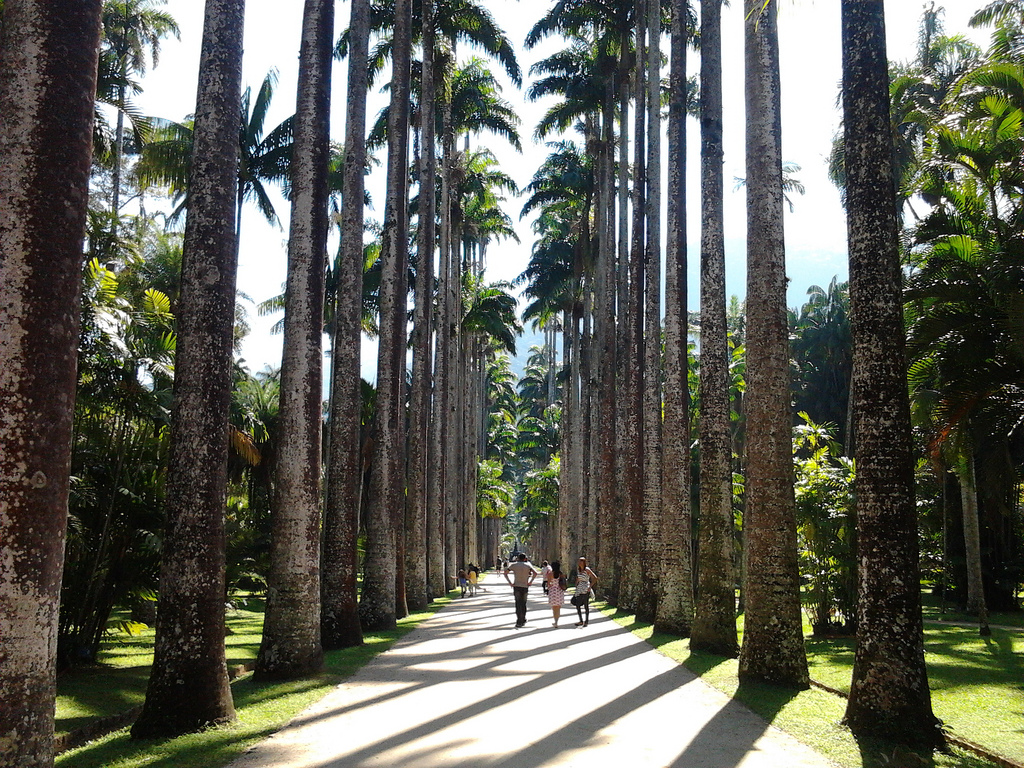
The Aleia Barbosa Rodrigues: 134 imperial palms in a double row, over thirty metres tall, descended from the one Dom João VI himself planted in 1808.
📌Watch out for
Paying at the ticket office: they only accept PIX and cash. If you want to pay by card, you have to buy online before you arrive.
💱 BRL exchange rate
Loading rate…
🌤️ Weather in Jardim Botânico do Rio de Janeiro
Loading weather…
There's an avenue of palm trees that feels like a cathedral. These are the imperial palms of the Aleia Barbosa Rodrigues, each more than thirty metres tall, in a perfect double row, all descended from the first one Dom João VI planted when he founded this garden in 1808. Walking along it, with the palm crowns outlined against the sky and Christ the Redeemer peeking out above the rainforest, is one of those things that make a trip worthwhile.
The Jardim Botânico do Rio de Janeiro is much more than a pretty park: it's a two-hundred-year-old scientific institution, with around 54 hectares open to visitors, thousands of identified plant species, a world-class herbarium and living collections that include orchids, bromeliads, cacti, Amazonian and carnivorous plants. It also has a Japanese Garden, a Sensory Garden designed to be explored by touch, ponds with giant water lilies, a museum, the ruins of an old gunpowder mill, and marmosets and toucans that turn up unannounced.
Here's the practical side, with the official 2026 prices and opening hours: how much it costs for foreigners and residents, who pays half price, what time each section opens (note: on Wednesdays the arboretum doesn't open until 11), how to pay at the ticket office, what route to take if you have two hours, and how to combine it with Parque Lage, just a few minutes away, and with a loop around the Lagoa.
📖 History of Jardim Botânico do Rio de Janeiro
The Jardim Botânico was founded on 13 June 1808 by Dom João VI, prince regent of Portugal, who had arrived in Rio a few months earlier fleeing Napoleon's troops. It was conceived as a Real Horto: an acclimatisation garden for species brought from the East Indies (nutmeg, cinnamon, pepper, tea) that had to adapt to the Brazilian climate. Over time it opened to the public and became a scientific institution. Dom João himself planted a royal palm native to the Antilles that became known as the Palma Mater: from its seeds descend the imperial palms that today line the Aleia Barbosa Rodrigues, the most photographed walkway in the garden. Throughout the 19th century the garden grew under the direction of botanists such as João Barbosa Rodrigues, who organised the collections and created the herbarium. Today the Instituto de Pesquisas Jardim Botânico do Rio de Janeiro is a federal body devoted to research, conservation and environmental education: it manages the visitable arboretum of around 54 hectares (within a much larger site), a herbarium with more than half a million specimens, seed banks, the Escola Nacional de Botânica Tropical and conservation programmes for Brazil's threatened flora. The grounds also hold historical remains, such as the Casa dos Pilões, what is left of the old 18th-century gunpowder factory.
🗺️ What to see
Tours nearby, in Rio De Janeiro
If you only have one day, take a guided tour on the first one: it sets up the rest of your trip and saves you a lot of walking. We look ours up on Civitatis: guided in Spanish and booked online with no fuss. They have over 50 activities in Rio De Janeiro. And there are free tours here: you book without paying and tip the guide whatever you think at the end, so trying one costs you nothing. Three are below so you get the idea: tap any of them and they all open.
They depart from Rio De Janeiro, 9 km away. If you book from this link we earn a commission and you pay no more.
1
The Aleia Barbosa Rodrigues (the imperial palms)
The avenue of imperial palms in a double row, descended from the one Dom João VI planted in 1808: the garden's most famous image.
Leer más ↓
It's the postcard image of the Jardim Botânico and the first stop for almost every visitor: a straight avenue lined with imperial palms over thirty metres tall, planted in a double row, forming a kind of green central nave. They all descend from the Palma Mater, the royal palm Dom João VI himself planted when he founded the garden in 1808, which died after being struck by lightning in the 20th century.
The perspective is hypnotic, especially early on, when the sun is low and the avenue is almost empty. From several spots in the garden you can also see Christ the Redeemer rising above the rainforest of the Serra da Carioca, which makes for some of the best photos in the city.
How to get there: from the main gate, it's the backbone of the visit. Best time: right when it opens, at 8. Tips: on Wednesdays the arboretum doesn't open until 11, so keep that in mind if you're coming early.
2
The Orquidário and the living collections
Greenhouses with thousands of orchids, bromeliads, cacti, carnivorous and insectivorous plants, plus collections from the Amazon and the Atlantic Forest.
Leer más ↓
The Orquidário holds one of the most important orchid collections in Brazil, with native and exotic species flowering in turns throughout the year. Nearby are the bromeliad greenhouses, the cactus garden, the insectivorous plant section and themed collections devoted to the Amazon, the Atlantic Forest and medicinal plants.
These collections are part of the institution's scientific work, not just the visit: many species are in conservation programmes for threatened flora. The signs give the scientific name, family and origin, which turns the walk into an open-air lesson.
How to get there: signposted sections within the arboretum. Best time: spring, for the orchids in bloom. Tips: ask at the visitor centre what's flowering that month.
3
The Jardim Japonês, the Jardim Sensorial and the Lago Frei Leandro
The themed corners: the Japanese garden with koi and bridges, the sensory garden to explore by touch and smell, and the pond with giant water lilies.
Leer más ↓
The Jardim Japonês, created with donations from Japan, brings together Asian species, ponds with koi, stone lanterns and bridges; it's one of the most peaceful corners of the grounds. The Jardim Sensorial was designed to be explored by touch and smell, with signs in braille and aromatic plants: it's one of the most successful accessibility projects in the city.
The Lago Frei Leandro, in the middle of the garden, is the pond where the giant water lilies float, those huge round leaves from the Amazon, and where you'll often see herons and turtles. Nearby is the Chafariz das Musas, a 19th-century cast-iron fountain brought over from Europe.
How to get there: all signposted on the garden map. Best time: mid-morning. Tips: the giant water lilies look their best in the warmer months.
4
The Museu do Jardim Botânico and the Casa Pacheco Leão
The exhibition spaces on the grounds, with shows on nature, science and the environment. Admission to both is free.
Leer más ↓
The Museu do Jardim Botânico is housed in a historic building on the grounds and offers exhibitions on biodiversity, science and the environment, with temporary shows that change during the year. The Casa Pacheco Leão, another historic building in the garden, also works as an exhibition space.
According to the institution itself, admission to both is free: you pick up your ticket on the official ticketing site. The museum is open Thursday to Tuesday from 10:00 to 18:00, with last entry at 17:00, and closed on Wednesdays. It's a good midday stop, with air conditioning and benches, in the middle of your outdoor walk.
How to get there: inside the grounds, signposted. Best time: any opening day, avoiding Wednesday. Tips: check the programme: there are some very good temporary exhibitions that few visitors know about.
5
The Casa dos Pilões and the site's historical heritage
The remains of the 18th-century royal gunpowder factory that operated on this land before the garden, preserved inside the park.
Leer más ↓
Before it was a botanical garden, the land was home to a sugar mill and, from the late 18th century, the Real Fábrica de Pólvora (Royal Gunpowder Factory). The Casa dos Pilões is what remains of it: a stone building with the pestles where the ingredients of the explosive were ground, now preserved and open to visitors as an archaeological site.
Nearby there are other historical remains, gateways, fountains and 19th-century sculptures scattered around the arboretum. That mix of botanical science, imperial history and industrial archaeology is what sets the Jardim Botânico apart from just any park.
How to get there: historical section of the arboretum, marked on the map. Best time: as part of the general visit. Tips: ask for the printed map at the entrance, because the paths branch off and it's easy to miss the best bits.
6
The garden's wildlife
Marmosets, toucans, herons, turtles and dozens of bird species living on the grounds, just metres from a Zona Sul avenue.
Leer más ↓
The garden works as a refuge for urban wildlife, connected to the rainforest of the Parque Nacional da Tijuca. It's common to see marmosets jumping between the trees, toucans in the treetops, herons in the ponds, turtles, and a huge variety of birds that makes the grounds one of the best birdwatching spots in the city.
You can't feed the animals or leave the paths: these are wild populations within a conservation institution. For anyone travelling with kids, the palms + monkeys + giant water lilies combo is usually the highlight of the day.
How to get there: throughout the arboretum, especially near the ponds and the wooded areas. Best time: first thing in the morning. Tips: bring binoculars if you're into birds; there are birdwatching groups that walk the garden.
💵 Prices
Tickets
| Type | Price |
|---|
| Entrada — visitantes extranjeros | R$ 80,00 (source: Instituto de Pesquisas Jardim Botânico do Rio de Janeiro, official ticket page updated on 27/04/2026; verified 22/09/2026) |
| Entrada — residentes en Brasil | R$ 40,00, a 50% discount on the general price (source: JBRJ, verified 22/09/2026) |
| Media entrada | Under Portaria JBRJ nº 052/2016: enrolled students with proof, people with disabilities, young people up to 21 with official photo ID, low-income young people aged 15 to 29 with an Identidade Jovem (CadÚnico), and people aged 60 or over with ID (source: JBRJ, verified 22/09/2026) |
| Gratuidad | Children up to 5; public-school students and teachers on school visits, by filling in the form available at the ticket office (source: JBRJ, verified 22/09/2026) |
| Museu do Jardim Botânico y Casa Pacheco Leão | Free admission, picking up your ticket at jbrj.eleventickets.com (source: JBRJ, verified 22/09/2026) |
| Horarios — Arboreto | Thursday to Tuesday, 8:00 to 17:00; Wednesday, 11:00 to 17:00. On 24/12 and 31/12 it opens 8:00 to 14:00, and it is closed on 25/12 and 1/1 (source: JBRJ, verified 22/09/2026) |
| Horarios — Museu do Jardim Botânico | Thursday to Tuesday, 10:00 to 18:00, with last entry at 17:00; closed on Wednesdays (source: JBRJ, verified 22/09/2026) |
| Formas de pago | At the garden's ticket office: PIX and cash only. Online (jbrj.eleventickets.com): PIX or credit card (source: JBRJ, verified 22/09/2026) |
🔄 updated monthlyOfficial / reference values · double-check when buying
Activities and tours
| Activity | Price | Duration | Operator |
|---|
| Self-guided walk through the arboretum | Included in admission | 2 to 3 h | JBRJ |
| Guided walking tours and themed tours | Official garden programme; check conditions and schedule at the visitor centre | 1 to 2 h | JBRJ |
| Electric cart tour | Service available on the grounds, with its own fee; ask on site | 30 to 60 min | JBRJ |
| Exercise (running, walking) | Included in admission | Allowed from 8:00 to 9:00 and from 16:00 to 18:00 | JBRJ |
| Birdwatching | Included in admission | 2 to 3 h | On your own or with birdwatching groups |
| Combine with Parque Lage | Parque Lage: free admission, 8:00 to 18:00 | 1 to 2 h extra | EAV Parque Lage |
🔄 updated monthlyOfficial / reference values · double-check when buying
🚌 How to get there and distances
Getting around
NotesThe most practical option: several Zona Sul lines run along Rua Jardim Botânico, right by the gates
Metro to Jardim de Alah + bus or walk
R$ 7,90 + R$ 5,00
NotesFrom the station you walk along the Lagoa; it's a pleasant 20 to 25-minute walk (source: MetrôRio, verified 22/09/2026)
Taxi and ride-hailing apps
Variable fare
Bicycle
Hourly rental or day pass
NotesThe Lagoa cycle path runs a few blocks from the garden; bikes aren't allowed inside
Electric carts inside the grounds
NotesA useful option for people with reduced mobility or to get an overview before walking
🔄 updated monthlyOfficial / reference values · double-check when buying
How to get there
| Route | Airlines / operators | Avg. price | Duration |
|---|
| Ipanema / Leblon → Jardim Botânico | City bus or taxi | R$ 5,00 / variable | 10 to 20 min |
| Copacabana → Jardim Botânico | City bus or taxi | R$ 5,00 / variable | 20 to 30 min |
| Centro → Jardim Botânico | Metro to Jardim de Alah + bus, or taxi | R$ 7,90 + R$ 5,00 / variable | 35 to 50 min |
| Galeão International Airport (GIG) → Jardim Botânico | Taxi or ride-hailing apps | Variable fare | 45 to 70 min |
🔄 updated monthlyOfficial / reference values · double-check when buying
🏨 Where to stay
No exact prices: a scale from $ (budget) to $$$$$ (luxury), with 2-3 options per category.
Jardim Botânico and Lagoa
Recommended optionsQuiet residential neighbourhoods with few hotels and plenty of short-term rentals; you sleep surrounded by silence and greenery, ten minutes from the beaches.
Recommended optionsFifteen minutes from the garden, with the best food scene and the beach on your doorstep; the most popular base for anyone who wants to combine everything.
Recommended optionsThe city's biggest concentration of hotels and budget hostels, twenty to thirty minutes by bus from the Jardim Botânico.
Recommended optionsIn-between neighbourhoods between the Lagoa and the bay, with mid-range hotels, a good bar scene and quick access to the garden.
🍴 Where to eat
Options / signature dishThe grounds have a café and a kiosk for a break, meant for a pause during the visit rather than a full meal.
Options / signature dishOne of Rio's most refined dining areas, with contemporary Brazilian restaurants, specialty coffee shops and neighbourhood bakeries a few blocks from the gate.
Options / signature dishTen minutes away, the kiosks around the Lagoa Rodrigo de Freitas serve Japanese, Middle Eastern and Brazilian food and open-air beer, with views of the water and the hills.
Options / signature dishThe café at Parque Lage, in the mansion's courtyard, is one of the loveliest breakfast spots in the city; it's worth checking whether it's open during the building's restoration works.
❓ Frequently asked questions
How much does it cost to enter the Jardim Botânico?+
Admission for foreign visitors is R$ 80, and for residents of Brazil, R$ 40 (50% discount). Half-price tickets apply to students, people with disabilities, young people up to 21, low-income young people with Identidade Jovem and people aged 60 or over, according to Portaria JBRJ nº 052/2016. Children up to 5 go free. Official prices verified on 22/09/2026 on the institute's own page, updated on 27/04/2026.
What are the opening hours?+
The arboretum opens Thursday to Tuesday from 8:00 to 17:00 and on Wednesdays from 11:00 to 17:00, a detail that surprises a lot of people. The Museu do Jardim Botânico opens Thursday to Tuesday from 10:00 to 18:00, with last entry at 17:00, and is closed on Wednesdays. On 24 and 31 December hours are reduced to 8:00 to 14:00, and on 25 December and 1 January it is closed.
Can I pay by card at the entrance?+
No. The garden's ticket office only accepts PIX and cash. If you want to pay by credit card, you need to buy your ticket in advance on the official sales site, jbrj.eleventickets.com, which also accepts PIX.
Is the museum paid separately?+
No: admission to the Museu do Jardim Botânico and the Casa Pacheco Leão is free, as long as you get your ticket on the official sales site. What you pay for is access to the arboretum, that is, the garden itself.
How much time should I set aside?+
Two or three hours are enough for the main route: the avenue of imperial palms, the orchid house, the Lago Frei Leandro, the Jardim Japonês and the Jardim Sensorial. If you add the museum, the Casa dos Pilões and an unhurried stroll, it takes half a day. With kids, allow extra time for the monkeys.
Can I run or exercise inside?+
Yes, but only at set times: physical activities, including running, are allowed from 8:00 to 9:00 and from 16:00 to 18:00. Outside those slots, the garden works as a space for visiting and contemplation.
How do I get there from Ipanema or Copacabana?+
The simplest option is the city bus (R$ 5,00), which takes between ten and twenty-five minutes and stops in front of the gates on Rua Jardim Botânico. You can also take the metro to Jardim de Alah (R$ 7,90) and walk about twenty minutes along the Lagoa, a stroll that's worth it in its own right.
Sources consulted (7)
- Instituto de Pesquisas Jardim Botânico do Rio de Janeiro — Ingressos (R$ 80 foreign visitors / R$ 40 residents, half-price tickets, free admission, payment methods; page updated on 27/04/2026): https://www.gov.br/jbrj/pt-br/assuntos/visitacao/ingressos
- JBRJ — Horários e ingressos (arboretum and museum): https://www.gov.br/jbrj/pt-br/assuntos/visitacao/horarios-e-ingressos
- JBRJ — Official ticket sales: https://jbrj.eleventickets.com
- MetrôRio — Meios e Tarifas (R$ 7,90 since 12/04/2026): https://www.metrorio.com.br/ComoPagar/MeiosTarifas
- Secretaria Municipal de Transportes do Rio — bus fares (R$ 5,00 since 4/01/2026): https://transportes.prefeitura.rio/historico-das-tarifas/
- EAV Parque Lage — O Parque (opening hours 8h-18h, free admission): https://eavparquelage.rj.gov.br/o-parque
- Wikipedia (ES) — «Jardín Botánico de Río de Janeiro»: https://es.wikipedia.org/wiki/Jard%C3%ADn_Bot%C3%A1nico_de_R%C3%ADo_de_Janeiro