📌Where it is
Between Rua Joaquim Silva (Lapa) and Rua Pinto Martins (Santa Teresa), in central Rio de Janeiro. It links the bohemian neighbourhood of Lapa with the climb up to Santa Teresa.
📌How to get there
On foot from the Arcos da Lapa (five minutes). By metro, Cinelândia or Carioca stations, plus a ten- to fifteen-minute walk; the VLT stops at Carioca or Cinelândia.
📌How much time to spend
20 to 40 minutes to walk it and take photos, although many people combine it with Lapa and the climb to Santa Teresa and make a half day of it.
📌Best time
Early in the morning, between 8 and 10, when there are far fewer people and the light is good. At night it is lit up, but the area takes on a different feel.
📌Currency and prices
Brazilian real (R$). The staircase is a public street: there is no admission charge and no official ticket office.
📌Language
Portuguese; around the tourist area some people get by in English and Spanish.
📌What surprises most
That it is the work of a single person: Chilean artist Jorge Selarón covered it in tiles over twenty years, with pieces sent by visitors from more than sixty countries.
📌Watch out for
The steps, which are uneven and slippery in the rain, and moments of carelessness: it is a very busy tourist spot in a high-traffic area. Avoid going alone at night.
💱 BRL exchange rate
Loading rate…
🌤️ Weather in Escadaria Selarón
Loading weather…
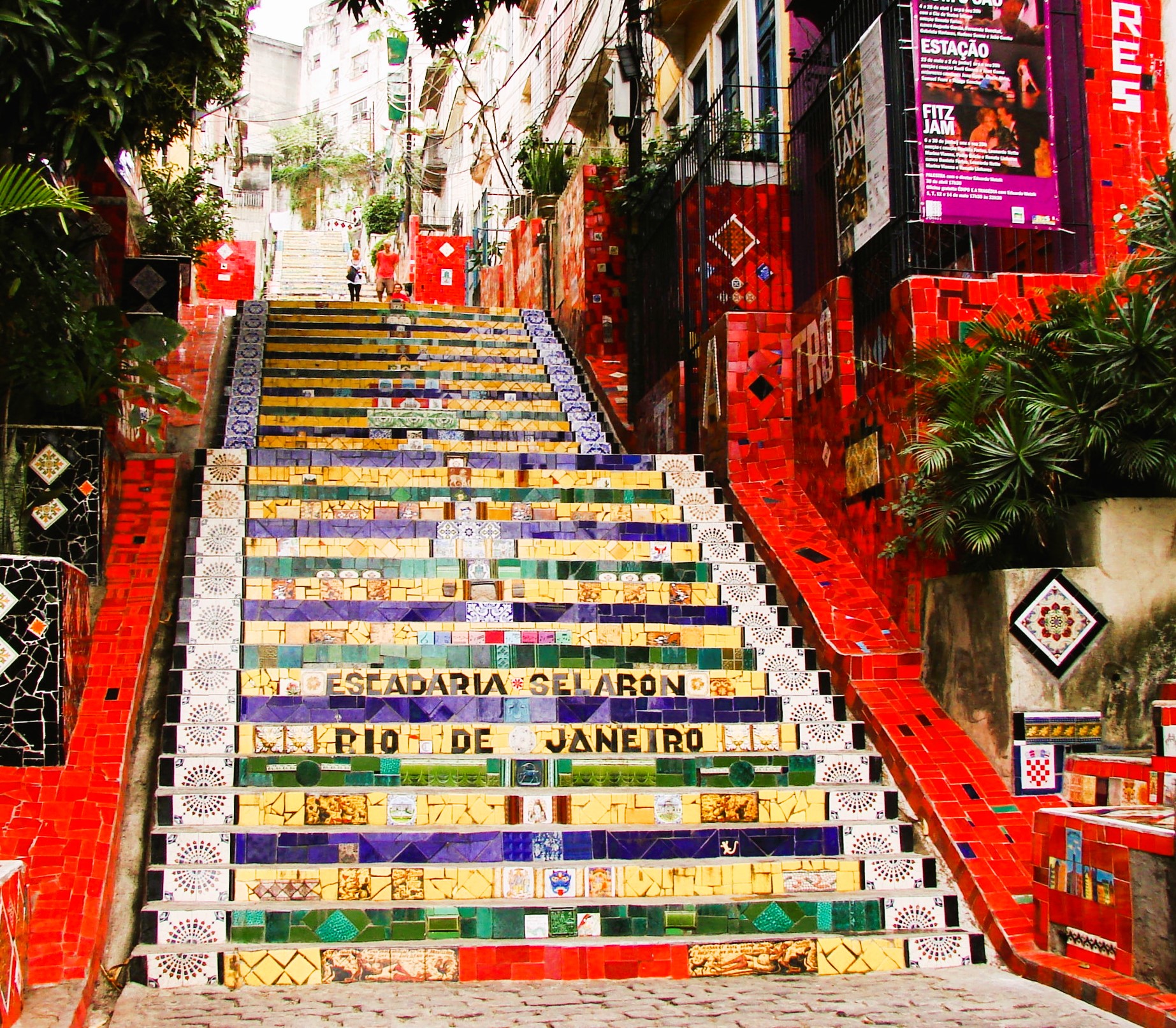
Two hundred and fifteen steps climbing from Lapa to Santa Teresa, covered one by one in tiles of every colour imaginable. Tiles from Brazil, Chile, Portugal, China, Japan and Argentina; mirrors, broken plates, hand-painted pieces with faces and flags. The Escadaria Selarón is a public work of art that began as the whim of a Chilean artist who lived on the corner and ended up as one of the most photographed places in Brazil.
Jorge Selarón arrived in Rio in the eighties and in 1990 began fixing up, on his own, the abandoned staircase in front of his house. He never stopped: he sold his paintings to buy materials, people started sending him tiles from all over the world, and the staircase kept growing until it became a living installation that he changed all the time. He used to say the work would only be finished on the day he died. He died on the steps in January 2013.
It's free, always open and you can walk it in half an hour. Here we tell you how to get there on foot from the Arcos da Lapa, what time to go to have the staircase almost to yourself, what to look for besides the colour —there's a hidden signature, there are tiles with a story, there are portraits of the pregnant woman Selarón painted hundreds of times—, and how to link it with Lapa, the bondinho and Santa Teresa in a single outing.
📖 History of Escadaria Selarón
Jorge Selarón (Chile, 1947 - Rio de Janeiro, 2013) was a painter and ceramicist who travelled through dozens of countries before settling permanently in Rio in 1983. He lived on Rua Joaquim Silva, in Lapa, opposite a run-down flight of steps that connected the neighbourhood with Santa Teresa. In 1990 he began repairing it on his own, covering it with tiles salvaged from building sites and rubbish dumps, at first in the colours of the Brazilian flag: green, yellow and blue. What started as a neighbourly fix-up became his life's work. He paid for the materials by selling his paintings —above all a recurring figure of a pregnant woman— and, as the staircase became well known, visitors from all over the world began sending him tiles: he is estimated to have collected pieces from more than sixty countries. Selarón never considered it finished; he changed it constantly, removing and replacing tiles, and often said the work would only end on the day he died. The staircase has 215 steps along some 125 metres and was recognised as part of the city's cultural heritage. On 10 January 2013 Selarón was found dead on the steps themselves, in circumstances that led to a police investigation. The staircase remained as a finished work and a place of tribute: today it is one of the most visited and photographed sites in Rio.
🗺️ What to see
Tours nearby, in Rio De Janeiro
If you only have one day, take a guided tour on the first one: it sets up the rest of your trip and saves you a lot of walking. We look ours up on Civitatis: guided in Spanish and booked online with no fuss. They have over 50 activities in Rio De Janeiro. And there are free tours here: you book without paying and tip the guide whatever you think at the end, so trying one costs you nothing. Three are below so you get the idea: tap any of them and they all open.
They depart from Rio De Janeiro, 1 km away. If you book from this link we earn a commission and you pay no more.
1
The 215 steps and the full mosaic
The stretch climbing from Rua Joaquim Silva to Rua Pinto Martins, with thousands of tiles from more than sixty countries covering steps, walls and landings.
Leer más ↓
The staircase has about 215 steps spread over several flights, with landings where the mosaic gets denser and you can stop to look. The colour base is the Brazilian flag —green, yellow and blue—, but layered on top are hundreds of pieces from everywhere: Portuguese azulejos, Mexican tiles, Chinese plates, mirrors, hand-painted ceramics and plaques with the names of cities and countries.
The walk takes twenty or thirty minutes, climbing slowly and looking at the details. Many people go up, take the photo on the first flight and turn back, but the upper flights have less-seen pieces and far fewer people. At the top you come out on Rua Pinto Martins, already on the edge of Santa Teresa.
How to get there: lower entrance on Rua Joaquim Silva, five minutes from the Arcos da Lapa. Best time: between 8 and 10 in the morning. Tips: the steps are uneven and slippery in the rain; wear comfortable shoes.
2
The tiles with a story and Selarón's portraits
The pieces sent by people from all over the world, the dedicated tiles and the recurring figure of the pregnant woman the artist painted hundreds of times.
Leer más ↓
Much of the charm is in the details. There are tiles with city names, flags, football club crests, and handwritten messages from visitors who sent or brought them. There are commemorative plaques, photos of Selarón himself at work and several appearances of his best-known painting: the silhouette of a pregnant woman, which he painted on canvas and also worked into the staircase in ceramic.
Selarón swapped pieces all the time, so the staircase you see today is not the one from ten years ago. After his death it has been kept up with periodic repairs, and it is still a place of tribute: it is common to find flowers or messages on the steps.
How to get there: all along the climb, on walls and landings. Best time: in the morning light, better for photos. Tips: take ten minutes to look at the side walls, not just the steps.
3
Where it meets Lapa and the Arcos
The staircase starts just metres from the heart of Lapa: the Arcos da Lapa, the samba bars and Rio's most famous nightlife scene.
Leer más ↓
The Escadaria sits right next to Lapa, the home of Rio's bohemian life. Five minutes' walk away are the Arcos da Lapa, the old colonial aqueduct that became the symbol of the neighbourhood and the viaduct for the Santa Teresa bondinho. Around it are samba bars, live music venues and a nightlife that gets going on Thursdays and explodes at weekends.
That's why the classic plan is to link it all: the staircase in the morning or mid-afternoon, a stroll past the Arcos, and Lapa's bars at night. By day the neighbourhood is calm and easy to walk; at night it's best to move in a group and by taxi or ride-hailing app.
How to get there: the bottom of the staircase is a five-minute walk from the Arcos. Best time: daytime for the staircase, night for Lapa. Tips: if you're staying out at night, leave your bag at the hotel and carry only the essentials.
4
At the top of the staircase begins the neighbourhood of steep streets, old mansions and the yellow bondinho: the natural continuation of the walk.
Leer más ↓
The steps end on Rua Pinto Martins, already on the slopes of Santa Teresa. From there you can keep climbing on foot up steep streets to Largo dos Guimarães, the heart of the neighbourhood, with its bars, restaurants and 19th-century mansions, or take the bondinho, the historic tram that crosses the Arcos da Lapa.
The climb on foot is demanding and best done by day and with company; many prefer to walk down from Santa Teresa to the staircase, which is the easy version of the same route. The staircase + bondinho + Santa Teresa combination is one of the best half days in central Rio.
How to get there: carry on uphill from the top of the staircase. Best time: mid-morning. Tips: if you're taking the bondinho, tickets are sold at Carioca station, in the Centro.
5
Photos: where and when
The first flight is the most photographed, but the best shot is higher up and early in the day, when the staircase is almost empty.
Leer más ↓
The classic postcard shot is taken from the bottom, on the first flight, with the staircase opening up in perspective. It's also where everyone gathers: between 11 and 16, in high season, there can be informal queues to get the photo on the usual step.
The trick is simple: go between 8 and 10 in the morning. The light is good, the staircase is almost empty and you can walk the whole thing without dodging people. The upper flights also offer less-seen framings, with the mosaic and the neighbourhood in the background. At night it's lit up and has its charm, but the surroundings change and it's not advisable to stay on your own.
How to get there: anywhere along the climb. Best time: first thing in the morning. Tips: don't use a tripod on the lower part at peak hours; it blocks the way and draws attention to your gear.
💵 Prices
Tickets
| Type | Price |
|---|
| Acceso a la Escadaria Selarón | Free. It is a public staircase linking Rua Joaquim Silva with Rua Pinto Martins; there is no ticket office, admission fee or closing time |
| Guías y tours a pie por Lapa y Santa Teresa | There are free walking tours (tip-based) and paid guided tours from local agencies; the price is set by each operator |
| Bondinho de Santa Teresa (si combinás el paseo) | PRICE NOT CONFIRMED by an official source on the date checked: the State Government website (rj.gov.br/bondesdesantateresa) was not responding on 22/09/2026. The reference tourist fare is R$ 20 return, free for registered residents, public school students, over-65s and Vale Social holders. Check at Carioca station before you travel |
🔄 updated monthlyOfficial / reference values · double-check when buying
Activities and tours
| Activity | Price | Duration | Operator |
|---|
| Walking the staircase and taking photos | Free | 20 to 40 min | Open access |
| Free walking tour of Lapa, the Escadaria and Santa Teresa | Tip-based (suggested tip for the guide) | 2 to 3 h | Local guide groups |
| Combine with the Santa Teresa bondinho | Tram ticket (see price note) | Half a day with the neighbourhood | Government of the State of Rio de Janeiro |
| Samba night in Lapa | Admission depends on the venue; many bars charge a minimum spend | One night | Lapa's samba venues and bars |
🔄 updated monthlyOfficial / reference values · double-check when buying
🚌 How to get there and distances
Getting around
NotesThe useful stations are Cinelândia and Carioca; from there you walk towards the Arcos da Lapa and Rua Joaquim Silva (source: MetrôRio, verified 22/09/2026)
VLT Carioca (modern tram in the Centro)
NotesConnects Santos Dumont, Central do Brasil, Praça XV and the port area; combines well with the historic Centro and the Museu do Amanhã (source: VLT Carioca / Motiva, verified 22/09/2026)
Taxi and ride-hailing apps
Variable fare
NotesThe whole Lapa-Escadaria circuit can be done on foot; the climb to Santa Teresa is steep
🔄 updated monthlyOfficial / reference values · double-check when buying
How to get there
| Route | Airlines / operators | Avg. price | Duration |
|---|
| Copacabana / Ipanema → Escadaria Selarón | MetrôRio Line 1 to Cinelândia + walk | R$ 7,90 | 25 to 35 min |
| Historic Centro → Escadaria Selarón | On foot or VLT to Carioca/Cinelândia | Free / R$ 5,00 | 10 to 20 min |
| Santa Teresa → Escadaria Selarón | Downhill on foot or bondinho to Carioca | Free / bondinho ticket | 15 to 25 min |
| Santos Dumont Airport (SDU) → Escadaria Selarón | Taxi, ride-hailing apps or VLT + walk | Variable / R$ 5,00 | 10 to 20 min |
🔄 updated monthlyOfficial / reference values · double-check when buying
🏨 Where to stay
No exact prices: a scale from $ (budget) to $$$$$ (luxury), with 2-3 options per category.
Recommended optionsThe neighbourhood above the staircase has guesthouses, hostels with views and boutique hotels in old mansions; it's the best area to stay if you want this circuit on your doorstep.
Recommended optionsHostels and budget hotels steps from the Arcos, handy for nightlife and with good metro links; the neighbourhood is noisy at weekends.
Recommended optionsHotels geared to business travel that drop their prices at weekends, a ten- to fifteen-minute walk from the staircase.
Zona Sul (Copacabana, Ipanema, Flamengo)
Recommended optionsIf you'd rather stay near the beach, the staircase is half an hour away by metro; it's the most popular choice for people who only visit the Centro by day.
🍴 Where to eat
Bares y botequins de Lapa
Options / signature dishJust metres from the staircase there are traditional bars with chopp, feijoada on Saturdays and bar food; at night the samba venues with live music join in.
Cafés y restaurantes de Santa Teresa
Options / signature dishAt the top of the staircase, the neighbourhood has cafés with views, contemporary Brazilian cooking and historic bars around Largo dos Guimarães.
Options / signature dishPay-by-weight restaurants and historic pastry shops in the Centro, a fifteen-minute walk away; they mostly open Monday to Friday at lunchtime.
Options / signature dishStalls selling pastel, caldo de cana and coconut water around the Arcos da Lapa and on Rua Joaquim Silva.
❓ Frequently asked questions
Do you have to pay to visit the Escadaria Selarón?+
No. It's a public staircase connecting two city streets: there's no ticket office, admission fee or closing time. If someone charges you to 'get in' or to 'look after' the place, it's not official. The only thing you pay for in the area is guided tours, which are optional.
What time is best to go?+
Between 8 and 10 in the morning. At that hour there are very few people, the light is good for photos and you can walk the whole staircase at a relaxed pace. From 11 to 16 is peak visitor time, especially in high season. At night it's lit up, but the area changes and it's best not to stay on your own.
Who was Jorge Selarón?+
A Chilean painter and ceramicist, born in 1947, who settled in Rio in 1983 and lived opposite the staircase. In 1990 he began covering it with tiles on his own, paying for the materials by selling his paintings. Over the years, visitors from more than sixty countries sent him tiles. He used to say the work would be finished on the day he died; he died on the steps on 10 January 2013.
Is it safe to visit?+
By day and with the usual caution for any very busy tourist spot, yes: it's one of the most visited attractions in the city and there are always people around. Carry the minimum, keep your phone put away when you're not using it, and avoid staying at night or wandering down empty side streets.
How long does the visit take?+
Between twenty and forty minutes if you only walk the staircase. But it makes sense to combine it: the Arcos da Lapa are five minutes away, and from the top you carry on to Santa Teresa. With those two you've got a full half day of historic, bohemian Rio.
How do I get there from Copacabana or Ipanema?+
By metro (Line 1) to Cinelândia and then a ten- to fifteen-minute walk towards the Arcos da Lapa and Rua Joaquim Silva. The fare is R$ 7,90, the public fare in force since 12 April 2026. By taxi or ride-hailing app it takes fifteen to thirty minutes depending on traffic.
Is it accessible for wheelchairs or people with reduced mobility?+
No. There are 215 uneven steps, with changes in level and no ramps or continuous handrails. From the pavement on Rua Joaquim Silva you can see the first stretch, which is the most photographed, but the full route means climbing on foot.
Sources consulted (6)
- Wikipedia (ES) — «Escalera de Selarón»: https://es.wikipedia.org/wiki/Escalera_de_Selar%C3%B3n
- Wikipedia (PT) — «Escadaria Selarón»: https://pt.wikipedia.org/wiki/Escadaria_Selar%C3%B3n
- MetrôRio — Meios e Tarifas (R$ 7,90 since 12/04/2026): https://www.metrorio.com.br/ComoPagar/MeiosTarifas
- VLT Carioca / Motiva — R$ 5,00 fare and operating hours from 5h to 23h: https://trilhos.motiva.com.br/redir/vltrio/
- Secretaria Municipal de Transportes do Rio — bus fares (R$ 5,00 since 4/01/2026): https://transportes.prefeitura.rio/historico-das-tarifas/
- The staircase has no management and no fee to check: it's a public street. The fare for the Santa Teresa bondinho remains unconfirmed because the official State Government website wasn't responding on 22/09/2026.