Viajá con Gus
HomeBrazilGenipabu
Genipabu
🇧🇷 Brazil · Northeast

Genipabu

Jump to what you need
📌Province/State
Rio Grande do Norte, Brazil (municipality of Extremoz, some 25-30 km north of Natal). Genipabu is the icon of the shifting dunes of the Rio Grande do Norte coast and one of the most famous landscapes in northeastern Brazil
📌Best time to go
September to February (drier and sunnier, ideal for the dunes and the buggy ride); warm all year. March to July can bring more rain, though the ride usually goes ahead anyway on clear days
📌Suggested days
1 to 2 days. Most people visit Genipabu on the classic day trip from Natal; with an extra night you can enjoy sunset over the dunes and other beaches on the northern coast
📌Currency
Brazilian real (BRL, R$). Bring cash for the beach barracas, the lagoon attractions, the dromedaries and tips, as well as a card
📌Getting there
Some 25-30 km north of Natal, 30-45 minutes from the centre and from Ponta Negra. You can get there by transfer, taxi, app, car or, most commonly, on an organised day trip from Natal that includes transport and the buggy ride
💱 BRL exchange rate
Loading rate…
🌤️ Weather in Genipabu
Loading weather…

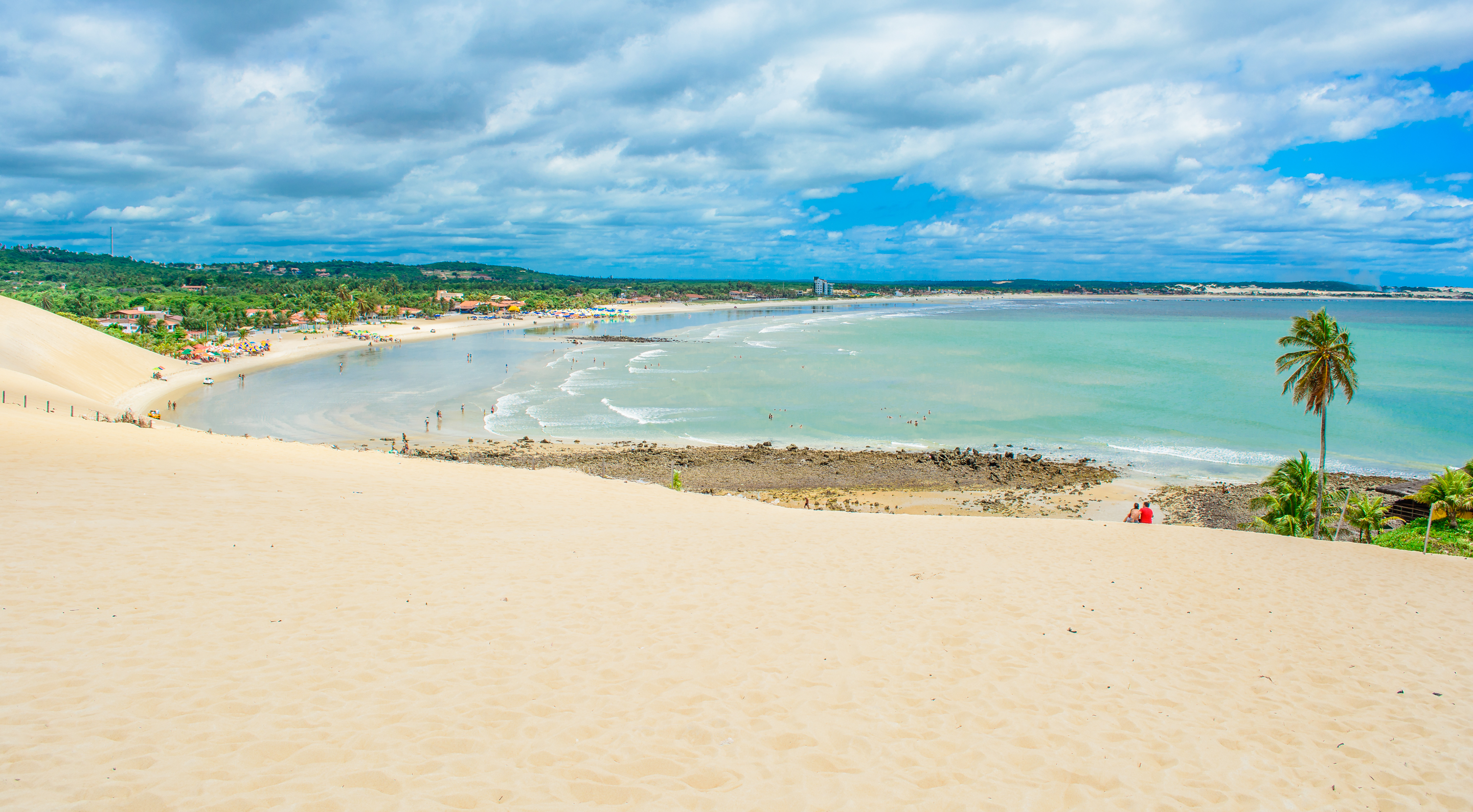
Genipabu is the icon of the dunes of Rio Grande do Norte and one of the most famous landscapes in northeastern Brazil: a sea of shifting golden dunes that spill almost to the shoreline, beside a lagoon and the ocean, a few kilometres north of Natal. Its big draw is the buggy ride across the dunes, an adrenaline-filled experience with the classic motto "with emotion or without emotion".

The route takes in the dunes, the Lagoa de Genipabu and the Lagoa de Jacumã, where you'll find rides such as the "esquibunda", the "aerobunda" (a zip line that drops you into the lagoon) and dromedary rides, an unexpected sight on a Brazilian beach. Genipabu is part of an environmental protection area that safeguards the dunes, the mangroves and the lagoon.

This guide covers the essentials of Genipabu with a practical eye: the buggy ride and the lagoon attractions, the beach and the dune viewpoint, how to get there from Natal, where to eat, and the tips that make this classic outing on the Rio Grande do Norte coast work.

📖 History of Genipabu

Genipabu is a beach and a set of dunes in the municipality of Extremoz, north of Natal, whose name comes from the jenipapo, a fruit and tree with Tupi Indigenous roots. Historically it was a fishing area with a natural landscape of shifting dunes that ended up protected as an Environmental Protection Area. The rise of the buggy ride turned Genipabu, during the 20th century, into one of the tourism symbols of Rio Grande do Norte. The full story is on our history page.

Read the full history ↓

🏛️ Genipabu is in Rio Grande do Norte

The state on Brazil's corner, where the continent bends south and comes closest to Africa: land of the Potiguara and of the Fortaleza dos Reis Magos, of cotton and of the country's largest salt works. This is where the Second World War's 'Springboard to Victory' took off, and today its dunes, buggies and falésias define the sun of Natal and Pipa.

Read the history of Rio Grande do Norte →

🗺️ What to see

1
Buggy ride across the dunes
The classic buggy run across the shifting dunes of Genipabu, with the "with or without emotion" option.
The buggy ride is the great Genipabu experience and one of the most famous in Brazil. Run by accredited local bugueiros, it crosses the spectacular landscape of shifting dunes that rise beside the sea and the lagoons, with climbs, drops and manoeuvres that the driver adjusts depending on whether you ask for the ride "com emoção" (more adrenaline) or "sem emoção" (calmer). The route includes viewpoints looking out over the dunes, the beach and the ocean, and stops at the lagoons for the various attractions. There are two classic versions: the short ride (just the Genipabu dunes and surroundings) and the long or Litoral Norte ride, which carries on to other beaches such as Pitangui, Jacumã and Muriú, even crossing a ferry over the Ceará-Mirim river. It's an unmissable activity, suitable for a range of ages once you pick your level of emotion. Getting there: the buggies leave from the barraca area of Genipabu; many tours from Natal already include it. Best time: dry, clear days. Tips: a buggy carries up to 4 people; bring sunscreen, a hat, water and some cash for the fees (ferry, environmental fee) and the attractions.
ℹ️ Capacity: Up to 4 people per buggy, with an accredited bugueiro; choose "with" or "without emotion" · Price: Short ride about R$ 290 per buggy; long ride (Litoral Norte) about R$ 390 per buggy (up to 4 people, split between them). On a tour from Natal, about R$ 145–220 per person depending on the season. Add the environmental fee + ferry (balsa): R$ 120 per buggy or R$ 30 per person (source: operators Marazul Receptivo / Viciada em Viajar, verified July 2026) · Tip: Sun protection is essential; bring cash for fees and attractions
2
Lagoa de Jacumã (aerobunda, esquibunda, zip line)
A lagoon among the dunes with water rides, including the zip line that ends in the water.
The Lagoa de Jacumã is one of the most entertaining stops on the buggy ride. Ringed by dunes, it offers several attractions: the "aerobunda", a rustic zip line that launches you from the top of a dune to drop into the lagoon; the "esquibunda" or "skibunda", sliding down the sand slope into the water sitting on a wooden board; and banana boat rides. It's a spot full of adrenaline and fun, with barracas for eating and resting. The attractions cost extra on top of the buggy and are paid per run or per use. It's one of the most memorable moments of the trip, especially for younger and more adventurous travellers, though there are also quieter ways to enjoy the lagoon. Getting there: it's one of the stops on the long Litoral Norte buggy ride. Best time: sunny days. Tips: bring clothes and shoes that can get wet, and a waterproof bag for your phone; budget extra for the attractions.
ℹ️ Distance: Stop on the long buggy ride (Litoral Norte), north of Genipabu · Price: Aerobunda/esquibunda from about R$ 20 per run; combos around R$ 60 per person (source: operators and inbound agencies in Natal, verified July 2026); banana boat extra. Check when you visit · Tip: Bring clothes you can get wet in and a waterproof bag for your phone
3
Dromedary ride
The unexpected experience of riding dromedaries over the dunes, a Genipabu trademark.
One of the most surprising and distinctive images of Genipabu is the dromedaries that carry visitors over the dunes. Introduced as a tourist attraction, they offer a short ride across the sand that has become one of the postcards of the place, evoking desert landscapes right on the Brazilian coast. It's a curious and photogenic experience, especially popular with families. The ride costs extra and usually takes place in the dune area near the barracas, with the animals led by their handlers. It's worth noting that there is a growing debate about animal welfare in this kind of attraction: some travellers and blogs choose not to take part because of concerns over how the dromedaries are treated, so it's a personal decision best made informed. Getting there: in the barraca and dune area of Genipabu, next to the start of the buggy ride. Best time: any clear day, ideally morning or late afternoon for the light. Tips: the ride is short (about 10 minutes); confirm the price before getting on and consider whether you want to do it on animal welfare grounds.
ℹ️ Distance: Dune and barraca area of Genipabu · Price: About R$ 120 per person for a ride of some 10 minutes (source: operators and inbound agencies in Natal, verified July 2026). Check when you visit · Tip: Very photogenic and popular with families; confirm the price before getting on
4
Genipabu beach and lagoon
The beach at the foot of the dunes and the freshwater lagoon, with barracas and a viewpoint.
Genipabu beach stretches out at the foot of the towering dunes, with barracas offering shade, seafood and a prime spot to take in the landscape where sand, lagoon and ocean meet. The Lagoa de Genipabu, freshwater, is ideal for a calm swim and usually has barracas around it. The whole area, protected as an Environmental Protection Area, has viewpoints with spectacular views, above all at sunset, when the golden light washes over the dunes. It's a good place to unwind after the hectic buggy ride and enjoy the natural setting. Getting there: in the heart of Genipabu, next to the dunes. Best time: all year; sunset is the best moment. Tips: access to the beach and the lagoon is free, but eating at the barracas and renting chairs/umbrellas costs money; ask about prices before you sit down.
ℹ️ Distance: Centre of Genipabu, at the foot of the dunes (Extremoz) · Price: Free access to the beach and the lagoon; eating at the barracas about R$ 30–80 per person; chair/umbrella rental extra (source: operators and inbound agencies in Natal, verified July 2026) · Tip: Don't miss the sunset from the dune viewpoint
5
Litoral Norte: Pitangui, Jacumã and Muriú
The beaches and lagoons that continue north of Genipabu on the long buggy ride.
The long buggy ride doesn't stop at Genipabu: it pushes north along the Litoral Norte of Rio Grande do Norte, a string of quiet beaches, dunes and beautiful freshwater lagoons. After crossing the Ceará-Mirim river by ferry, you reach beaches such as Pitangui, Jacumã and Muriú, less crowded and with a wilder feel. The Lagoa de Pitangui is a crystal-clear lagoon that's ideal for swimming and for kayaking or stand-up paddle, while the beaches of Muriú and Jacumã offer sand, barracas and calm sea. It's the most relaxed, scenic side of the route, the perfect counterpoint to the adrenaline of the dunes. Getting there: it's part of the long buggy ride (Litoral Norte) that leaves from Genipabu. Best time: dry, sunny days. Tips: this route takes longer (half a day or more); bring a swimsuit, water and money for the ferry and the barracas.
ℹ️ Distance: North of Genipabu, crossing the Ceará-Mirim river by ferry · Price: Included in the long buggy ride (~R$ 390/buggy); environmental fee + ferry (balsa) R$ 120 per buggy or R$ 30 per person (source: Marazul Receptivo, verified July 2026) · Tip: The Lagoa de Pitangui is ideal for swimming and for kayaking or SUP
6
Ecopark and dune viewpoint
Panoramic views over the sea of dunes and the lookout area, with memorable sunsets.
Genipabu has viewpoints and lookout areas from which you can take in the full scale of the sea of shifting dunes, the lagoon and the ocean. They're the best places to understand the unique landscape that made this spot famous and to take the most striking photos, above all in the early morning or at sunset. The area is part of the Genipabu Environmental Protection Area, created to preserve the dunes, the mangroves and the lagoons against tourist pressure. Some points have barracas and services; others keep a wilder feel. It's an ideal way to close the day, watching the golden light transform the sand. Getting there: the viewpoints are within the Genipabu dune area itself, reachable on foot or on the buggy ride. Best time: sunrise or sunset, with soft light and gentler temperatures. Tips: respect the protected areas and stay on the permitted tracks; the dunes are a fragile ecosystem.
ℹ️ Distance: In the dune area of Genipabu, next to the barracas · Price: Free access to the viewpoints; some attractions and services cost extra · Tip: Sunset over the dunes is one of the most beautiful moments on the Rio Grande do Norte coast
Advertisements
What nobody tells you

💵 Prices

Tickets

TypePrice
Buggy ride across the dunes (short, per buggy for up to 4 people)About R$ 290 per buggy (source: operators and inbound agencies in Natal, verified July 2026); on a tour from Natal, about R$ 145–220 per person depending on the season. Check when you visit
Long buggy ride (Litoral Norte, per buggy for up to 4 people)About R$ 390 per buggy; plus environmental fee + ferry (balsa) R$ 120 per buggy or R$ 30 per person (source: Marazul Receptivo / Viciada em Viajar, verified July 2026)
Aerobunda / esquibunda / zip line (each attraction)From about R$ 20 per run; combos around R$ 60 per person (source: operators and inbound agencies in Natal, verified July 2026). Check when you visit
Dromedary rideAbout R$ 120 per person for some 10 minutes (source: operators and inbound agencies in Natal, verified July 2026). Check when you visit
Beach and lagoon accessFree (eating at the barracas extra, about R$ 30–80 per person)
🔄 updated monthlyOfficial / reference values · double-check when buying

Activities and tours

ActivityPriceDurationOperator
Buggy ride across the dunesAbout R$ 290 (short) to R$ 390 (long) per buggy; or R$ 145–220 per person on a tour (source: operators and inbound agencies in Natal, verified July 2026)Half a dayAccredited bugueiros of Genipabu (Setur RN)
Rides at the Lagoa de JacumãFrom about R$ 20 per run; combos ~R$ 60 per person (source: operators and inbound agencies in Natal, verified July 2026)1-2 hLagoon operators
Dromedary rideAbout R$ 120 per person (source: operators and inbound agencies in Natal, verified July 2026)About 10 minLocal operators
Full-day trip from NatalAbout R$ 145–250 per person depending on season and what's included (source: operators and inbound agencies in Natal, verified July 2026)Full dayInbound agencies in Natal
🔄 updated monthlyOfficial / reference values · double-check when buying
Advertisements

🚌 How to get there and distances

Getting around

ModePriceDurationNotes
BuggyAbout R$ 290–390 per buggy (up to 4 people) depending on the route (source: operators and inbound agencies in Natal, verified July 2026)VariableThe main way to cover the dunes and lagoons; bugueiros must be accredited
Taxi / app / transferNatal–Genipabu about R$ 60–110 each way (source: operators and inbound agencies in Natal, verified July 2026)VariableFor getting there from Natal and moving around the area; app coverage can be limited in Genipabu itself
Rental carFrom about R$ 120–250 per day depending on category and season (source: operators and inbound agencies in Natal, verified July 2026)VariableUseful for combining with other beaches on the northern coast of Rio Grande do Norte; the buggy is separate, for going into the dunes
Organised tourAbout R$ 145–250 per person with transport and buggy (source: operators and inbound agencies in Natal, verified July 2026)Full dayMany people visit Genipabu on a day tour from Natal, with transport and the ride included
🔄 updated monthlyOfficial / reference values · double-check when buying

How to get there

RouteAirlines / operatorsAvg. priceDuration
Natal airport (NAT) → GenipabuTransfers, taxi, appTaxi/app about R$ 90–150; private transfer about R$ 150–250 (source: operators and inbound agencies in Natal, verified July 2026)About 50 min to 1 h
Natal centre / Ponta Negra → GenipabuTransfers, car, toursTaxi/app about R$ 60–110; tour from about R$ 145 per person (source: operators and inbound agencies in Natal, verified July 2026)About 30-45 min (some 25-30 km)
Organised tour from NatalLocal inbound agenciesAbout R$ 145–250 per person depending on the season (source: operators and inbound agencies in Natal, verified July 2026)Full day
🔄 updated monthlyOfficial / reference values · double-check when buying

🏨 Where to stay

No exact prices: a scale from $ (budget) to $$$$$ (luxury), with 2-3 options per category.

CategoryPriceRecommended options
Charming pousadas facing the dunes$$$$$About R$ 200–500 a night. Pousadas facing the dunes and the beach, with a pool and views over the Genipabu landscape; ideal for enjoying the sunset in peace
Budget / family$$$$$About R$ 120–250 a night. Family-run pousadas and cheap places to stay in the Genipabu and Extremoz area, simple but well located for the dunes
Base in Natal (Ponta Negra)$$$$$About R$ 200–600 a night depending on category. Many people stay in Natal (Ponta Negra), where there's a wide choice of hotels, and visit Genipabu on a day trip

🍴 Where to eat

TypePriceOptions / signature dish
Rio Grande do Norte seafood$$$$$About R$ 50–120 per person. Peixe, camarão, shellfish and regional dishes at the barracas and restaurants facing the dunes and the beach
Beach and lagoon barracas$$$$$About R$ 25–60 per person. Sharing plates, fried snacks, coconut water and caipirinhas facing the dunes and lagoons, in a relaxed setting
Typical northeastern food$$$$$About R$ 15–40 per person. Tapioca, carne de sol, macaxeira (cassava) and northeastern sweets at stalls and cheap diners
Advertisements

📖 History of Genipabu

Origins, formation and what the sources say.

The name, the dunes and the fishers

The dunes of Genipabu don't stay put: they move. Pushed by the trade winds that blow in off the ocean almost all year, these mountains of golden sand advance several metres a year inland, slowly burying whatever they find in their path and reshaping the landscape without pause. Walking on them means walking on a living desert that tomorrow will no longer be the same. That geological phenomenon —rare to see on a tropical coast, with the sea on one side and freshwater lagoons on the other— is the key to understanding why this corner of the municipality of Extremoz, barely half an hour from Natal, ended up as the most famous landscape in Rio Grande do Norte.

The name comes from the jenipapo (genipapo), a tree and fruit with Tupi Indigenous roots whose dark juice was traditionally used by Indigenous peoples for body paint and as a dye. That place name reveals, as in much of the northeastern coast, the deep presence of the Indigenous cultures who lived in the region before Portuguese colonisation. Genipabu is also spelled Jenipabu, and both spellings coexist in documents, maps and even in the official name of the protected area.

What defines Genipabu, then, is its landscape of shifting dunes: enormous mountains of sand that drop almost to the sea, beside freshwater lagoons such as Genipabu and Jacumã. It's a singular natural setting, shaped by the constant interplay of ocean, sand and water, which for centuries was no more than the backdrop to local life. Before its tourism fame, Genipabu and its surroundings were fishing country with a rugged, thinly populated landscape: the dunes, the lagoons and the beach made up a strikingly beautiful place with little economic use beyond small-scale fishing. That same untouched nature would in time become the engine of its transformation into one of the great attractions of the northeast.

Origin of the name Genipabu
The place name Genipabu comes from the jenipapo (genipapo), a tree and fruit with Tupi roots whose juice was used as a dye and for body paint among Indigenous peoples. It's a name inherited from the original cultures of the Rio Grande do Norte coast.
Source: https://pt.wikipedia.org/wiki/Genipabu

Environmental protection and the tourism boom

The exceptional natural value of Genipabu led to its official protection as an Environmental Protection Area (APA): the APA Jenipabu was created on 17 May 1995 by state Decree nº 12.620, covering parts of the municipalities of Extremoz and Natal (around 97% of the area is in Extremoz and barely 3% in the capital). Its purpose is to preserve the fixed and shifting dunes, the lagoons, the rivers, the beaches and the mangroves of the area, under the management of IDEMA (Instituto de Desenvolvimento Sustentável e Meio Ambiente do Rio Grande do Norte). In 2009 an ecological-economic zoning plan was added, defining which uses are allowed in each sector, seeking to reconcile the conservation of a fragile, dynamic landscape with the growing tourist interest the place was attracting.

The buggy ride across the dunes took off in those same decades and became the main attraction in Genipabu. Driven by local bugueiros —who over time organised themselves and had to be accredited to operate inside the protected area—, the runs across the dunes, with their famous choice of "with emotion or without emotion", along with the lagoon attractions (aerobunda, esquibunda, banana boat) and the dromedary rides, made Genipabu an unmissable stop for anyone visiting Natal.

Tourism growth transformed the local economy and turned Genipabu into one of the symbols of Rio Grande do Norte, present in brochures, postcards and state campaigns. At the same time, the pressure on the dunes and the lagoons made it necessary to regulate the activity to protect the ecosystem. Today Genipabu balances its huge tourist appeal with its status as an environmental protection area, keeping alive the natural spectacle of the dunes that made it famous.

The bugueiros and the buggy culture

If there's one figure inseparable from the identity of Genipabu, it's the bugueiro, the buggy driver who guides visitors across the dunes. The buggy ride began informally, when light vehicles started venturing onto the sand, and over the years it turned into an organised, professional activity that supports many families in Extremoz and around.

The famous question "com emoção ou sem emoção?" (with emotion or without emotion?) became an emblem of tourism in Rio Grande do Norte: it sums up the choice between a calm, scenic run and one packed with manoeuvres, dizzying drops and adrenaline on the shifting dunes. The bugueiros know the changing terrain inch by inch and can read the sand, which the wind constantly reshapes.

To operate inside the Environmental Protection Area, the bugueiros had to organise into associations, get accredited and comply with safety and traffic rules designed to reconcile the activity with the conservation of the fragile dune ecosystem. Today the bugueiro's trade is part of the region's living cultural heritage and one of the great attractions of the experience: behind the wheel is someone who knows the landscape and who also acts as guide, improvised photographer and ambassador for Genipabu.

Genipabu, tourism symbol of the northeast

Over the decades, Genipabu stopped being just a fishing beach and became one of the great icons of tourism in northeastern Brazil and the most recognisable image of Rio Grande do Norte. Its golden dunes, the buggies mid-manoeuvre, the dromedaries silhouetted against the sand and the sunsets over the lagoon turn up again and again in brochures, advertising campaigns, television shows and postcards of the state.

Its proximity to Natal —barely half an hour away— cemented Genipabu as the classic outing for anyone visiting the state capital, included in almost every tour package. The landscape has also served as a set for film and television productions and commercials, which helped spread its image across Brazil and abroad, linking the state with sun, dunes and adventure.

That success brought with it the challenge of sustainability. The mass arrival of visitors and vehicles on an ecosystem of shifting dunes, lagoons and mangroves made it necessary to reinforce its status as an Environmental Protection Area, regulate buggy traffic and promote responsible tourism practices. Today's Genipabu tries to balance its role as a star destination with the need to preserve the natural spectacle that made it famous, so that the dunes keep moving freely to the rhythm of the wind for many more generations.

📚 Bibliography

  • Wikipedia (PT) — «Genipabu»: https://pt.wikipedia.org/wiki/Genipabu
  • Wikipedia (ES) — «Genipabú»: https://es.wikipedia.org/wiki/Genipab%C3%BA
  • Wikipedia (PT) — «Extremoz»: https://pt.wikipedia.org/wiki/Extremoz
  • Wikipedia (PT) — «Genipapo (Genipa americana)»: https://pt.wikipedia.org/wiki/Jenipapo
  • Secretaría de Turismo de Río Grande do Norte (Setur RN): http://www.turismo.rn.gov.br/
  • IDEMA RN — Área de Proteção Ambiental de Genipabu: http://www.idema.rn.gov.br/
  • ISA — Decreto nº 12.620 (17/05/1995), cria a APA Genipabu: https://acervo.socioambiental.org/acervo/documentos/decreto-n-12620-de-170595-cria-area-de-protecao-ambiental-genipabu-nos-municipios
  • WikiParques — «Área de Proteção Ambiental Jenipabu»: https://www.wikiparques.com/wiki/%C3%81rea_de_Prote%C3%A7%C3%A3o_Ambiental_Jenipabu
  • Viaje na Viagem — Passeio de bugue a Genipabu e Litoral Norte: https://www.viajenaviagem.com/passeio-de-bugue-a-genipabu-e-litoral-norte/
  • Viciada em Viajar — Passeio de buggy em Genipabu: https://www.viciadaemviajar.com/passeio-de-buggy-em-genipabu/
  • Marazul Receptivo — Lagoa de Genipabu e Litoral Norte: https://marazulreceptivo.com.br/blog/lagoa-de-genipabu/

❓ Frequently asked questions

What is Genipabu and why is it famous?+
Genipabu is a set of shifting dunes, lagoons and beach north of Natal, in Rio Grande do Norte, famous for its spectacular landscape of golden sand beside the sea and, above all, for the classic buggy ride across the dunes. It's one of the tourism icons of northeastern Brazil, with the celebrated choice of a ride "with emotion or without emotion".
How much does the buggy ride cost?+
In 2025 the short ride is around R$ 290 per buggy and the long one (Litoral Norte) around R$ 390 per buggy, in both cases for up to 4 people, plus the environmental fee (~R$ 10) and the ferry (~R$ 60) per buggy. If you book it as a tour from Natal, the per-person price usually runs from R$ 145 to R$ 220 depending on the season (higher in peak season, from late December to February). Check the figures when you book.
How do you get to Genipabu?+
It's some 25-30 km north of Natal, in the municipality of Extremoz, about 30-45 minutes from the centre and from Ponta Negra. You can get there by transfer, taxi, app, car or, most commonly, on an organised day trip from Natal, which usually includes transport and the buggy ride.
What does "with emotion or without emotion" mean?+
It's the classic question the bugueiro asks before the ride. "Com emoção" means a run with more adrenaline: manoeuvres, steep drops and speed on the dunes. "Sem emoção" is calmer and more scenic, ideal if you'd rather enjoy the landscape without the scares. You choose when you get into the buggy.
What rides are there at the lagoons and how much do they cost?+
At the Lagoa de Jacumã, a usual stop on the long buggy ride, there are attractions such as the aerobunda (a zip line that drops you into the lagoon), the esquibunda (sliding down the dune on a board into the water) and banana boat. They cost from about R$ 20 per run, with combos around R$ 60 per person. There are also the famous dromedary rides over the dunes (about R$ 120 per person). All of it is paid separately from the buggy.
Is it worth staying overnight or is it a day trip?+
Most people visit Genipabu as a day trip from Natal, since it's very close. That said, there are charming pousadas facing the dunes (from about R$ 200 a night) if you want to enjoy the sunset and the quiet at a slower pace, or combine it with other beaches on the northern coast of Rio Grande do Norte.
Sources consulted (7)
Still planning?
Explore more destinations in Brazil
See all destinations →
Advertisements
Image credits
Photos from Wikimedia Commons, each under its own licence (CC BY, CC BY-SA or public domain). Open each file to see its author and licence.
Dunas de Genipabu 3