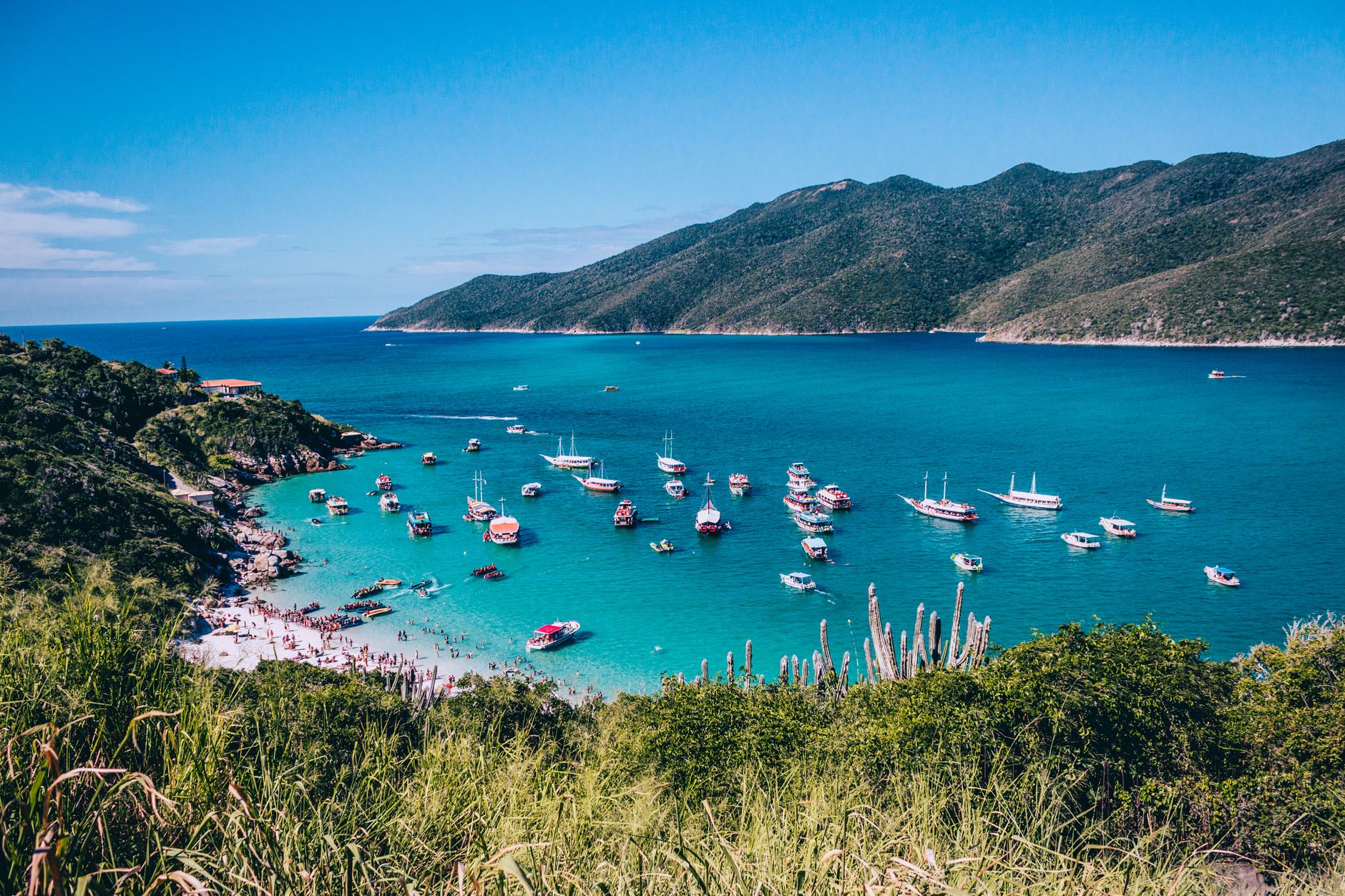
Arraial do Cabo is known as the 'Brazilian Caribbean' for its clear turquoise water and white-sand beaches, in the Região dos Lagos of Rio de Janeiro state. It is the region's diving and snorkelling destination par excellence: the clarity of the water, a result of the upwelling phenomenon, makes for exceptional visibility and rich marine life.
Beaches such as Praia do Forno, Praia do Farol (on Ilha do Cabo Frio) and the in-town Praia dos Anjos, along with the Gruta Azul and the lighthouse, make boat trips the star activity. The town keeps its origins as a fishing village and a strong bond with the sea, with the historic arrival of Amerigo Vespucci tied to the region. It is a simpler, more seafaring destination than nearby Búzios.
This guide covers the essentials of Arraial do Cabo: the boat trips and the best beaches, diving and snorkelling, viewpoints such as Pontal do Atalaia, where to eat fish and how to get here from Rio or from Cabo Frio. It is ideal for anyone who loves clear water, diving and picture-perfect beaches.
The Arraial do Cabo region is associated with the earliest days of colonisation: it is linked to the landing of Amerigo Vespucci's expedition in the early 16th century and to the setting up of one of Brazil's first brazilwood trading posts in the Praia dos Anjos area. A fishing village for centuries, in the 20th century it housed a caustic soda and alkali plant that shaped its development, before establishing itself, thanks to its crystal-clear water and the upwelling, as one of the main diving and beach destinations in the Região dos Lagos.
Read the full history ↓The Cidade Maravilhosa and its state: from Villegagnon's França Antártica to the founding by Estácio de Sá in 1565, from the gold of Minas to the Portuguese court of 1808, capital of the Empire and of the Republic for almost two centuries. Land of Christ the Redeemer and Sugarloaf, of carnival and bossa nova, and of a coastline running from Búzios to colonial Paraty.
Read the history of Rio de Janeiro →If you book from here we earn a commission and you pay no more. Prices and availability come from Civitatis.
No exact prices: a scale from $ (budget) to $$$$$ (luxury), with 2-3 options per category.
Origins, formation and what the sources say.
The water at Arraial do Cabo has a quirk that throws anyone seeing it for the first time: it is cold, almost icy for the tropics, and yet as clear as a swimming pool. That paradox —cold water, Caribbean sea— is neither a coincidence nor brochure make-up: it is the same oceanic phenomenon that five hundred years ago turned this headland into a landmark for the first European expeditions to explore the coast of what is now Brazil. Arraial do Cabo holds a prominent place in the accounts of Brazil's earliest colonial days. Historical tradition links the region to the landing of the Portuguese expedition that the navigator Amerigo Vespucci took part in, at the start of the 16th century. In the area of today's Praia dos Anjos, one of the first factories or feitorias devoted to exploiting pau-brasil (brazilwood), the dye timber that gave the country its name, is said to have been set up.
These trading posts were outposts from which Europeans traded the valuable timber with indigenous peoples, loading it onto ships bound for Europe. Setting one up at Arraial do Cabo makes it, according to that account, one of the pioneering points of organised Portuguese presence on the Brazilian coast.
Beyond the details that research qualifies, this origin ties Arraial do Cabo to the dawn of Brazil's colonial history and to the trade that marked the first contacts between Europeans and indigenous peoples. The region, with its waters and its headland, was thus an early stage for European Atlantic expansion in the New World.
For centuries, Arraial do Cabo was above all a fishing community. Its economy revolved around the sea: small-scale fishing, including the traditional catching of shoals such as tainha, was an essential part of local life. Being a headland, with its particular waters, made the area a privileged spot for fishing.
That singularity of its waters has a scientific explanation: the upwelling phenomenon (ressurgência). Along this stretch of coast, certain wind and current conditions bring deep, cold, nutrient-rich water to the surface. That input of nutrients favours great biological productivity —hence the abundance of fish— and, at the same time, contributes to the extraordinary clarity and colour of the water that characterises the destination today.
The importance of the upwelling even led to oceanographic research centres being set up in town. So the same phenomenon that sustained Arraial's fishermen for generations would, in time, become the basis of its transformation into one of Brazil's great destinations for diving and crystal-clear beaches.
In the 20th century, Arraial do Cabo went through a stage shaped by industry. The region housed a major plant tied to the production of caustic soda and alkalis (the Companhia Nacional de Álcalis), which drew on local resources such as salt and limestone. This industrial plant carried considerable weight in the town's economy and urban growth for decades, pulling in workers and population.
In time, though, it was tourism that revealed the real potential of Arraial do Cabo. Its white-sand beaches and, above all, its exceptionally clear, turquoise water —a result of the upwelling— earned it the nickname 'Brazilian Caribbean'. Being close to Rio de Janeiro and to the other resorts of the Região dos Lagos, such as Cabo Frio and Búzios, drove its growth as a destination.
Diving, snorkelling and boat trips to beaches and islands such as Praia do Farol turned Arraial into a magnet for sea lovers. The town kept its seafaring, fishing essence while adapting to tourism, balancing the conservation of unique waters and ecosystems against a growing flow of visitors. Today Arraial do Cabo is a byword for crystal-clear water, diving and idyllic beaches on the Rio state coast.
The tourism boom also transformed the boating infrastructure: where small fishing boats once put out, dozens of schooners and speedboats now operate, casting off every morning from the Pier de Arraial and Praia dos Anjos for Ilha do Cabo Frio and the Gruta Azul. In high season —summer, Carnival and long weekends— the town takes in a number of visitors several times its resident population, generating an economic boom but also strain on the carrying capacity of protected beaches. Since 2026 local authorities have tightened enforcement on tourist boats, banning open bar on board and stepping up safety checks, in an attempt to professionalise an activity that drives a good part of the municipality's economy.
For much of its modern history, Arraial do Cabo was a district of the neighbouring municipality of Cabo Frio. Only in 1985 did it win political emancipation and become an independent municipality, a milestone that coincided with the start of its tourism take-off and with a growing awareness of the value of its natural and fishing heritage. The new autonomy let the community manage its territory more directly, in a context of transition from the industrial economy of the Álcalis plant towards tourism.
One of the most significant steps in that direction was the creation, in 1997, of the Arraial do Cabo Marine Extractive Reserve (Resex-Mar), one of the first marine extractive reserves in Brazil. This conservation category recognises the rights of traditional small-scale fishing communities to the sustainable use of the sea's resources, seeking to reconcile the historic fishing activity with the protection of the ecosystems shaped by the upwelling. It is a pioneering model of shared management between the state and local fishermen.
The Resex and the protected status of many of its marine areas explain why certain sites today, such as Ilha do Cabo Frio and Praia do Farol, have regulated access and visitor caps. The balance between mass tourism —which in high season multiplies the town's population— and the conservation of exceptionally clear, biodiverse waters is Arraial do Cabo's great contemporary challenge, for a destination that owes its fame precisely to the health of that sea.
Oceanographic research also left an institutional mark: the Instituto de Estudos do Mar Almirante Paulo Moreira (IEAPM), run by the Brazilian Navy, has operated in town since the 1960s and studies exactly the upwelling phenomenon that explains the clarity of these waters. For anyone visiting Arraial do Cabo today, understanding this layer of history —colonial feitoria, fishing village, industrial hub, marine reserve and now a mecca for dive tourism— helps you appreciate the destination beyond the postcard: every boat heading out to Praia do Farol sails over water that for centuries fed generations of small-scale fishermen, whose descendants are today, to a large extent, the people who guide the trips, run the pousadas and defend, through the Resex-Mar, the right to go on living off the sea that made this corner of the Região dos Lagos famous.