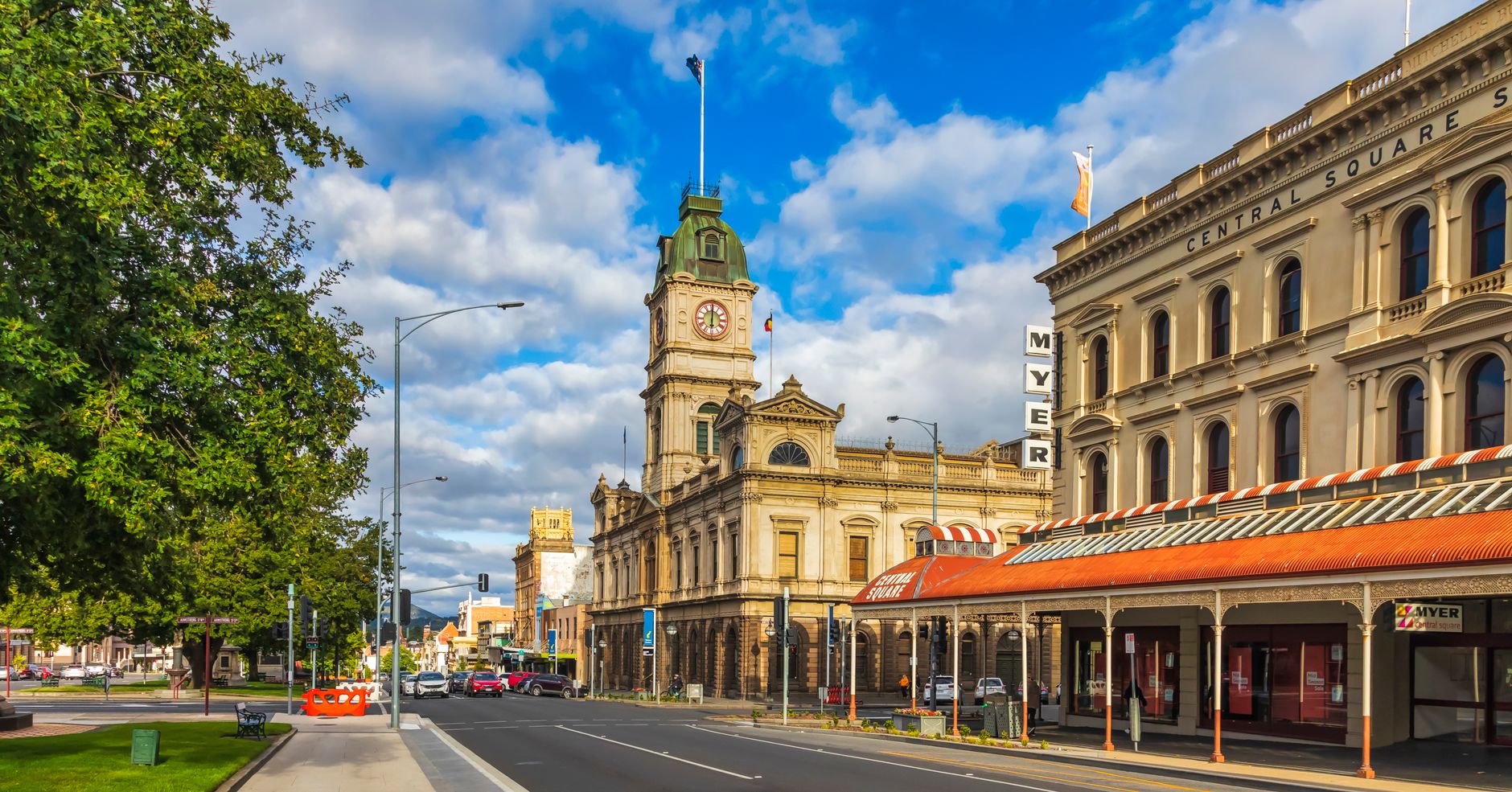
Ballarat is the city of the Australian gold rush: when gold was found in its creeks in 1851, tens of thousands of prospectors from all over the world flocked there and, within a few years, turned it into one of the richest and grandest cities in 19th-century Australia. You can still feel that heritage today in its boulevards of Victorian buildings, its statues and gardens, and above all at Sovereign Hill, the living museum that recreates life on the goldfields.
But Ballarat is also the birthplace of a founding myth of Australian democracy: the 1854 Eureka Rebellion, when miners rose up against the abuses of the colonial government under the Southern Cross flag. That brief, bloody episode — told at the Eureka Centre — left its mark on the country's political identity.
This guide takes a practical look at Ballarat: what Sovereign Hill is like and how much it costs, what to see at the Eureka Centre and the Art Gallery of Ballarat (free), the Wildlife Park, Lake Wendouree and its botanical gardens, how to get there by train from Melbourne with the capped regional fare, and how to get around with myki. All with verified prices in Australian dollars and tips for every season.
Ballarat is the ancestral Country of the Wadawurrung (Wathaurong) people, of the Kulin nation, who lived for thousands of years off the Yarrowee Creek valley and its resources, understanding the waterways as the veins and arteries of their land. Everything changed in 1851, when the discovery of gold sparked one of the biggest gold rushes in the world: within weeks thousands of prospectors arrived, rivers were diverted, forests were cleared and the landscape was devastated, with a profound impact on the Wadawurrung. Ballarat became a rich and populous city. In 1854, the miners' anger over abusive licences and their lack of rights erupted in the Eureka Rebellion: on 3 December, government troops stormed the Eureka Stockade and killed at least 22 miners. Although it was a military defeat, the rebellion led to democratic reforms and remains a symbol of republicanism and the fight for rights in Australia. With the wealth from gold, the city filled with grand Victorian architecture. The full story is on our history page.
Read the full history ↓The smallest state on the mainland and the richest during the gold rush: land of the Kulin nations, colonised from 1835 around Melbourne, transformed by the gold of Ballarat and Bendigo and by the Eureka rebellion of 1854, seen as the cradle of Australian democracy.
Read the history of Victoria →Some places make no sense on your own; with someone explaining them, they change completely. We look ours up on Civitatis: guided in Spanish and booked online with no fuss. They have 14 activities in Melbourne. And there are free tours here: you book without paying and tip the guide whatever you think at the end, so trying one costs you nothing. Three are below so you get the idea: tap any of them and they all open.
They depart from Melbourne, 102 km away. If you book from this link we earn a commission and you pay no more.
No exact prices: a scale from $ (budget) to $$$$$ (luxury), with 2-3 options per category.
Origins, formation and what the sources say.
Before the word 'gold' changed its fate, the Ballarat area was —and still is— the ancestral Country of the Wadawurrung people (also spelt Wathaurong or Wathaurung), one of the peoples of the Kulin nation of south-central what is now Victoria. Their territory stretched from the coast near Geelong to just north of Ballarat, and took in the valleys of creeks such as the Yarrowee, which runs through the city.
For the Wadawurrung, waterways were literally the veins and arteries of their Country: the backbone of life, food and stories. For tens of thousands of years they studied the plants, animals, climate and landforms, and that deep knowledge allowed them to manage the land —with fire, with water management, with seasonal calendars— to obtain everything they needed to live well: food, clothing, shelter. They were not aimless nomads, but custodians of a territory they knew in fine detail.
Like the other Kulin peoples, they understood the landscape within the Dreaming, the order created in the Dreamtime, where rivers, hills, animals and people are bound together by law and kinship. That worldview, and the relationship with the Yarrowee and the land of Ballarat, did not disappear with colonisation: despite everything that came afterwards, Wadawurrung culture and language are still alive and practised today, and the Wadawurrung remain the Traditional Owners of this land.
In August 1851, just months after Victoria separated from New South Wales as a colony, gold was found at Ballarat. The news spread like wildfire: within days, hundreds of people crowded along the Yarrowee creek in search of the metal, and within a few weeks thousands had arrived. Ballarat became the epicentre of one of the biggest gold rushes in world history, drawing prospectors from all over Australia, Europe, China and the Americas.
The impact on the landscape —and on the Wadawurrung— was devastating. Within weeks, the diggers had diverted the course of the Yarrowee and other creeks to search for gold in their beds; as the diggings grew, the river was diverted again to make room for the population boom. Huge stretches of forest were cleared, the fertile soil was dug up and lost, and the ground was riddled with tunnels and shafts. The destruction of the environment swept away the traditional Wadawurrung way of life, as the people lost access to their resources, to sacred sites and to much of their cultural and linguistic knowledge.
Ballarat, on the other hand, grew rich and populous at dizzying speed. Surface alluvial gold gave way to deep quartz-reef mining, which required capital and companies, and the city filled with banks, shops, theatres and hotels. In barely a decade, a valley inhabited by the Wadawurrung was transformed into one of the most prosperous cities of the British Empire in the southern hemisphere.
The wealth from gold sat alongside an unjust system. To dig for gold, every miner had to pay a costly monthly licence, whether they struck it lucky or not, and the police enforced it with humiliating, brutal raids. On top of that, miners had no right to vote and no representation in the colonial government. Resentment kept building until it boiled over in Ballarat.
On 29 November 1854, at Bakery Hill, the miners raised the Southern Cross flag —the Eureka Flag— for the first time and began building a stockade on the Eureka diggings, in open defiance of the government. They chose Peter Lalor as their leader and swore to defend their rights and liberties. At dawn on Sunday 3 December 1854, when the stockade was lightly guarded, government troops launched a surprise attack. The fight was short and bloody: at least 22 miners and around 5 soldiers were killed.
Militarily, Eureka was a defeat. Politically, it was a triumph. Public opinion swung behind the miners: those arrested were tried and acquitted, the hated licence was abolished (replaced by a modest annual 'miner's right' and an export duty), the administration of the goldfields was reformed and miners were given representation in Victoria's Legislative Council. Peter Lalor, the leader of the rebellion, ended up being elected to parliament. Over time, Eureka became a founding myth of democracy, republicanism and the struggle for rights in Australia, and its flag a national symbol.
With the wealth from gold, Ballarat was built on a grand scale. During the second half of the 19th century came the wide boulevards, ornate buildings, banks, theatres and hotels that today make its centre one of the best-preserved collections of Victorian architecture in Australia. Lydiard Street, with Her Majesty's Theatre —one of the oldest working theatres in the country— and Sturt Street, with its statues and broad central promenade, bear witness to that 'golden age'. Institutions such as the Art Gallery of Ballarat (1884), the oldest regional gallery in the country, were founded, and the Botanical Gardens were laid out beside Lake Wendouree.
When the easy gold ran out, Ballarat managed to reinvent itself as a regional, industrial and educational hub without losing its heritage. In the 20th century, that heritage became its great tourism asset: in 1970 Sovereign Hill opened, the living museum that recreates life on the goldfields and is today one of the most visited historical attractions in Australia, alongside the Eureka Centre, dedicated to the rebellion.
Recent decades have also seen growing recognition of Wadawurrung history. The people's culture and language, hit hard by the gold rush, are still alive and being revitalised, and today they are shared in spaces such as the Wadawurrung Cultural Precinct at Sovereign Hill and through the work of the Traditional Owners corporation. Many events in the city open with a Welcome to Country or an Acknowledgement of Country.
Today Ballarat brings together three layers of history in one place: the ancient Country of the Wadawurrung, the gold rush that made it rich and devastated the landscape, and the Eureka Rebellion that turned it into a symbol of Australian democracy. Exploring it —from Sovereign Hill to the Eureka flag, from Lydiard Street to Lake Wendouree— is like reading that history in the open air.