Viajá con Gus
Home › Australia › Cairns
Cairns
🇦🇺 Australia · Queensland

Cairns

🪪 What do I need to enter Australia?Pick your citizenship and we tell you the visa, the days and the paperwork, with the official source.

By leaving your email and citizenship you agree to receive the documents you asked for and weekly travel news. You can unsubscribe whenever you want. How we handle your data.
Jump to what you need
📌State
Queensland, in the tropics at the far northern end of the state (Far North Queensland). Cairns is the base city of the tropical north: around 150.000 residents, its own international airport and the most popular gateway to the Great Barrier Reef and to the Wet Tropics rainforest, a World Heritage site. It sits on Trinity Bay, between the sea and rainforest-covered mountains.
📌Best time to go
The best season is the dry season, from May to October: sunny days, 24-29 °C, low humidity, good sea conditions for snorkelling and NO dangerous jellyfish in the open sea. The wet season (November to April) is hot and very humid, with heavy rain, possible cyclones and 'stinger season' (jellyfish), when it's best to swim in a lycra suit. That's why the city has no town beach but a large public lagoon instead. June to August are the busiest months.
📌Suggested days
With 3 days you cover the essentials: a full day on the Great Barrier Reef (snorkelling/diving), a day in Kuranda via the Skyrail and the scenic train, and a day in the city, the Esplanade and the lagoon. With 4 to 6 days you can add trips to the Atherton Tablelands, the waterfalls, Fitzroy Island or Green Island, and use Cairns as a base for Port Douglas and the Daintree rainforest.
📌Getting there
By plane to Cairns International Airport (CNS), ~7 km from the centre, with flights from Brisbane, Sydney, Melbourne and international connections (Qantas, Virgin Australia, Jetstar and Asian airlines). Also by road from Brisbane (~17 h) or from Townsville (~4,5 h) on the Bruce Highway, and on the Spirit of Queensland train.
📌Getting around
Central Cairns is walkable. City buses are run by Kinetic under the state TransLink network; you pay with very cheap paper tickets (single, daily, weekly) bought on board by card or cash (there's no go card in Cairns, it's only used in South East Queensland). Uber and taxis work well. There are shuttles to the airport. For the reef, Kuranda and day trips, people use tours with transfers included.
📌Language and currency
English; Australian dollar (AUD, A$). Card and contactless payments are accepted almost everywhere; bring some cash for markets and stalls. Type I plugs (230V).
💱 AUD exchange rate
Loading rate…
🌤️ Weather in Cairns
Loading weather…

Cairns is the capital of tropical Australia and the ideal base for experiencing two of the planet's natural wonders in just a few days: the Great Barrier Reef, only 40 minutes away by boat, and the world's oldest tropical rainforest, which climbs the mountains right behind the city. Few places in the world let you have breakfast in town, snorkel among corals at midday and walk among giant ferns in the rainforest in the afternoon.

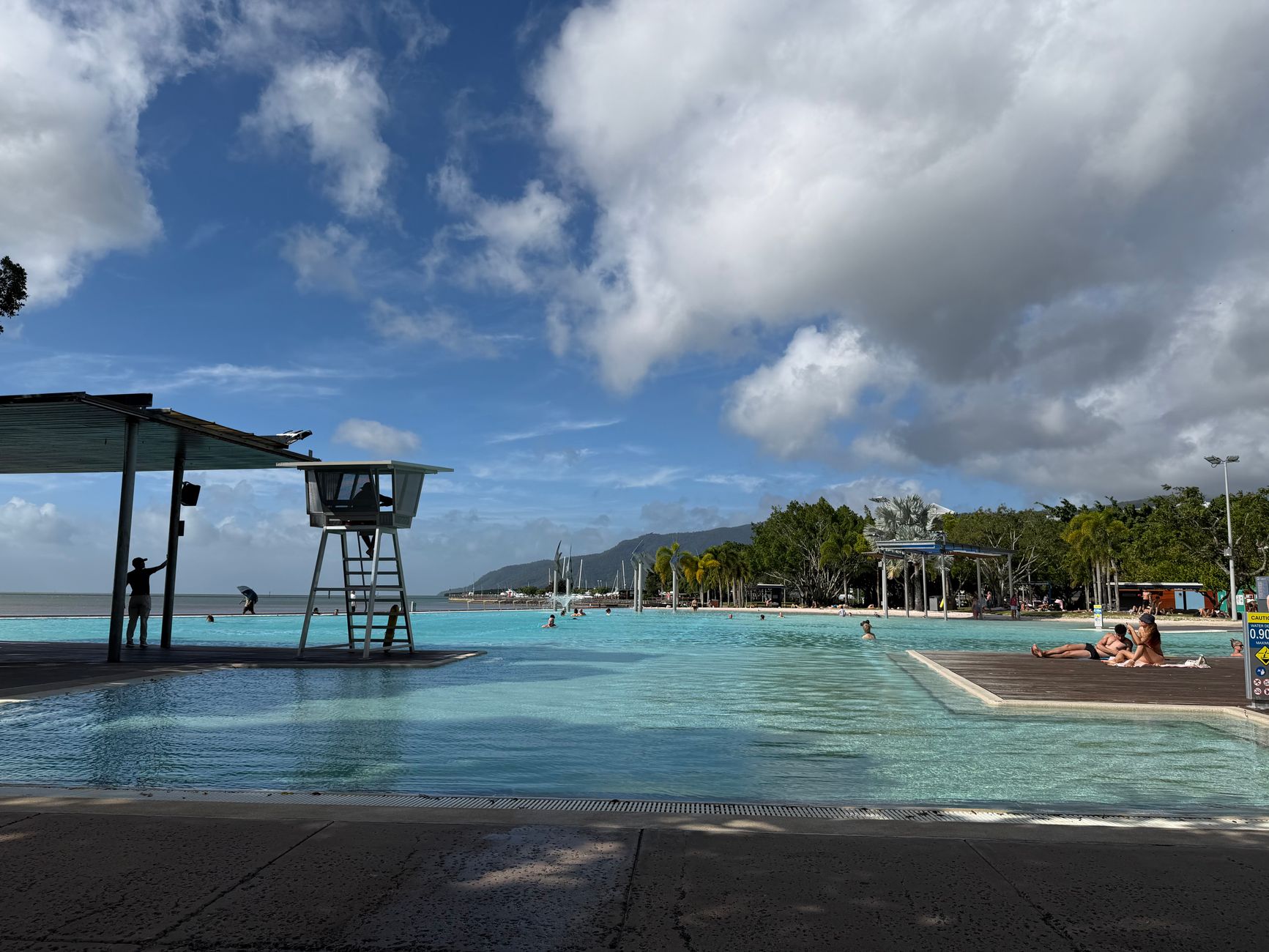
The city itself is relaxed, tropical and all about the outdoors. Since the sea off Cairns is all mangroves and jellyfish, instead of a town beach there's a huge free public lagoon on the Esplanade, the waterfront promenade where people swim, jog, picnic and watch the wetland birds. From there the boats leave for the reef, the buses head to Kuranda via the famous Skyrail over the rainforest, and the day trips go to the Atherton Tablelands, the waterfalls and the nearby islands.

This guide covers the best of Cairns with a practical eye: how to get to the reef and what it costs, how to ride the cable car up to Kuranda and come back down on the scenic train, what to see in the city and around it, when to go to avoid jellyfish season, how to get around and how to use Cairns as a springboard to Port Douglas and the Daintree. All verified, so you can plan your trip to the tropical north without any fuss.

📖 History of Cairns

Cairns is Gimuy, the name given by its Traditional Owners, the Gimuy Walubara Yidinji people, who together with the Yirrganydji (Djabugay-speaking) lived on this coast for millennia. James Cook named Trinity Bay in 1770, but the European town was only founded in 1876, as a port to export the gold discovered on the Hodgkinson River, and took its name from the Governor of Queensland, William Cairns. Sugar cane, the railway to Kuranda and, later, Great Barrier Reef tourism shaped the city. The full story — the Yidinji and Djabugay, gold, sugar cane and tourism — is on our history page.

Read the full history ↓

🏛️ Cairns is in Queensland

The state of sunshine and the tropics: land of dozens of Aboriginal nations, born as the Moreton Bay penal settlement in 1824, separated from New South Wales in 1859 and shaped by sugar cane, wool and mining. It is home to the Great Barrier Reef and the Daintree Rainforest, two World Heritage Sites.

Read the history of Queensland →

🗺️ What to see

Tours you can book

If you book from here we earn a commission and you pay no more. Prices and availability come from Civitatis.

1
Great Barrier Reef (day trip from Cairns)
The largest reef on the planet, 40 minutes away by boat, for snorkelling and diving among corals, turtles and tropical fish.
Leer más ↓
Cairns is the most popular gateway to the Great Barrier Reef, and the main reason many people come. The outer reef is about 40-90 minutes away by boat, and dozens of operators run day trips: fast catamarans to fixed pontoons (with snorkelling, diving, semi-submarine and food), sailing boats to less crowded reefs, and dive trips for certified divers and beginners. You'll see hard and soft corals, sea turtles, clownfish, rays and sometimes harmless reef sharks. Options range from large, comfortable pontoon tours (ideal for families and non-swimmers, with safe areas) to small, more 'adventurous' trips. Many include snorkel gear, a guide, lunch and a lycra suit. Introductory or certified diving usually costs extra. Getting there: boats leave from the Marina/Reef Fleet Terminal in central Cairns, with optional hotel transfers. Best time: May to October (dry season), with better visibility and no stingers in the open sea. Tips: if you get seasick, take a tablet beforehand; there's an Environmental Management Charge (the reef's environmental levy) that is sometimes charged separately (~A$8-10). Day trips cost around A$230-300 per person (verified July 2026).
ℹ️ Location: Outer reef 40-90 min by boat; departures from the Reef Fleet Terminal, central Cairns · Best time to go: May to October (dry season, better visibility, no stingers on the reef) · Admission: Day trip from ~A$230-300 pp; diving extra; reef environmental levy ~A$8-10 (verified July 2026) · Duration: Full day (7-9 h)
2
Kuranda: Skyrail and scenic train
Ride a cable car over the rainforest and come back down on the historic 1891 train to the mountain village of Kuranda.
Leer más ↓
One of the star activities in Cairns is visiting Kuranda, a picturesque mountain village at 328 m, deep in the tropical rainforest. The fun is in how you get there: the Skyrail Rainforest Cableway, a 7,5 km cable car that glides above the canopy of the Wet Tropics rainforest (a World Heritage site), with intermediate stations, lookouts over Barron Falls and boardwalks for walking among the trees. And for the way back (or the way up), the Kuranda Scenic Railway, a historic train opened in 1891 that climbs the mountain through hand-carved tunnels and viaducts, with a photo stop at the falls. The classic plan is to combine both: go up on one and come down on the other. In Kuranda there are craft markets, a butterfly sanctuary, a koala and bird park, and good cafés. It's a full day, very photogenic and family-friendly. Getting there: the Skyrail leaves from the Smithfield terminal (~15 min from Cairns) and the train from Cairns or Freshwater station; there are packages with transfers. Best time: all year round; the rainforest looks just as green. Tips: book ahead in high season; the train has occasional closures for maintenance (check dates). Skyrail + train combo package from A$145,50 adult, A$79,50 child (Skyrail, verified July 2026).
ℹ️ Location: Kuranda, in the mountains; Skyrail from Smithfield, train from Cairns/Freshwater · Best time to go: All year round · Admission: Skyrail + train combo A$145,50 adult, A$79,50 child (source: Skyrail, verified July 2026) · Duration: Full day
3
Cairns Esplanade and Lagoon
The waterfront promenade with the big free public lagoon facing Trinity Bay, the city's social heart.
Leer más ↓
Since the sea off Cairns is all mangroves, muddy tides and jellyfish, the city replaced the beach with the Cairns Esplanade Lagoon: a huge 4.800 m² filtered saltwater pool on the waterfront, free of charge, with lifeguards, lawns, shade and artificial sand. It's the city's meeting point, ideal for safe swimming all year round, especially during jellyfish season. The Esplanade around it is a waterfront promenade several kilometres long with paths, outdoor gyms, sports courts, picnic areas and public barbecues, plus a wetland where you can watch birds. At sunset it fills with people jogging, cycling and eating at the food trucks. In 2025 the lagoon was renovated with new LED lighting and filtration. Getting there: right in the centre, within walking distance of any CBD hotel. Best time: all year round; essential during stinger season. Tips: the lagoon is closed on Wednesdays until midday for cleaning; bring a towel; there are night markets (Cairns Night Markets) nearby. Everything is free.
ℹ️ Location: Central Cairns waterfront, on Trinity Bay · Best time to go: All year round (key during jellyfish season) · Admission: Free (municipal public lagoon) · Duration: 1 to 3 hours
4
Green Island and Fitzroy Island
Two nearby reef islands, ideal for a day out: beach, snorkelling and rainforest a short ferry ride away.
Leer más ↓
Very close to Cairns there are two islands perfect for a day of beach and snorkelling without going as far as the outer reef. Green Island is a coral cay with tropical rainforest, surrounded by fringing reef: you can snorkel straight from the beach, and there are rainforest trails, a small resort and areas for non-swimmers. Fitzroy Island is a mountainous continental island with coral beaches (Nudey Beach is famous), trails to lookouts, snorkelling and a turtle rehabilitation centre. Both are reached by fast ferry from the Cairns Marina (about 45 min) and are ideal for families or anyone who wants nature without getting seasick out at sea. They can be combined with guided snorkelling. Getting there: Great Adventures (Green Island) and Fitzroy Island Adventures ferries from the Reef Fleet Terminal. Best time: May to October; wear lycra during jellyfish season. Tips: bring your own supplies (water, reef-safe sunscreen); return ferries to Green Island cost around A$100-110 and to Fitzroy ~A$90 (verified July 2026).
ℹ️ Location: Reef islands off Cairns; ~45 min by ferry from the Marina · Best time to go: May to October; lycra during jellyfish season · Admission: Return ferry Green Island ~A$100-110, Fitzroy ~A$90 (verified July 2026) · Duration: Full day
5
Atherton Tablelands (plateau and waterfalls)
The volcanic plateau behind Cairns, with waterfalls, craters, lakes, plantations and cool air.
Leer más ↓
Climbing up from Cairns through the rainforest you reach the Atherton Tablelands, a fertile, cool volcanic plateau with landscapes that surprise you with how green they are and a milder climate. This is waterfall country: the Waterfalls circuit (Millaa Millaa, Zillie, Ellinjaa), Josephine Falls, and natural swimming spots like Lake Eacham and Lake Barrine (volcanic crater lakes with crystal-clear water). There are also coffee, tea, chocolate and tropical fruit plantations, and farmers' markets. It's a complete contrast to the coast: cool air, rolling fields, cloud forest and wildlife such as platypuses (in Yungaburra), tree kangaroos and birds. You can do it on an organised day tour or at your own pace in your own car. Getting there: by rental car (~1,5 h from Cairns) or on full-day tours. Best time: all year round; the waterfalls are fuller after the wet season. Tips: bring insect repellent, walking shoes and swimwear for the natural pools; ideally combine waterfalls + a lake + Yungaburra. Full-day tours from ~A$150-200 pp (verified July 2026).
ℹ️ Location: Plateau west of Cairns; ~1,5 h by car · Best time to go: All year round; waterfalls fuller after the wet season · Admission: Waterfalls and lakes free; full-day tours from ~A$150-200 pp (verified July 2026) · Duration: Full day
6
Cairns Botanic Gardens and Centenary Lakes
Free tropical botanic gardens with rainforest, orchids and walking trails, in the suburb of Edge Hill.
Leer más ↓
The Cairns Botanic Gardens are among the best tropical botanic gardens in Australia and a free green escape within the city. They hold a huge collection of wet tropics plants: palms, aroids, orchids, Wet Tropics rainforest plants, a conservatory, a garden of plants traditionally used by Aboriginal people and trails that head into real rainforest. Next to them are the Centenary Lakes (freshwater and saltwater lakes with mangroves), and trails like the Red Arrow and Blue Arrow start here, walks through urban rainforest with lookouts over the city. It's a perfect plan for a quiet morning, free and in the shade, with good birdwatching. Getting there: in the suburb of Edge Hill, ~10 min by car/bus from the centre. Best time: early morning, when it's cooler and there are more birds. Tips: bring insect repellent and water; the visitor centre has a trail map; free entry. Free guided walks are available.
ℹ️ Location: Edge Hill, ~10 min from central Cairns · Best time to go: Early morning · Admission: Free (municipal public garden) · Duration: 1 to 3 hours
7
Cairns Aquarium and Esplanade nightlife
A modern aquarium of the tropical north and the lively bar and night market area in the centre.
Leer más ↓
The Cairns Aquarium is a modern aquarium dedicated to the ecosystems of the tropical north: the rivers and rainforests of the Wet Tropics, the mangroves, the Great Barrier Reef and the deep sea. It has large tanks with sharks, rays, turtles and reef fish, plus crocodiles, and it's a good plan for rainy days or for getting to know the wildlife before or after visiting the reef. It offers experiences such as sleeping over at the aquarium or diving with sharks. At night, central Cairns comes alive around the Esplanade and Lake and Shields streets: bars, seafood restaurants, Asian food, the Cairns Night Markets (a night market with food stalls and souvenirs) and a young backpacker scene. It's a city for eating out and enjoying the warm weather. Getting there: the aquarium and the bar area are right in the centre, within walking distance. Best time: the aquarium, any day (ideal if it's raining); the nightlife, every night. Tips: the aquarium costs around A$52 adult, A$32 child (verified July 2026); the night markets are free to browse.
ℹ️ Location: Central Cairns (aquarium on Florence St; night markets on the Esplanade) · Best time to go: Aquarium ideal on rainy days; nightlife every night · Admission: Cairns Aquarium ~A$52 adult, A$32 child; night markets free (verified July 2026) · Duration: 2 to 3 hours
📶I have never landed without internet. I arrive and my phone connects to the strongest network in the country I am visiting: I can say I landed, sort out transport, book tours and keep posting, at a seriously good price. I always use the Maya eSIM — check their plans by clicking the banner.See plans →Maya Mobile eSIM — download, install, go
What nobody tells you

💵 Prices

Tickets

TypePrice
Cairns Esplanade LagoonFree (public lagoon)
Cairns Botanic GardensFree (public garden)
Skyrail + Kuranda Scenic Railway (combo)A$145,50 adult, A$79,50 child (source: Skyrail, verified July 2026)
Kuranda Scenic Railway (solo tren, ida y vuelta)~A$85 return; Gold Class upgrade A$57 per leg (verified July 2026)
Cairns Aquarium~A$52 adult, A$32 child (verified July 2026)
Tasa ambiental de la Gran Barrera (EMC)~A$8-10 per person/day, sometimes included in the tour (verified July 2026)
🔄 updated monthlyOfficial / reference values · double-check when buying

Activities and tours

ActivityPriceDurationOperator
Great Barrier Reef day trip (snorkelling and pontoon)From ~A$230-300 pp (verified July 2026)Full day (7-9 h)Quicksilver, Sunlover, Reef Magic, Passions of Paradise and others
Skyrail + scenic train combo to KurandaA$145,50 adult, A$79,50 child (verified July 2026)Full daySkyrail Rainforest Cableway + Kuranda Scenic Railway
Ferry and a day on Green Island or Fitzroy IslandReturn ferry ~A$90-110 (verified July 2026)Full dayGreat Adventures, Fitzroy Island Adventures
Full-day tour to the Atherton Tablelands (waterfalls)From ~A$150-200 pp (verified July 2026)Full dayCairns operators
Diving (introductory or certified) on the reefFrom ~A$100 on top of the day trip (verified July 2026)Within the reef dayCairns dive operators
Rafting on the Tully or Barron RiverFrom ~A$150-230 p/p (verified July 2026)Half day to full dayRaging Thunder, R'n'R Rafting
🔄 updated monthlyOfficial / reference values · double-check when buying

🚌 How to get there and distances

Getting around

TransLink bus tickets (how to pay)
Price
Single A$0,50; daily A$1; weekly A$5 (source TransLink Cairns, verified July 2026)
Notes
In Cairns, public transport is the state TransLink network, run locally by Kinetic (formerly Sunbus). You pay with PAPER tickets bought on board by card or cash: single (with a 2-hour transfer window), daily or weekly, at very cheap fares subsidised by the Queensland government. Heads-up: the go card is NOT used in Cairns (it's only for South East Queensland/Brisbane). To plan routes and timetables, use the MyTranslink app and Google Maps.
Uber and taxis
DurationVariable
Price
Short trips around town from ~A$12-18 (approximate, verified July 2026)
Notes
Uber and taxis (Cairns Taxis) work well, handy at night and for the airport.
Airport shuttle (CNS) to the centre
Duration15-25 min
Price
~A$15-20 per person; public bus A$1 with a ticket (verified July 2026)
Notes
Shared shuttles and buses link the airport (7 km away) with hotels in the centre and with Palm Cove.
On foot around the centre
Free
Notes
The CBD, the Esplanade, the lagoon, the marina and the restaurants are all close together and easy to walk.
Car or campervan hire
PriceFrom ~A$45-80 per day (approximate, verified July 2026)
DurationVariable
Notes
Very useful for the Atherton Tablelands, Port Douglas and the Daintree; in the city you barely need one.
🔄 updated monthlyOfficial / reference values · double-check when buying

How to get there

RouteAirlines / operatorsAvg. priceDuration
Cairns Airport (CNS) → centreShuttle, Uber, taxi, public busShuttle ~A$15-20; bus A$1 with a ticket; taxi/Uber ~A$25-30 (verified July 2026)15 to 25 minutes
Flights to CairnsQantas, Virgin Australia, Jetstar; international (Asian airlines)Varies by origin and how far ahead you bookDirect from Brisbane (~2,5 h), Sydney, Melbourne
Brisbane → Cairns by road (Bruce Highway)Hire car, long-distance bus or the Spirit of Queensland trainTrain from ~A$180-300 depending on class (verified July 2026)~24 h by train / ~17 h by car
Cairns ↔ Port Douglas / DaintreeHire car, Exemplar/Trans North shuttle or toursShuttle to Port Douglas ~A$45-55 (verified July 2026)~1 h to Port Douglas
🔄 updated monthlyOfficial / reference values · double-check when buying

🏨 Where to stay

No exact prices: a scale from $ (budget) to $$$$$ (luxury), with 2-3 options per category.

Luxury hotels and resorts
Price$$$$$
Recommended options
Crystalbrook Riley/Bailey/Flynn, Pullman Reef Casino, Shangri-La The Marina: A$250-500 per night (verified July 2026)
Mid-range hotels and apartments
Price$$$$$
Recommended options
Hilton Cairns, Novotel, Pacific Hotel, apartments on the Esplanade: A$130-250 per night (verified July 2026)
Boutique and characterful hotels
Price$$$$$
Recommended options
Riley and boutique options in the centre and Palm Cove: A$180-350 per night (verified July 2026)
Hostels and budget
Price$$$$$
Recommended options
Gilligan's, Nomads, Mad Monkey: dorms A$30-45, private rooms A$90-140 per night (verified July 2026)

🍴 Where to eat

Alta cocina y mariscos
Price$$$$$
Options / signature dish
Ochre, Dundee's, the Crystalbrook hotel restaurants: modern Australian cuisine and seafood, A$45-90 per dish (verified July 2026)
Restaurantes del centro (Esplanade y marina)
Price$$$$$
Options / signature dish
Salt House, Prawn Star (seafood on a boat), Waterbar & Grill: A$25-50 per dish (verified July 2026)
Comida asiática y street food
Price$$$$$
Options / signature dish
Rusty's Markets, Thai, Japanese and Chinese restaurants, Cairns Night Markets: A$12-28 per dish (verified July 2026)
Cafés y desayunos tropicales
Price$$$$$
Options / signature dish
Cafés on the Esplanade and in Edge Hill with local tropical fruit: A$12-25 (verified July 2026)

📖 History of Cairns

Origins, formation and what the sources say.

Gimuy: the land of the Yidinji and the Djabugay

Long before there was a single street, this strip of tropics between the sea and the rainforest already had a name: Gimuy. That is what Cairns is called by its Traditional Owners, the Gimuy Walubara Yidinji people, whose presence on this coast goes back thousands of years. The name 'Gimuy' comes from the Yidiny language and, according to local tradition, refers to a plant found in the area (a kind of fig or blue plum). It's a reminder of how deeply this people's identity is bound up with their Country, the land that sustains them.

The region was, and still is, the territory of more than one people. South of the Barron River, Yidiny-speaking groups (Gimuy Walubara Yidinji) predominated; to the north, on the coast running from the Barron towards Port Douglas, lived the Yirrganydji, who spoke dialects of the Djabugay language. These were peoples of an extraordinarily rich land: the tropical rainforest, now a World Heritage Site, gave them fruit, medicinal plants, fibres and game, while the sea, the mangroves and the rivers provided fish, shellfish and turtles.

That abundance supported complex cultures, with finely tuned seasonal calendars, vast botanical knowledge and a network of ties with neighbouring peoples on the tableland and the coast. The Yidinji and Djabugay had their Dreamings (the ancestral stories that explain the origin of the land, rivers, mountains and laws) and sacred sites throughout the region. None of this disappeared when the Europeans arrived. Today the descendants of these peoples hold native title claims over their ancestral lands and work to preserve their languages and culture, which feature in many of the tours visitors take today.

Trinity Bay: from Cook to frontier violence

The first European to leave a name here was, as at so many points along the east coast, James Cook. In 1770, sailing HMB Endeavour north, he named the bay Trinity Bay because he passed it on Trinity Sunday. Cook kept going: a little further north he would run aground on the Great Barrier Reef. For almost a century, the Gimuy coast remained Yidinji and Djabugay territory, little more than a line on imperial maps.

The first Europeans to stay arrived in the late 1860s. They were beche-de-mer (sea cucumber) fishermen, who gathered and dried this product, much sought after in Asia. Their presence marked the start of sustained contact, and of conflict too. In 1872 a violent clash broke out between the Yidinji people and the fisherman Phillip Garland over the use of a large native waterhole; the incident gave its name to the place known as 'Battle Camp'. It was just one of many clashes on the colonial frontier, which was especially bloody across North Queensland, with massacres and dispossession that devastated the First Peoples.

Behind the tropical beauty that draws tourists today lies a hard history of resistance and dispossession. The Yidinji and Djabugay lost access to much of their Country, were displaced and, in many cases, forced to live on missions and reserves far from their lands. That their names and stories are heard again today, on the cableways over the rainforest and in cultural centres, is the result of a long struggle for recognition.

Gold, a port and sugar cane: the birth of Cairns

The European town was born suddenly, and because of gold. In 1875 gold was discovered on the Hodgkinson River fields, on the tableland to the west. That gold needed a port on the coast to reach the world, and in 1876 expeditions were organised to found one. The surveyor Brinsley G. Sheridan chose a spot on Trinity Bay, and in late 1876 the place was named Cairns, after William Wellington Cairns, then Governor of Queensland.

The early days were extremely tough: a muddy settlement among the mangroves, with heat, humidity and competition from rival ports such as Port Douglas. What saved Cairns was the railway. From 1886, work began on a line up to the Atherton Tableland (heading for Herberton), a heroic feat of engineering that climbed the mountain through tunnels and viaducts carved by hand in the middle of the rainforest. The section to Kuranda opened in 1891 and is now the famous Kuranda Scenic Railway, one of the city's major attractions.

With the railway, Cairns secured its future. The fertile tropical land filled with plantations of sugar cane, bananas and other crops, and the town established itself as the commercial centre of the far north. The Chinese community played a huge, and often forgotten, role in that growth: present from early on in farming and trade, it left a deep mark on the city's economy and life. Sugar cane, with its mills and hard labour (including, in the early years, the trafficking of Pacific Islander workers known as 'blackbirding'), shaped the landscape and society of the north for generations.

From military base to capital of tropical tourism

The 20th century turned Cairns from a sugar town into a city. During the Second World War, its strategic position in the north made it an important Allied base: airfields, barracks and depots were built, and thousands of Australian and American soldiers passed through on their way to the Pacific. The war left behind infrastructure and a momentum the city would later put to good use.

After the war, Cairns grew on sugar cane, fishing and, more and more, tourism. But the big leap came in 1984, with the opening of Cairns International Airport. Suddenly, travellers from Australia, Asia, Europe and the Americas could fly straight to the doorstep of two natural wonders: the Great Barrier Reef, 40 minutes away by boat, and the tropical rainforest of the Wet Tropics. The city reinvented itself as the tourism capital of the tropical north.

The following decades brought a boom in diving and snorkelling operators, resorts, the Skyrail (the cableway over the rainforest, opened in 1995), the revamp of the Esplanade with its big public lagoon, and international recognition for the region: the Great Barrier Reef has been a World Heritage Site since 1981 and the Wet Tropics of Queensland since 1988. Cairns began welcoming hundreds of thousands of visitors from all over the world every year.

Today the city faces a double challenge. On one hand, it has to look after the treasures that sustain it: the Great Barrier Reef is threatened by coral bleaching and climate change, and much of Cairns' economy and identity depends on its health. On the other, it has to keep recognising the Yidinji and Djabugay peoples and giving them back their rightful place, since their ancient culture is an essential part of what makes this corner of the tropics unique. The story of Cairns, from gold and sugar cane to coral and rainforest, is at heart the story of a place that learned its greatest wealth lay in its natural world.

📚 Bibliography

  • Wikipedia (EN) — «Cairns»: https://en.wikipedia.org/wiki/Cairns
  • Wikipedia (EN) — «History of Cairns»: https://en.wikipedia.org/wiki/History_of_Cairns
  • Cairns Regional Council — First People's history & languages: https://www.cairns.qld.gov.au/experience-cairns/facts-figures-history/first-peoples-history
  • Cairns Australia — Cairns history (traditional owners to now): https://cairnsaustralia.com/cairns-tourist-information-centre/cairns-history/
  • Wikipedia (EN) — «Yidinji»: https://en.wikipedia.org/wiki/Yidinji
  • Wikipedia (EN) — «Djabugay»: https://en.wikipedia.org/wiki/Djabugay
  • Kuranda Scenic Railway — History (1891 line): https://www.ksr.com.au/about-us/history/
  • Wikipedia (EN) — «Kuranda Scenic Railway»: https://en.wikipedia.org/wiki/Kuranda_Scenic_Railway
  • Wet Tropics Management Authority — World Heritage: https://www.wettropics.gov.au/
  • Atherton Tableland Net Guide — The History of Cairns: https://athertontablelandnetguide.com/cairns/history/

❓ Frequently asked questions

How many days should you spend in Cairns?+
With 3 days you can cover the essentials: one day on the Great Barrier Reef, one day up to Kuranda by Skyrail and scenic train, and one day in the city, the Esplanade and the lagoon. With 4 to 6 days you can add the Atherton Tablelands, Green or Fitzroy Island, and use Cairns as a base for Port Douglas and the Daintree rainforest.
When is the best time to visit Cairns?+
The dry season from May to October: sunny, low humidity, 24-29 °C, good conditions for snorkelling and no dangerous jellyfish in open water. The wet season (Nov-Apr) is hot and very humid, with heavy rain and stinger (jellyfish) season, when it's best to swim in a lycra suit. June to August is the busiest period.
How much does it cost to visit the Great Barrier Reef from Cairns?+
A snorkel/pontoon day trip costs from around A$230-300 per person (verified July 2026), including the boat, snorkel gear, guide and lunch. Diving (introductory or certified) is paid separately (~A$100 extra), and there's usually a reef environmental fee of A$8-10, sometimes already included. The outer reef is 40-90 minutes away by boat.
How do I get up to Kuranda and how much does it cost?+
The classic plan is to go up on the Skyrail (a cableway over the rainforest) and come back down on the Kuranda Scenic Railway (a historic 1891 train), or the other way round. The combo costs A$145,50 per adult and A$79,50 per child (source Skyrail, verified July 2026). The train alone, return, is around A$85. There are packages with hotel transfers.
Can you swim in Cairns? Are there jellyfish?+
The sea in front of Cairns has no city beach (it's mangroves), and from November to April there are stingers (dangerous jellyfish). That's why people swim in the Cairns Esplanade Lagoon, a large free public pool on the waterfront, open all year round. On the reef and the islands you wear a lycra suit during stinger season, which the tours provide.
How do I get around Cairns, and is the go card used?+
The centre is walkable. Buses belong to the state TransLink network (run by Kinetic) and you pay with very cheap paper tickets bought on board (single A$0,50, daily A$1, weekly A$5; verified July 2026), by card or cash. Important: the go card is NOT used in Cairns, only in South East Queensland. Uber and taxis work well, and for the reef and excursions people use tours with transfers.

More places in Australia

CanberraCoffs HarbourCoober PedyCradle MountainDarwinEsperance
See every place in Australia →The history of Australia →
Sources consulted (10)
Still planning?
Explore more destinations in Australia
See all destinations →