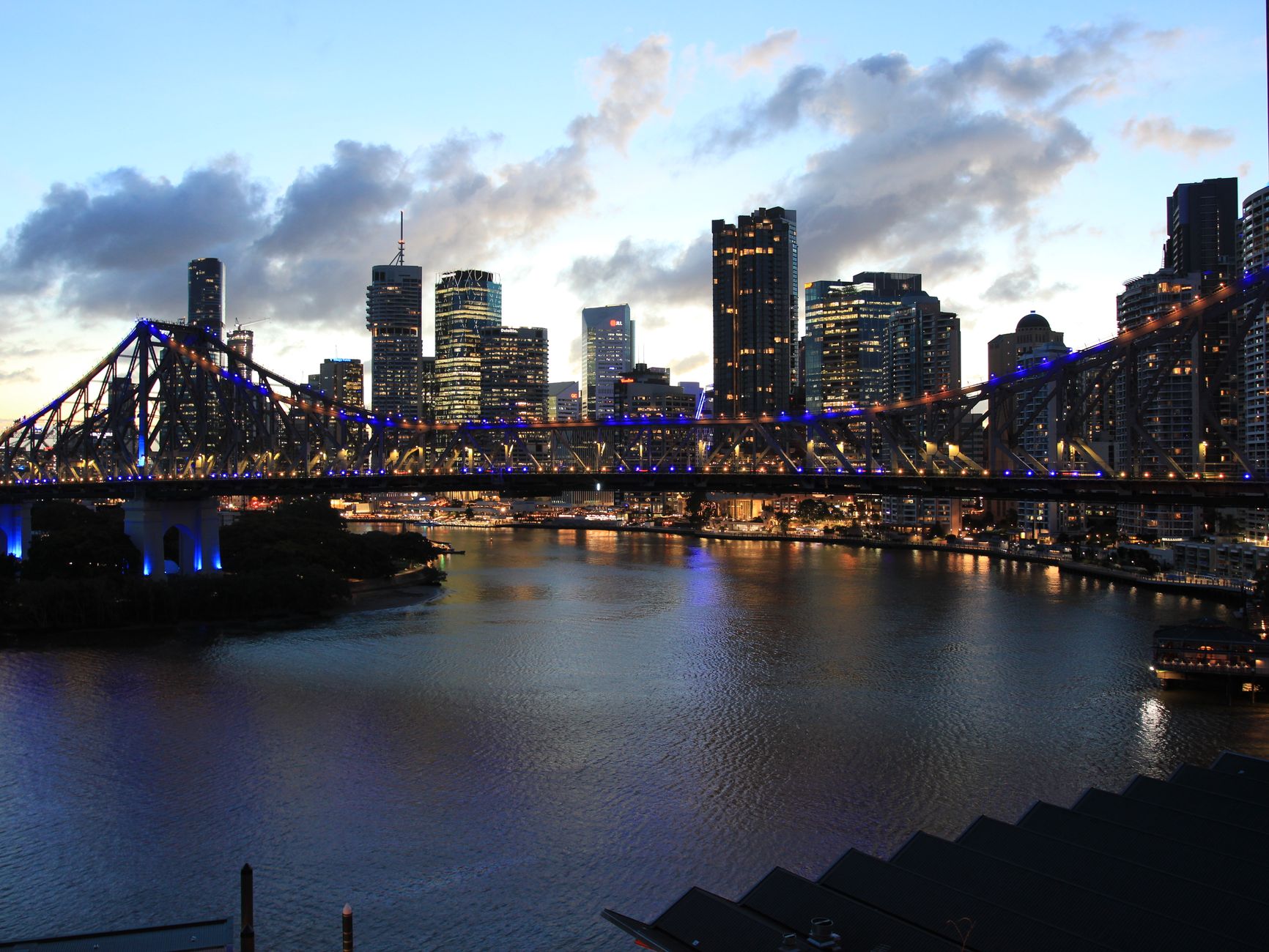
Brisbane is Queensland's sunny, laid-back capital. For years it lived in the shadow of Sydney and Melbourne, but today it has earned its place as one of the most enjoyable cities in Australia. Set along a wide, winding river and blessed with a subtropical climate almost all year round, it combines an enviable outdoor lifestyle (pools, parks, waterside terraces) with a cultural, food and neighbourhood scene that keeps on growing. It's also the host of the 2032 Olympic Games, which has firmly put it on the world map.
The heart of the city is South Bank, on the southern side of the river: a cultural parkland with free museums (the Queensland Art Gallery and the bold GOMA), Streets Beach, an artificial beach right in the centre, the Wheel of Brisbane and kilometres of walkways and gardens. Across the water lie the historic and business centre; up and down the river are neighbourhoods with real character, such as Fortitude Valley (nightlife and music), West End (bohemian and multicultural) and New Farm. They're all linked by the city's best transport: the CityCat ferries, which glide along the river and are a trip in themselves.
This guide explores Brisbane with a practical and curious eye: how to make the most of South Bank and its free museums, cruise the river on a CityCat, cuddle a koala at the historic Lone Pine sanctuary, head up to the Mt Coot-tha lookout, cross (or climb) the Story Bridge and use the city as a base for the Moreton Bay islands and the beaches of the south-east. It's a capital best enjoyed without rushing, at the easy pace of the river and the Queensland sun.
Brisbane is the traditional Country of the Turrbal and Jagera/Yuggera peoples, who lived in the region for more than 20,000 years and called the peninsula where the city centre now stands Meanjin. The European city began as a penal colony: in 1824 a convict settlement was set up at Redcliffe, on Moreton Bay, and in 1825 it moved upriver to its current site as a secondary punishment prison for the most difficult convicts from New South Wales. The penal settlement closed in 1842 and the area was opened to free settlers; in 1859 Queensland separated from NSW and Brisbane became its capital. Colonisation tragically displaced and decimated the First Nations peoples. Over the 20th and 21st centuries, after Expo 88 and on the road to the 2032 Games, Brisbane grew from a big country town into a modern capital. The full story is on our history page.
Read the full history ↓The state of sunshine and the tropics: land of dozens of Aboriginal nations, born as the Moreton Bay penal settlement in 1824, separated from New South Wales in 1859 and shaped by sugar cane, wool and mining. It is home to the Great Barrier Reef and the Daintree Rainforest, two World Heritage Sites.
Read the history of Queensland →If you book from here we earn a commission and you pay no more. Prices and availability come from Civitatis.
No exact prices: a scale from $ (budget) to $$$$$ (luxury), with 2-3 options per category.
Origins, formation and what the sources say.
Long before there was a single street or building, the curved peninsula where Brisbane's central business district now stands had a name of its own: Meanjin (sometimes written Mian-jin or Miguntyun). In the Turrbal language it is thought to mean something like 'spike-shaped place' or 'pointed place', after the way the land juts into the bend of the river. That land, and the whole Brisbane River valley, is the traditional Country of the Turrbal and Jagera peoples (also written Yuggera or Yagara), who lived here for more than 20,000 years.
The river, which the Turrbal called Maiwar, was the centre of life. It provided fish, shellfish and water, and it was a route between clans. Moreton Bay, which the Quandamooka people know as their sea, and its sand islands completed a territory rich in resources. The peoples of the region lived by fishing, hunting and gathering, with a deep knowledge of the seasons: when each plant flowered, when the fish ran, when it was time to gather together. Large ceremonial and trading gatherings (bora) brought different groups together, and places such as today's Mount Coot-tha (from 'ku-ta', the honey of native bees) were part of a landscape full of meaning.
The colonisers justified themselves with the myth of an 'empty land', but south-east Queensland was a cultural landscape known in every detail. It had names, Dreaming stories (the Law and creation) and customs handed down through countless generations. To understand Brisbane's history without erasing the people who were here first, and who are still here, you have to start by recognising that Brisbane is Meanjin, Turrbal and Jagera land.
European Brisbane began as a prison. In the early 1820s, the colony of New South Wales, based in Sydney, needed a place of 'secondary punishment' for repeat offenders and its most troublesome convicts: somewhere remote and harsh that would be almost impossible to escape from. In 1823, Governor Thomas Brisbane, who would give his name to the river and to the future city, sent the surveyor John Oxley to explore Moreton Bay and look for a site.
In September 1824, the ship Amity landed about 54 people at Redcliffe, on the bay. Among them were Lieutenant Henry Miller, the first commandant, a group of guards and around thirty convicts. But Redcliffe proved inhospitable, with little good water, plenty of mosquitoes and tension with the Aboriginal people. In 1825 the settlement moved upriver to a bend in the Brisbane River, in the area the Turrbal called Meanjin, where the city centre stands today. This was the start of the Moreton Bay Penal Settlement.
It was a feared place. Under Commandant Patrick Logan (1826-1830), the colony became a byword for brutality, with forced labour, floggings and ferocious discipline. Logan died violently in 1830 while on an expedition. The convicts all but celebrated his death and wrote ballads about him. Meanwhile, the European occupation brought disease, violence and dispossession to the Turrbal and Jagera, whose world was beginning to fall apart. The penal colony operated until 1839-1842. By then convict transportation was in decline, and the area was getting ready to open up to free settlers.
In 1842, the Moreton Bay district was officially opened to free settlement, and the old penal settlement began turning into a town. It was named Brisbane, after the river, and grew slowly as a river port and the hub of a region of graziers, farmers and traders. Settlers arrived from the British Isles, and over the years waves of German, Chinese and other immigrants gave the town its first diverse character.
The big leap came in 1859, when Queensland separated from New South Wales and became a colony in its own right, with Brisbane as its capital. Driven by wool and farming, and by gold and sugar further north, the young city acquired institutions, government buildings, churches and a busy port. That growth, however, was built on the continuing dispossession of the First Peoples. They were pushed off their lands, confined to missions and reserves, and devastated by disease and frontier violence.
Throughout the 19th century and into the early 20th, Brisbane settled into life as a provincial capital of timber houses on stilts, the typical 'Queenslanders' designed for the subtropical climate. Every so often it was hit by major river floods, a constant in its history, with notable ones in 1893, 1974 and 2011. During the Second World War the city played a key role. It was the headquarters of the American general Douglas MacArthur in the South West Pacific, and it filled up with Allied troops, which sped up its modernisation and its links with the rest of the world.
For much of the 20th century, Brisbane was known as a 'big country town': quiet, conservative and overshadowed by Sydney and Melbourne. The 1970s and 1980s, under the long state government of Joh Bjelke-Petersen, were politically turbulent, marked by corruption and by the demolition of much of the city's historic heritage. But those years also laid the ground for change.
The turning point was the 1988 World Expo (World Expo 88), held right on the south bank of the river. Millions of visitors discovered a more cosmopolitan Brisbane. Afterwards, the Expo site became South Bank Parklands, the cultural park with an artificial beach that is now the heart of the city. From there Brisbane reinvented itself. It reclaimed the river as public space, launched the CityCat ferries and revived neighbourhoods such as Fortitude Valley (declared a live music precinct) and West End. It also built a strong food, arts and coffee scene.
Today Brisbane is a modern capital with more than 2.5 million people in its metropolitan area, the third largest in Australia, and proud of its climate, its river and its outdoor lifestyle. The big goal on the horizon is 2032, when it will host the Olympic and Paralympic Games. The Games are already transforming its infrastructure and its international profile.
At the same time, the city is rethinking its relationship with the past. Several things are part of a more honest look at how this capital was born: recognising that Brisbane is Meanjin, Turrbal and Jagera land; bringing back names and languages; giving First Peoples' culture a place in museums, festivals and Welcome to Country ceremonies; and working towards historical truth. For travellers, knowing that beneath the skyscrapers and the South Bank beach lies a history of more than 20,000 years, plus a penal colony few people talk about, makes a visit to Queensland's sunny capital far richer.