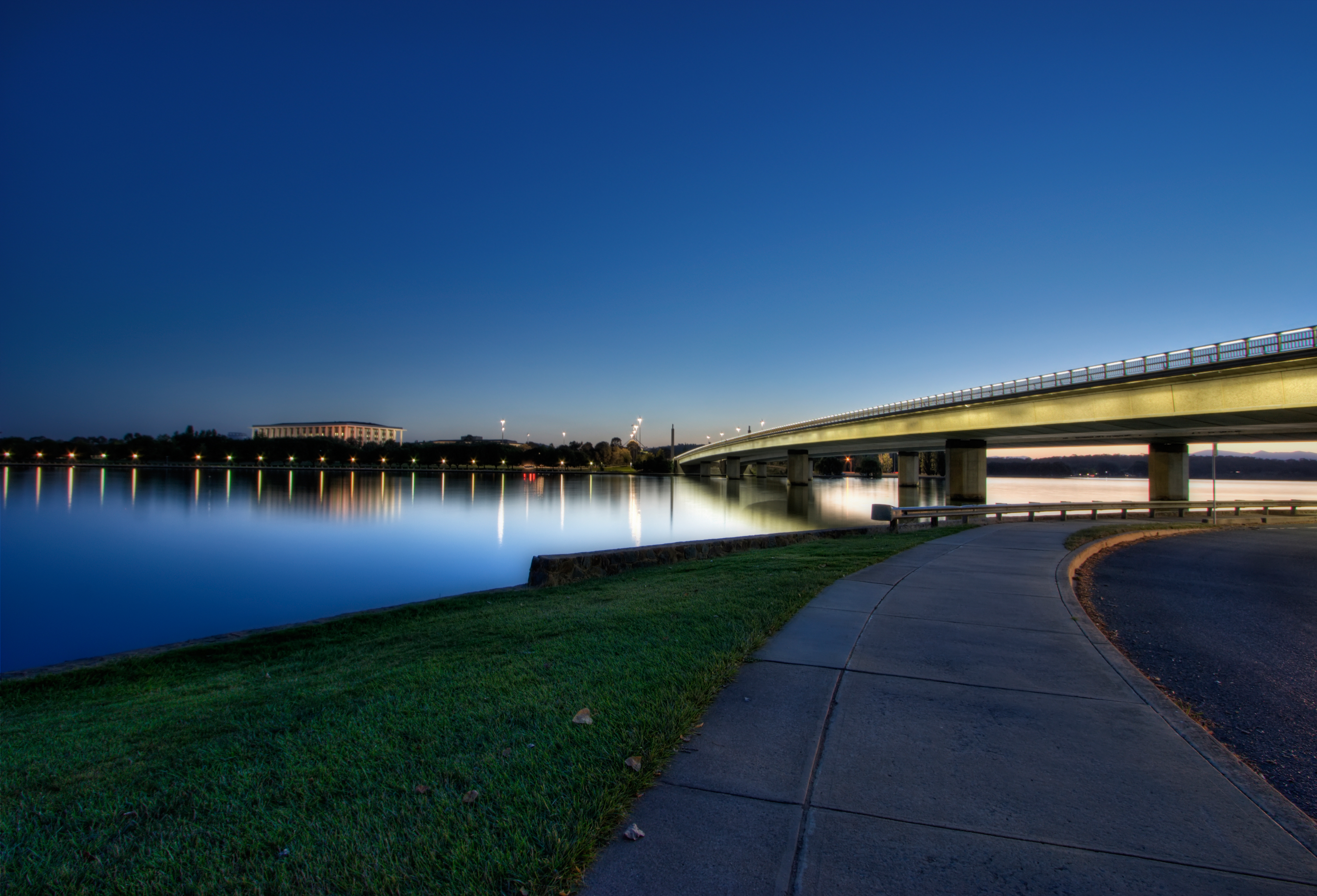
Canberra is Australia's capital, and also the most misunderstood city in the country. Australians themselves tend to see it as a place for bureaucrats and politicians, but visitors find a green, relaxed capital that is surprisingly rich in culture. It's a one-of-a-kind city, fully planned in the early 20th century by the American architects Walter Burley Griffin and Marion Mahony Griffin. Its layout of circles, axes and radial avenues is arranged around a large artificial lake, Lake Burley Griffin, and surrounded by hills and nature reserves.
Its main draw is the national institutions, almost all free and world-class: the moving Australian War Memorial (one of the most important war museums in the world), Parliament with its lawn you can walk on, the National Gallery, the National Museum of Australia, the National Portrait Gallery, the National Library and the hands-on Questacon for kids. On top of that there are gardens, lookouts over the city, a growing food and cool-climate wine scene, and the Floriade tulip festival, which turns the capital into a sea of flowers in spring.
This guide explores Canberra with a practical, curious eye: how to make the most of the free national museums, visit Parliament and the War Memorial, cycle or take a boat around Lake Burley Griffin, head up to the Mount Ainslie and Black Mountain lookouts, and enjoy Floriade and the nearby wineries. It's a capital planned down to the last detail, ideal for two or three days of culture, history and nature, and far more fun than its 'government town' reputation suggests.
Canberra is the traditional Country of the Ngunnawal and Ngambri peoples, who lived on the 'Limestone Plains' for more than 20,000 years and gathered in the region for large ceremonial meetings, including the bogong moth season. The name is believed to come from 'Kamberra/Nganbra', linked to the idea of a 'meeting place'. European settlers arrived in the 1820s and the area became grazing land. When the Australian colonies federated in 1901, Sydney and Melbourne both wanted to be the capital, and the solution was to create a new, neutral capital in its own territory. The site was chosen in 1908, the international design competition won by the Griffins was launched in 1911-1912, and Canberra was officially founded and named in 1913. The full story is on our history page.
Read the full history ↓The small territory created from scratch to house the national capital: ancestral land of the Ngunnawal people, chosen in 1908 as a compromise in the rivalry between Sydney and Melbourne, and planned by the architect Walter Burley Griffin. Its city, Canberra, is the seat of federal power.
Read the history of Australian Capital Territory →If you book from here we earn a commission and you pay no more. Prices and availability come from Civitatis.
No exact prices: a scale from $ (budget) to $$$$$ (luxury), with 2-3 options per category.
Origins, formation and what the sources say.
Before there was a capital, before the very idea of Australia as a nation even existed, the gently rolling plains where Canberra stands today were the Country of the Ngunnawal and Ngambri peoples, alongside neighbouring groups such as the Ngarigo and Walgalu. They lived here for more than 20,000 years, in a region the settlers would later call the 'Limestone Plains', after the limestone outcrops of the Molonglo River valley.
The city's very name keeps that memory alive: 'Canberra' comes from a local word, recorded as 'Kamberra', 'Nganbra' or 'Canberry', usually translated as 'meeting place' or 'gathering place'. And that's exactly what it was. Every summer, when bogong moths migrated in swarms and sheltered by the millions in the crevices of the nearby mountains (the Brindabellas and the Alps), Aboriginal groups from across a vast region gathered in the high country to celebrate and feast on these fat-rich moths, at large ceremonial gatherings where people traded and arranged marriages. The area was a seasonal meeting point of enormous cultural importance.
Life followed a calendar finely tuned to the land: hunting, fishing in the rivers, gathering food and holding ceremonies marked the year. The landscape was not an empty space waiting to be 'settled', but a territory full of names, Dreaming stories and responsibilities of care handed down over countless generations. Recognising that Canberra is, first and foremost, a Ngunnawal and Ngambri 'meeting place' is the starting point for understanding why, thousands of years later, this was the very spot chosen as the heart of the nation.
Europeans arrived in the valley relatively late, and at first they came to graze livestock. The explorer Charles Throsby travelled through around 1820-1821 and named the area the Limestone Plains. A few years later the settlers began to arrive: in 1823-1824, Joshua John Moore was granted land on the banks of the Molonglo and called his station 'Canberry', taking the local Aboriginal name for the place. Other grazing families, such as the Campbells at Duntroon and the Murrays at Yarralumla, gradually took over the valley with large sheep properties.
For most of the 19th century, the area was a quiet rural district of the colony of New South Wales: stations, stone churches (like the historic St John's, from 1845, still standing in Reid) and small settlements. For the Ngunnawal, by contrast, it was devastating. The occupation of their land and waters, diseases brought by Europeans and frontier violence drastically reduced the original population and pushed them off their Country. Yet they never disappeared: Ngunnawal and Ngambri descendants are still here today and assert their unbroken connection to the land.
Nothing about this peaceful valley of sheep stations suggested it would one day become a nation's capital. But in the early 20th century, national politics had other plans.
On 1 January 1901, Australia's six British colonies joined together in a federation and the Commonwealth of Australia was born. But a fight broke out straight away: which city would be the new country's capital? The two big rivals, Sydney and Melbourne, fought fiercely for the honour, and neither would accept the other. The solution, written into the Constitution itself, was a Solomonic one: a brand-new capital would be built on its own federal territory, located in New South Wales but no less than 100 miles (about 160 km) from Sydney. While it was being built, Melbourne would serve as the temporary capital.
After years of searching and arguing over the location, the Limestone Plains site in the Molonglo valley was chosen in 1908. In 1911 the Federal Capital Territory (today's ACT) was created and an international competition was launched to design the city from scratch. The winner, in 1912, was the entry by Chicago landscape architect Walter Burley Griffin, prepared with his wife and partner, the architect Marion Mahony Griffin, whose exquisite drawings were key to winning over the jury. The Griffins, who had trained in the circle of Frank Lloyd Wright and the 'garden city' movement, imagined a capital of geometric axes, concentric circles and radiating avenues, blending into the landscape of hills and arranged around a large artificial lake.
On 12 March 1913 the foundation ceremony was held and the city was given its official name: Canberra, reviving the old Aboriginal word for 'meeting place'. And so, on sheep-grazing plains, one of the few capitals in the world planned entirely before it existed came into being.
Building Canberra was a slow job, full of setbacks. The Griffins clashed with the bureaucracy and ran into administrative conflicts, and Walter resigned as head of the project in 1920, with much of his vision still unrealised. The First World War and the Great Depression held up construction. In 1927 the Provisional Parliament House (today's Old Parliament House) opened: a white building meant as a temporary solution that ended up housing Parliament for more than sixty years. The federal government began moving from Melbourne to the new capital.
For decades, Canberra was a small, sprawling, half-finished city, the butt of jokes for its artificial feel and lack of life. The big push came in the 1950s and 1960s, when the National Capital Development Commission sped up its development. The symbolic milestone was the creation of Lake Burley Griffin in 1963-1964, by damming the Molonglo River: at last, the centrepiece of the Griffins' plan became reality. Year after year, the great national institutions were laid out around the water: the National Library, the National Gallery, the High Court, the National Museum. And there was the moving Australian War Memorial, opened in 1941 at the foot of Mount Ainslie.
In 1988, for Australia's bicentenary, the new Parliament House opened on Capital Hill, with its revolutionary design of a building 'inside the hill', topped with grass you can walk on. With it, Canberra finally completed its grand ceremonial axis: the War Memorial, Anzac Parade, the lake and Parliament lined up in a single straight line, just as the Griffins had dreamed.
Today Canberra is a city of around 460,000 people, the largest inland city in Australia, and a mature capital that has left much of its boring reputation behind. Home to the federal government, ministries, embassies from all over the world, the Australian National University (ANU) and the major cultural institutions, it combines very high standards of education and quality of life with an exceptionally green setting. It's known as 'the bush capital' for the many nature reserves, parks and trees that surround it and weave through it, where it's common to come across kangaroos at dusk.
The city has come into its own in recent decades: food precincts like Braddon, the Kingston Foreshore waterfront, a café and bar scene, the cool-climate Canberra District wine region and big festivals like Floriade, the largest flower festival in the Southern Hemisphere, which fills the lakeshore with tulips every spring. That said, it's still a calm, human-scale capital, very different from the bustle of Sydney or Melbourne.
At the same time, Canberra has been coming to terms with the more uncomfortable side of its history. Opposite Old Parliament House, the Aboriginal Tent Embassy, a protest camp set up by Aboriginal activists in 1972, still stands as a permanent symbol of First Peoples' struggle for their rights and their land, and it is one of the most significant political sites in the country. Acknowledging Ngunnawal and Ngambri Country, the presence of Aboriginal culture in museums and ceremonies, and reflecting on the colonial past are all part of life in the capital today.
For travellers, understanding that Canberra was a 'meeting place' for the First Peoples thousands of years before it became a planned capital, and that this same idea of gathering ended up defining the city designed to unite a nation, makes a visit to this green, young and one-of-a-kind capital far richer.