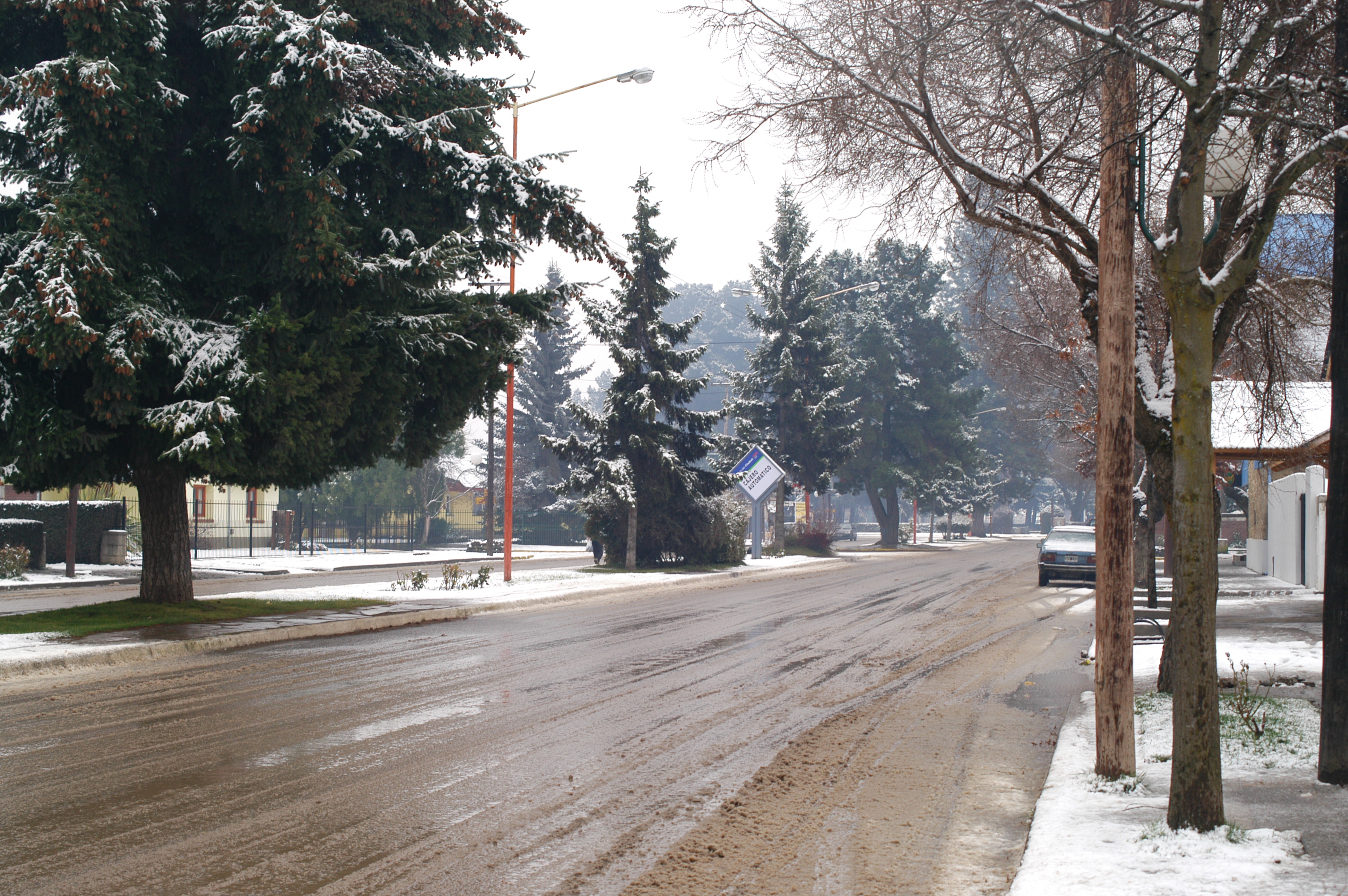
Trevelin is the Welsh village of the Chubut mountains, a corner where the epic of the settlers from Wales is still alive in the surnames, the tea houses, the flour mills and even in the name of the place: Trevelin means 'mill town' in Welsh (from tref, town, and melin, mill). Set in the green valley of the Percy river (also called 16 de Octubre), about 25 km south of Esquel, it is one of the most charming villages in Andean Patagonia.
Its story goes back to 1885, when the Welsh who had settled in the lower Chubut river valley, on the Atlantic, explored towards the mountains looking for new fertile land and founded this colony at the foot of the Andes. The historic Molino Andes (Museo Regional Molino Viejo) is a museum today and the symbol of the village, and the Welsh tea houses, with their black cake (teisen ddu) and homemade treats, keep a century-old tradition going.
Beyond its Welsh stamp, Trevelin is an ideal base for nature: nearby Los Alerces National Park, the tulip fields that bloom in spring, the Nant y Fall waterfall, the Futaleufú river and the Chilean border, and the landscapes of the Valle 16 de Octubre. Quiet, orderly and with a character of its own, it offers a different experience from nearby Esquel, more focused on culture, food and the rural mountain landscape.
Trevelin was born in 1885 as the Welsh colony of Chubut pushed towards the mountains, when settlers from the Chubut river valley explored and populated the fertile Valle 16 de Octubre. Its name, 'mill town' in Welsh, recalls the flour mills that brought the place to life. In 1902 its inhabitants voted to belong to Argentina in a famous plebiscite. The full version is on the history page.
Read the full history ↓The heart of Atlantic and Andean Patagonia: Tehuelche and Mapuche land, setting of the only large Welsh colony in the Americas, cradle of Argentine oil at Comodoro Rivadavia, home to the whales of Península Valdés and to the thousand-year-old forest of Los Alerces.
Read the history of Chubut →They depart from Esquel, 23 km away. If you book from this link we earn a commission and you pay no more.
No exact prices: a scale from $ (budget) to $$$$$ (luxury), with 2-3 options per category.
Origins, formation and what the sources say.
There is a village at the foot of the Patagonian Andes whose name means, literally, 'mill town' in a Celtic language spoken fifteen thousand kilometers away, in a small country west of England. That village is Trevelin, and it is living proof that the Welsh epic in Patagonia did not stop at the coast: twenty years after landing, its protagonists kept walking until they planted their mills on the very slopes of the mountain range.
Trevelin's story is inseparable from the great epic of Welsh settlement in Patagonia. In 1865 a contingent of immigrants from Wales arrived at Golfo Nuevo, on the Atlantic coast of Chubut, looking for a place to preserve their language, their religion and their culture away from English pressure. They settled in the arid lower valley of the Chubut river and, with enormous effort and irrigation systems, managed to make farming prosper.
Over the years, the search for new fertile land pushed the settlers to explore westwards, towards the Andes. In 1885 an expedition led by Welsh colonists reached a green, fertile valley at the foot of the range, which they named Valle 16 de Octubre. There, that same year, the first families began to settle, giving rise to Trevelin.
The village's name, Trevelin, comes from the Welsh tref (town) and melin (mill): 'mill town'. It recalls the flour mills the settlers built to process the valley's wheat, an activity that shaped the economic life of the young community and remains the historic symbol of the place.
One of the most famous episodes in Trevelin's history is the plebiscite of 1902. In those years the border between Argentina and Chile in the mountain zone was in dispute, and the question was submitted to international arbitration under the British Crown. To help settle the line, the inhabitants of the Valle 16 de Octubre were asked which country they preferred.
On 30 April 1902 the Welsh settlers and the valley's other inhabitants took part in a vote in which they overwhelmingly expressed their wish to belong to Argentina, despite their British origin. The gesture was taken into account in the arbitration award and helped keep the region on the Argentine side. The community remembers the episode with pride and it forms part of the village's founding story.
John Daniel Evans, one of the pioneers and the builder of the mill, embodies the spirit of those settlers. His horse Malacara, which saved his life during a clash, even has a grave that became a historic site. Welsh memory lives on in the tea houses, the surnames, the chapel and the museums that keep the story of the settlement.
More than a century after its founding, Trevelin keeps its Welsh identity alive in a singular way. Although the Welsh language faded over the generations, the community preserves cultural traditions such as the eisteddfod (a festival of music, poetry and choral singing), the tea houses with their black cake and baking, and an architecture and set of place names that recall the pioneers' origin.
Evans's old flour mill, today the Museo Regional Molino Viejo, and Molino Nant Fach, a working replica built by a descendant of the settlers, are the main witnesses of that past. The village is organized around an octagonal square, Plaza Coronel Fontana, from which the streets radiate outwards, a distinctive layout.
Through the 20th century Trevelin diversified its economy towards livestock, farming, tulip growing and, increasingly, tourism, resting on its Welsh heritage and its privileged position near Los Alerces National Park, the Futaleufú river and the Chilean border. Today it combines the legacy of its founders with its role as gateway to an exceptional stretch of nature in the Chubut mountains.
The activity that shaped life in the young Trevelin was milling wheat. The Valle 16 de Octubre, with its fertile soils and mountain rainfall, proved ideal for growing cereals, and the Welsh settlers reproduced here the flour mills they knew from home. The most famous was the Andes mill, built by John Daniel Evans in the early 20th century, which supplied flour to much of the region and gave the village its name.
The Andes mill ran until the 1950s, when changes in production and transport made the business unviable. In 1971 Welsh pioneers and local residents created the Regional History Museum, which years later moved into the old mill building, turning it into the Museo Regional Molino Viejo. Decades on, Mervyn Evans, a descendant of the settlers, built Molino Nant Fach, a working replica that still produces flour and recreates the Trevelin of the pioneers.
Through the 20th century the local economy diversified: cereal farming and livestock were joined by fruit growing, tulip production and, especially from the end of the century, tourism. Today wheat and mills are above all memory and heritage, but they remain the identity symbol that explains the name and the spirit of the village.
Before founding mills, John Daniel Evans had dodged death by a single leap on horseback. On 3 or 4 March 1884, returning from an exploration towards the mountains, Evans was ambushed by a group of Indigenous fighters at a spot known ever since as the 'Valle de los Mártires', where several of his fellow explorers died. Pursued and with no way out in sight, he spurred his dapple-grey horse, Malacara, and launched it over a ravine some four meters deep that opened up suddenly in the ground. The animal jumped and survived; his pursuers, facing the same drop, chose not to copy the maneuver. That leap saved Evans's life and sealed Malacara's legend as one of the best-remembered animals in Patagonian history.
A year and a half later, in October 1885, Evans rode Malacara again on a very different venture: the expedition known as 'Los Rifleros', which accompanied Luis Jorge Fontana, governor of what was then the National Territory of Chubut, on his exploration towards the Andes. The group, made up of Welsh settlers armed with rifles (hence the name), crossed much of present-day Chubut until reaching, in November of that year, the fertile valley at the foot of the range where Colonia 16 de Octubre — today's Trevelin — would be founded shortly afterwards. The valley's name does not refer to the expedition's arrival but to the date of Law 1532 on National Territories (16 October 1884), the act that created the Territory of Chubut, of which Fontana was the first governor.
Malacara lived many more years after his heroic leap and the Rifleros crossing, dying in 1909 at the age of 31 — an exceptional lifespan for a horse. His remains still rest in a small grave a few blocks from Trevelin's octagonal square, now one of the most endearing and most visited historic sites in the village: a small family museum that remembers, with almost filial affection, the animal that gave the Welsh village of the mountains a second chance to exist.