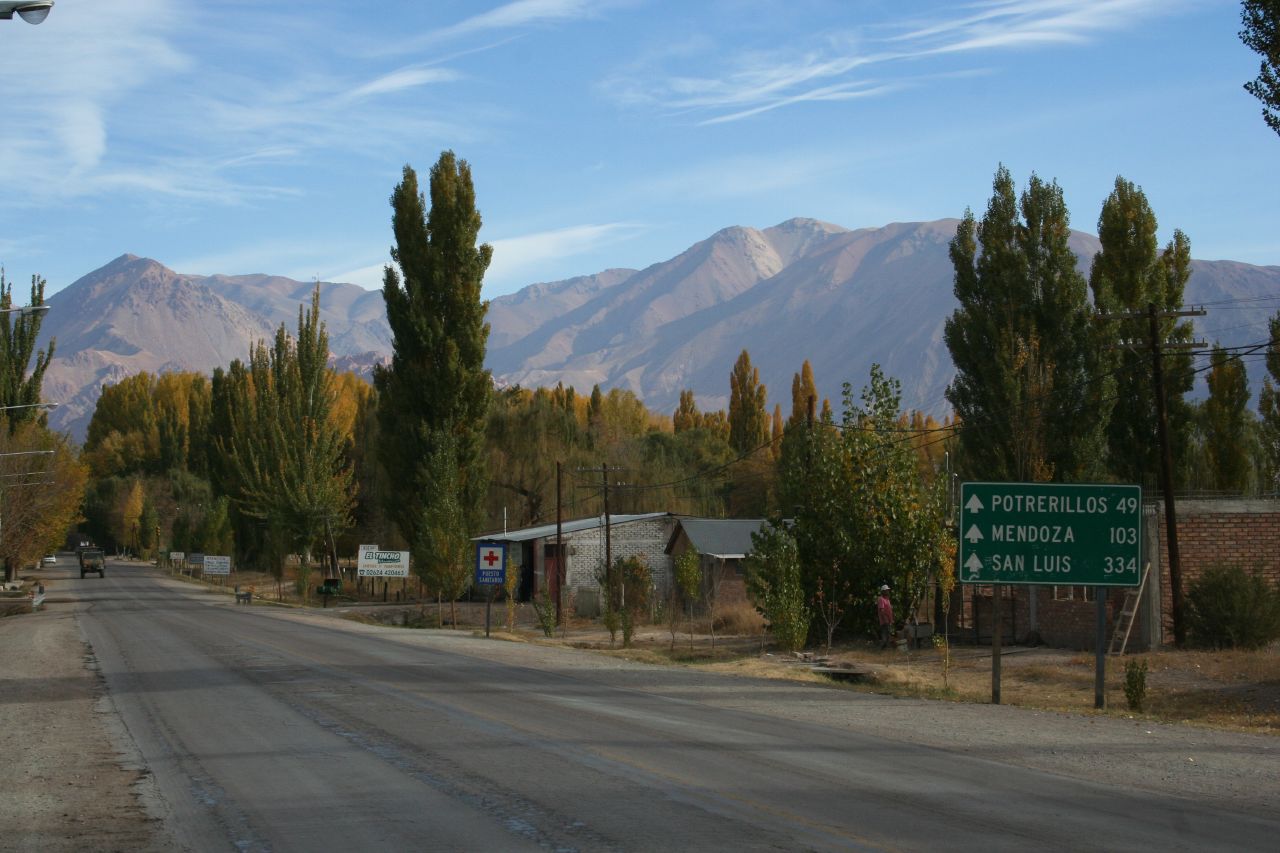
Uspallata is a mountain village in western Mendoza, about 100 km from the provincial capital via RN 7, and the classic base for exploring the high mountains: the roads to Aconcagua Park, Puente del Inca and the Cristo Redentor international pass into Chile all start here. Its valley, ringed by colored hills at almost 2,000 meters, is one of the most photogenic landscapes on the whole Andean corridor.
The valley holds unusual layers of history: thousand-year-old petroglyphs on Cerro Tunduqueral, a forest of petrified araucarias 230 million years old that Charles Darwin described in 1835, the colonial Bóvedas where metals were smelted, and the abandoned tracks of the Trans-Andean Railway. And one fact that surprises everyone: 'Seven Years in Tibet' (1997), with Brad Pitt, was filmed here, because the landscape is almost identical to the Himalaya.
In this guide you will find what to see in Uspallata, how much admission to Aconcagua Park and the historic sites costs, how to get there from Mendoza by bus or car, where to sleep and eat on any budget, and how many days are worth spending to make the most of the valley and the high-mountain road.
Uspallata was the southern frontier of the Inca empire — the petroglyphs of Cerro Tunduqueral and the tambos of the Qhapaq Ñan bear witness to that — the route of one column of the Army of the Andes in 1817 and a colonial mining outpost, as the Bóvedas recall. In 1891 the Trans-Andean Railway arrived, and in 1996 Hollywood did: 'Seven Years in Tibet' with Brad Pitt was shot here.
Read the full history ↓The land of sun and good wine: a Huarpe oasis at the foot of Aconcagua, cradle of San Martín's Army of the Andes, rebuilt after the 1861 earthquake and turned into the world capital of Malbec and the high mountains.
Read the history of Mendoza →A local guide tells you in half an hour what no sign at the site will ever explain. We look ours up on Civitatis: guided in Spanish and booked online with no fuss. They have 17 activities in Mendoza Capital. And there are free tours here: you book without paying and tip the guide whatever you think at the end, so trying one costs you nothing. Three are below so you get the idea: tap any of them and they all open.
They depart from Mendoza Capital, 59 km away. If you book from this link we earn a commission and you pay no more.
No exact prices: a scale from $ (budget) to $$$$$ (luxury), with 2-3 options per category.
Origins, formation and what the sources say.
In September 1996 a private plane landed in Mendoza with the most famous man in Hollywood on board. Brad Pitt was coming to spend four months in a mountain village of 3,000 people that most Argentines could barely place on a map: Uspallata. Director Jean-Jacques Annaud had traveled half the world looking for somewhere that could stand in for Tibet to film 'Seven Years in Tibet' — China had barred him over the political content of the film — and he found it in this Mendoza valley at 1,900 meters, whose arid hills and violently blue skies are almost indistinguishable from the Himalaya. The production brought in 413 foreign crew, 58 Tibetan monks and as many as 12 yaks; it built a replica of Lhasa in the middle of the valley and left some 20 million dollars in the region. Several scenes were shot at the foot of Cerro Tunduqueral, a sacred Indigenous site with thousand-year-old petroglyphs.
The anecdote looks like a whim of globalisation, but it is really the last scene of a script that has been repeating for centuries: Uspallata was always a place of passage between worlds. Through this valley ran the roads of the Inca empire, the mule trains loaded with colonial silver, San Martín's liberating army, the first train to link the Atlantic with the Pacific and, finally, the Hollywood cameras. Few villages this small pack so much history per square meter.
The deep history of the valley begins long before any empire: about 230 million years ago, when Uspallata was a forest of giant araucarias. That forest was buried under volcanic ash and turned to stone. In March 1835 a young English naturalist crossing the Andes on muleback came across dozens of fossil trunks standing upright on the hillside and was fascinated: it was Charles Darwin, mid-voyage on the Beagle, and the find now known as the Darwin Forest — some fifty petrified araucarias still preserved — served him as evidence that the mountain range had risen from the sea floor.
The first human inhabitants of the valley arrived thousands of years ago. The Indigenous peoples of the region — hunters, gatherers and later farmers linked to the Agrelo culture and to the Huarpe — left their most striking testimony on Cerro Tunduqueral: petroglyphs around a thousand years old with human figures, animals and masks carved into the rock, at a site archaeology reads as ceremonial.
By the 15th century the Inca empire had pushed its southern frontier to these latitudes and made Uspallata a hub of its road network, the Qhapaq Ñan. Inca tambos survive in the valley — stone way stations such as Ranchillos and Tambillos — that formed part of the road towards the mountain passes, part of the system UNESCO declared a World Heritage Site in 2014. The name 'Uspallata' itself has Indigenous roots, and the famous Puente del Inca, the natural thermal-water formation over the Las Cuevas river, recalls that presence in its name: tradition says the Incas used it as a crossing and already knew of its healing waters.
With the Spanish conquest, the valley added to its role as a corridor an activity that would mark its landscape: mining. In the Paramillos de Uspallata, some 2,800 meters up in the foothills, seams of silver, lead and zinc were worked from the 17th century onwards, among the oldest mines in what is now Argentina. The Jesuits worked those mines until their expulsion in 1767, and the ore came down to the valley to be smelted.
The most visible witness of that period is the Bóvedas de Uspallata: distinctive adobe structures crowned with conical domes, associated with the old metal-smelting ovens. Their outline, unique in Argentine colonial architecture, became the emblem of the village. Tradition also links them to the struggle for independence: the story goes that in the days of the Army of the Andes they supported the casting of ordnance directed by Friar Luis Beltrán, the brilliant craftsman behind San Martín's artillery. Restored and turned into a site museum, they are now an essential stop for understanding the valley's productive past.
Mining never entirely disappeared from Uspallata's horizon: even in the 21st century the possible extraction of copper in the area sparks heated debate between economic development and the protection of water and landscape, a sign that the valley's relationship with its metals is still alive.
In January 1817 the Uspallata valley lived through the most momentous days in its history. General José de San Martín was launching the crossing of the Andes, one of the greatest logistical feats in military history: some 5,000 men, thousands of mules and horses crossing the range by six simultaneous routes to liberate Chile. While the bulk of the army marched via the Los Patos pass to the north, the column of Colonel Juan Gregorio de Las Heras — around 800 men — took the Uspallata road, the most direct one, with a precious load: the army's artillery, the cannon cast by Friar Luis Beltrán that could not go by the steeper routes.
The advance was not quiet. In late January 1817, royalist parties coming down from Chile clashed with the patriot vanguard in the combats of Picheuta and Potrerillos, right in the Uspallata corridor: they were among the first shots fired in the whole liberation campaign. Las Heras prevailed, secured the pass and on 8 February joined the rest of the army on the far side of the range. Four days later, victory at Chacabuco opened the gates of Santiago.
The landscape those soldiers saw is practically the same one travelers see today on RN 7: the same ochre hills, the same wind, the same immensity. That is why the region forms part of the Ruta Sanmartiniana circuits, and sites such as the Picheuta guard post — where a historic stone bridge survives — keep the memory of the campaign alive.
The second revolution to cross Uspallata came on rails. In 1887, driven by the Chilean brothers Juan and Mateo Clark, construction of the Trans-Andean Railway began from Mendoza, a pharaonic project to link Buenos Aires with Valparaíso — the Atlantic with the Pacific — crossing the Andes at almost 3,200 meters. On 22 February 1891 the first stretch, from Mendoza to Uspallata, opened, and the village became a key station on the route. After two decades of titanic works, rack sections to climb the gradients and an international tunnel bored beneath the summit, the full line was inaugurated on 5 April 1910, right in the middle of the centenary celebrations of Argentina and Chile.
For decades the Trasandino was one of the great railway adventures in the world: passengers, freight and mail crossed the range in a day, with stops at Uspallata, Polvaredas, Punta de Vacas and Puente del Inca, where an elegant thermal hotel — built in the early 20th century and destroyed by an avalanche in 1965 — received the elite of both countries. But avalanches, costs and competition from lorries wore the service down: passenger trains stopped running in 1979, and on 3 July 1984 an avalanche destroyed part of the track on the Chilean side. It was never repaired.
Today the stone stations and rusting rails you see beside RN 7 are one of the valley's melancholy postcards, and every so often the dream revives of a bi-oceanic corridor linking the two oceans through Uspallata again.
Today's Uspallata lives off its position, as it always has. RN 7, one of the busiest international corridors in South America, made it the last service town before the high mountains: lorries bound for Chile fill up here, the Mendoza–Santiago buses stop here and climbers dreaming of Aconcagua, the roof of the Americas at 6,961 meters, stock up here; its provincial park lies 80 km to the west. Tourism turned the village into an excursion base: trekking, horse riding, rafting on the Mendoza river, 4x4 crossings and the classic high-mountain circuit threading together Puente del Inca, the Horcones lagoon and the Cristo Redentor.
The filming of 'Seven Years in Tibet' left a lasting mark on local identity: guides still point out the film's locations and the village proudly plays up its likeness to the Himalaya. Other productions have gone on using these landscapes, cementing Uspallata as a natural film location.
For the traveler, the valley offers something increasingly rare: layers of genuine history — petroglyphs, Inca tambos, colonial vaults, independence battlefields, ghost railway stations and Hollywood sets — within a few kilometers, wrapped in one of the most imposing mountain landscapes in Argentina. Uspallata is no longer just a place you pass through: it is a destination where the mountains tell their own life story.