Viajá con Gus
HomeArgentinaValle Fértil (San Agustín)
Valle Fértil (San Agustín)
🇦🇷 Argentina · Cuyo

Valle Fértil (San Agustín)

Jump to what you need
📌Province/State
San Juan (Valle Fértil department; main town San Agustín del Valle Fértil)
📌Best time to go
Autumn, winter and spring; summer is very hot (start early for Ischigualasto)
📌Suggested days
1 to 2 days (a base for Ischigualasto and, if you have time, Talampaya)
📌Currency
Argentine peso (ARS). Bring cash; the park and local shops do not always have a card terminal
📌Language
Spanish
📌Getting there
From the city of San Juan, about 250 km (roughly 4 h) via RN 141 and RP 510. You can also come from the city of La Rioja (3-4 h) and from Córdoba (8-9 h). Ischigualasto park is about 75 km from the town
💱 ARS exchange rate
Loading rate…
🌤️ Weather in Valle Fértil (San Agustín)
Loading weather…

San Agustín del Valle Fértil, the main town of the Valle Fértil department, is a green oasis in the arid east of San Juan, a quiet town of hills, a reservoir and shady trees that works as the main base for visiting the famous Ischigualasto Provincial Park (the Valle de la Luna), a World Heritage Site. Its name says it all: in the middle of San Juan's dryness, this is a valley of unexpected fertility.

The town, ringed by the Sierras Pampeanas, offers a placid atmosphere of tree-lined streets, a reservoir for cooling off and a good starting point for exploring the region. A few kilometers away opens Ischigualasto, one of the most important palaeontological sites in the world, where some of the oldest dinosaurs on the planet were found, and beyond it Talampaya, in La Rioja, with which it forms a pair of unmissable parks.

This guide covers the essentials of Valle Fértil: the town of San Agustín and its hill surroundings, the San Agustín reservoir, the crafts and local life, and above all how to organize the visit to Ischigualasto from here and, if you have time, to Talampaya. A destination that combines the calm of a hill oasis with the closeness of one of Argentina's great natural and palaeontological treasures.

📖 History of Valle Fértil (San Agustín)

Valle Fértil is a hill oasis in eastern San Juan, inhabited since pre-Hispanic times and settled in the colonial period for its water and its fertile land, rare in the region. The main town, San Agustín, grew as a farming village and is today the base for tourism to Ischigualasto, the Valle de la Luna, one of the oldest dinosaur sites in the world and a World Heritage Site.

Read the full history ↓

🏛️ Valle Fértil (San Agustín) is in San Juan

The province of sun and wine in the heart of Cuyo: Huarpe land, birthplace of Sarmiento, rebuilt after the devastating earthquake of 1944, of Syrah wineries, high cordillera and the lunar landscape of Ischigualasto.

Read the history of San Juan →

🗺️ What to see

1
Ischigualasto Provincial Park (Valle de la Luna)
A palaeontological site and desert landscape, a World Heritage Site.
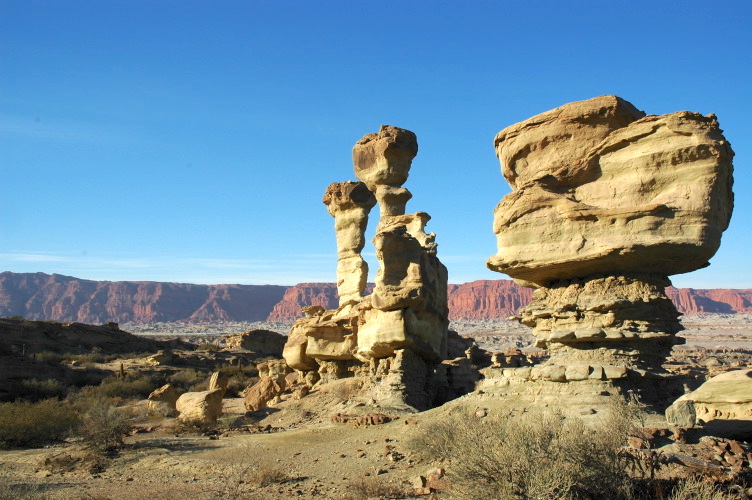
Ischigualasto, known as the Valle de la Luna, is the main reason to stay in Valle Fértil. It is a provincial park of surreal desert landscapes — eroded formations, gullies, rock shapes such as 'el Hongo', 'la Cancha de Bochas' or 'el Submarino' — and one of the most important palaeontological sites in the world: some of the oldest dinosaurs on the planet (Eoraptor, Herrerasaurus) were found in its Triassic rocks. It is covered on a guided vehicle circuit of about 3 hours. Together with neighboring Talampaya, in La Rioja, it forms a UNESCO World Heritage Site.
ℹ️ About 75 km from San Agustín; the traditional circuit is done in your own vehicle following a guide. General admission (source: the park's official site, rates in force since 1 July 2026, verified July 2026): Argentines $45,000 ARS, foreigners $65,000 ARS; bike/trekking circuit $40,000 ARS; full-moon night circuit $45,000 ARS; camping $11,000 ARS. Free for under-6s, Valle Fértil residents, people with a disability and Malvinas veterans.
2
The town of San Agustín and its hill surroundings
A green oasis of tree-lined streets among the Sierras Pampeanas.
San Agustín del Valle Fértil is a quiet, pleasant town, surprisingly green in the middle of San Juan's aridity, ringed by the Sierras Pampeanas. Its tree-lined streets, its square, its church and its unhurried rhythm make it an agreeable place to rest before or after a day at Ischigualasto. The surrounding hills invite walks and outings, and from the town you can reach viewpoints and pockets of nature.
ℹ️ Easy to cover on foot; ideal for a quiet stay.
3
San Agustín reservoir
A reservoir beside the town, ideal for cooling off and fishing.
A few steps from the town, the San Agustín reservoir is Valle Fértil's cooling-off spot par excellence: a lake ringed by hills where visitors and locals swim, fish, picnic and enjoy the water, especially welcome given the heat here. It is a perfect natural complement to a stay in San Agustín, above all in the warm months.
ℹ️ Beside the town; free access. Kayak or boat rental depending on the season.
4
Talampaya National Park (La Rioja)
The neighboring red-walled canyon, part of the same UNESCO site.
Just over 60 km to the north, already in La Rioja, Talampaya National Park impresses with its great canyon of reddish walls up to 150 meters high, petroglyphs, formations such as 'la Catedral' and 'el Monje' and wildlife including guanacos and condors. Along with Ischigualasto it makes up the World Heritage Site. It is covered on guided excursions by vehicle (overland truck), trekking or bike, booked at the park.
ℹ️ Park admission (source: official site argentina.gob.ar/parquesnacionales, rates in force since 1 June 2026, verified July 2026): general/foreigners $25,000 ARS, Argentine residents $12,000 ARS, La Rioja residents $8,000 ARS, students $10,000 ARS, plus the guided excursion separately (compulsory: you cannot go round on your own). Pensioners with Argentine ID, under-6s and people with a disability go free.
5
Crafts and local life
Weaving, pottery and regional produce from the valley.
Valle Fértil keeps craft and farming traditions alive: weaving, basketry, regional preserves and valley produce are sold at stalls and shops in the town. Local life, unhurried and warm, and the regional cooking (with kid goat as its emblem) are part of the appeal of a place that invites you to slow down and get to know the culture of eastern San Juan.
ℹ️ Shops and stalls in the town; ask about markets and opening hours.
6
Viewpoints and hills of the Sierras Pampeanas
Walks and panoramic views of the valley and the reservoir.
The hills around San Agustín offer walks to natural viewpoints from which you can take in the contrast between the green of the oasis, the mirror of the reservoir and the dryness all around. They are short outings, ideal at sunset, that round out a visit to Ischigualasto with a look at the landscape of the Sierras Pampeanas and the plants and wildlife of the scrub.
ℹ️ Short trails from the town; bring water, comfortable shoes and sun protection.
Advertisements
What nobody tells you

💵 Prices

Tickets

TypePrice
Ischigualasto — traditional circuit, Argentine visitors$45,000 ARS per person (source: official site ischigualasto.gob.ar, rates in force since 1 July 2026, verified July 2026)
Ischigualasto — traditional circuit, foreigners$65,000 ARS per person (source: official site ischigualasto.gob.ar, verified July 2026)
Ischigualasto — alternative circuits (bike, Cerro Morado, Río Salado) and full-moon night circuitAlternative circuit $40,000 ARS; full-moon night circuit $45,000 ARS; camping $11,000 ARS (source: official site ischigualasto.gob.ar, verified July 2026)
Talampaya (La Rioja) — park admissionGeneral/foreigners $25,000 ARS, Argentine residents $12,000 ARS, La Rioja residents $8,000 ARS, students $10,000 ARS (source: official site argentina.gob.ar/parquesnacionales, rates since 1 June 2026, verified July 2026); compulsory guided excursion separate
San Agustín reservoirFree, open access (source: direct visit, verified July 2026)
Crafts and regional produceUS$ 3–15 depending on the piece: weaving, preserves and basketry (range based on local stalls, verified July 2026)
🔄 updated monthlyOfficial / reference values · double-check when buying

Activities and tours

ActivityPriceDurationOperator
Excursion to Ischigualasto (Valle de la Luna)Admission $45,000 ARS (Argentines, official source, verified July 2026) + transport; excursion with transport from San Agustín US$ 25–50 per person (range based on local agencies, verified July 2026)Half day to full dayAgencies in San Agustín / the provincial park
Combined Ischigualasto + Talampaya excursionUS$ 75–140 per person, transport included; each park's admission and excursions separate (range based on local agencies, verified July 2026)Full day (a long one)Local agencies
Hill walks and the reservoirFree on your own; with a guide US$ 12–25 per person (range based on local guides, verified July 2026)Half dayOn your own / local guides
Full-moon night circuit at Ischigualasto$45,000 ARS per person (source: official site ischigualasto.gob.ar, verified July 2026)At night (depending on the moon phase)Ischigualasto Provincial Park
🔄 updated monthlyOfficial / reference values · double-check when buying
Advertisements

🚌 How to get there and distances

Getting around

ModePriceDurationNotes
Car / rentalFuel, premium petrol about $1,400–1,600 ARS/liter (source: YPF pumps, verified July 2026); rental from US$ 40/dayVariableHighly advisable: Ischigualasto is about 75 km away and the circuit is driven in your own vehicle
Organised excursions with transportUS$ 25–50 per person to Ischigualasto; US$ 75–140 for the combined trip with Talampaya (range based on local agencies, verified July 2026)VariableAgencies in the town run trips to Ischigualasto and Talampaya with a guide
Remís / local taxiUS$ 7–17 for short trips around town (range based on local fares, verified July 2026)VariableUseful within San Agustín; for Ischigualasto take the excursion or a car
On footFreeVariableThe town of San Agustín is easy to cover on foot
🔄 updated monthlyOfficial / reference values · double-check when buying

How to get there

RouteAirlines / operatorsAvg. priceDuration
City of San Juan → San Agustín (bus/car)Vallecito, regional companies; carCoach US$ 10–22 (range based on online ticket agencies, verified July 2026); fuel if drivingApprox. 4 h (about 250 km)
City of La Rioja → San Agustín (car/bus)Car; regional servicesFuel, or coach US$ 9–18 (range based on online ticket agencies, verified July 2026)Approx. 3-4 h
Córdoba → San Agustín (bus/car)Long-distance companies; carCoach US$ 35–62 (range based on online ticket agencies, verified July 2026)Approx. 8-9 h
🔄 updated monthlyOfficial / reference values · double-check when buying

🏨 Where to stay

No exact prices: a scale from $ (budget) to $$$$$ (luxury), with 2-3 options per category.

CategoryPriceRecommended options
Hotels and inns$$$$$Hotels and inns in San Agustín, the base for Ischigualasto: US$ 60–125 a night for a double (range according to Booking/Tripadvisor, verified July 2026).
Cabins and guesthouses$$$$$Cabins, hostels and cheap guesthouses in the town: US$ 30–70 a night (range according to Booking budget, verified July 2026).
Camping$$$$$Campsites beside the reservoir and in the town: US$ 7–16 per person a night (range according to traveler reviews, verified July 2026).

🍴 Where to eat

TypePriceOptions / signature dish
Regional San Juan cooking$$$$$Kid goat (chivito), empanadas, locro and regional preserves in local eateries: US$ 9–20 per main course (range according to Tripadvisor, verified July 2026).
Grills and family eateries$$$$$Grills and eateries in San Agustín, with asado and home cooking: US$ 7–16 per dish (range according to traveler reviews, verified July 2026).
Cafés and kiosks$$$$$Cafés, bakeries and kiosks for breakfast or a packed lunch before Ischigualasto: coffee and medialunas US$ 3–7 (range according to local reviews, verified July 2026).
Advertisements

📖 History of Valle Fértil (San Agustín)

Origins, formation and what the sources say.

The muleteer who gave a dinosaur its name

In the late 1950s a muleteer and tracker from Valle Fértil named Victorino Herrera guided a group of scientists through the grey badlands of Ischigualasto, that desolate spot locals avoided and the world now knows as the Valle de la Luna. Herrera knew every gully in the terrain and knew where 'stone bones' came to the surface. He took them straight to them. Among the remains he helped find was a predator more than 230 million years old, one of the oldest dinosaurs ever discovered. When the palaeontologist Osvaldo Reig described it scientifically in 1963, he did something unusual: instead of honoring a colleague or a patron, he named the animal after the muleteer. So a goat herder from eastern San Juan was immortalised in palaeontology textbooks all over the planet: Herrerasaurus ischigualastensis.

That anecdote sums up the curious fate of Valle Fértil: a remote hill oasis, founded in the 18th century to grow wheat and raise livestock, that ended up as the gateway to one of the most important scientific windows in the world — the only place on the planet where you can read, layer by layer, the complete chapter of the Triassic in which the dinosaurs were born.

The Yacampis: the oasis before Spain

The name says it all: in the middle of the arid east of San Juan, this valley in the Sierras Pampeanas has water, wet meadows and workable land — a rarity that drew people here from remote times. Its pre-Hispanic inhabitants were the Yacampis, a people whom archaeological and linguistic evidence links to the Diaguita of the northwest. They lived from irrigated farming, hunting and gathering carob pods, and left their traces across the valley: mortars hollowed out of the bedrock for grinding seeds, petroglyphs and the remains of settlements in the hill gorges.

The first Spaniards reached the region around 1596, and with them the religious orders: first the Dominicans and, from 1611, the Jesuit missionaries, who settled to evangelise the native population. For almost two centuries, however, the valley remained a marginal territory of the Cuyo corregimiento — which, curiously, depended on Chile until the Viceroyalty of the Río de la Plata was created in 1776 — with people scattered across livestock outposts and no formal town to organize them. That founding would come only at the end of the 18th century, and by administrative decision rather than spontaneously.

1788: the Villa de San Agustín de Jáuregui is born

On 4 April 1788, on instruction from the town council of San Juan de la Frontera, the field marshal Pedro Pablo de Quiroga founded the Villa de San Agustín de Jáuregui with some 150 settlers. The name honored Agustín de Jáuregui, who had been viceroy of Peru, and the layout followed the colonial manual: square, church, plots shared out among the Spanish families and the valley's Indigenous people relocated near the church for their evangelisation. So was born the town everyone now simply calls San Agustín, the seat of the Valle Fértil department.

Through the 19th century and much of the 20th, the town lived off the land and off relative solitude. Its people grew wheat and maize on irrigated land, raised goats and cattle in the hills, and worked small mines in the Sierra de la Huerta and Valle Fértil, in a subsistence economy shaped by distance: San Agustín is 250 km from the San Juan capital, and the roads were rough well into the 20th century. That isolation, an economic sentence for generations, ended up preserving two treasures: the serene oasis-town atmosphere travelers fall for today, and a stretch of untouched badlands to the northeast that locals called Ischigualasto.

The Triassic comes to light: Romer, Reig and the stone bones

Locals in Valle Fértil always knew there were 'stone bones' at Ischigualasto, but science was slow to arrive. The turning point was 1958, when the palaeontologist Alfred Romer of Harvard University — one of the world's leading authorities on fossil vertebrates — visited the basin and was astounded: he recognized at once that those grey and reddish layers held an exceptional record of the Triassic. His enthusiasm stirred the pride (and the reaction) of Argentine science: over the following years, expeditions from the Museo de La Plata and the Instituto Lillo in Tucumán, with Osvaldo Reig and later José Bonaparte among their leading figures, systematically excavated the site.

The results were extraordinary. Guided by trackers such as Victorino Herrera, the remains of Herrerasaurus appeared, described by Reig in 1963, along with other reptiles from the dawn of the age of dinosaurs. What makes Ischigualasto unique is not only the age of its fossils — more than 230 million years — but their continuity: it is the only place in the world where the Triassic sedimentary sequence is exposed complete and in order, with the exact transition in which the dinosaurs, then small and marginal animals, began to take over the planet. For palaeontologists it is the equivalent of finding the original manuscript of a whole chapter in the history of life.

Eoraptor, UNESCO and worldwide recognition

Definitive fame came in two waves. In 1988 a joint Argentine-American expedition with Paul Sereno and Fernando Novas found the first Herrerasaurus skeleton with a complete skull, a cover-of-the-journal discovery. And in 1991, during a campaign by the Universidad Nacional de San Juan and the University of Chicago, the San Juan palaeontologist Ricardo Martínez lifted from the ground a rock holding the almost perfect skeleton of a primitive dinosaur the size of a large hen. Described in 1993, it was named Eoraptor lunensis: 'the dawn thief of the Valley of the Moon'. For years it was considered the oldest known dinosaur, and it remains a celebrity of documentaries about the origin of the dinosaurs.

The seal came in 2000, when UNESCO declared the 'Ischigualasto–Talampaya Natural Parks' a World Heritage Site, some 275,000 hectares shared between San Juan and La Rioja, for their continental Triassic fossil record, unique in the world, and their desert landscapes sculpted by erosion: el Hongo, la Cancha de Bochas, el Submarino, the red walls of the La Rioja canyon. That 'worthless' spot the valley people avoided became the engine of the region.

What does 'Ischigualasto' mean?
The etymology is disputed. The most widespread version translates it as 'place where the moon settles', although other studies attribute it to regional languages with senses such as 'land without life' or link it to place names of Kakán or Huarpe origin. No interpretation is conclusively documented; the nickname 'Valle de la Luna', by contrast, is modern and refers to its lunar landscape.
Source: https://es.wikipedia.org/wiki/Parque_provincial_Ischigualasto

San Agustín today: kid goat, the reservoir and the gateway to the Valle de la Luna

International recognition transformed San Agustín del Valle Fértil without taking away its soul. The old farming town of 1788 is now the natural tourist base for Ischigualasto: every morning cars and excursions leave its guesthouses and cabins for the park, about 75 km away, and many travelers put together the combined day with Talampaya from here. The local economy blends that growing tourism with the activities of always — irrigated farming, goat herding that puts kid goat at the center of the regional table, loom weaving and basketry.

But Valle Fértil is not only a base camp. The San Agustín reservoir, right beside the town, is the area's natural swimming pool: a sheet of water among the hills where people swim, fish and paddle, a double blessing in a department where summer bites. The Sierras Pampeanas offer viewpoints and short walks with views of the contrast that defines the place: the intense green of the oasis set against endless dryness. And the sky, far from any light pollution, gives starry nights that rival the rock formations in the park. Travellers who come for the dinosaurs usually leave with another image: a hill town that has spent more than two centuries cultivating its fertile valley with a patience not even world fame could hurry.

📚 Bibliography

  • Wikipedia (ES) — «San Agustín del Valle Fértil»: https://es.wikipedia.org/wiki/San_Agust%C3%ADn_del_Valle_F%C3%A9rtil
  • Wikipedia (ES) — «Departamento Valle Fértil»: https://es.wikipedia.org/wiki/Departamento_Valle_F%C3%A9rtil
  • Wikipedia (ES) — «Parque provincial Ischigualasto»: https://es.wikipedia.org/wiki/Parque_provincial_Ischigualasto
  • Wikipedia (ES) — «Parque nacional Talampaya»: https://es.wikipedia.org/wiki/Parque_nacional_Talampaya
  • Wikipedia (ES) — «Herrerasaurus»: https://es.wikipedia.org/wiki/Herrerasaurus
  • Wikipedia (ES) — «Eoraptor»: https://es.wikipedia.org/wiki/Eoraptor
  • UNESCO — Parques Naturales Ischigualasto / Talampaya: https://whc.unesco.org/es/list/966/
  • Parque Provincial Ischigualasto (oficial): https://www.ischigualasto.gob.ar/
  • InfoValleFértil — Historia de Valle Fértil: sucesos que determinaron la fundación de la villa San Agustín: https://infovallefertil.com/contenido/20602/historia-de-valle-fertil-sucesos-que-determinaron-la-fundacion-de-la-villa-san-a
  • Gobierno de San Juan — Valle Fértil celebra 237 años de historia, naturaleza y cultura: https://sisanjuan.gob.ar/23-prensa/2025-04-04/61313-valle-fertil-el-pais-verde-que-festeja-237-anos-de-vida
  • San Juan al Mundo — Departamento Valle Fértil: https://www.sanjuanalmundo.com/articulo?id=16281
  • Turismo San Juan (oficial): https://www.sanjuan.tur.ar/

❓ Frequently asked questions

How much does admission to Ischigualasto cost?+
Since 1 July 2026, the traditional circuit costs $45,000 ARS for Argentine visitors and $65,000 ARS for foreigners (source: official site ischigualasto.gob.ar, verified July 2026). The alternative circuits (bike, Cerro Morado, Río Salado) cost $40,000 ARS and the full-moon night circuit $45,000 ARS; camping, $11,000 ARS. Under-6s, Valle Fértil residents, people with a disability and Malvinas veterans are exempt. Check the official website when you visit.
How far is Ischigualasto and how do you get round it?+
It is about 75 km from San Agustín del Valle Fértil, roughly an hour. The park is covered on a guided vehicle circuit of about 3 hours: you go in with your own vehicle following a guide, or on an excursion booked in town. There are also alternative circuits by bike or on foot.
Can it be combined with Talampaya?+
Yes. Ischigualasto (San Juan) and Talampaya (La Rioja) are neighboring, complementary parks, both part of the same World Heritage Site. Many excursions from Valle Fértil offer the combined visit in one long day (US$ 75–140 per person, range verified July 2026, with admission and excursions separate). Admission to Talampaya, since 1 June 2026, is $25,000 ARS general/foreigners and $12,000 ARS for Argentine residents (source: official site argentina.gob.ar/parquesnacionales, verified July 2026), plus the compulsory guided excursion.
What is the best time to go?+
Autumn, winter and spring are the most comfortable. Summer is very hot in this arid area; if you come then, start early to see Ischigualasto in the cooler hours and use the reservoir to cool off. Always bring water and sun protection.
Is it worth staying overnight in San Agustín?+
Yes, it is the most practical option: staying in San Agustín lets you see Ischigualasto without rushing (including an early start to avoid the heat), enjoy the reservoir and the town, and possibly add Talampaya. It is a quiet, pleasant place for one or two nights, with lodging from around US$ 30 a night (range verified July 2026).
How do you get to Valle Fértil from San Juan?+
From the city of San Juan it is about 250 km via RN 141 to Marayes and then RP 510 to San Agustín, around 4 hours by car on paved road. By coach there are regional services from the San Juan terminal (US$ 10–22 each way, range based on online ticket agencies, verified July 2026). You can also come from the city of La Rioja in 3-4 hours and from Córdoba in 8-9 hours.
What is there to see in Valle Fértil besides Ischigualasto?+
The town of San Agustín with its tree-lined streets and hill-oasis rhythm, the San Agustín reservoir for swimming, fishing or paddling, the viewpoints of the Sierras Pampeanas at sunset, the crafts and the regional cooking with kid goat as its emblem. And just over 60 km away, Talampaya National Park (La Rioja), with its 150-meter red-walled canyon, which fits perfectly into one long day.
Sources consulted (8)
Still planning?
Explore more destinations in Argentina
See all destinations →
Advertisements
Image credits
Photos from Wikimedia Commons, each under its own licence (CC BY, CC BY-SA or public domain). Open each file to see its author and licence.
Ischigualasto provincial park