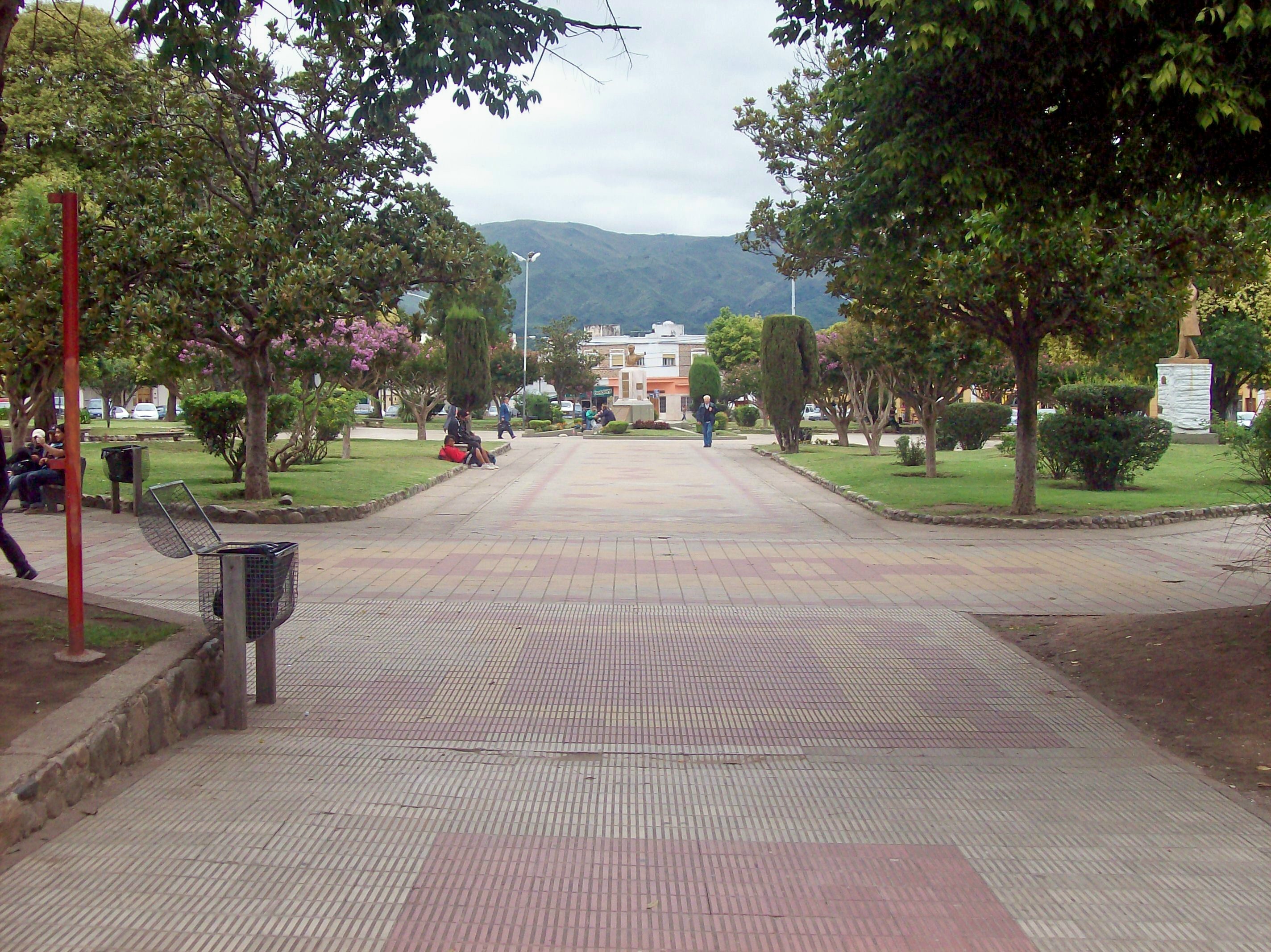
Cosquín is a hill town in the Punilla Valley, in Córdoba, whose name is a byword for Argentine popular music. Every January it hosts the National Folklore Festival, the most important and prestigious of its kind in the country, which over nine nights —the famous 'nine moons'— turns this small town into the capital of Argentine folk music, with the best performers and an audience that comes from everywhere.
But Cosquín is not only the festival. It's also a typical Punilla town, on the banks of the Cosquín River, with its river swimming spots, its ring of hills, its Cosquín Rock (another big music festival) and the chairlift up Cerro Pan de Azúcar to look out over the valley. Its identity is deeply tied to music and to the hill traditions of Córdoba.
This guide covers the essentials of Cosquín with a practical eye: the National Folklore Festival and Plaza Próspero Molina, the river and its swimming spots, Cerro Pan de Azúcar and the surrounding hills, and how to get around this Punilla Valley town, the folk music capital of Argentina.
The Cosquín area was inhabited by the Comechingones, the Indigenous people of the Córdoba hills, from whose language the name of the place comes (linked to a chief or a local group). During the colonial period it organized itself around estancias and chapels, and with the arrival of the railway and the boom in hill tourism in the early 20th century it grew into a resort town. In 1961 the National Folklore Festival was born, which over time made Cosquín the National Capital of Folklore and carried its name across the entire Spanish-speaking world. The full story is on our history page.
Read the full history ↓The landlocked province of sierras and rivers: Comechingón land founded by Cabrera in 1573, seat of the oldest university in the country and of the great Jesuit legacy, cradle of the University Reform and of the Cordobazo, capital of sierra tourism and of cuarteto.
Read the history of Córdoba →They depart from Villa Carlos Paz, 20 km away. If you book from this link we earn a commission and you pay no more.
No exact prices: a scale from $ (budget) to $$$$$ (luxury), with 2-3 options per category.
Origins, formation and what the sources say.
Nine nights, one stage and an entire country looking toward the hills of Córdoba: that single image explains why the word 'Cosquín' means folk music in any Spanish-speaking corner of the world. But long before Plaza Próspero Molina filled with guitars, bombo drums and famous voices, this valley already had a name of its own, given by the people who lived here thousands of years before the first festival existed.
In pre-Hispanic times the Cosquín region, in the Punilla Valley, was inhabited by the Comechingones, the Indigenous people of the Córdoba hills. They lived in villages, farmed, hunted and gathered, and kept a close relationship with the river and the hills of the valley. Their mark endures in the culture, in the archaeological sites and, above all, in the area's place names.
The name 'Cosquín' itself has Indigenous roots and is linked to the Comechingones who lived in the valley. Tradition and scholarship suggest it derives from the name of a chief or of a local group. As with many hill place names in Córdoba, its exact etymology admits different readings, but all of them agree on its pre-Hispanic origin, predating the arrival of the Spanish.
That Comechingón inheritance is part of the deep substrate of Cosquín. The valley, with its mild climate, its river and its hills, was inhabited for centuries before it became a tourist town and, much later, the capital of Argentine folk music. The memory of the original peoples is part of the identity of the whole Punilla region.
Through the colonial period and the centuries that followed, the Cosquín area organized itself around estancias, chapels and farming, as part of the Spanish settlement of the Córdoba hills. The Cosquín River and the surrounding hills shaped the life of a quiet village in the valley.
The great push for Cosquín's development came, as it did across the Punilla Valley, with the arrival of the railway in the late 19th and early 20th centuries. The train connected the region with Córdoba and the rest of the country and opened the hills to tourism. In those years the dry, temperate climate of the Córdoba hills established them as a destination for rest and health, and hotels, guesthouses and summer homes sprang up all over the area.
Cosquín grew this way into a hill resort town, with its river swimming spots, its surrounding peaks and its summer-village life. For much of the 20th century it was, above all, a peaceful place to rest in Punilla, before a cultural event changed its name and its place in Argentine history forever.
The event that marked the history of Cosquín and projected it around the world was the creation of the National Folklore Festival, and its origin is as homemade as it is moving: the first edition, from 21 to 29 January 1961, was held literally on National Route 38, closing traffic with a stage built of brick and mortar right in the middle of the street. The idea had been born a year earlier, in August 1960, when a public assembly of residents elected a Municipal Tourism and Development Commission (later the Municipal Folklore Commission) to come up with something that would stop tourists driving straight past the town. Among those founding residents were Dr. Santos Sarmiento, Reynaldo Wisner, Germán Cassenave and Gerardo Barrera, who worked unpaid to bring in figures such as Jaime Dávalos and the Uruguayan Aníbal Sampayo. The result exceeded every expectation.
Year after year, each January, the festival grew in prestige and in crowds until it stood as the most important of its kind in the country, by then settled in Plaza Próspero Molina, the great stage of Argentine folk music. Its most legendary night came on 31 January 1965: Jorge Cafrune, against festival rules, gave up minutes of his own set to introduce a woman from Tucumán unknown to the wider public. 'I'm going to leave you a girl from Tucumán: Mercedes Sosa', he said. That woman of almost 30 sang 'Canción del derrumbe indio', took the ovation of the square, was named the festival's revelation and signed a record contract: the international career of the greatest voice in Latin American folk music was born that night in Cosquín.
The festival's nine nights —the famous 'nine moons'— became a symbol of national culture, and the cry of '¡Aquí Cosquín!' that opens each moon is a trademark of Argentine radio and television. The festival turned Cosquín into the National Capital of Folklore, an identity that still defines the town: performing at the Próspero Molina remains the highest recognition an artist working in the folk tradition can get, and the Pre-Cosquín contest, which picks new talent from across the country, has kept that mystique alive more than six decades later.
On the doorstep of the 21st century, Cosquín added a new chapter to its musical history. In 2001 Cosquín Rock was born, a rock festival driven by producer José Palazzo that took the town's name to project Argentine rock with the same mass appeal as folk music. Although over the years the event has been held at various sites around the Punilla Valley and Córdoba, the name 'Cosquín Rock' remains inseparably tied to the town and to its tradition as a stage for popular music.
Cosquín Rock established itself as one of the most important rock festivals in Argentina and in Latin America, drawing tens of thousands of young people and the big names of Argentine and international rock over two days each summer. Cosquín thus came to have a singular double musical identity: folk music in January, with its historic festival, and rock in February, with its contemporary one, turning the town and the whole valley into an epicenter of popular music through the summer.
Today Cosquín lives off that cultural identity and the tourism it generates. Plaza Próspero Molina, Cerro Pan de Azúcar, the river, the peñas and the two big festivals make the town a destination where music is the through line. More than six decades after that first festival in 1961, Cosquín is still, above all, a byword for Argentine popular music, a name that evokes January nights in the hills and the voice of an entire country.