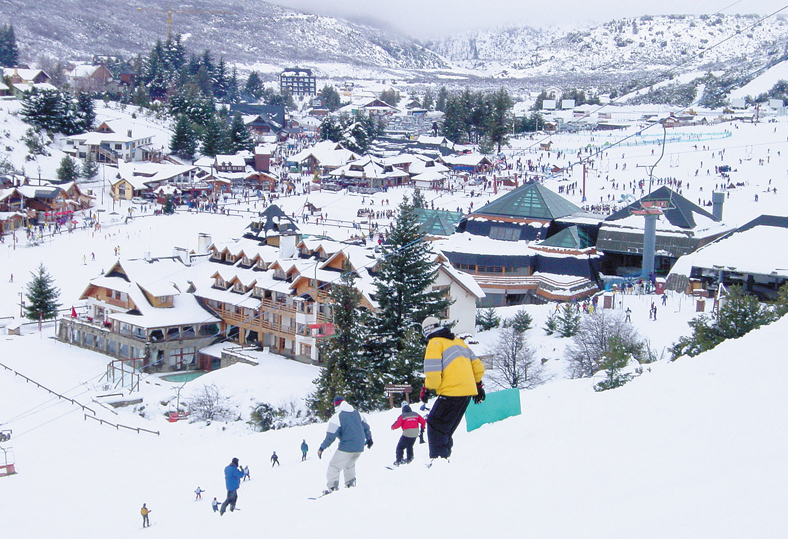
Cerro Catedral is the largest and most complete ski resort in South America, about 19 km from San Carlos de Bariloche, inside Nahuel Huapi National Park. Its rock spires, which recall the towers of a Gothic cathedral and give the mountain its name, loom over an enormous ski area, with dozens of runs for every level, modern lifts and spectacular views over Lake Nahuel Huapi and the Andes.
In winter (from June-July to September, depending on the snow), Catedral becomes the capital of Argentine skiing: it draws skiers and snowboarders from all over the country and abroad, with schools, equipment rental, a base village with hotels, restaurants and après-ski, and options for beginners and experts alike. It hosts competitions and is a fixture of the winter holidays.
But Catedral isn't only snow. In summer the mountain shows an equally appealing face: you can ride the chairlift or gondola up to the high viewpoints, trek to Frey refuge and the lagoons, ride mountain bikes, climb and take in unforgettable panoramas of Nahuel Huapi. Close to the base and inside the park, it's one of Bariloche's great tourist icons all year round.
Cerro Catedral began to develop as a ski resort in the 1930s-1940s, driven by Bariloche's tourism boom and the creation of Nahuel Huapi National Park. It was one of the first ski resorts in the country, and over the decades it modernized until it became the largest ski area in South America. The full version is on the history page.
Read the full history ↓The province that crosses Patagonia from the cordillera to the sea: Tehuelche and Mapuche land, land of Carmen de Patagones and the Conquest of the Desert, of the apples of the Alto Valle, of Bariloche and the Nahuel Huapi, and of the beaches of Las Grutas.
Read the history of Río Negro →They depart from Bariloche, 12 km away. If you book from this link we earn a commission and you pay no more.
No exact prices: a scale from $ (budget) to $$$$$ (luxury), with 2-3 options per category.
Origins, formation and what the sources say.
Seen from the city on a clear day, the rock spires on Catedral's summit really do look like the towers of a Gothic temple pointing at the Patagonian sky: hence the name of a mountain that would end up becoming the secular cathedral of South American skiing. The development of Cerro Catedral is tightly bound to the birth of tourism in Bariloche and to the creation of Nahuel Huapi National Park, the first in Argentina, established in its modern form in the 1930s out of the land donated to the national government by the explorer Francisco Moreno in 1903. In those years, pushed along by figures from the fledgling conservation and tourism movement, Bariloche began to take shape as an alpine-inspired mountain destination, with log and stone architecture meant to echo Switzerland and Bavaria.
Skiing, brought over by European immigrants —many of them central Europeans who saw in the Patagonian landscape echoes of their home mountains— and by local enthusiasts, found an ideal setting on the slopes of Cerro Catedral, whose distinctive granite spires recall the towers of a cathedral. Towards the end of the 1930s and the start of the 1940s the first installations went up and the groundwork was laid for what would be one of the country's first ski resorts, with the primitive chairlifts and drag lifts that look almost archaeological next to today's infrastructure.
The construction of tourist infrastructure in Bariloche, such as the emblematic Hotel Llao Llao (opened in 1938, destroyed by fire in 1939 and rebuilt in stone and concrete to reopen in 1940) and the Civic Centre designed by the architect Ezequiel Bustillo, went hand in hand with this process. Skiing stopped being the pursuit of a few pioneers and gradually became a draw capable of bringing visitors in winter, complementing the summer season of lakes and mountains and laying the foundations of what is today one of the most important tourism economies in Patagonia.
Through the second half of the 20th century, Cerro Catedral was steadily modernized and expanded. Successive generations of lifts went in —drag lifts, chairlifts and gondolas—, runs were prepared for different levels and a base village was built with hotels, restaurants and services at the foot of the mountain, in what is now known as Villa Catedral.
The growing popularity of winter holidays in Argentina, especially among students and families arriving in graduation-trip groups, established Catedral as the country's leading snow destination from the 1960s and 1970s onwards. The resort hosted national and international competitions and earned a reputation as the largest and most complete ski area in South America, with some 120 kilometers of runs across roughly 600 skiable hectares that set it apart from other resorts in the region, including the Chilean ones and those in the northern hemisphere that receive visitors in the opposite season.
Running the ski resort, inside Nahuel Huapi National Park, has been in the hands of private concessionaires who operate the lifts and services under the Catedral Alta Patagonia brand, in coordination with the national park authorities, since the whole mountain lies within a protected natural area. Investment in modernizing the lifts, in snowmaking systems to supplement natural snowfall and in services has aimed at keeping it competitive against other resorts at home and abroad, in a context of climate change that has made the snow season more variable across the whole cordillera.
Although its worldwide fame comes from skiing, Cerro Catedral also established itself as a mountain destination all year round. In summer the lifts run for sightseeing, carrying visitors up to viewpoints with exceptional views of Lake Nahuel Huapi and the Andes, and the mountain fills with trekking, mountain biking, climbing and paragliding.
The Refugio Frey area, beside Toncek lagoon and ringed by spectacular granite spires, became one of the best-loved mountaineering and rock climbing destinations in Patagonia. The trail leading there from the base of Catedral is an unmissable classic for anyone who loves the outdoors.
Today Catedral belongs to the set of Bariloche tourist icons alongside the Circuito Chico, Cerro Campanario and Lake Nahuel Huapi. Its combination of a great ski resort in winter and an adventure mountain in summer, plus its closeness to the city and its place inside Nahuel Huapi National Park, keeps it among the main attractions of the Andean-Patagonian region.
The granite spires crowning Cerro Catedral not only gave it its name, they also made the mountain a fundamental stage for the birth of mountaineering and rock climbing in Argentina. As early as the 1930s and 1940s, the pioneers of the Club Andino Bariloche —founded in 1931— began exploring these walls and opening the first climbing routes on the area's excellent granite.
In that context Refugio Emilio Frey was built beside Toncek lagoon at the foot of the spires, one of the country's most emblematic mountain huts. Its name honours Emilio Frey, an engineer and pioneering mountaineer, a key figure of the Club Andino Bariloche and of the region's exploration. The refuge became the base from which generations of climbers reached the celebrated granite towers, and it remains a meeting point for the national and international climbing community.
So, alongside the growth of the ski resort, Catedral forged a double identity: on one side, the great snow resort; on the other, a temple of mountaineering and climbing, with the Frey as its symbol. That legacy keeps alive a tradition of sport and exploration that is an essential part of Bariloche's mountain culture.