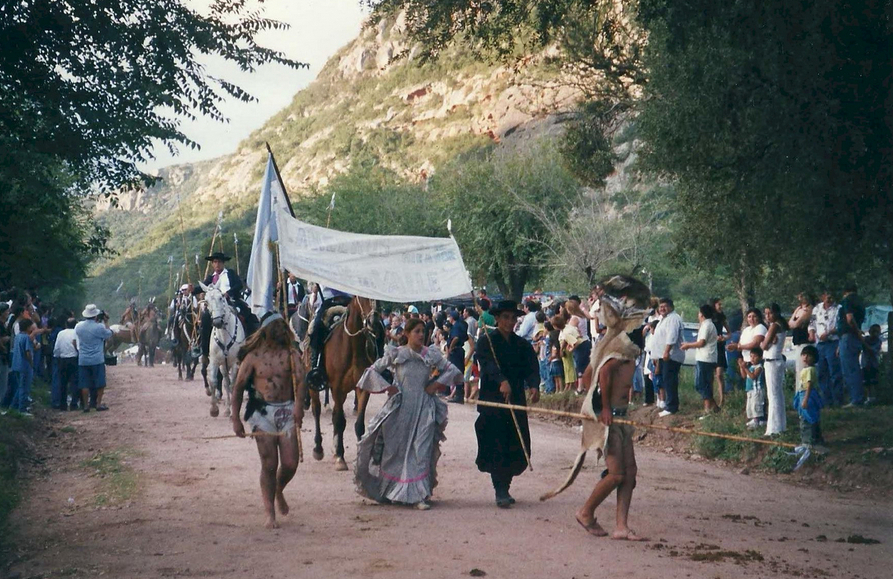
Cerro Colorado is a cultural and natural reserve in northern Córdoba holding one of the most important sets of rock art in Argentina: official surveys count more than 35,000 figures painted by Indigenous peoples across hundreds of shelters and walls of the reddish rock that gives the place its name. It's a site of enormous archaeological value, set among low sierras, scrub and streams, far from the mass tourist circuits.
The rock paintings of Cerro Colorado, attributed to the Comechingón and Sanavirón peoples, depict human figures, animals, hunting scenes and, strikingly, images that record contact with the Spanish conquistadors (riders on horseback, for instance). They date from a period running from about 1,500 years ago to some 400 years ago, and they are a unique record of the life and worldview of the region's Indigenous peoples and of that collision of worlds.
Cerro Colorado carries another cultural echo: it was the place the great musician and poet Atahualpa Yupanqui chose to live, and his house is now a museum. This guide covers the essentials with a practical eye: the paintings and the archaeological reserve, the museum, Yupanqui's house-museum, the sierras and scrub around it, and how to get to and move around this history-laden corner of northern Córdoba.
For centuries Cerro Colorado was an important centre for the region's Indigenous peoples —Comechingones and Sanavirones—, who over hundreds of years left thousands of paintings on its red sandstone shelters and walls. The paintings depict human figures, animals, ritual scenes and, by the time of the conquest, the arrival of the Spanish. The site was declared a reserve and a monument to protect this heritage, one of the most valuable in Argentine rock art. In the 20th century the musician Atahualpa Yupanqui chose Cerro Colorado to live in, adding another cultural layer to the place. The full story is on our history page.
Read the full history ↓The landlocked province of sierras and rivers: Comechingón land founded by Cabrera in 1573, seat of the oldest university in the country and of the great Jesuit legacy, cradle of the University Reform and of the Cordobazo, capital of sierra tourism and of cuarteto.
Read the history of Córdoba →No exact prices: a scale from $ (budget) to $$$$$ (luxury), with 2-3 options per category.
Origins, formation and what the sources say.
There is a place in northern Córdoba where the conquest of America was painted through the eyes of the conquered: on the red rock walls of Cerro Colorado, among thousands of figures of pumas, llamas and hunters, Spanish riders on horseback appear, drawn by the very peoples who watched that new and violent world break in. For centuries Cerro Colorado was an important centre for the region's Indigenous peoples. The area was inhabited by Comechingones and Sanavirones, peoples who lived from farming, hunting and gathering, and who found in the hill's reddish sandstone shelters, caves and walls a good place to live and, above all, to set out their world in paint.
Over hundreds of years, these peoples covered the rock walls with thousands of paintings, using mineral pigments in different colours. The paintings show an enormous variety of motifs: human figures, animals of the region (pumas, llamas, rheas, birds), hunting and everyday scenes, geometric motifs and figures with an apparently ritual or magical meaning. It is one of the richest and most significant sets of rock art in Argentina.
This art was not mere decoration: it reflected the worldview, the beliefs, the social life and the relationship of these peoples with their surroundings. Cerro Colorado thus became a kind of great book painted on stone, which to this day preserves the graphic memory of the communities that lived in these sierras long before the Europeans arrived.
One of the most fascinating and valuable aspects of the rock art of Cerro Colorado is that some of its paintings record the moment of contact between Indigenous peoples and the Spanish conquistadors. Among the traditional figures there are depictions of riders on horseback, of men in European dress and of scenes reflecting the irruption of a new and violent world.
That makes the paintings an exceptional historical document: a graphic record of the conquest seen through the eyes of Indigenous peoples themselves. The horse, an animal unknown in America until the Europeans arrived, and the figure of the conquistador were set down on rock by those who lived through that encounter, offering a unique perspective on one of the most decisive episodes in American history.
For the Comechingones and Sanavirones, conquest and colonization meant the beginning of a process of subjugation, depopulation and profound transformation of their world. The paintings of Cerro Colorado, covering both life before the conquest and the impact of contact, are therefore heritage of extraordinary historical and symbolic value, giving a voice to those whom history written by the victors so often silenced.
Because of its exceptional value, Cerro Colorado was protected as a reserve and a monument, with the aim of preserving its thousands of paintings and the natural and cultural setting around them. Conserving this rock art —threatened by erosion, weather and human action— is a permanent task, given how fragile the paintings are and how irreplaceable their historical and archaeological value is.
On top of its archaeological side, Cerro Colorado carries a particular weight in 20th-century Argentine culture: it was the place the great musician, guitarist and poet Atahualpa Yupanqui chose to live. In his house in the area, known as 'Agua Escondida', the artist found the quiet and the inspiration of this northern Córdoba landscape. That house now works as a museum and is a place of pilgrimage for lovers of Argentine folk music and culture.
So Cerro Colorado combines two great dimensions that make it unique: the archaeological heritage of Indigenous peoples, with one of the most important sets of rock art in the country, and the cultural memory tied to Yupanqui. Far from the mass circuits, in a setting of low sierras and scrub, it's a destination for anyone after deep history, ancient art and the trace of one of Argentina's great artists, whose zambas and milongas —many written or polished in that same hill silence— still sound like one of the deepest voices in Argentine popular song.
Systematic study of the Cerro Colorado paintings gathered pace in the 20th century, when researchers and archaeologists surveyed and catalogued the thousands of motifs painted on the shelters. Figures such as the archaeologist Aníbal Montes helped document the site, establish chronologies and spread the word about its importance, laying the groundwork for its protection. The research established that the paintings span a long period, running from about 1,500 years ago to barely 400, that is, up to the time of contact with the Spanish. More than twenty painted shelters have been catalogued in the sector known as Cerro Colorado proper, along with the neighbouring hills Veladero and Inti Huasi, which complete the set of rock art sites in the reserve.
Once its exceptional value was recognized, the site was legally protected. In 1961 it was declared a National Historic Site (decree 881/1961), and in 1992 the province of Córdoba established it as the Cerro Colorado Cultural and Natural Reserve, covering some 3,000 hectares, with the aim of preserving both the archaeological heritage and the sierra and scrub setting around it. That double status —cultural and natural— reflects the idea that the paintings cannot be understood or conserved apart from their landscape: the same scrub of espinillos, quebrachos and algarrobos, and the same reddish sandstone hills, are the scenery the Comechingones and Sanavirones saw and painted centuries ago.
Conserving this rock art is a permanent and delicate task: erosion, shifts in humidity and temperature, smoke, lichens and human action constantly threaten the paintings. That's why visits are made with a guide along controlled trails at fixed times, and there is continuous monitoring and protection work aimed at making sure this treasure reaches future generations. The reserve also runs a permanent research programme that keeps adding findings and sharpening our understanding of a site that still holds open questions about the lives of its original authors.