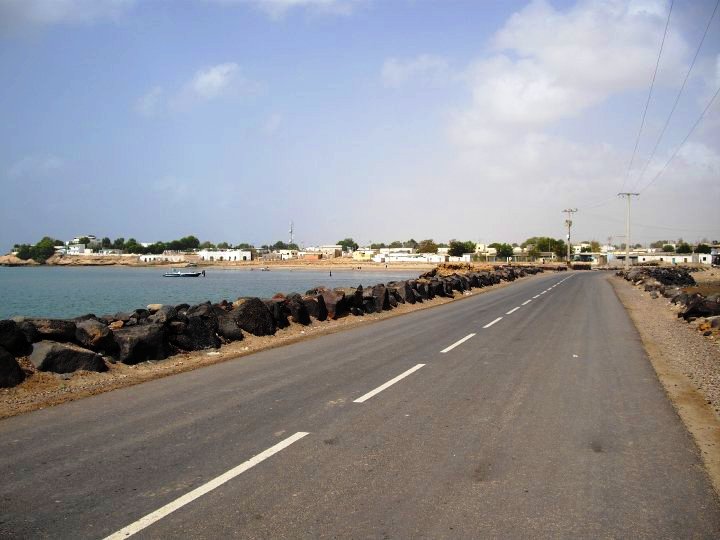
Obock is one of those places where time seems to have stood still. On Djibouti's northern coast, facing the Gulf of Tadjoura, this small Afar port is where it all began: the French landed here in the 19th century and founded their first enclave, the seed of what would become the colony and later the Republic of Djibouti. From that past remain colonial houses eaten away by salt, a lighthouse, a marine cemetery and a melancholy air of lost glory.
Today Obock is a quiet, remote and authentic place, far from the tourist trail. Its attractions are simple but charming: strolling among the old buildings, visiting the Ras Bir lighthouse, looking in on the graves of French soldiers who died of fever, swimming at almost deserted beaches and feeling the slow pulse of an Afar fishing town. It is also a sensitive point on the migration map of the Horn of Africa, from where many try to cross the sea to Yemen.
This guide tells you how to visit Obock: how to get there by boat or along the northern road, what to see in the town and its surroundings, its founding role in Djibouti's history, when to go to enjoy the coast and the gulf's whale sharks, and how to combine it with Tadjoura and the beaches of the northern shore on a trip through the lesser-known Djibouti.
Obock began as the first French enclave in the Horn of Africa: on 11 March 1862, representatives of the Afar sultans ceded to France the port and anchorage of Obock, which the French wanted as a coaling station for their steamships, especially after the Suez Canal opened in 1869. It became a true colony in 1884 with the arrival of administrator Léonce Lagarde, but its anchorage was poor and in 1894 the colonial capital moved to the better port of Djibouti, on the other side of the gulf. Obock was then relegated to a quiet provincial port. The full story is on our history page.
Read the full history ↓In Obock, on the northern shore of the gulf, the first French foothold in the Horn of Africa took root in 1862; today it is a quiet Afar port with an end-of-the-world feel.
Read the history of The north: Obock and the Afar coast →No exact prices: a scale from $ (budget) to $$$$$ (luxury), with 2-3 options per category.
Origins, formation and what the sources say.
Long before the French arrived, Obock was an anchorage on the Afar coast, on the northern shore at the mouth of the Gulf of Tadjoura. It was a meeting point for fishermen, nomadic herders and the trade that crossed the Bab el-Mandeb strait towards Arabia. The region was part of the Afar world, ruled by sultanates such as Tadjoura, and it belonged to the old trade networks of the Red Sea, where salt, livestock, slaves, coffee and goods moved between Africa and the Arabian Peninsula.
Its strategic position, facing the sea routes that linked the Mediterranean with the Indian Ocean, is exactly what would draw the European powers in the 19th century. The Horn of Africa became a prized piece on the colonial board, especially once the opening of the Suez Canal in 1869 turned the Red Sea into the great maritime highway between Europe and its Asian colonies. Whoever controlled coaling stations along that route would control the traffic of steamships.
In that context, the modest port of Obock went from Afar anchorage to France's first foothold in the Horn of Africa almost overnight. The modern history of Djibouti begins here, on this arid, luminous coast.
On 11 March 1862, representatives of the Sultan of Tadjoura signed an agreement in Paris with Édouard Thouvenel, Napoleon III's foreign minister, ceding to France 'the ports, the harbour and the anchorage of Obock'. France wanted a coaling station of its own for its steamships on the route to its Asian colonies, so it would not have to depend on the British port of Aden, across the strait. The purchase was cheap and, for almost two decades, it was barely used: Obock remained a possession on paper.
That changed in the 1880s, when colonial rivalry in the region picked up speed. The merchant Pierre Arnoux settled there in 1881, and in August 1884 Léonce Lagarde arrived. He set up an administration, extended French holdings around the Gulf of Tadjoura and turned Obock into a real colony. By around 1885 the settlement had some eight hundred inhabitants and even a school. From Obock, France signed treaties with the Afar and Issa sultans and gradually pieced together the territory it would call the French Somali Coast.
Those were Obock's years in the spotlight. It was the starting point for explorers, traders and adventurers (figures linked to the arms trade and to the exploration of Ethiopia passed through here), and it was the capital of the new colony. But its anchorage had a serious problem: it was too exposed to winds and currents and gave ships little shelter.
The flaw in Obock's anchorage would cost it its role as capital. On the southern shore of the Gulf of Tadjoura there was a site with a much better sheltered natural harbour, and there Léonce Lagarde founded a new city: Djibouti. In 1894, barely a decade after Obock became a colony, the colonial administration moved the capital from Obock to Djibouti, which would also be the starting point of the railway planned towards Ethiopia. Obock never recovered from the blow.
The officials, the merchants and much of the activity left along with the capital. Obock's population fell and the town was pushed into a minor administrative role: capital of the Dankali district in 1914, then a simple post, and in 1929 part of the 'circle of the Adaïls'. While Djibouti grew into a modern port and railway hub, Obock slowly faded. All that remains of its brief heyday is the memory held in its colonial houses, its lighthouse and its seaside cemetery, where Europeans who died of fever in those early years lie buried.
That cemetery, the Cimetière Marin, is today one of Obock's symbols: a place of graves worn down by sun and salt that speaks of the high cost in lives of the colonial venture in such a harsh climate. Walking around Obock means walking through the memory of Djibouti's origins, frozen in a town that stood still while the country moved on without it.
After Djibouti's independence in 1977, Obock remained a quiet, mostly Afar regional capital, living off fishing, small trade and nomadic herding in the interior. With around 20,000 inhabitants, it keeps its slow pace and its end-of-the-world feel, far removed from the bustle of the capital. Its remote beaches, its lighthouse and its colonial heritage draw the few travellers who venture to the north side of the gulf, almost always combining the visit with Tadjoura.
In recent decades, however, Obock's geography has given it a dramatic new role. Facing the Bab el-Mandeb strait, it has become one of the main departure points for irregular migration from the Horn of Africa to the Arabian Peninsula. Thousands of people, mostly Ethiopians and Somalis fleeing poverty and conflict, set off from these shores across the dangerous stretch of sea to Yemen, hoping to find work in the Gulf. The crossings are clandestine and often deadly. It is one of the busiest and most lethal migration routes in the world, and Obock sits at its centre.
This double identity, a peaceful historic town on one side and a migration hotspot on the other, makes Obock a place full of meaning. For the curious traveller, it is a unique window onto the origins of Djibouti and onto the realities of today's Horn of Africa: a silent corner where colonial nostalgia, traditional Afar life and present-day tragedies live side by side, all under the same relentless sun of the Red Sea coast.