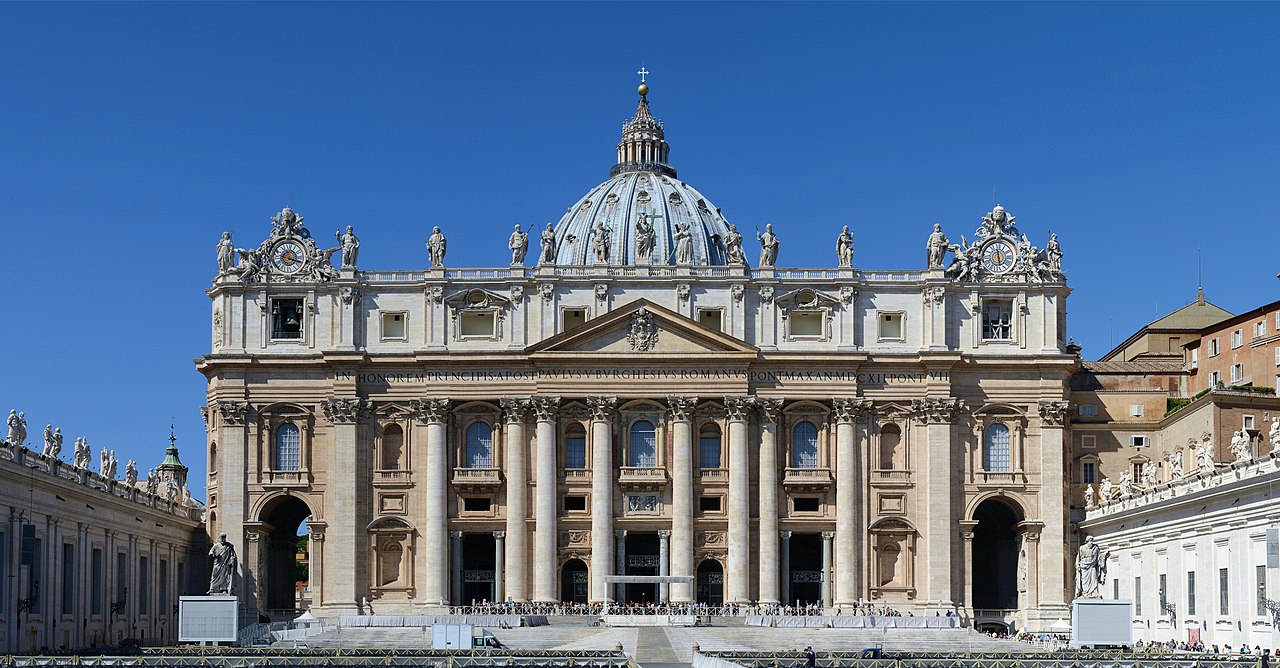
St. Peter's Basilica is the largest and most important church in Christendom, and one of the high points of art of all time. It stands on the Vatican Hill, on the spot where, according to tradition, the apostle Peter was buried — the man Jesus called the 'rock' on which he would build his Church. Walking into St. Peter's means stepping into a space of colossal proportions — 186 metres long, a nave that overwhelms — crowned by Michelangelo's dome, and on which the greatest geniuses of the Renaissance and the Baroque worked over more than a century: Bramante, Raphael, Michelangelo, Maderno and Bernini.
Inside await some of the most famous works in the history of art: Michelangelo's Pietà, carved when the artist was just 24, now protected behind glass; Bernini's gigantic bronze baldachin rising over the papal altar; the Chair of St. Peter, also by Bernini, amid a burst of golden light; and, in the grottoes below, the tombs of dozens of popes. Beneath the high altar, at the exact centre of the basilica, lies what tradition identifies as the tomb of St. Peter himself.
This practical guide explains how to make the most of your visit: when to go to avoid the security queues, which works not to miss, how the dress code works (strict, with shoulders and knees covered), how to climb the dome and how to book a visit to the Necropolis. Admission to the basilica is free, which surprises many people: what you pay for is the climb up the dome and the guided tour of the Scavi, which is arranged separately.
The current basilica is not the first: over the tomb of St. Peter, the emperor Constantine had a great early Christian basilica built around 319-333 — Old St. Peter's — which stood for more than a thousand years. Crumbling and outdated, it was demolished at the start of the 16th century on the orders of Pope Julius II, who decided to build a new and colossal one: in 1506 the first stone was laid following Bramante's design. The works dragged on for more than 120 years and passed through the hands of Raphael, Antonio da Sangallo and, above all, Michelangelo, who from 1547 designed the great dome. Carlo Maderno lengthened the floor plan and built the façade, and the basilica was consecrated in 1626 by Urban VIII. Later, Gian Lorenzo Bernini gave it its definitive Baroque face with the baldachin, the Chair and the colonnade of the square. The full story, with the apostle's tomb and the centuries of construction, is on our history page.
Read the full history ↓The monumental heart of the Vatican: St. Peter's Basilica, raised over the apostle's tomb, Michelangelo's dome and the great elliptical square embraced by Bernini's colonnade.
Read the history of The Basilica and the Square →A local guide tells you in half an hour what no sign at the site will ever explain. We look ours up on Civitatis: guided in Spanish and booked online with no fuss. They have over 50 activities in Roma. And there are free tours here: you book without paying and tip the guide whatever you think at the end, so trying one costs you nothing. Three are below so you get the idea: tap any of them and they all open.
They depart from Roma, 4 km away. If you book from this link we earn a commission and you pay no more.
No exact prices: a scale from $ (budget) to $$$$$ (luxury), with 2-3 options per category.
Origins, formation and what the sources say.
It all starts with a tomb. In the 1st century, the Vatican Hill, on the right bank of the Tiber, was an area on the outskirts of Rome taken up by gardens, a circus built by Caligula and Nero (where, according to tradition, many Christians were martyred after the Great Fire of Rome in 64) and a necropolis, a pagan cemetery with streets of small mausoleums. Somewhere on that slope, around the year 64 or 67, Peter is said to have been buried: the fisherman from Galilee whom the Gospels present as the first of the apostles, and whom Jesus, according to the story, called 'the rock' on which he would build his Church.
During the first two centuries, in times of persecution, that tomb was a place of quiet veneration for the Christians of Rome. Around the year 160, a small monument was built over it, the so-called 'Trophy of Gaius', mentioned in ancient sources. The memory that Peter was buried in exactly that spot was passed down from generation to generation. Centuries later, it was that memory that would decide where the largest church in Christendom was built. The site was an awkward one, a slope that had to be levelled, chosen only because tradition insisted that the apostle lay right beneath it.
In the 20th century, between 1939 and 1950, excavations ordered by Pope Pius XII uncovered that ancient necropolis beneath the basilica, along with the monument over the tomb. In 1968, Paul VI announced that bone remains had been identified which researchers considered, with reasonable probability, to be those of the apostle. That archaeological level is today the Necropolis (Scavi), which can be visited with a booking and a guide.
The turning point came with Constantine, the first emperor to legalise and protect Christianity. Around 319-333, Constantine ordered a great basilica to be built over Peter's tomb. History knows it as 'Old St. Peter's' or the Constantinian basilica. It was a monumental undertaking: to build it, part of the hill had to be sliced away and much of the pagan necropolis buried, always respecting the exact spot of the tomb, which ended up beneath the altar. It was a basilica with five naves, fronted by a large atrium, with room for thousands of pilgrims.
For more than a thousand years, this basilica was one of the great pilgrimage centres of Christendom. There, on Christmas Day in the year 800, Pope Leo III crowned Charlemagne emperor, a decisive moment in European history. Generations of popes, emperors and kings were buried or crowned within its walls, which gradually filled with mosaics, chapels and monuments.
But over the centuries the building deteriorated: the walls were leaning, the structures were close to collapse, and the early Christian style looked outdated next to the splendour of the Renaissance. By the late 15th century, Pope Nicholas V was already thinking about renovating it. The radical decision, however, would be taken in the early 16th century by a pope of enormous ambition: Julius II resolved to demolish Constantine's venerable basilica and build a new one in its place, the largest ever seen. Not everyone agreed: tearing down a thousand years of sacred history was a controversial decision.
On 18 April 1506, Pope Julius II laid the first stone of the new St. Peter's Basilica, following the design of Donato Bramante, the great architect of the Renaissance. Bramante imagined a centrally planned building in the shape of a Greek cross (with four equal arms), crowned by a huge dome inspired by the Pantheon in Rome. He was so ambitious, and demolished the old basilica so energetically, that he earned the nickname 'Maestro Ruinante'. When he died in 1514, the work had barely begun.
Some of the greatest artists of the age followed him. Raphael took over and proposed lengthening the plan into a Latin cross. Then came Baldassare Peruzzi and Antonio da Sangallo the Younger, each with his own design, in a back-and-forth of ideas that dragged on for decades. The decisive turn came in 1547, when Pope Paul III put Michelangelo, by then over 70, in charge of the work. Michelangelo went back to Bramante's idea of a central plan, simplified and unified the design, and drew up the great dome that crowns the building: a masterpiece of engineering with a double shell, inspired by Brunelleschi's dome in Florence but taller and more slender.
Michelangelo died in 1564 without seeing his dome finished; it had only been built up to the drum. It was completed by his pupils Giacomo della Porta and Domenico Fontana, who closed it in 1590 under Pope Sixtus V, raising it somewhat higher than planned. At about 136 metres high up to the cross, it is still the tallest dome in the world and the unmistakable symbol of Rome on the skyline.
In the 17th century, the Counter-Reformation Church wanted a basilica that would impress and welcome the crowds, and that reopened the old debate between a central plan and a Latin-cross plan. The Latin cross won: Pope Paul V commissioned Carlo Maderno to lengthen the building with a great nave towards the entrance and to build the monumental façade, finished around 1614-1626. That extension has a curious consequence you notice when you visit: from the square, the long nave partly 'hides' Michelangelo's dome, which can only be seen in full from a distance. On 18 November 1626, Pope Urban VIII solemnly consecrated the new basilica, 120 years after the first stone was laid.
The artist who gave St. Peter's its Baroque soul was Gian Lorenzo Bernini, a brilliant sculptor and architect who worked there for decades. The Baldacchino is his: the colossal bronze canopy, almost 30 metres high, over the papal altar (1623-1634). So is the Chair of Saint Peter, the gilded throne wrapped in a glory of light at the far end of the apse (1657-1666). And above all, so is the great elliptical colonnade that embraces St. Peter's Square, one of the most perfect urban spaces ever designed.
With Bernini, the basilica and its square were conceived as one great religious stage set, designed to move the faithful and proclaim the greatness of the Church. The result is a collective work spanning more than a century and a half, in which popes, architects and styles followed one another, from the High Renaissance to the triumphant Baroque.
With the creation of Vatican City State in 1929, through the Lateran Pacts signed between the Holy See and the Italian state, the basilica came to lie within a sovereign state, the smallest in the world, although it is still physically surrounded by Rome. Since then, St. Peter's has been the main stage for the life of the Catholic Church: it hosts the great Christmas and Easter liturgies, canonisations, papal funerals and the Masses that open a new pontificate. Every Wednesday the Pope holds the General Audience in the square, and every Sunday he prays the Angelus.
The basilica has witnessed moments that shaped modern history: the Second Vatican Council, opened inside it in 1962; the long pontificate of John Paul II and the assassination attempt he survived in the square in 1981; and the huge gatherings of faithful and tourists that fill the square, especially during Holy Years or Jubilees. It is not just a monument: it is a living church, in constant use, which means visitors must respect the silence, the prayerful atmosphere and the dress code.
In 1984, UNESCO added Vatican City (with the basilica, the square, the palaces and the Museums) to the World Heritage List, recognising its unique artistic and spiritual value. Every year, tens of millions of pilgrims and visitors from all over the world walk through its doors. Few buildings pack in so much: over the humble tomb of a fisherman from Galilee stands the largest church in Christianity, the fruit of the genius of Bramante, Raphael, Michelangelo and Bernini, and a symbol of twenty centuries of religious and artistic history.