The Vatican Museums are much more than a museum. They are the greatest artistic treasure the popes amassed over five centuries, and one of the most impressive cultural visits anywhere in the world. Room after room brings Greek and Roman sculpture, Renaissance maps painted in gold, tapestries, Egyptian mummies, papal carriages and modern art. The grand finale is the Raphael Rooms and Michelangelo's Sistine Chapel. There are estimated to be several kilometres of galleries and tens of thousands of works on display.
The collection began in 1506, when Pope Julius II bought a newly unearthed sculptural group, the 'Laocoön', and put it on public display in the Vatican. After that, pope after pope added masterpieces, enlarged palaces and created museums: the Pio-Clementino for classical sculpture, the Egyptian Museum, the Etruscan Museum, the Pinacoteca for painting, the Gallery of Maps and the contemporary art rooms. The result is a dazzling maze that overwhelms you with both the number and the quality of its works.
This practical guide helps you find your way through it all. It covers which rooms and works you shouldn't miss, how to book tickets (booking online in advance is practically essential to avoid queues that last hours), how much it costs, when entry is free, how to avoid the crowds and how to combine the visit with the Sistine Chapel and the basilica. The Sistine Chapel is the high point of the route and has its own page; here we focus on the rest of the vast Vatican museum complex.
The Vatican Museums began in 1506, when Pope Julius II acquired the sculpture of the 'Laocoön', just discovered in Rome, and placed it in the Belvedere courtyard of the Vatican. That opened to the public what would become one of the greatest art collections in history. Over the centuries the popes, who were great patrons and collectors, kept expanding it. The Pio-Clementino Museum of classical art was created in the 18th century. The Egyptian and Etruscan museums and the Pinacoteca followed in the 19th century, and the modern and contemporary art collections in the 20th and 21st. On top of all this come the works the popes commissioned on site from the great Renaissance artists, such as the Rooms painted by Raphael and Michelangelo's Sistine Chapel ceiling. The full story of papal collecting is on our history page.
Read the full history ↓The other Vatican: the Vatican Museums and the Raphael Rooms, the Sistine Chapel with Michelangelo's ceiling and Last Judgment, and the underground necropolis with the presumed tomb of Saint Peter.
Read the history of The Museums →A local guide tells you in half an hour what no sign at the site will ever explain. We look ours up on Civitatis: guided in Spanish and booked online with no fuss. They have over 50 activities in Roma. And there are free tours here: you book without paying and tip the guide whatever you think at the end, so trying one costs you nothing. Three are below so you get the idea: tap any of them and they all open.
They depart from Roma, 4 km away. If you book from this link we earn a commission and you pay no more.
No exact prices: a scale from $ (budget) to $$$$$ (luxury), with 2-3 options per category.
Origins, formation and what the sources say.
On 14 January 1506, in a vineyard on the Esquiline Hill in Rome, workers digging the ground came across an extraordinary marble sculptural group: three figures twisted in agony, a man and his two sons attacked by serpents. Pope Julius II, informed at once, sent two of the greatest artists of the day to examine it, the architect Giuliano da Sangallo and the young Michelangelo, who immediately recognised the piece described by the Roman writer Pliny the Elder: the 'Laocoön', a masterpiece of Hellenistic sculpture. Julius II bought it without hesitation and had it installed in the Belvedere courtyard of his Vatican palaces.
That gesture — buying an ancient sculpture and displaying it in a space within the Vatican — is considered the founding act of the Vatican Museums. The Laocoön caused a sensation among Renaissance artists: its drama, its anatomy and its twisting pose had a powerful influence on Michelangelo, who was then beginning to think about the Sistine ceiling, and on all the art of the following centuries.
The Belvedere courtyard gradually filled with other ancient sculptures — the Apollo Belvedere, the Belvedere Torso — and became the first museum of classical sculpture of the modern era, a place where the papacy displayed its passion for Greco-Roman Antiquity. Without anyone fully planning it, one of the greatest art collections in history had been born.
The Vatican's museums weren't built only by buying antiquities: many of their treasures are works that the popes themselves commissioned from great artists to decorate their palaces. The same Julius II who bought the Laocoön was one of the greatest patrons in history: around 1508 he commissioned Michelangelo to paint the ceiling of the Sistine Chapel and, at the same time, the young Raphael to decorate his private apartments, known as the Raphael Rooms.
So, between 1508 and 1520, two of the greatest geniuses of the Renaissance worked almost next door to each other for the same pope, in a legendary rivalry. Raphael covered the Rooms with frescoes such as the 'School of Athens', a synthesis of classical thought, while Michelangelo painted, alone and reluctantly, the hundreds of figures on the Sistine ceiling. The result made the Vatican the artistic centre of the world, a magnet for artists from all over Europe who came to study those works.
The popes who followed kept up the tradition: they commissioned tapestries from Raphael's cartoons, had the Gallery of Maps painted at the end of the 16th century, and expanded palaces and galleries. For the Renaissance and Baroque papacy, art was a tool of prestige and a way of asserting the grandeur of the Church, especially after the Protestant Reformation. That combination of collecting Antiquity and patronising living artists explains why the Vatican Museums hold both the Laocoön of the Greeks and Raphael's Rooms.
For centuries, the papal collections grew in a scattered way across the palaces. It was in the 18th century that they took the form of true museums, open and organised, in tune with the Enlightenment spirit of the age. Between 1771 and 1793, Popes Clement XIV and Pius VI created the Pio-Clementino Museum, designed specifically to display classical sculpture in rooms of great beauty such as the Round Hall and the Octagonal Court: one of the first great public museums in the world.
The 19th century brought an enormous expansion and a diversification of the collections. Pope Gregory XVI founded the Gregorian Etruscan Museum (1837), with treasures from the necropolises of Lazio, and the Gregorian Egyptian Museum (1839), with mummies and antiquities from the Nile, many of which had reached Rome in imperial times. Pius VII expanded the antiquities collections, and over the course of the century galleries were added, along with the Pinacoteca for painting (which would be definitively organised in the 20th century) and new rooms.
This period was not without its upheavals: during the Napoleonic occupation, many of the Vatican's masterpieces — including the Laocoön and the Apollo Belvedere — were taken to Paris as spoils of war, and only returned after Napoleon's fall, in 1816, thanks to the efforts of the sculptor Antonio Canova. That experience strengthened the idea of artistic heritage as something to be protected and displayed, and established the Vatican Museums as an institution.
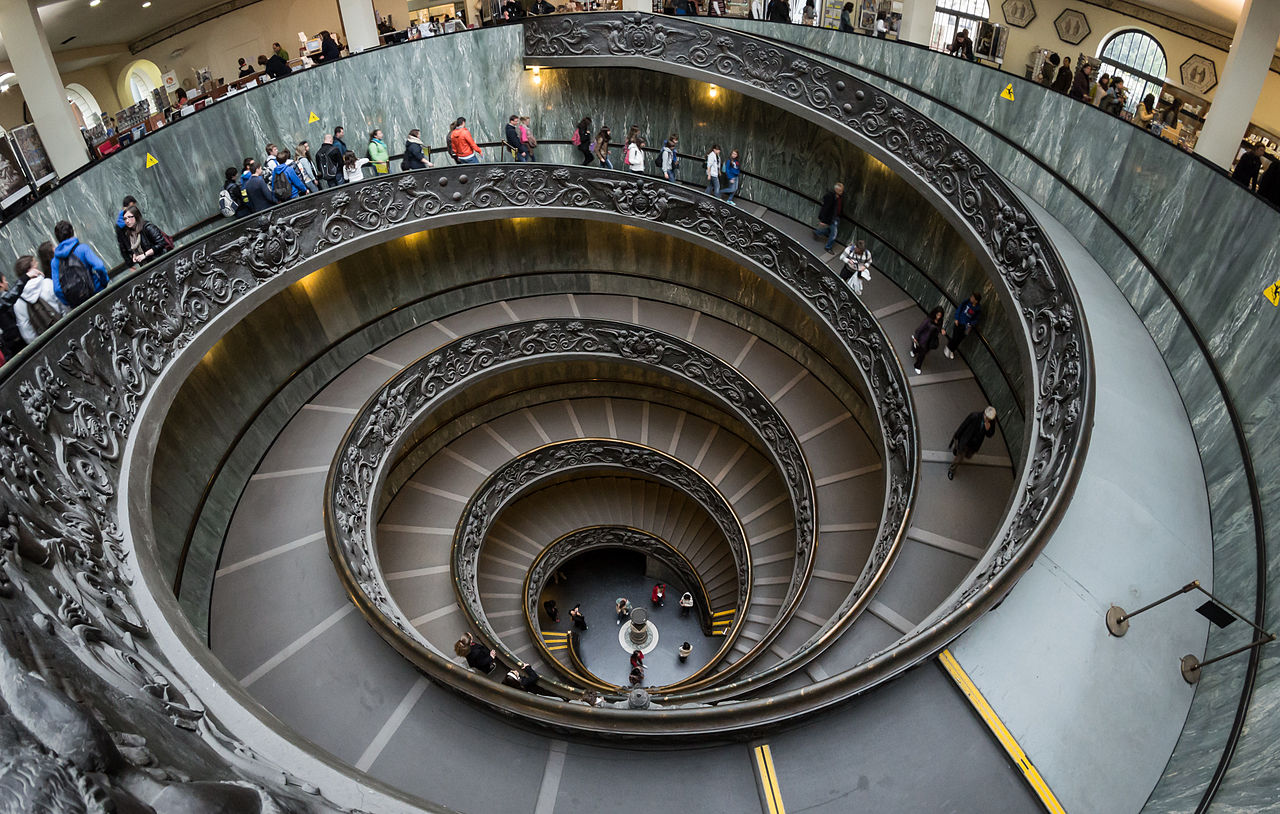
The 20th century transformed the Museums and their setting. In 1929, the Lateran Pacts signed between the Holy See and the Italian State created Vatican City as an independent sovereign state, the smallest in the world. The Museums thus found themselves inside a state of their own, and their management was modernised. Shortly afterwards, in 1932, Pope Pius XI opened a new monumental entrance for visitors, with the famous double-helix spiral staircase designed by Giuseppe Momo, which would become one of the iconic images of the Vatican.
Throughout the century, the Museums kept growing and opening up to new periods of art. In 1973, Pope Paul VI inaugurated the Collection of Modern and Contemporary Religious Art, with works by artists such as Matisse, Chagall, Dalí, Van Gogh, Gauguin and Francis Bacon, bringing 20th-century art into the papal heritage. The Gregorian Profane Museum, the Pio Christian Museum and the Missionary Ethnological Museum, with art from all over the world, were also added.
One of the great events of the late 20th century was the restoration of the Sistine Chapel (1980-1994), which gave Michelangelo's frescoes back their original colours, hidden for centuries under soot and grime, in a project as admired as it was debated. Today the Vatican Museums receive several million visitors every year, which poses challenges for conservation and crowd management, and calls for ever stricter booking and capacity-control systems.
The Vatican Museums are today one of the largest and most visited museum complexes on the planet. Across their several kilometres of galleries, five centuries of papal collecting and thirty centuries of art history sit side by side along a single route: sculptures from classical Greece and imperial Rome, mummies from ancient Egypt, Etruscan bronzes, Renaissance frescoes, Flemish tapestries, painting from Giotto to Caravaggio, the modern art of Matisse and Chagall, and the absolute climax of Michelangelo's Sistine Chapel.
That accumulation is the result of a unique history: that of a power, the papacy, which for centuries was at once a religious authority, a state and one of the greatest patrons and collectors in history. Every pope wanted to leave his mark by buying antiquities, commissioning works or founding new museums, and the result is this visual encyclopaedia of Western civilisation (and not only Western, thanks to the Egyptian, Etruscan and ethnological collections).
That's why visiting the Vatican Museums is much more than seeing beautiful art: it's a journey through the memory of European collecting and a way to understand how art served power and faith for centuries. The institution now faces the challenge of preserving this heritage against the wear and tear of millions of visitors a year, balancing public access with the protection of fragile works such as the Sistine frescoes. From that Laocoön bought by Julius II in 1506 to the contemporary art rooms, the Vatican Museums remain an unmissable stop for anyone travelling to Rome.