Viajá con Gus
Home › Russia › Volgograd
Volgograd
🇷🇺 Russia · The Volga and the south

Volgograd

🪪 What do I need to enter Russia?Pick your citizenship and we tell you the visa, the days and the paperwork, with the official source.

By leaving your email and citizenship you agree to receive the documents you asked for and weekly travel news. You can unsubscribe whenever you want. How we handle your data.
Jump to what you need
📍Region
Volgograd (Волгоград) is the capital of the oblast of the same name, in southern Russia, on the western bank of the lower Volga, about 900 km south-east of Moscow. With close to a million inhabitants, it stretches out in a long strip for more than 80 km along the river. Founded in the 16th century as Tsaritsyn, it was called Stalingrad between 1925 and 1961, and that name was etched into world history for ever by the Battle of Stalingrad (1942-1943), one of the most decisive and bloodiest clashes of the Second World War. The city was completely flattened and later rebuilt, and today it is a great living memorial, dominated by the colossal Motherland statue on Mamayev Kurgan hill
📌Current restrictions
Plainly and without drama: because of the war in Ukraine and the international sanctions in force in 2026, travelling to Russia today comes with real restrictions. Most Western governments advise against non-essential travel; there are no direct flights from Western Europe or the Americas (you get there via Istanbul, Dubai or Central Asia); foreign Visa and Mastercard cards do NOT work in the country; and you need a visa. Volgograd is also in southern Russia, relatively close to the conflict zone, so take extra care and check the official advisories. This guide is informative and cultural, not an invitation to ignore those warnings
📌Best time to visit
From May to September, with warm, dry weather (summer can be very hot, over 30 °C). Spring and early autumn are pleasant for visiting the open-air memorials. 2 February (anniversary of the end of the battle) and 9 May (Victory Day) are the most solemn and busiest dates. Winter is cold and windy
📌Suggested days
With 1 or 2 days you can cover the essentials: the Mamayev Kurgan memorial complex with the Motherland statue, the Stalingrad Battle Panorama Museum, Pavlov's House and the Volga embankment. An extra day lets you add a museum, a river trip and the nearby lock on the Volga-Don Canal. Above all it is a destination of historical memory, best explored calmly and respectfully
📌Getting there
Volgograd has an airport (code VOG), with domestic flights and flights to a few foreign hubs. From Moscow, Russian Railways (RZD) trains take about 18-20 hours (long-distance overnight trains); there are also rail connections with the south and the Caucasus. In summer, Volga river cruises call at the city. Note: because it is close to the conflict zone, check the status of airports and trains before you travel
📌Getting around
Volgograd has an unusual 'metrotram' (a fast tram that runs partly underground, like a light metro), as well as trams, trolleybuses and buses. You pay with a local card or in cash. Since the city is very long and narrow, it makes sense to combine public transport and taxis. Taxis and Russian apps (Yandex Go) are cheap. The major memorials are served by public transport
📌Language and currency
Russian is spoken; English is very limited. The currency is the Russian rouble (RUB, ₽). In July 2026, 1 USD ≈ 80-90 ₽ roughly (the exchange rate is volatile because of the sanctions; check on the day you travel). Foreign cards do not work: bring cash in dollars or euros and change it into roubles at banks in the country
💱 RUB exchange rate
Loading rate…
🌤️ Weather in Volgograd
Loading weather…

Volgograd is, above all, a place of memory. Under its former name, Stalingrad, this city on the lower Volga was the scene, between 1942 and 1943, of the Battle of Stalingrad, one of the longest, bloodiest and most decisive battles of the entire Second World War. There, after months of house-to-house fighting and an encirclement that trapped a whole German army, the course of the war on the Eastern Front changed for good. The city was completely destroyed and lost hundreds of thousands of lives, among its defenders and its civilians alike. Rebuilt afterwards from the rubble, today it is a vast living memorial.

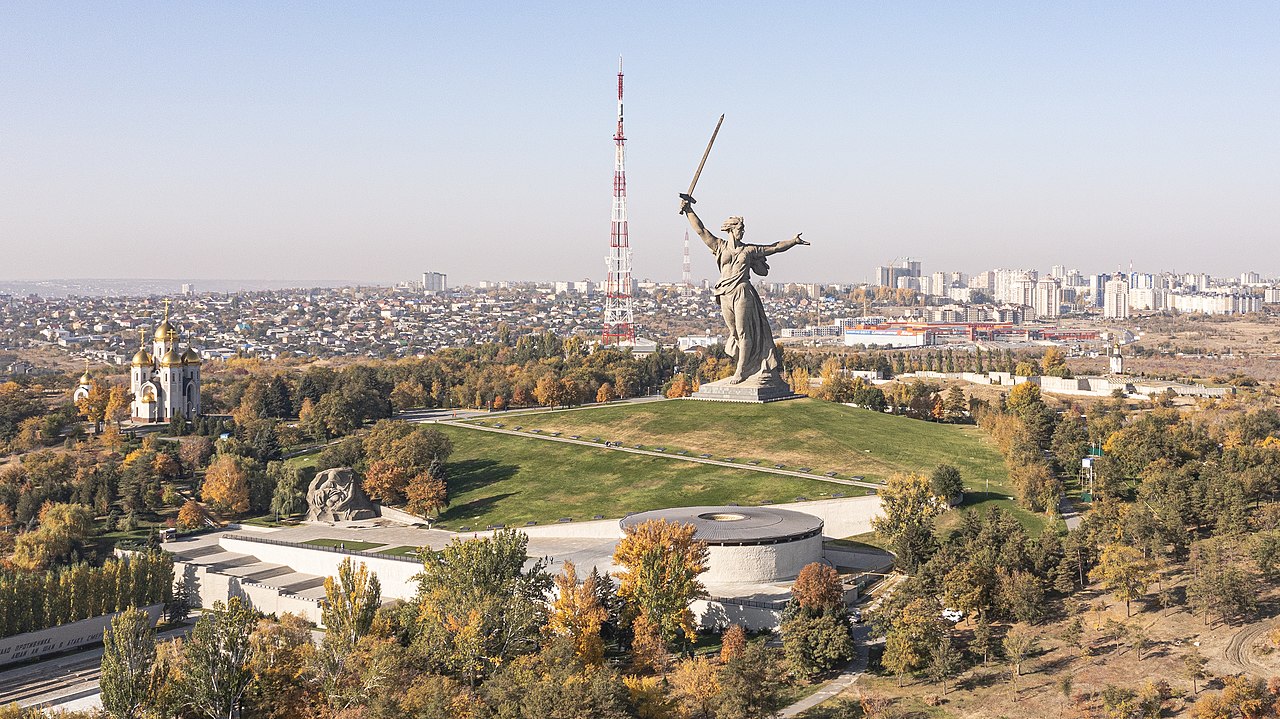
The symbol of that memory is Mamayev Kurgan, the hill that overlooks the city and was one of the most fiercely contested points of the battle. On top of it stands the colossal 85-metre statue 'The Motherland Calls', one of the tallest in the world, presiding over a solemn memorial complex that you climb through sculptures, graves and an eternal flame. It is a place that calls for silence and reflection, and one to visit with respect for the scale of what it commemorates.

This guide covers Volgograd soberly and without sensationalism: what Mamayev Kurgan, the battle's Panorama Museum and Pavlov's House mean and how to visit them, plus the Volga embankment and other corners of the city. First, a necessary note: travelling to Russia today, in the middle of a war and under sanctions, comes with real restrictions, and Volgograd is in the south of the country, closer to the conflict zone; always check the official advisories. Take this guide as informative and historical reading about a place central to the memory of the 20th century.

📖 History of Volgograd

Volgograd was founded in 1589 as the fortress of Tsaritsyn, on the bank of the Volga, to protect the southern frontier and the river route. It grew into a commercial and industrial city and, after the Revolution, was renamed Stalingrad ('Stalin's city') in 1925, in honour of Joseph Stalin, who had played a part in its defence during the Civil War. Between 23 August 1942 and 2 February 1943 the Battle of Stalingrad was fought here, one of the most decisive clashes of the Second World War: the German 6th Army tried to take the city in a brutal street-by-street fight; the Soviet defenders held on, clinging to the bank of the Volga, and a counter-offensive (Operation Uranus) encircled and destroyed the Axis forces. The Soviet victory marked a turning point in the war, but at an immense human cost, with hundreds of thousands of military and civilian dead on both sides and the city reduced to rubble. Rebuilt after the war, in 1961, as part of the de-Stalinisation pushed by Khrushchev, the city changed its name to the neutral Volgograd ('Volga city'). In 1967 the great memorial complex crowned by the statue 'The Motherland Calls' was inaugurated on Mamayev Kurgan hill. Today Volgograd is an industrial capital and a major centre of historical memory, with recurring debates about temporarily restoring the name Stalingrad on commemorative dates. The full story is on our history page.

Read the full history ↓

🏛️ Volgograd is in the Volga and the south

Russia's great mother river and the mixed south: Tatar Kazan, the Stalingrad that turned a world war, and the subtropical balcony on the Black Sea.

Read the history of The Volga and the south →

🗺️ What to see

1
Mamayev Kurgan and 'The Motherland Calls'
The memorial hill overlooking the city, crowned by the colossal Motherland statue: the great monument to the Battle of Stalingrad and its fallen.
Leer más ↓
Mamayev Kurgan (the 'mound of Mamai') is the heart of Volgograd's memory and one of the most striking war memorials in the world. It is a hill that overlooks the city and the Volga, and during the Battle of Stalingrad it was one of the most ferociously contested points: it changed hands many times and tens of thousands of soldiers died on its slopes. It is said that after the battle the ground was so churned up by shrapnel that for years barely any grass grew on it. Between 1959 and 1967 the great memorial complex was built here, the work of sculptor Yevgeny Vuchetich. Visitors climb a processional way that passes several sculptural ensembles —the walls with reliefs of the fighting, the Square of Heroes, the pool, the Hall of Military Glory with its eternal flame watched over by a guard— until they reach the top. There stands 'The Motherland Calls' (Ródina-mat zovyot), an 85-metre female figure with her sword raised, calling her children to defend the homeland; when it was unveiled it was the tallest free-standing statue in the world, and it is still one of the largest. It is a solemn place, visited in silence and with respect. Many Russians come to pay tribute to their fallen ancestors. The full climb, with its 200 steps (one for each day of the battle), is an overwhelming experience. Getting there: on the hill overlooking the north-central part of the city; it has its own metrotram stop (Mamayev Kurgan). Best time: any; especially solemn on 2 February and 9 May. Admission: access to the open-air memorial complex is free. Tips: visit it in a reflective mood; dress respectfully; allow at least a couple of hours for the full route.
ℹ️ Distance: Hill above the north-centre; Mamayev Kurgan metrotram stop · Best time to visit: Any; very solemn on 2 February and 9 May · Admission: Free (open-air memorial complex, verified July 2026) · Duration: 2-3 hours
2
Stalingrad Battle Panorama Museum
The great museum on the banks of the Volga that tells the story of the battle, with a monumental 360-degree panoramic painting and the remains of Gerhardt's Mill.
Leer más ↓
The Stalingrad Battle Panorama Museum, on the banks of the Volga, is the main place to understand what happened in the city between 1942 and 1943. Its most famous piece is the Panorama: a huge circular 360-degree painting, about 16 metres high and 120 metres around, that surrounds the viewer and recreates the climax of the battle, with the final Soviet assault on Mamayev Kurgan. Combined with foreground elements (terrain, weapons, objects), it creates a powerful sense of immersion. The museum also holds a very thorough exhibition on the battle: weapons, uniforms, documents, letters, photographs, dioramas and personal belongings of soldiers and civilians from both sides, which help you grasp the scale of the suffering and sacrifice. Outside, military hardware from the period is on display (tanks, guns, an aircraft). Next to the museum stand the remains of Gerhardt's Mill (Guérhardt), deliberately kept in ruins: a building riddled by the fighting that has been left just as it was after the battle, as a silent testimony to the destruction. It is an essential visit, handled with seriousness and historical rigour. Getting there: in the centre, on the banks of the Volga, near Pavlov's House; on foot or by city transport. Best time: any; ideal to combine with Mamayev Kurgan. Admission: the museum and the Panorama cost a moderate amount (about 400-600 ₽, ~5-7 USD, verified July 2026); the outdoor area with the military hardware and the mill is free. Tips: allow time for the Panorama; audio guides and guided tours are available.
ℹ️ Distance: Centre, Volga bank, next to Pavlov's House (on foot) · Best time to visit: Any · Admission: Museum and Panorama ~400-600 ₽ (~5-7 USD); outdoor area free (verified July 2026) · Duration: 2 hours
3
Pavlov's House (Dom Pavlova)
The building that a small group of Soviet soldiers defended for almost two months, a symbol of resistance in the battle.
Leer más ↓
Pavlov's House (Dom Pavlova) is one of the most moving symbols of resistance in the Battle of Stalingrad. It is a four-storey apartment building near the bank of the Volga that, in September 1942, was taken by a small group of Soviet soldiers under Sergeant Yakov Pavlov. That handful of men, just two or three dozen, fortified the building and held it for almost two months against repeated German assaults, at a key point overlooking the square and the approaches to the river. The stubborn defence of Pavlov's House became a legend and an emblem of the city's spirit of resistance: it is said that the German command even marked it on their maps as a full-blown fortress. The building was left half-destroyed and was rebuilt after the war; on one side, a fragment of the bullet-riddled wall was preserved and turned into a monument, with a commemorative inscription, as a permanent reminder. Today it is an ordinary residential building, but its memorial wall and its history make it an essential, sober stop on the Stalingrad memory route, very close to the Panorama Museum. Getting there: in the centre, near the Panorama Museum and the Volga bank; on foot. Best time: any. Admission: free (it is a building with an outdoor memorial wall). Tips: combine it with the Panorama Museum and Gerhardt's Mill, right next door; read the commemorative plaque.
ℹ️ Distance: Centre, next to the Panorama Museum (on foot) · Best time to visit: Any · Admission: Free (outdoor memorial wall, verified July 2026) · Duration: 20-30 minutes
4
Volga embankment and river station
The promenade along the great river, with monumental staircases, gardens and the river station: the city's bright breathing space.
Leer más ↓
After the emotional weight of the memorials, the Volga embankment (naberezhnaya) offers Volgograd's bright, open breathing space. The promenade runs along the bank of the great river in the city centre, with gardens, fountains, monuments and an imposing Soviet-style monumental staircase that leads down from the city to the water, flanked by colonnades (the propylaea). It is one of the most elegant corners of post-war rebuilt Volgograd. From here you can take in the sheer width of the Volga —which on this dammed stretch looks almost like a lake— and the pleasure boats set off. The river station (rechnoy vokzal) is a large Soviet building from which cruises and local boats depart. The embankment is where locals come out for a stroll, and where visitors can sit down to rest, have a drink and watch the city's everyday life. The same stretch of river is the starting point for other sights, such as the lock on the Volga-Don Canal, and from the water you get a good sense of the geography that was key to the battle: whoever controlled the bank controlled the supplies. Getting there: in the centre, on the banks of the Volga; on foot. Best time: spring to autumn, especially at sunset. Admission: strolling is free; boat trips have their own fare (about 500-1.000 ₽, ~6-12 USD, verified July 2026). Tips: combine it with a river trip; it is the calm counterpoint to the memorials.
ℹ️ Distance: Centre, Volga bank (on foot) · Best time to visit: Spring to autumn; at sunset · Admission: Promenade free; boat ~500-1.000 ₽ (~6-12 USD) (verified July 2026) · Duration: 1-2 hours
5
Gerhardt's Mill (Guérhardt) and Square of the Fallen Fighters
The preserved ruins of a mill destroyed in the battle and the central square with its eternal flame: deliberate scars of the war.
Leer más ↓
Gerhardt's Mill (sometimes transcribed Guérhardt, or called Grudinin's Mill) is one of the most striking testimonies to the destruction of Stalingrad. It is an early 20th-century steam mill that was completely riddled with bullets and burnt out during the battle and that, unlike almost every other building in the city, was not rebuilt: it was deliberately kept in its ruined state, its brick walls pierced by shells, as a permanent monument to what happened there. It stands next to the Panorama Museum, forming a single memorial ensemble with it. In the city centre you will also find the Square of the Fallen Fighters (Ploshchad Pavshikh Bortsov), Volgograd's main square, presided over by an obelisk and an eternal flame in memory of the city's defenders, from both the Civil War and the Second World War. An honour guard stands watch there and official ceremonies are held. Nearby grows a poplar that survived the battle, marked with a plaque as a living witness. These sober, meaningful places round off the city's memory route and help convey the scale of both the tragedy and the reconstruction. Getting there: in the centre; the mill next to the Panorama Museum, the Square of the Fallen Fighters in the heart of the city; on foot. Best time: any. Admission: free (outdoor monuments). Tips: visit them respectfully; read the information plaques; combine them with the other memorials in the centre.
ℹ️ Distance: Centre; mill next to the Panorama Museum (on foot) · Best time to visit: Any · Admission: Free (outdoor monuments, verified July 2026) · Duration: 45 minutes to 1 hour
6
Volga-Don Canal and the first lock
The great Soviet hydraulic project linking the Volga and the Don, with a monumental triumphal arch at its first lock.
Leer más ↓
On the outskirts of Volgograd, in the Krasnoarmeysk district, is the start of the Volga-Don Canal (Lenin Canal), one of the great hydraulic engineering projects of the Soviet era. Opened in 1952, the canal links the two great rivers of European Russia, the Volga and the Don, allowing continuous navigation for the first time between the Caspian Sea and the Sea of Azov (and from there the Black Sea), a dream centuries old. It was built in record time, largely with Gulag prisoner labour, a fact worth remembering without embellishment. The canal's first lock, beside the Volga, is marked by a spectacular triumphal arch in Soviet imperial style, one of the grandest in the country, framing the passage of the ships. A gigantic statue of Stalin once stood there, removed during de-Stalinisation. The ensemble reflects the monumental ambition of post-war Stalinist architecture. It is a visit some way from the centre, of interest mainly to those who enjoy engineering, Soviet history and river navigation. You can watch ships passing through the lock and see the great arch. Getting there: south of the city, in Krasnoarmeysk; by metrotram/bus or taxi. Best time: spring to autumn. Admission: seeing the arch and the lock from outside is free. Tips: it is a secondary outing; add it only if you have extra time.
ℹ️ Distance: South of the city, Krasnoarmeysk (metrotram/bus or taxi) · Best time to visit: Spring to autumn · Admission: Free (viewed from outside, verified July 2026) · Duration: 1-2 hours including travel
📶I have never landed without internet. I arrive and my phone connects to the strongest network in the country I am visiting: I can say I landed, sort out transport, book tours and keep posting, at a seriously good price. I always use the Maya eSIM — check their plans by clicking the banner.See plans →Maya Mobile eSIM — connect before you land
What nobody tells you

💵 Prices

Tickets

TypePrice
Mamáyev Kurgán y estatua de la Madre PatriaFree (open-air memorial complex, verified July 2026)
Museo-Panorama de la Batalla de Stalingrado~400-600 ₽ (~5-7 USD); outdoor area with military hardware free (verified July 2026)
Casa de Pávlov (muro-monumento)Free (verified July 2026)
Molino Guérhardt y plaza de los CaídosFree (outdoor monuments, verified July 2026)
Paseo del Volga (malecón)Free; pleasure boat ~500-1.000 ₽ (~6-12 USD, verified July 2026)
Museo de Historia Local / Museo Memorial~200-400 ₽ (~2,5-5 USD, verified July 2026)
Arco y esclusa del canal Volga-DonFree (viewed from outside, verified July 2026)
🔄 updated monthlyOfficial / reference values · double-check when buying

Activities and tours

ActivityPriceDurationOperator
Guided tour of the Battle of Stalingrad memorialsGuided tour 1.500-3.500 ₽ per group (~18-44 USD, verified July 2026)Half dayLocal guides and historians
Guided entry to the Panorama MuseumAdmission ~400-600 ₽ + guide/audio guide ~300 ₽ (~9-11 USD, verified July 2026)2 hoursStalingrad Battle Panorama Museum
Boat trip on the Volga500-1.200 ₽ per person (~6-15 USD, verified July 2026)1-2 hoursVolgograd river station (summer)
Historical walking tour of the rebuilt centreTip-based free tour (tip ~500-1.000 ₽); private tour from 1.500 ₽ (~6-18 USD, verified July 2026)2-3 hoursLocal guides
Excursion to the Volga-Don Canal and the first lockExcursion 1.500-3.000 ₽ per person (~18-37 USD, verified July 2026)Half dayLocal agencies
Ride on the city's metrotram (tram-metro)Ticket ~35 ₽ (~0,5 USD, verified July 2026)Depends on routeVolgograd city transport
🔄 updated monthlyOfficial / reference values · double-check when buying

🚌 How to get there and distances

Getting around

Metrotram (fast tram / light metro)
PriceTicket ~35 ₽ (~0,5 USD) in cash (verified July 2026)
DurationVariable
Notes
Volgograd's unusual tram, which runs underground like a metro along its central section; it links the centre with the great memorials, including Mamayev Kurgan
Tram, trolleybus and city bus
DurationVariable
NotesHandy in a very long, narrow city (more than 80 km along the Volga)
Price
~35 ₽ per ticket (~0,5 USD), paid to the driver or with a local card (verified July 2026)
On foot
Free
DurationVariable
Notes
The historic centre (Panorama Museum, Pavlov's House, Square of the Fallen Fighters, riverside promenade) is compact; the nearby memorials are easy to combine with walks
Taxi and Russian apps (Yandex Go)
PriceAverage city ride ~200-450 ₽ (~2,5-6 USD, verified July 2026)
DurationVariable
Notes
Practical given the length of the city; pay in cash or with a Russian card
River boat
PriceCruises ~500-1.000 ₽ (~6-12 USD, verified July 2026)
DurationVariable
Notes
In summer, Volga boats work both as a leisurely outing and as a link to the opposite bank and nearby destinations
🔄 updated monthlyOfficial / reference values · double-check when buying

How to get there

RouteAirlines / operatorsAvg. priceDuration
Volgograd Airport (VOG) → centreBus, taxi/YandexBus ~40 ₽; taxi ~700-1.000 ₽ (~9-12 USD, verified July 2026)40-50 min
Moscow → Volgograd by overnight train (RZD)Russian Railways (RZD / РЖД)Sleeper berth from ~3.000-6.000 ₽ (~37-75 USD, verified July 2026)Approx. 18-20 hours
Volgograd and southern Russia / the Caucasus by trainRussian Railways (RZD)Varies by destination and classVariable
Volga river cruise (Kazan, Nizhny Novgorod, Astrakhan)Russian river cruise companiesDepends on itinerary (several days)Several days (summer)
Domestic flight from Moscow or other citiesRussian domestic airlinesVariable; check availability given the regional situation~2 hours from Moscow
🔄 updated monthlyOfficial / reference values · double-check when buying

🏨 Where to stay

No exact prices: a scale from $ (budget) to $$$$$ (luxury), with 2-3 options per category.

Luxury / upscale in the centre
Price$$$$$
Recommended options
6.000-13.000 ₽ per night (~75-162 USD). Examples: Hampton by Hilton (locally operated), Volgograd Hotel, Southern Palmyra, in the centre near the riverside promenade (verified July 2026)
Well-located mid-range
Price$$$$$
Recommended options
2.800-5.500 ₽ per night (~35-69 USD). Examples: Hotel Volgograd, Hotel Yuzhny, hotels near the Square of the Fallen Fighters and the station (verified July 2026)
Practical, near the memorials
Price$$$$$
Recommended options
3.000-6.000 ₽ per night (~37-75 USD). Hotels in the centre with easy access to the Metrotram and Mamayev Kurgan (verified July 2026)
Budget / hostels
Price$$$$$
Recommended options
Dorm bed 500-1.200 ₽; budget double 1.600-3.000 ₽ (~6-37 USD). Hostels near the centre and the train station (verified July 2026)

🍴 Where to eat

Cocina rusa tradicional
Price$$$$$
Options / signature dish
Main course 350-800 ₽ (~4-10 USD): borscht, pelmeni, Volga fish, at restaurants in the centre (verified July 2026)
Cocina del sur y caucásica
Price$$$$$
Options / signature dish
Dish 350-700 ₽ (~4-9 USD): shashlik, Georgian and Armenian cuisine (khachapuri, khinkali), very common in southern Russia (verified July 2026)
Cafés y comida rápida local
Price$$$$$
Options / signature dish
Light meal 250-500 ₽ (~3-6 USD): cafés, bakeries and budget spots in the centre (verified July 2026)
Restaurantes con vista al Volga
Price$$$$$
Options / signature dish
Set menu 1.500-3.500 ₽ per person (~18-44 USD): restaurants along the riverside promenade with river views, Russian and international cuisine (verified July 2026)

📖 History of Volgograd

Origins, formation and what the sources say.

Tsaritsyn: a fortress on the lower Volga

The city the world would come to know as Stalingrad, and today as Volgograd, was born in 1589 under the name Tsaritsyn. It was founded as a fortress on the bank of the lower Volga, on the southern frontier of the Russian state, to protect the river route and the southern lands from raids by the nomadic peoples of the steppe. Its name had nothing to do with the tsars: it probably came from a local Turkic place name ('Sary-su', 'yellow water', or something similar), although its resemblance to the Russian word for 'tsarina' led to some confusion.

Lying at a point where the Volga comes close to the River Don, Tsaritsyn held a strategic position for trade and communications between the Caspian, the Caucasus and the heart of Russia. During the 17th and 18th centuries it was the scene of the great Cossack and peasant revolts that shook the south of the country, such as those of Stenka Razin and Yemelyan Pugachev, who went as far as besieging or taking the city.

In the 19th century, with the arrival of the railway and the boom in steam navigation on the Volga, Tsaritsyn grew into a thriving commercial and industrial city: a port for grain, oil and timber, with metalworks and sawmills. By the early 20th century it was already a major transport hub and one of the fastest-growing cities in southern Russia.

The origin of the name Tsaritsyn
Despite its resemblance to 'tsaritsa' (tsarina), the name Tsaritsyn almost certainly comes from an earlier Turkic place name linked to the local Tsaritsa river, whose own name is thought to derive from Turkic expressions such as 'sary-su' ('yellow water') or 'sary-sын'. The phonetic similarity to the Russian word is a coincidence.
Source: https://en.wikipedia.org/wiki/Volgograd

From Tsaritsyn to Stalingrad: revolution and a new name

The 1917 Revolution and the Russian Civil War hit the lower Volga hard. Because of its strategic value as a transport hub and gateway to the Caucasus and its resources, Tsaritsyn saw fierce fighting between the Red Army and the White forces in 1918 and 1919. Joseph Stalin, then a rising leader in charge of supplies and military organisation in the region, played a prominent role in the Bolshevik defence of the city.

That role would be remembered years later: in 1925, with Soviet power consolidated and Stalin rising within the Party, the city was renamed Stalingrad ('Stalin's city') in his honour. It was one of many places in the country that took the leader's name during the period of the personality cult.

As Stalingrad, the city became a major industrial centre of the first Soviet five-year plan. Huge factory complexes went up, such as the Dzerzhinsky Tractor Factory (which would produce tanks in wartime), along with metallurgical and chemical plants, and the population grew quickly as workers arrived from all over the country. By the early 1940s, Stalingrad, stretched out along the bank of the Volga, was a symbol of Soviet industrialisation and a key piece of the southern economy.

The Battle of Stalingrad (1942-1943)

The name Stalingrad was etched forever into world history by the battle fought in the city between 23 August 1942 and 2 February 1943, one of the longest, bloodiest and most decisive clashes of the Second World War. This account is told soberly and without sensationalism, given the scale of what it represents.

In the summer of 1942, as part of its offensive towards the Caucasus and its oilfields, Nazi Germany sent the 6th Army, under General Friedrich Paulus, against Stalingrad. The city was first devastated by air raids that caused enormous civilian casualties, and then turned into an urban battlefield. For months the fighting went street by street, house by house and even floor by floor, in a brutal struggle over every ruin, with places such as Pavlov's House and the Mamayev Kurgan hill changing hands again and again. The Soviet defenders, under generals such as Vasily Chuikov, held on to a narrow strip along the bank of the Volga, barely kept supplied by crossings of the river under fire.

In November 1942, the Red Army launched Operation Uranus, a counter-offensive that broke through the weaker flanks, held by Romanian and other Axis troops, and completely encircled the German 6th Army inside the city. Trapped, without enough supplies and in the depths of winter, the encircled forces finally surrendered in early February 1943; Paulus himself, newly promoted to field marshal, was taken prisoner. The casualty figures were colossal — hundreds of thousands killed, wounded and captured on both sides, as well as the civilian population — making Stalingrad one of the deadliest battles in history.

A turning point in the war
Many historians regard the German defeat at Stalingrad as the great turning point of the war on the Eastern Front: after it, the strategic initiative passed lastingly to the Red Army, which would from then on advance westwards. The human cost, however, was immense for both sides and for the city's civilian population.
Source: https://en.wikipedia.org/wiki/Battle_of_Stalingrad

Reconstruction and a new name

When the battle ended, Stalingrad was a sea of ruins. Hardly a single building was left standing, and the population, which before the war had been around half a million, had been decimated and scattered. Rebuilding the city became a gigantic and symbolic undertaking: Stalingrad, together with Coventry in England, was one of the first cities in the world to establish an international twinning, precisely as a gesture of reconciliation between peoples who had suffered the destruction of war.

In the 1940s and 1950s, the city was reborn in the monumental Stalinist architecture of the post-war years: wide avenues, colonnaded buildings, the grand staircase down to the Volga embankment, the Square of the Fallen Fighters. New factories and neighbourhoods went up, and the population grew again. The city spread out, long and narrow, for dozens of kilometres along the river.

In 1961, as part of the de-Stalinisation pushed by Nikita Khrushchev — the process of criticising and dismantling the cult of Stalin that began after the dictator's death in 1953 — the city stopped bearing his name. It was renamed Volgograd, 'city on the Volga', a neutral, geographical name. The change made sense within that policy, but it left a certain emotional unease: for many people, especially veterans, the heroism and sacrifice were tied to the name Stalingrad, not to Stalin the man.

Mamayev Kurgan and the building of memory

The memory of the battle took shape in one of the most striking monumental ensembles in the world. Between 1959 and 1967, on the Mamayev Kurgan hill — one of the most fiercely contested points of the fighting — the great memorial complex 'To the Heroes of the Battle of Stalingrad' was built, the work of sculptor Yevgeny Vuchetich and engineer Nikolai Nikitin. Visitors climb a processional route lined with sculptural groups, walls with reliefs, the Square of Heroes and the Hall of Military Glory with its eternal flame, all the way to the top.

Crowning the ensemble is 'The Motherland Calls' (Rodina-mat zovyot), an 85-metre female figure who brandishes a sword and turns her face to call her children to defend the homeland. When it was unveiled in 1967 it was the tallest free-standing statue in the world, and it is still among the largest; it is also the tallest sculpture of a female figure ever built. The remains of tens of thousands of soldiers lie on the hill, and Marshal Chuikov, one of the city's defenders, is buried there.

Other sites complete this landscape of memory: the Stalingrad Battle Panorama Museum, with its huge circular painting; Pavlov's House, a symbol of the resistance; and the preserved ruins of the Gerhardt mill, deliberately left just as they were. The whole city centre is, in a sense, a memorial. These places are visited with respect and quiet reflection, as befits the scale of the tragedy they recall.

The Motherland statue
'The Motherland Calls' stands 85 metres tall including the sword and, when it was unveiled in 1967, was the tallest free-standing statue in the world. Built in pre-stressed reinforced concrete, it was an engineering feat by Nikolai Nikitin, the same engineer behind the Ostankino TV tower in Moscow. Because of its size and exposure, it needs constant maintenance.
Source: https://en.wikipedia.org/wiki/The_Motherland_Calls

Volgograd today: memory, debate and the present

Today's Volgograd is a large industrial and transport centre in southern Russia, with around a million inhabitants spread over more than 80 kilometres along the Volga. It keeps its strong industrial base (metallurgy, chemicals, machinery) and its role as a link between the Russian heartland, the Caucasus and the Caspian, reinforced by the Volga–Don Canal, the waterway that finally connected the two rivers in 1952.

Its identity, however, still revolves around the battle. The city is a destination for historical remembrance, drawing visitors from all over Russia and abroad, and every 2 February (the anniversary of the victory in the battle) and every 9 May (Victory Day) it holds solemn commemorations. There is also a recurring public debate about giving the city back the name Stalingrad, at least symbolically: in practice, on certain commemorative dates the city officially takes back that name for a few days, a decision that stirs emotions and controversy within Russian society itself, given the historical weight of Stalin as a figure.

For travellers, Volgograd is a sober and overwhelming place that helps you grasp the scale of the suffering of the Second World War on the Eastern Front and the way Russia remembers that tragedy. It is worth repeating, just as soberly, that in the current context of war and international sanctions, travel to the country comes with real restrictions, and that Volgograd, in the south, is relatively close to the conflict zone; this guide is offered for strictly informational and historical purposes, without disregarding official travel advice.

📚 Bibliography

  • Wikipedia (ES) — «Volgogrado»: https://es.wikipedia.org/wiki/Volgogrado
  • Wikipedia (EN) — «Volgograd»: https://en.wikipedia.org/wiki/Volgograd
  • Wikipedia (EN) — «Battle of Stalingrad»: https://en.wikipedia.org/wiki/Battle_of_Stalingrad
  • Wikipedia (ES) — «Batalla de Stalingrado»: https://es.wikipedia.org/wiki/Batalla_de_Stalingrado
  • Wikipedia (EN) — «The Motherland Calls»: https://en.wikipedia.org/wiki/The_Motherland_Calls
  • Wikipedia (EN) — «Mamayev Kurgan»: https://en.wikipedia.org/wiki/Mamayev_Kurgan
  • Wikipedia (EN) — «Pavlov's House»: https://en.wikipedia.org/wiki/Pavlov%27s_House
  • Wikipedia (EN) — «De-Stalinization»: https://en.wikipedia.org/wiki/De-Stalinization
  • Wikipedia (EN) — «Volga–Don Canal»: https://en.wikipedia.org/wiki/Volga%E2%80%93Don_Canal

❓ Frequently asked questions

Can you travel to Volgograd in 2026 given the war and the sanctions?+
To put it soberly and honestly: it is physically possible (borders are open to tourists and the city functions normally), but there are real restrictions and an added warning: Volgograd is in southern Russia, relatively close to the conflict zone. Most Western governments advise against non-essential travel to Russia; there are no direct flights from the West; foreign Visa and Mastercard cards do not work; and you need a visa. Take extra care, check the status of airports and trains, and always consult your country's official advisories. This guide is strictly informational and historical.
What was the Battle of Stalingrad?+
It was one of the longest, bloodiest and most decisive battles of the Second World War, fought in this city (then Stalingrad) between August 1942 and February 1943. The German 6th Army tried to take it in brutal street-by-street fighting; the Soviet defenders held on with their backs to the Volga, and a counteroffensive encircled and destroyed the Axis forces. The victory marked a turning point in the war, but at an immense human cost, with hundreds of thousands of military and civilian dead and the city reduced to rubble. Today Volgograd is one great memorial to that tragedy.
How many days do I need to see Volgograd?+
In 1 or 2 days you can see the essentials: the Mamayev Kurgan memorial complex with The Motherland Calls statue, the Panorama Museum of the Battle of Stalingrad, Pavlov's House, the Square of the Fallen Fighters and the Volga promenade. With one more day you can add a museum, a river trip and the lock on the Volga–Don Canal. It is above all a destination of historical memory, best explored calmly and respectfully.
Why did the city change its name from Stalingrad to Volgograd?+
The city was founded as Tsaritsyn in 1589; in 1925 it was renamed Stalingrad in honour of Joseph Stalin. In 1961, during the de-Stalinisation driven by Nikita Khrushchev — who sought to erase the cult of Stalin — it was changed to the neutral name Volgograd ('city on the Volga'). The name Stalingrad remains deeply emotive because of the battle, and on certain commemorative dates the city symbolically takes that name back, something that sparks debate within Russia itself.
Is it appropriate to visit the memorials as a tourist?+
Yes, always with respect and a quiet attitude. Mamayev Kurgan, the Panorama Museum and Pavlov's House are places of remembrance and, for many Russian families, of mourning for fallen ancestors. Visit them quietly, dress modestly and avoid any festive behaviour. They are places that help you grasp the scale of the suffering caused by the war, and are treated here soberly and without sensationalism. You will see many Russians paying their respects; join them in that respect.
How do I pay if my cards don't work?+
Because of the sanctions, Visa and Mastercard cards issued outside Russia do not work in shops or at ATMs. Travellers bring cash in dollars or euros and exchange it for roubles at trusted banks inside the country. It is worth working out your budget in advance. Volgograd is an inexpensive city in dollar or euro terms, and many of its main memorials are free to visit.

More places in Russia

El Anillo de OroEkaterimburgoKaliningradoKazánKizhiLago Baikal
See every place in Russia →The history of Russia →
Sources consulted (12)
Still planning?
Explore more destinations in Russia
See all destinations →
Image credits
Photos from Wikimedia Commons, each under its own licence (CC BY, CC BY-SA or public domain). Open each file to see its author and licence.
Mamayev Kurgan Volgograd