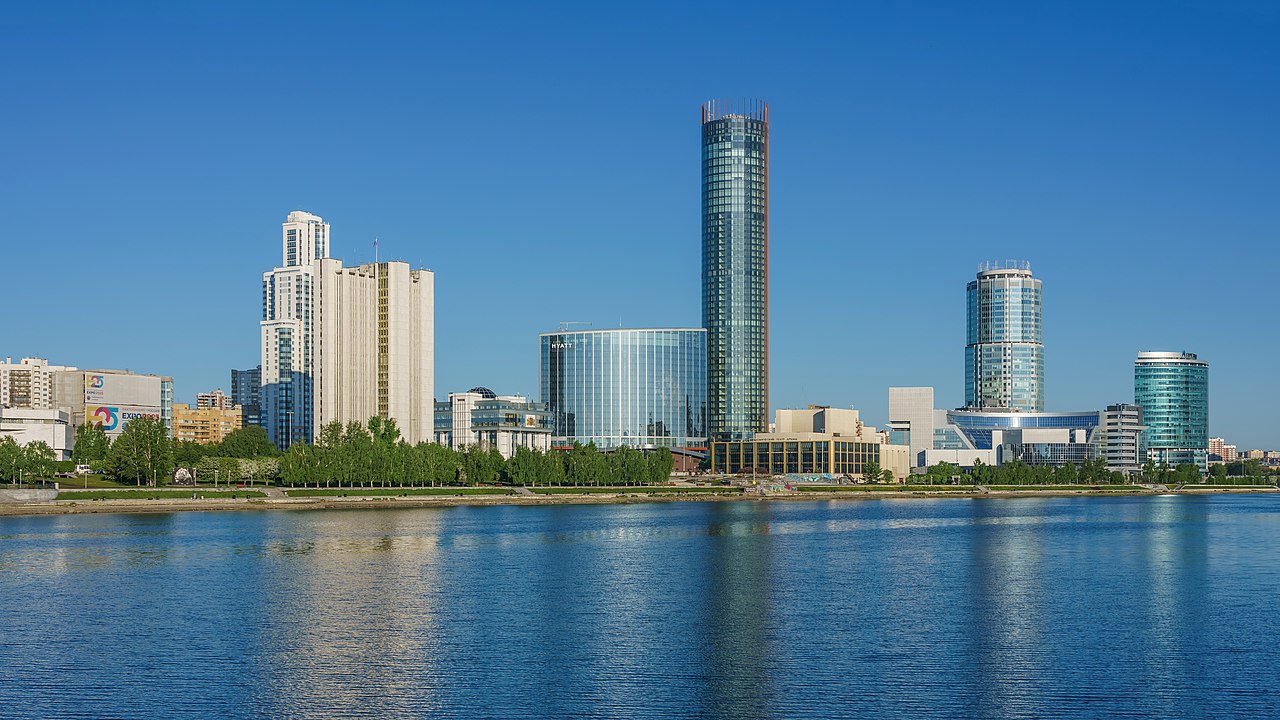
Yekaterinburg is the great city of the Urals, that range of worn-down mountains separating Europe from Asia, which Russia sees as its backbone. A few kilometres from the centre, an obelisk marks the imaginary line where one continent ends and the other begins, and you can stand with one foot in each. The city was born in 1723 as a fortress-factory to exploit the region's iron and copper, and that practical, industrial soul still beats beneath its glass skyscrapers, its wide avenues and its avant-garde Soviet workers' districts.
But if Yekaterinburg has a place in world history, it is because of one tragic night: 16 to 17 July 1918, when the last tsar, Nicholas II, his wife, their five children and their servants were shot by the Bolsheviks in the basement of a house in the city. Today the huge Church on the Blood stands on that site, and in a nearby forest, at Ganina Yama, seven wooden chapels remember each member of the imperial family. It is a place of pilgrimage and memory that draws travellers from all over the country.
Beyond the Romanovs, Yekaterinburg surprises with its urban energy: it is one of the capitals of constructivist architecture, with buildings from the 1920s and 1930s that look like ships and machines; it has the Yeltsin Center, one of the most modern museums in Russia; viewpoints over the skyline from the Vysotsky skyscraper; and a scene of cafés, street art and music that makes it feel young. It's worth saying plainly: because of the war in Ukraine and the sanctions, travelling to Russia today has its peculiarities (there are no direct flights from the West, foreign cards don't work). This guide is informative and cultural; check the current situation and official advice before deciding.
Yekaterinburg was founded in 1723 on the orders of Peter the Great as an ironworks and fortress on the banks of the Iset River, driven by the statesman Vasily Tatishchev and the German-born engineer Wilhelm de Gennin, and named in honour of Empress Catherine I (Yekaterina). For two centuries it was the great mining and metalworking centre of the Urals and a hub of routes into Siberia. In July 1918, in the city's Ipatiev House, the Bolsheviks shot Tsar Nicholas II and his whole family. Renamed Sverdlovsk in 1924 in honour of the Bolshevik leader Yakov Sverdlov, it became a Soviet industrial powerhouse, a 'closed city' to foreigners during the Cold War because of its arms factories (the American U-2 spy plane was shot down near here in 1960) and the hometown of Boris Yeltsin. In 1991 it got its original name back. The full story is on our history page.
Read the full history ↓Endless Asian Russia: the border between Europe and Asia in the Urals, the vastness of Siberia and the Trans-Siberian that runs all the way to the Pacific.
Read the history of The Urals, Siberia and the Far East →No exact prices: a scale from $ (budget) to $$$$$ (luxury), with 2-3 options per category.
Origins, formation and what the sources say.
Yekaterinburg wasn't born from a village or a monastery, as so many Russian cities were, but from an industrial decision. In the early 18th century, Peter the Great needed iron and copper for his wars and his navy, and the Ural Mountains, the long range that separates Europe from Asia, were packed with ore. In 1720 the tsar sent Vasily Tatishchev, an enlightened statesman, to the region to organise mining and metalworking. Tatishchev picked a spot on the banks of the Iset River and proposed building a large ironworks there.
The key piece of work was a dam (the one locals now fondly call the Plotinka), completed in 1723 under the direction of another decisive figure: Wilhelm de Gennin, a German-born engineer in Russian service. The water held back on the Iset powered the plant's hammers and bellows. That walled factory, with its workshops, its workers and its garrison, was the seed of the city. It was named Yekaterinburg in honour of Empress Catherine I (Yekaterina), wife of Peter the Great, and also placed under the protection of Saint Catherine, patron saint of mining.
Throughout the 18th and 19th centuries, Yekaterinburg was the heart of the Urals' metalworking empire: iron, copper, gold, semi-precious stones and malachite came out of its mines and workshops. The great Siberian Road also ran through here. This overland route linked European Russia with the vast East, and prisoners and exiles marched along it on their way to the Siberian penal colonies. The city became a crossroads between two worlds, the gateway to Asia.
Few cities have a geography as loaded with symbolism as Yekaterinburg. The Ural Mountains are the classic dividing line between Europe and Asia, and the city sits right on their eastern slope, a stone's throw from that imaginary line. For Russians, crossing the Urals always meant something: leaving European Russia behind and heading into the immensity of Siberia, eleven time zones of forests, steppes and rivers all the way to the Pacific.
That sense of a threshold left its mark on the landscape. In 1837, when the future Tsar Alexander II toured the country as heir to the throne, accompanied by his tutor, the poet Vasily Zhukovsky, the first obelisk marking the border between the two continents was put up near the city. Over the years different versions of the marker followed one another: a marble one topped by a golden eagle, destroyed after the Revolution, then a granite one in 1926. Today several monuments line the divide. The most visited, about 17 kilometres from the centre, has become a ritual for travellers, who stand astride the line with one foot in Europe and the other in Asia.
The city's growth got its final push in the early 20th century from the Trans-Siberian Railway, the colossal line whose tracks, laid from 1891 onwards, would link Moscow with the Pacific. Yekaterinburg ended up on its route, and the train brought modern industry, banks, trade and a prosperous middle class that filled the centre with mansions. When the 1917 Revolution broke out, it was already a thriving city of the Urals… and it was about to enter history in the most tragic way.
The episode that gave Yekaterinburg a permanent place in history took place in the summer of 1918, in the middle of the Russian Civil War. After the February Revolution of 1917 and the abdication of Tsar Nicholas II, the imperial family was placed under arrest and moved from place to place: the tsar, his wife Alexandra, their four daughters Olga, Tatiana, Maria and Anastasia, and the tsarevich Alexei, a boy suffering from haemophilia. In April 1918 the Bolsheviks brought them to Yekaterinburg and locked them up in a house requisitioned from an engineer named Nikolai Ipatiev. It came to be known as the Ipatiev House and was renamed, with chilling coldness, the 'house of special purpose'.
On the night of 16 to 17 July 1918, anti-communist troops (the 'Whites') and the Czech Legion were closing in on the city. Fearing the family would be freed and become a rallying banner for the counter-revolution, the local soviet ordered the execution. Nicholas II, his wife, their five children and four servants were taken down to the basement on the pretext of a photograph, and there they were shot and finished off. It was the brutal end of the Romanov dynasty, which had ruled Russia for more than three centuries.
The bodies were taken to the outskirts, to a wooded spot called Ganina Yama, where the executioners tried to destroy them and hide them in an old mine shaft; they were later buried at a nearby site, Porosyonkov Log. For decades the exact location of the remains was kept secret. Only after the fall of the USSR, in 1991 and again in 2007, were they found and identified through DNA testing. The Russian Orthodox Church canonised the family in 2000. Today the Church on the Blood stands on the site of the Ipatiev House. At Ganina Yama there is a monastery with seven wooden chapels, one for each member of the family who was killed. This memory is handled in a sober, devout way: it is a place of mourning, not a spectacle.
In 1924, barely six years after the killings, the city was renamed Sverdlovsk in honour of Yakov Sverdlov, an early Bolshevik leader who, from Moscow, had been involved in the order on the Romanovs' fate. Under that name the city went through its biggest transformation. Stalin's five-year plans turned it into one of the great industrial powerhouses of the USSR. Uralmash went up, a colossal heavy-machinery plant surrounded by an entire workers' district. The city also filled with constructivist architecture, the Soviet avant-garde of the 1920s and 30s, whose geometric, experimental buildings still set it apart today.
During the Second World War, with the front threatening the west of the country, hundreds of factories and millions of people were evacuated eastwards. Sverdlovsk, sheltered behind the Urals, became a crucial arsenal for the Soviet Union: tanks, guns and ammunition made here fed the war effort. That military role also shaped it during the Cold War, when it became a 'closed city', off-limits to foreigners for forty years because of its arms factories and secret facilities.
Two episodes from that era hit the city. In 1960, an American U-2 spy plane flown by Francis Gary Powers was shot down by a Soviet missile in the skies over Sverdlovsk while photographing military sites. The pilot survived and was captured, and the incident set off a diplomatic crisis at the height of the Cold War. Then in 1979, an accidental release of anthrax spores from a military biological weapons facility killed dozens of people, a disaster the USSR covered up for years. Sverdlovsk was both an industrial point of pride and a state secret.
One of the key figures at the end of the USSR came from this city: Boris Yeltsin. He was born in the region, trained as an engineer in Sverdlovsk and built his career in the Communist Party there before making the leap to Moscow. It was Yeltsin who, as local party chief in 1977, received the Politburo's order to demolish the Ipatiev House so it wouldn't become a place of monarchist pilgrimage. Years later, in his memoirs, he wrote that 'sooner or later we will be ashamed of this piece of barbarism'. Yeltsin went on to become the first president of post-Soviet Russia, and today the city honours him with the modern Yeltsin Center, one of the most ambitious museums in the country.
With the collapse of the Soviet Union in 1991, the city got its historic name back and was once again called Yekaterinburg (the surrounding region, however, is still called Sverdlovsk). The 1990s were hard, as they were all over Russia, with economic crisis, mafias and industry in ruins. Since the start of the 21st century, though, Yekaterinburg has bounced back as the great metropolis of central Russia, with glass skyscrapers like the Vysotsky, an international airport, universities, an intense cultural life and a young scene of art, music and cafés.
Today Yekaterinburg is Russia's fourth-largest city and one of the most dynamic outside the two capitals. Its whole past lives on in layers: the founding factory by the Plotinka, the mansions of the turn-of-the-century middle class, the constructivist avant-garde, the imperial memory of the Romanovs and the contemporary pulse of a city looking to the future. Like the obelisk that marks it, it is still a border place: between Europe and Asia, between industrial Russia and the new one, between history and the present. Keep in mind that you visit it in a delicate context: since 2022, the war in Ukraine and international sanctions have affected travel to Russia, and understanding its past helps you look more deeply at what you see today on the banks of the Iset.