Affiliate link: we earn a commission.
📌Location
The Zona Colonial is the historic quarter of Santo Domingo, capital of the Dominican Republic, on the banks of the Ozama River, on the country's south coast facing the Caribbean Sea. It's the 'Primada City of the Americas': the first city founded by Europeans in the New World (1498), with the first cathedral, the first university and the first fortress on the continent. Its ensemble of monuments was declared a World Heritage Site by UNESCO in 1990. It's the historic heart of a metropolis of more than three million people
📌Service town
Santo Domingo itself concentrates every service: Las Américas International Airport (SDQ) is about 25-30 km to the east (roughly 30-40 minutes on the Las Américas highway). La Isabela International Airport (JBQ), smaller and for domestic flights, is to the north. The Zona Colonial is fully integrated into the city, with boutique hotels, hostels, restaurants, banks, ATMs, pharmacies and tourism offices. It's very walkable and connects with the rest of the capital via the Malecón, taxis, apps and the nearby metro line
📌Best time to go
The Zona Colonial can be enjoyed year-round, but the best time is the dry season, from December to April, with sunny days, less rain and pleasant temperatures for walking. Between May and November it's hotter and more humid, with afternoon showers, and from August to October is the period with the highest chance of hurricanes (Santo Domingo is on the south coast, somewhat more sheltered than the east). To walk around, the morning or the late afternoon is best, when the heat eases
📌Suggested days
With 1 full day you cover the icons: the Primada Cathedral, the Alcázar de Colón, Calle Las Damas, the Ozama Fortress, the National Pantheon and the main plazas. With 2 to 3 days you can go through the museums at leisure, enjoy the nightlife of Calle El Conde and Plaza España, and add the Faro a Colón, Los Tres Ojos or a getaway to the nearby beaches (Boca Chica, Juan Dolio). It's the ideal base for combining history, culture and Caribbean city life
💱 DOP exchange rate
Loading rate…
🌤️ Weather in Zona Colonial
The Zona Colonial of Santo Domingo is, quite simply, where European America began. Founded at the end of the 15th century, this is the 'Primada City of the Americas': here stood the first cathedral, the first university, the first hospital and the first fortress in the New World, and along its cobbled streets walked Christopher Columbus, his son Diego, Hernán Cortés and so many other protagonists of the conquest. Walking it means covering the first stones of half a millennium of history.
But the Zona Colonial isn't a frozen museum: it's a living neighborhood, full of people, music and color. Its stone streets are lined with colonial mansions, convents and churches, but also with cafés, galleries, boutique hotels, bars and restaurants. Calle El Conde, pedestrian and commercial, beats by day and by night; Plaza España, facing the imposing Alcázar de Colón, fills with tables as the sun goes down; and the rhythm of merengue and bachata seeps in everywhere.
This guide covers the essentials of the Zona Colonial with a practical and warm eye: the Primada Cathedral, the Alcázar de Colón, the historic Calle Las Damas, the Ozama Fortress, the unmissable museums and plazas, where to eat and how to get around with common sense. Declared a World Heritage Site by UNESCO in 1990, it's the historic heart of the Caribbean and a must-visit on any trip to the Dominican Republic.
📖 History of Zona Colonial
The Zona Colonial is the original core of Santo Domingo, the first permanent European city on the American continent. Founded in 1498 by Bartolomé Colón, brother of Christopher, on the eastern bank of the Ozama River, it was moved shortly after (around 1502, under governor Nicolás de Ovando) to the western bank, where the stone city we know today was laid out, with a grid plan that would be a model for many cities of the New World. During the first decades of the 16th century, Santo Domingo was the capital and main base of Spanish colonization in the Americas: from here set out expeditions toward Cuba, Mexico and the mainland, and here were raised the New World's first institutions: the Cathedral of Santa María la Menor (the first cathedral in the Americas), the Santo Tomás de Aquino University (1538, the first on the continent), the first hospital, the Royal Audiencia and the Ozama Fortress. The Alcázar de Colón was the residence of Diego Colón, the Admiral's son, and the seat of viceregal power. Over time, the axis of the Spanish empire shifted toward Mexico and Peru, and Santo Domingo lost prominence, which paradoxically helped preserve its layout and its colonial monuments. The city went through dominations, attacks (like that of the corsair Francis Drake in 1586) and historical ups and downs, but its old quarter survived and, in 1990, UNESCO declared it a World Heritage Site as the 'Colonial City of Santo Domingo'. The full history is on our history page.
Read the full history ↓🏛️ Zona Colonial is in Distrito Nacional
The capital, Santo Domingo: the oldest European city in the Americas still inhabited, home to the continent's first cathedral, university, hospital and fortress, with its Colonial Zone declared a World Heritage Site and its lively Malecón on the Caribbean.
Read the history of Distrito Nacional →🗺️ What to see
Tours nearby, in Santo Domingo
A local guide tells you in half an hour what no sign at the site will ever explain. We look ours up on Civitatis: guided in Spanish and booked online with no fuss. They have over 20 activities in Santo Domingo. And there are free tours here: you book without paying and tip the guide whatever you think at the end, so trying one costs you nothing. Three are below so you get the idea: tap any of them and they all open.
They depart from Santo Domingo, 5 km away. Affiliate link: we earn a commission.
1
Primada de América Cathedral (Santa María la Menor)
The first cathedral built on the American continent, a Gothic-Renaissance jewel in the heart of the Zona Colonial.
Read more ↓
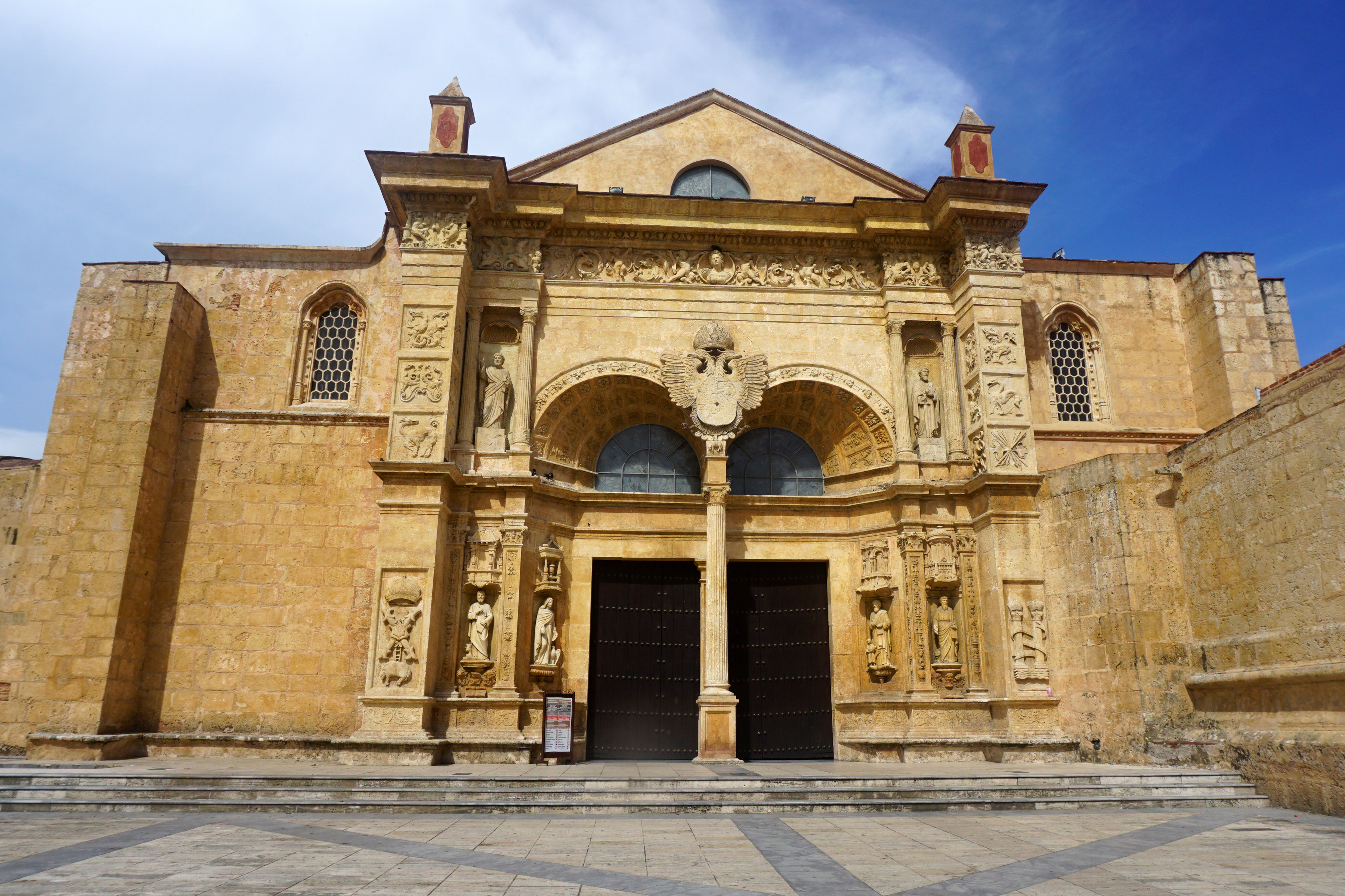
The Cathedral of Santa María la Menor, known as the Primada de América Cathedral, is the most emblematic monument of the Zona Colonial and a landmark in the continent's history: it's the first cathedral built in the Americas, raised in the first half of the 16th century. Its construction began around 1512 and was completed toward 1540, combining elements of the late Gothic with the Renaissance that was beginning to arrive from Europe.
Located facing Parque Colón, the social heart of the Zona, the cathedral impresses with its coral-stone facade, its carved portals and, above all, its interior: naves with ribbed vaults, side chapels with religious artworks, tombs and a treasury of liturgical objects. For centuries it was believed to hold the remains of Christopher Columbus (today a historical dispute, since Seville also claims them).
It's a fully working church, so it's best to respect the service times and dress appropriately to enter. Touring it with an audio guide or a guide helps you understand the enormous historical weight of every corner. It's the natural starting point of any visit to the Zona Colonial.
Getting there: right in the center of the Zona Colonial, facing Parque Colón; it's walkable. Best time to go: in the morning to avoid the heat and make the most of the light; respect Mass times. Tips: you have to dress respectfully (shoulders and knees covered); children enter free.
ℹ️ Distance: Facing Parque Colón, center of the Zona Colonial (on foot) · Best time to go: In the morning; respect service times · Admission: RD$ 60 per person (tourist visit; source: Catedral Primada, verified July 2026); children free · Duration: 45 minutes to 1 hour
2
Alcázar de Colón and Plaza España
The viceregal palace of the Columbus family, today a museum, facing the great plaza where the Zona's nightlife beats.
Read more ↓
The Alcázar de Colón is one of the most imposing and significant buildings in the Zona Colonial. It was built at the start of the 16th century as the residence of Diego Colón, son of Christopher Columbus and viceroy of the Indies, and of his wife María de Toledo. From this Gothic-Mudéjar and Renaissance palace, much of the first Spanish colonization of the Americas was governed, which makes it a central place in the continent's history.
Today it works as the Alcázar de Colón Museum, which recreates the life of the colonial nobility with furniture, tapestries, artworks and period objects, letting you imagine how life was lived at the 16th-century viceregal court. Its arches, its galleries and its views of the Ozama River are of great beauty.
The Alcázar looks out onto Plaza España, a large esplanade that is one of the liveliest spaces in the Zona Colonial: by day, a historic lookout; by night, a meeting point full of restaurants and bars with open-air tables, ideal for dinner and a drink with the lit-up facade behind you. To one side are the Reales Atarazanas, the old port warehouses.
Getting there: at the northeastern end of the Zona Colonial, next to the river; it's walkable. Best time to go: the museum from 9:00 to 17:00, closed Mondays; the plaza, at sunset and at night for the atmosphere. Tips: combine the museum visit with dinner on Plaza España.
ℹ️ Distance: Plaza España, next to the Ozama River, Zona Colonial (on foot) · Best time to go: Museum by day (closed Mondays); the plaza at sunset and at night · Admission: RD$ 600 adults, RD$ 300 children and students (verified July 2026). The plaza is free · Duration: 1 to 2 hours (museum and plaza)
3
Calle Las Damas and the Ozama Fortress
The first cobbled street in the Americas and the oldest military fortress on the continent, beside the river.
Read more ↓
Calle Las Damas is the oldest street in the Americas with a European layout: the first cobbled road in the New World, opened at the start of the 16th century. Its name comes, according to tradition, from the ladies of the court of María de Toledo (wife of Diego Colón) who used to stroll along it. Walking it means literally treading on the first steps of European urbanization on the continent, among colonial mansions, museums and historic buildings like the Casa de los Jesuitas and the National Pantheon.
At the end of the street, looking out over the Ozama River, stands the Ozama Fortress, the oldest military fortification in the Americas, built in the first decades of the 16th century to defend the harbor entrance. Its most famous element is the Tower of Homage, a sturdy stone keep from which you can see over the river and the city. The fortress was a prison, a barracks and a witness to practically all of Dominican history, from the colony to the 20th century.
Visiting the fortress lets you climb the tower, walk its walls and courtyards, and enjoy one of the best views of the mouth of the Ozama. It's a perfect complement to a walk along Calle Las Damas.
Getting there: Calle Las Damas runs along the east of the Zona Colonial to the fortress, beside the river; all on foot. Best time to go: in the morning or mid-afternoon to avoid the heat. Tips: there are local guides at the gate; bring water and comfortable footwear for the cobblestones.
ℹ️ Distance: East of the Zona Colonial, beside the Ozama River (on foot) · Best time to go: Morning or mid-afternoon (because of the heat) · Admission: Calle Las Damas free; Ozama Fortress, about RD$ 100 per person (verified July 2026) · Duration: 1 to 1.5 hours
4
Calle El Conde and Parque Colón
The Zona's pedestrian commercial artery and the plaza with the Columbus statue, the heart of everyday life.
Read more ↓
Calle El Conde is the backbone of everyday life in the Zona Colonial: a pedestrian, commercial artery that crosses the historic quarter from east to west, full of shops, cafés, ice cream parlors, bookstores, bars and restaurants. By day it's where tourists mix with Dominicans out shopping, vendors, shoe shiners and musicians; at night it comes alive with people heading out to eat and drink. It's the best place to feel the neighborhood's living pulse.
Halfway along, El Conde opens onto Parque Colón, the Zona's central square, presided over by a statue of Christopher Columbus and flanked by the Primada Cathedral. It's the great meeting point: shaded benches, pigeons, people chatting, cafés with outdoor tables and a permanent social atmosphere. From here the main streets and monuments radiate out.
Walking along El Conde and resting in Parque Colón is the most natural way to start getting to know the Zona Colonial and to get your bearings, since almost everything is a few minutes away on foot. It's also a good place to take the pulse of the local food and culture.
Getting there: El Conde crosses the Zona Colonial; Parque Colón is in its center, next to the cathedral; all on foot. Best time to go: daytime for shopping and the atmosphere; nighttime for dinner and going out. Tips: it's a tourist area, so look after your belongings; there are persistent vendors but the atmosphere is safe with common sense.
ℹ️ Distance: Central pedestrian axis of the Zona Colonial; Parque Colón next to the cathedral (on foot) · Best time to go: Daytime for shopping and the atmosphere; nighttime for going out · Admission: Free (public street and park) · Duration: 1 to 2 hours (or more)
5
National Pantheon and the museums of the Zona
The mausoleum of the Dominican heroes and a network of museums that tell the country's history on Calle Las Damas.
Read more ↓
The National Pantheon is one of the most solemn buildings in the Zona Colonial. Located on Calle Las Damas, in an old 18th-century Jesuit church, it was turned into a national mausoleum to honor the founders and heroes of the Dominican nation. Its interior, sober and monumental, guards the remains of key figures of the country's independence and history, with a permanent honor guard. It's a place of civic memory and a good point for understanding Dominican national identity.
The Zona Colonial also concentrates a notable network of museums that let you go deeper into the history. The Museum of the Royal Houses, housed in the building that held the Royal Audiencia and the Captaincy General, recreates the colonial administration and displays weapons, furniture and objects of the era. The Casa del Cordón (considered one of the first stone houses in the Americas) and various house-museums round out the offering.
Visiting these spaces helps give context to the neighborhood's stones and monuments, connecting the colonial era with the later history of the Dominican Republic. They're ideal for days when the heat invites you into cool interiors.
Getting there: the Pantheon and the Museum of the Royal Houses are on Calle Las Damas and around it; all on foot. Best time to go: daytime; respect the solemnity of the Pantheon (appropriate dress). Tips: confirm the museums' hours and opening days, and consider a guided visit to make the most of them.
ℹ️ Distance: Calle Las Damas and around, Zona Colonial (on foot) · Best time to go: Daytime; appropriate dress at the Pantheon · Admission: National Pantheon, free (appropriate dress); Museum of the Royal Houses, about RD$ 100 (verified July 2026) · Duration: 1 to 2 hours
6
Faro a Colón and Los Tres Ojos (outside the Zona)
The monumental Columbus mausoleum across the river and the underground lagoons of Los Tres Ojos, near the Zona.
Read more ↓
Beyond the Zona Colonial proper, but a short distance away, there are two attractions worth adding. The Faro a Colón is a colossal concrete monument shaped like a lying-down cross, inaugurated in 1992 on the 500th anniversary of Columbus's arrival in the Americas, on the eastern side of the Ozama River (Santo Domingo Este). It holds what the Dominican Republic maintains are the remains of Christopher Columbus (in a historical dispute with Seville) and a set of rooms with exhibitions. At night, its system of powerful light beams projects a luminous cross into the sky.
Los Tres Ojos, for its part, is a nature park with underground lagoons (the 'eyes' of water) inside limestone caverns, surrounded by vegetation. You tour them by stairs and walkways, and one of the lagoons is crossed on a small raft. It's a cool and surprising oasis a few minutes from downtown, very popular for a half-day getaway.
Both sites are east of the river, outside the historic quarter, but they're easily reached by taxi or app from the Zona Colonial and they round out the historical visit very well with monuments and nature.
Getting there: east of the Ozama River (Santo Domingo Este), by taxi, app or excursion from the Zona Colonial. Best time to go: daytime; the Faro also at night for the lighting. Tips: combine both in half a day; bring repellent for Los Tres Ojos.
ℹ️ Distance: East of the Ozama River (Santo Domingo Este); taxi/app from the Zona Colonial · Best time to go: Daytime; the Faro also at night for the lighting · Admission: Faro a Colón: about RD$ 200; Los Tres Ojos: about RD$ 200 per person (verified July 2026) · Duration: Half a day (both)
🛡️ Getting sick far from home shouldn't cost you thousands of USD
Abroad, getting sick is more than a bad day. In many destinations public healthcare depends on appointments, queues and availability, and private care is paid upfront. An emergency can cost thousands of USD, right when you are far from home and on a tight budget. That is why I recommend you never leave without travel assistance.
I recommend GO! Assistance because it covers what matters: medical care, emergencies, medication and hospitalization depending on the plan. It protects you 24 hours a day, anywhere in the world, with real-time solutions on the ground. GO! 365 ECO and GO! 365 give you USD 45,000 of global coverage: the first with a USD 100 deductible, the second with none.
If you quote from Argentina, in October GO! also offers 12 interest-free instalments on all its products.
An emergency abroad can cost thousands of dollars. Travel with assistance.
GO! Assistance has 50% off in October and, with our link, you get an extra 20%.
Pick origin, destination, dates and ages and see the price of your travel assistance in a minute.
📶 Internet from the moment you land
I have never been left without internet on a trip. I land and my phone connects to the strongest network in the country I am visiting: I can let people know I arrived, sort out transport, book tours and keep posting content at a super affordable price (really cheap!). I always use the Maya Mobile eSIM, check out its plans by clicking the banner. See Maya Mobile plans →
Affiliate link: we earn a commission.


💵 Prices
Tickets
| Type | Price |
|---|
| Primada de América Cathedral (tourist visit) | RD$ 60 per person (verified July 2026); children free |
| Alcázar de Colón (Museum) | RD$ 600 adults, RD$ 300 children and students (verified July 2026) |
| Ozama Fortress and Tower of Homage | About RD$ 100 per person (verified July 2026) |
| Museum of the Royal Houses | About RD$ 100 per person (verified July 2026) |
| National Pantheon | Free (open access; appropriate dress) |
| Calle El Conde, Parque Colón and Plaza España | Free (public spaces) |
| Faro a Colón | About RD$ 200 per person (verified July 2026) |
| Parque Los Tres Ojos | About RD$ 200 per person (verified July 2026) |
🔄 updated monthlyOfficial / reference values · double-check when buying
Activities and tours
| Activity | Price | Duration | Operator |
|---|
| Guided walking tour of the Zona Colonial | US$ 20–35 per person (verified July 2026) | 2 to 3 hours | Local guides and agencies of the Zona Colonial |
| Combined museum visit (Alcázar, Casas Reales, Cathedral) | About RD$ 760 for the three admissions bought separately (verified July 2026) | Half a day | Museums of the Zona Colonial |
| Night tour and dinner on Plaza España | US$ 20–45 per person at the plaza's restaurants (verified July 2026) | One night | Restaurants and local guides of Plaza España |
| Excursion to the Faro a Colón and Los Tres Ojos | US$ 25–59 per person on a combined tour (verified July 2026) | Half a day | Santo Domingo agencies and tourist taxis |
| Merengue/bachata class or a night of dancing | US$ 15–30 per person/hour (verified July 2026) | 1-2 h / one night | Dance schools and bars of the Zona Colonial |
| Santo Domingo city tour (Zona Colonial + Malecón) | US$ 25–45 per person (verified July 2026) | Half a day to a full day | Agencies in the capital |
🔄 updated monthlyOfficial / reference values · double-check when buying
🚌 How to get there and distances
Getting around
NotesThe Zona Colonial is compact and flat, made for walking. Almost all the monuments are a few minutes apart. Comfortable footwear for the cobblestones
App for locating transport
Free (the app)
NotesTo get around Santo Domingo (Metro, OMSA, corridors) the most used app for seeing routes and real-time location is MOOVIT, with good coverage of the capital; Google Maps works for the Metro. For taxis, Uber. The informal conchos don't show up accurately: for those, ask in the street (verified July 2026)
Taxi and apps (Uber, etc.)
NotesThe most comfortable and safest way to reach the airport, the Faro a Colón, Los Tres Ojos or other parts of the city, especially at night. Uber is paid by card or cash within the app; street taxis, in cash, agreeing the price beforehand
NotesSmall tourist trains and carts that offer tours around the Zona Colonial, convenient for a first panoramic look. They're paid in cash
Carros públicos (conchos) and guaguas — how you pay
NotesThe city's cheap shared transport. You ALWAYS pay in cash, in pesos, to the driver; there's no card and no app. Useful for connecting with other areas, though for the visitor a taxi/app is usually more practical
Santo Domingo Metro and the integrated SIT fare — how you pay
PriceRD$ 20 the Metro; integrated SIT fare (Metro + Cable Car + OMSA) RD$ 35 (source: OPRET / SIT Dominicana, verified July 2026)
NotesThe metro doesn't cross the Zona Colonial (the nearest station is Parque Independencia/Máximo Gómez, a few minutes away by taxi), but it connects with the rest of the capital quickly and safely. You pay with the reloadable Metro card (RD$ 60 + minimum top-up RD$ 20) or, since February 2026, by tapping a contactless bank card (VISA/Mastercard EMV) or a digital wallet directly; there are also cash ticket offices. The integrated SIT fare of RD$ 35 lets you combine Metro, Cable Car and OMSA with transfers within 30 minutes, paying by card
🔄 updated monthlyOfficial / reference values · double-check when buying
How to get there
| Route | Airlines / operators | Avg. price | Duration |
|---|
| Las Américas Airport (SDQ) → Zona Colonial (taxi or app) | Airport taxis, transfers and apps | US$ 24–40 depending on the service (verified July 2026) | About 30 to 40 min (some 25-30 km on the Las Américas highway) |
| La Isabela Airport (JBQ) → Zona Colonial | Taxis and transfers | About US$ 15–25 (verified July 2026) | About 30 to 45 min depending on traffic |
| Punta Cana (PUJ) → Santo Domingo / Zona Colonial | Private transfers, buses (Expreso Bávaro) and car rental | US$ 90–150 by private transfer; RD$ 400–600 by guagua (verified July 2026) | About 2.5 to 3 hours on the Coral highway |
| Santiago / the north → Santo Domingo (long-distance bus) | Caribe Tours, Metro and others | RD$ 200–350 per person (verified July 2026) | About 2 to 2.5 hours (Santiago); depending on origin |
🔄 updated monthlyOfficial / reference values · double-check when buying
🏨 Where to stay
No exact prices: a scale from $ (budget) to $$$$$ (luxury), with 2-3 options per category.
Boutique hotels in colonial mansions
Recommended optionsUS$ 80–150 a night; boutique hotels set in restored mansions and manor houses of the historic quarter, with colonial courtyards, plenty of charm and an unbeatable location for doing everything on foot (verified July 2026)
Luxury and landmark hotels
Recommended optionsUS$ 180–350 a night; e.g. Hodelpa Nicolás de Ovando, in governor Ovando's 16th-century house. For New Year and high season, book in advance (verified July 2026)
Mid-range hotels and inns
Recommended optionsUS$ 50–90 a night; a broad offering of mid-range hotels and inns within the Zona Colonial, with a good balance of location and price (verified July 2026)
Recommended optionsUS$ 15–35 a night; hostels and budget lodgings in the Zona and around, much chosen by backpackers and travelers on a tight budget (verified July 2026)
🍴 Where to eat
Restaurants on Plaza España and Calle Las Atarazanas
Options / signature dishUS$ 20–45 per dish; the most famous dining area: restaurants with open-air tables facing the Alcázar de Colón, with Dominican and international cooking and the lit-up facade behind (verified July 2026)
Dominican criollo cooking
Options / signature dishRD$ 300–700 per dish; eateries and restaurants with the typical dishes: 'la bandera' (rice, beans and meat), mofongo, sancocho, mangú, fish with coconut and tostones (verified July 2026)
Cafés and ice cream parlors on Calle El Conde
Options / signature dishRD$ 100–300 per order; cafés, ice cream parlors and simple spots along the pedestrian artery, ideal for a break, a Dominican coffee or a fresh juice (verified July 2026)
Bars, taverns and nightlife
Options / signature dishRD$ 300–800 per order; rum bars, terraces and venues with live music (merengue, bachata, jazz) spread around the Zona, especially lively at weekends (verified July 2026)
📖 History of Zona Colonial
Origins, formation and what the sources say.
The founding of Santo Domingo (1498) and the move to the western bank of the Ozama
The Zona Colonial is the original core of Santo Domingo, considered the first permanent European city on the American continent. Its founding is attributed to Bartolomé Colón, brother of Christopher Columbus, in 1498, on the eastern bank of the Ozama River (where Santo Domingo Este stands today). That first settlement, named in honor of Saint Dominic de Guzmán (according to a tradition tied to the Columbus family's devotion and to the day of their arrival), was born as the base of Spanish administration in Hispaniola, the island discovered on Columbus's first voyage of 1492.
A few years later, the site was moved to the western bank of the Ozama River. This refounding, which happened around 1502, is usually associated with governor Nicolás de Ovando, after a hurricane damaged the original city and because of the advantages of the new site. It was there, on the west bank, that the stone city we know today as the Zona Colonial was laid out.
A fundamental aspect is that Santo Domingo was planned with a grid layout (an orthogonal or 'damero' plan), with streets crossing at right angles around plazas. This urban model, a pioneer in the Americas, would serve as a reference for the founding of countless colonial cities across the continent. The Zona Colonial is, therefore, not only the first city but also the first 'trial run' of European urban planning in the New World.
The origin of the name 'Santo Domingo'
There are several explanations for the name: devotion to Saint Dominic de Guzmán (founder of the Dominican order), the fact that the arrival or founding was associated with a Sunday (domingo), or a tribute to Christopher Columbus's father, named Doménico. The sources record these versions with nuances, without an absolute consensus.
Source: https://es.wikipedia.org/wiki/Santo_Domingo
The move to the western bank (around 1502)
Historiography agrees that the city was moved from the eastern to the western bank of the Ozama at the start of the 16th century, generally under the government of Nicolás de Ovando and after hurricane damage. The exact date (around 1502) and the details vary slightly by source.
Source: https://es.wikipedia.org/wiki/Ciudad_Colonial
The first capital of the Americas: the New World's 'firsts' (16th century)
During the first decades of the 16th century, Santo Domingo was the capital and nerve center of Spanish colonization in the Americas. From here were organized and dispatched many of the expeditions that would lead to the conquest of Cuba, Mexico (Hernán Cortés passed through the city) and other lands of the continent. It was the seat of power, the main port and the gateway for people, goods and ideas into the New World.
That centrality explains why the city accumulated an impressive list of American 'firsts'. Here the Cathedral of Santa María la Menor was built, the continent's first cathedral (begun around 1512). Here the Santo Tomás de Aquino University was founded, in 1538, considered the first university in the Americas. Here stood the first hospital (the San Nicolás de Bari Hospital), the first military fortress (the Ozama Fortress, with its Tower of Homage) and the first cobbled street with a European layout (Calle Las Damas). The Royal Audiencia, the first court in the Americas, and the Captaincy General were also established here.
The symbol of that era's power is the Alcázar de Colón, the palace built for Diego Colón, the Admiral's son and viceroy of the Indies, and his wife María de Toledo. From its halls much of the fledgling overseas empire was governed. This concentration of pioneering institutions is what makes the Zona Colonial a unique place: the laboratory where Europe began building its presence in the Americas.
The 'firsts' of the Americas
It is widely accepted that Santo Domingo held the first cathedral, the first university (1538), the first hospital, the first fortress and the first cobbled street on the continent. Some of these claims to primacy (especially that of the university) are the subject of academic debate against other American institutions, so they should be qualified.
Source: https://es.wikipedia.org/wiki/Universidad_Aut%C3%B3noma_de_Santo_Domingo
The Alcázar de Colón and viceregal power
The Alcázar de Colón was built at the start of the 16th century as the residence of Diego Colón, viceroy of the Indies. The sources describe it as the center of early colonial power, from which the first phase of Spanish colonization in the Americas was administered.
Source: https://es.wikipedia.org/wiki/Alc%C3%A1zar_de_Col%C3%B3n
Decline, attacks and Drake's sacking (1586)
Santo Domingo's prominence did not last long. As the conquest advanced onto the mainland and the immense riches of Mexico and Peru were discovered, the axis of the Spanish empire shifted toward those viceroyalties, far richer in gold and silver. Hispaniola lost economic and political importance, and Santo Domingo stopped being the center of colonization and became a peripheral city of the empire.
That decline brought hard times but, paradoxically, it was one of the reasons the colonial city was so well preserved: as it lost dynamism, it wasn't demolished or massively rebuilt, and many of its 16th-century buildings reached us almost intact. What was a loss for the economy was a blessing for the heritage.
Among the most dramatic episodes of those centuries is the attack by the English corsair Francis Drake in 1586. Drake took and sacked the city, demanded a ransom, occupied the cathedral and caused damage to numerous buildings before withdrawing. It was a hard blow for Santo Domingo and a sign of its vulnerability once its old importance was gone. Over the following centuries, the city would also go through foreign dominations (French, Haitian) and wars, but its historic quarter survived it all.
The shift of the imperial axis
Historians agree that the discovery of the great mineral riches of Mexico and Peru shifted the Spanish empire's center of gravity away from Hispaniola, causing the economic decline of Santo Domingo from the mid-16th century.
Source: https://es.wikipedia.org/wiki/Santo_Domingo
The sacking by Francis Drake (1586)
The sources agree that the corsair Francis Drake attacked and sacked Santo Domingo in 1586, occupying the city and demanding a ransom, in one of the most famous episodes of its colonial decline. The details of the damage caused are told with some variation.
Source: https://es.wikipedia.org/wiki/Ciudad_Colonial
Independences, dominations and upheavals up to the Republic
The Zona Colonial witnessed the great upheavals of Dominican history. After centuries of Spanish rule, the island went through periods of French control (at the start of the 19th century) and, above all, of Haitian occupation between 1822 and 1844. Dominican independence was proclaimed on 27 February 1844, precisely in the heart of the Zona Colonial: at the Puerta del Conde and the bastion of today's Plaza de la Independencia, where the patriot Francisco del Rosario Sánchez and the other 'trinitarios' led by Juan Pablo Duarte sealed the birth of the Dominican Republic.
The young nation then lived through new turbulence: a brief re-annexation to Spain (1861-1865), from which it freed itself with the War of the Restoration, and later occupations and interventions, including that of the United States in the 20th century. Throughout all this history, the buildings of the Zona Colonial, the Ozama Fortress, the churches, the mansions, were the setting for and witnesses to the country's key events.
That symbolic weight crystallized in places of memory like the National Pantheon, housed in an old Jesuit church on Calle Las Damas, where the remains of the nation's founders and illustrious figures rest. The Zona Colonial thus stopped being only the colonial origin and became also the historical and civic heart of the Dominican nation.
The 1844 independence at the Puerta del Conde
The sources agree that the independence of the Dominican Republic was proclaimed on 27 February 1844 at the Puerta del Conde, in what is now the Plaza de la Independencia enclosure, within the Zona Colonial, after the period of Haitian rule. It's one of the country's founding milestones.
Source: https://es.wikipedia.org/wiki/Independencia_de_la_Rep%C3%BAblica_Dominicana
World Heritage (1990) and the dispute over Columbus's remains
The exceptional value of the Zona Colonial was recognized by the international community in 1990, when UNESCO inscribed the 'Colonial City of Santo Domingo' on the World Heritage list. The recognition stresses that this is the first permanent European settlement in the Americas, with an urban layout that served as a model for almost every planner in the New World, and with an ensemble of monuments that preserves the first examples of European architecture on the continent: cathedral, fortress, palace, hospital, convents and manor houses.
The inscription drove the conservation and enhancement of the historic quarter, which combines its character as a living, inhabited neighborhood with its role as a great open-air museum of the beginnings of colonial America. Today the Zona is at once world heritage, a tourist attraction and a cultural center of the Dominican capital.
One of the great mysteries still surrounding the Zona Colonial is the final resting place of Christopher Columbus's remains. For centuries they were associated with the Primada Cathedral; the Dominican Republic maintains that they rest in the monumental Faro a Colón, inaugurated in 1992 across the river. But Seville Cathedral, in Spain, also claims to hold the Admiral's remains. DNA studies carried out in recent decades have fueled the debate without conclusively closing it, so Columbus's last resting place remains a riddle shared between two shores of the Atlantic.
UNESCO's criterion (1990)
UNESCO inscribed the Colonial City of Santo Domingo in 1990 for being the first permanent European settlement in the Americas and for its pioneering urban layout and ensemble of monuments, which influenced urban planning across the continent. The recognition covers the whole historic quarter.
Source: https://whc.unesco.org/en/list/526/
The dispute over Columbus's remains
Both Santo Domingo (the Faro a Colón) and Seville claim to hold the remains of Christopher Columbus. Genetic studies have provided data on the Seville remains, but they have not definitively settled the controversy, partly because the Dominican authorities have not allowed the Faro remains to be analyzed. It's a question still open.
Source: https://es.wikipedia.org/wiki/Faro_a_Col%C3%B3n
❓ Frequently asked questions
Why is the Zona Colonial so important?+
Because it's the historic quarter of Santo Domingo, the first permanent European city in the Americas, founded at the end of the 15th century. Here stood the first cathedral, the first university, the first hospital and the first fortress in the New World. It was declared a World Heritage Site by UNESCO in 1990. It is, literally, where the history of European America began.
How much time do I need to visit it?+
With 1 full day you cover the icons: the Primada Cathedral, the Alcázar de Colón, Calle Las Damas, the Ozama Fortress, the National Pantheon and the plazas. With 2 to 3 days you can go through the museums at leisure, enjoy the nightlife and add the Faro a Colón, Los Tres Ojos or a getaway to nearby beaches like Boca Chica or Juan Dolio.
Is it safe to walk around the Zona Colonial?+
Yes, it's one of the most touristy and most patrolled areas of Santo Domingo, and by day it's easy to walk around calmly. At night, the busy areas (El Conde, Plaza España) are safe with common sense. As in any big city, it's best to carry little cash, look after your phone, avoid lonely streets at night and use a taxi or app to move to other areas.
Where are Columbus's remains really?+
It's one of the great historical disputes. The Dominican Republic maintains that they're at the Faro a Colón in Santo Domingo; for centuries they were also associated with the Primada Cathedral. But Seville (Spain) also claims to hold the remains in its cathedral. DNA studies have fueled the debate without fully settling it, so it's best to take it as a question still under discussion.
How do I get to the Zona Colonial from the airport?+
Las Américas Airport (SDQ) is about 25-30 km to the east, roughly 30-40 minutes by car on the Las Américas highway. A taxi or app costs between US$ 24 and 40. From Punta Cana it's about 2.5 to 3 hours on the Coral highway, by private transfer (US$ 90-150), bus or rental car.
How much do admissions to the main monuments cost?+
The rates are affordable: the Primada Cathedral costs about RD$ 60, the Alcázar de Colón RD$ 600 (RD$ 300 for children and students), the Ozama Fortress and the Museum of the Royal Houses run about RD$ 100 each, and the Faro a Colón and Los Tres Ojos another RD$ 200 each. The National Pantheon and the plazas are free. These are reference prices verified as of July 2026 and it's worth checking them when visiting.
What else can I see near the Zona Colonial?+
Very close by are the Malecón of Santo Domingo (the coastal avenue), the Faro a Colón and Parque Los Tres Ojos with its underground lagoons, all east of the river. You can also combine it with a beach getaway to Boca Chica or Juan Dolio, both less than an hour to the east.
How do I get around and how do I pay for transport in Santo Domingo in 2026?+
The Zona Colonial is walkable. For the rest of the city (airport, Faro a Colón, Los Tres Ojos), the most comfortable option is taxi or Uber (RD$ 150-400 for short trips). The Metro doesn't reach the historic quarter, but it's a few minutes away: it costs RD$ 20 and is paid with the reloadable Metro card or, since February 2026, by tapping your contactless bank card (VISA/Mastercard EMV) or digital wallet directly at the turnstiles. There's the integrated SIT fare of RD$ 35 that combines Metro, Cable Car and OMSA buses with transfers within 30 minutes. On the other hand, the conchos, guaguas and street taxis are always paid in cash, in pesos. To see routes in real time, use the Moovit app (verified July 2026).
More places in Dominican Republic
Sources consulted (23)
- Unesco — «Colonial City of Santo Domingo»: https://whc.unesco.org/en/list/526/
- Wikipedia (ES) — «Ciudad Colonial de Santo Domingo»: https://es.wikipedia.org/wiki/Ciudad_Colonial
- Wikipedia (ES) — «Santo Domingo»: https://es.wikipedia.org/wiki/Santo_Domingo
- Hodelpa Hotels (official website of the chain; the hotel is listed as Hodelpa Nicolás de Ovando): https://www.hodelpa.com/
- Ideas Para Viajar — «Precio entrada Alcázar de Colón»: https://ideasparaviajar.com/precio-entrada-alcazar-de-colon
- Ideas Para Viajar — «Precio entrada Faro a Colón»: https://ideasparaviajar.com/precio-entrada-faro-a-colon
- MUSEOSRD — «Museo Alcázar de Colón»: https://museosrd.gob.do/museos/museo-alcazar-de-colon/
- Los Tres Ojos (official): https://lostresojos.com/
- Wikipedia (ES) — «Catedral de Santa María la Menor»: https://es.wikipedia.org/wiki/Catedral_de_Santa_Mar%C3%ADa_la_Menor
- Wikipedia (ES) — «Alcázar de Colón»: https://es.wikipedia.org/wiki/Alc%C3%A1zar_de_Col%C3%B3n
- Wikipedia (ES) — «Fortaleza Ozama»: https://es.wikipedia.org/wiki/Fortaleza_Ozama
- Wikipedia (ES) — «Calle Las Damas»: https://es.wikipedia.org/wiki/Calle_Las_Damas
- Wikipedia (ES) — «Faro a Colón»: https://es.wikipedia.org/wiki/Faro_a_Col%C3%B3n
- Go Dominican Republic (Ministerio de Turismo) — «Santo Domingo»: https://www.godominicanrepublic.com/es/
- Aeropuerto Internacional Las Américas (SDQ): https://aerodom.com/
- OPRET — «Pasajes individuales y tarifas del Metro»: https://www.opret.gob.do/Servicios/PasajesIndividuales
- SIT Dominicana — «Tarifa integrada» (RD$ 35): https://sitdominicana.com/tarifa-integreda-v4/
- Infobae — «El Metro de Santo Domingo introduce pago con tarjetas» (Feb 2026): https://www.infobae.com/republica-dominicana/2026/02/18/el-metro-de-santo-domingo-introduce-pago-con-tarjetas-y-amplia-su-capacidad/
- Moovit — Santo Domingo public transport (real-time app) — a crowdsourced public transport app (the data is uploaded by users; it is not an official source for fares or schedules): https://moovitapp.com/index/en/public_transit-Santo_Domingo-5979
- Go Dominican Republic — Cómo moverse: https://www.godominicanrepublic.com/es/
- Before Boarding — «Taxi Santo Domingo: precios y traslados»: https://beforeboarding.com/taxi-santo-domingo/
- Go Dominican Republic — Gastronomía dominicana: https://www.godominicanrepublic.com/es/
- Wikipedia (ES) — «Gastronomía de la República Dominicana»: https://es.wikipedia.org/wiki/Gastronom%C3%ADa_de_la_Rep%C3%BAblica_Dominicana