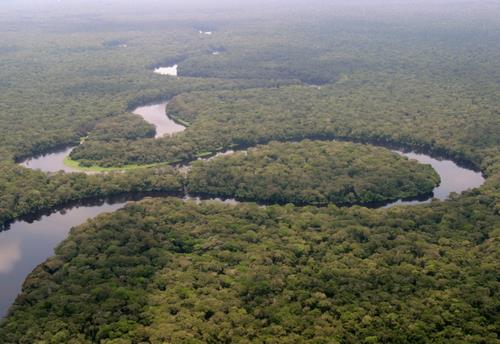
Salonga National Park is one of the planet's great natural secrets: the largest expanse of protected tropical rainforest in Africa, a green ocean covering tens of thousands of square kilometres in the inaccessible heart of the Congo Basin. With no roads and crossed only by winding rivers, it is a world of humid forest, swamps and water where nature is still in charge and human presence is minimal. It is a World Heritage Site and a biodiversity sanctuary of global importance.
Above all, Salonga is the realm of the bonobo: along with the chimpanzee, the great ape closest to humans. It exists only in the DR Congo, and the park is home to one of the largest populations in the world (thousands of individuals). It shares this forest with forest elephants, the rare Congo peafowl, crocodiles, forest antelopes and wildlife that is still little studied. It is also one of the planet's largest carbon reservoirs, crucial in the fight against climate change.
This guide explains what Salonga is, why it matters so much and how it can (or cannot) be visited: an extreme expedition destination, almost closed to tourism, reserved for researchers, conservationists and very well-prepared travellers. More than a conventional visitor guide, it is an invitation to understand and value one of the last great sanctuaries of intact rainforest on Earth, in the deepest heart of Africa.
Salonga National Park was created in 1970, under the Mobutu regime, to protect a huge portion of the equatorial rainforest of the central Congo Basin, and in 1984 it was declared a World Heritage Site by UNESCO. Its isolation protected it for decades, but the Congo wars and poaching put it on the List of World Heritage in Danger in 1999. Thanks to co-management between ICCN and WWF and anti-poaching efforts, it was removed from that list in 2021. Its full story is told on our history page.
Read the full history ↓The green heart of the country: the second-largest tropical rainforest in the world, crossed by the Congo River, with Kisangani, the Wagenia fishermen and the vast Salonga park, a refuge for bonobos.
Read the history of The river and the great equatorial forest →No exact prices: a scale from $ (budget) to $$$$$ (luxury), with 2-3 options per category.
Origins, formation and what the sources say.
Salonga National Park protects a monumental stretch of the equatorial rainforest of the central Congo Basin, the second-largest continuous mass of tropical rainforest on the planet after the Amazon. Covering between 33,000 and 36,000 km² —larger than many countries—, it is the largest protected area of tropical rainforest in Africa and one of the largest in the world. It spreads across the deepest and most isolated interior of the DR Congo, with no roads, crossed only by winding blackwater rivers, swamps and flooded forests.
This rainforest formed over millions of years in the great depression of the Congo Basin, an ecosystem of extraordinary stability and biodiversity. Before it became a park, and still today in its surroundings, it was the territory of forest peoples —Bantu communities and hunter-gatherer groups— who lived from fishing, hunting and gathering, with a detailed knowledge of the forest. Its extreme isolation, which makes it so hard to visit today, was for centuries its best protection.
Salonga's importance for the planet goes beyond its wildlife: it is one of the largest carbon reservoirs on Earth. Its trees and peat soils store huge amounts of carbon, so its conservation is key in the fight against global climate change. Protecting Salonga is not just about saving the bonobos: it is about preserving one of the planet's great lungs.
Salonga is, above all, the great sanctuary of the bonobo (Pan paniscus), one of our closest living relatives. Along with the chimpanzee, the bonobo shares around 99% of its DNA with humans, but it stands out for its female-dominated societies and for resolving conflicts through social bonds and affection rather than violence, which has earned it the nickname of 'the peaceful ape'. It is endemic to the DR Congo: it lives only in the forests south of the Congo River, and nowhere else in the world.
The park is home to one of the largest remaining bonobo populations, estimated in the thousands, which makes it an essential stronghold for the survival of the species, classified as endangered. Poaching for bushmeat and habitat loss are its main threats. That is why conservation efforts in Salonga focus largely on protecting this great ape and studying its populations, which are still poorly known.
The bonobo was not recognised as a species distinct from the chimpanzee until 1929, and much of what we know about it comes from research carried out in the Congo's forests and in sanctuaries such as Lola ya Bonobo, near Kinshasa. Salonga represents its future in the wild: without this vast protected forest, 'the peaceful ape' would have very little chance of surviving in the wild in the long term.
Salonga National Park was created in 1970, under the regime of Mobutu Sese Seko, which at the time pushed for the creation of several large protected areas in the country (then called Zaire). It was established to protect a representative portion of the equatorial rainforest of the central Congo Basin, taking advantage precisely of its enormous isolation and sparse population. From the start, its colossal size and inaccessibility made it a unique case among African parks.
In 1984, UNESCO inscribed Salonga on the World Heritage List, recognising its outstanding universal value as the largest block of protected tropical rainforest in Africa and as a habitat for threatened and endemic species, with the bonobo at the top of the list. That international recognition confirmed the park's global importance, but it did not shield it from the threats that lay ahead.
The park was organised into two large blocks, north and south, separated by an inhabited corridor, which reflects how complex it is to protect such a vast territory in a country with huge governance and resource difficulties. Management was entrusted to the Congolese Institute for Nature Conservation (ICCN), the country's parks authority, which for decades had to protect an immense area with very limited means.
The isolation that had protected Salonga for decades was no longer enough by the end of the 20th century. The Congo Wars (1996-2003), the deadliest conflict since the Second World War, plunged the country into chaos and seriously weakened the protection of its parks. Poaching —of elephants for ivory and of other animals for their meat— soared, and wildlife populations took a heavy blow. In 1999, as the situation deteriorated, UNESCO placed Salonga on the List of World Heritage in Danger.
Recovery was slow and difficult. From 2015-2016, the ICCN set up a co-management of the park with WWF, which brought resources, staff and a stronger strategy against poaching, support for rangers and work with local communities. Surveillance became more professional, wildlife surveys were carried out and efforts were made to reduce the pressure on elephants and bonobos. These efforts, not free of tensions and challenges, began to pay off.
In 2021, after years of improvements in management and conservation conditions, UNESCO removed Salonga from the List of World Heritage in Danger, an important recognition of the work done. It does not mean the park is safe —poaching, poverty in the surrounding area and institutional weakness remain threats—, but it marked a hopeful turning point for Africa's largest rainforest sanctuary.
Today Salonga National Park remains one of the planet's great natural treasures and a symbol of conservation in the DR Congo. Under the co-management of the ICCN and WWF, efforts continue to protect the bonobos, forest elephants, the Congo peafowl and a whole body of biodiversity that is still little explored, as well as to preserve its essential role as a carbon reservoir in the face of climate change. Rangers patrol an immense territory in extreme conditions, often at great risk.
The park faces enormous challenges: the poverty of surrounding communities, which sometimes drives illegal hunting and fishing; weak institutions; pressure from economic interests on the forest; and the difficulty of protecting such a vast and inaccessible area. At the same time, research initiatives, very limited ecotourism and international funding aim to make its conservation viable in the long term, showing that preserving Salonga can also benefit the local population.
For travellers, Salonga is an almost mythical destination: the largest protected rainforest in Africa, practically closed to tourism, reserved for those willing to take on a real expedition. More than a place to 'visit', it is a place to understand and value: one of the last great sanctuaries of untouched nature on Earth, the silent kingdom of the bonobo in the deepest heart of the Congo.