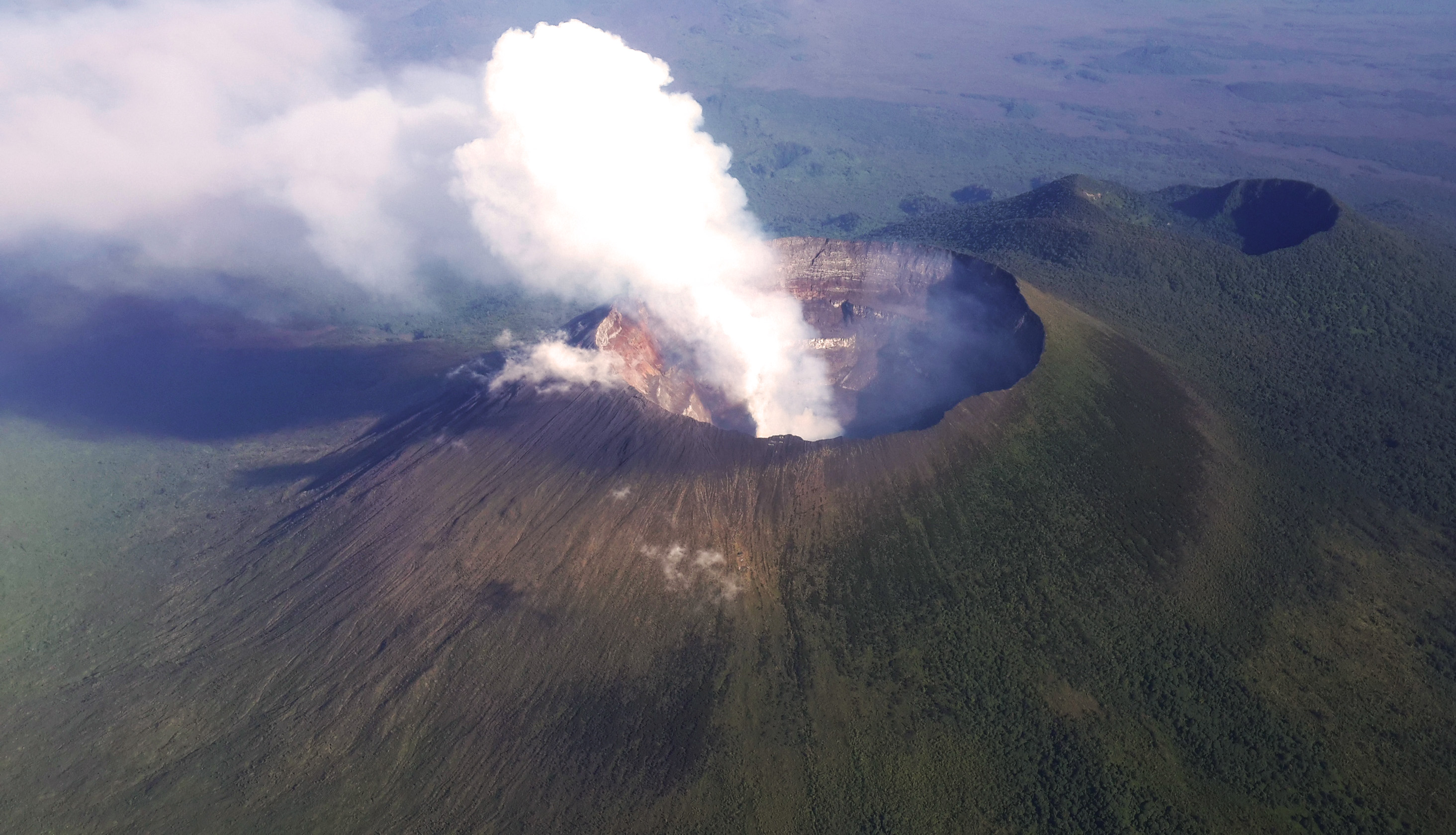
Important notice: this guide describes the Nyiragongo climb for reference, but the activity is suspended. The volcano lies inside Virunga National Park, closed to tourism since 2020, in a region of eastern DR Congo shaken by armed conflict. Since early 2025, the M23 rebel group has held Goma —the starting point of the trek— and many governments advise against all travel to the area. On top of that, Nyiragongo is an active and dangerous volcano. Before considering any trip, you must check the park's official status and the safety advisories. With that warning in mind, it is worth getting to know one of the most astonishing volcanoes on the planet.
Nyiragongo is one of those natural wonders that seem to belong to another world: an active 3.470-metre volcano that holds in its crater one of the largest permanent lava lakes on Earth. Peering over the crater rim at night and seeing that cauldron of molten rock bubbling and glowing in the dark, with the red glare lighting up the columns of smoke, was —when the climb was allowed— one of the most awe-inspiring experiences Africa had to offer. Few places on the planet let you see the Earth's fiery interior so close up.
But Nyiragongo is not just beauty: it is a fearsome neighbour for the hundreds of thousands of people who live at its foot, in Goma. Its lava is unusually fluid and can flow at great speed; its eruptions in 1977, 2002 and 2021 caused deaths and flattened entire neighbourhoods of the city. This guide explains what Nyiragongo is, what the climb was like, and why this volcano embodies both the fascination and the danger of living in one of the most volcanically active regions in the world, always with the warning that visiting it today depends on a peace that has not yet arrived.
Nyiragongo is one of the most active volcanoes in Africa and holds one of the largest lava lakes in the world. Its lava, exceptionally fluid because of its composition, can flow at more than 60 km/h, which makes it especially deadly. The 1977 eruption killed hundreds of people; the 2002 eruption destroyed much of Goma and displaced some 250.000 residents; the May 2021 eruption caused dozens of deaths and destroyed more than a thousand homes. It is both a magnet for volcanologists and adventurers and a constant threat to the region. The full geological history is on our dedicated page.
Read the full history ↓The mountainous east is home to the mountain gorillas of Virunga, the lava lake of Nyiragongo and the Great Lakes. It is also an area of active armed conflict, so always check the official travel advice.
Read the history of The east: the Kivus, the volcanoes and the Great Lakes →A local guide tells you in half an hour what no sign at the site will ever explain. We look ours up on Civitatis: guided in Spanish and booked online with no fuss. They have 7 activities in Kigali. And there are free tours here: you book without paying and tip the guide whatever you think at the end, so trying one costs you nothing. Have a look below: tap any of them to see them all.
They depart from Kigali, 94 km away. If you book from this link we earn a commission and you pay no more.
No exact prices: a scale from $ (budget) to $$$$$ (luxury), with 2-3 options per category.
Origins, formation and what the sources say.
Nyiragongo is part of the Virunga chain of volcanoes, which rises in the Albertine Rift, the western branch of East Africa's Great Rift Valley: a colossal fracture in the Earth's crust where the continent is slowly pulling apart. That geological tension is what fuels volcanism in the region, one of the most active in Africa. Nyiragongo, a stratovolcano some 3.470 metres high, is the most famous and dangerous volcano in this chain, along with its neighbour Nyamuragira.
What makes Nyiragongo unique is its lava lake. At the bottom of its huge crater, around two kilometres across, a mass of molten rock persists more or less permanently: one of the few persistent lava lakes in the world and, at different times, the largest of them all. The lake rises and falls over the years, and its behaviour is a key indicator of the volcano's activity, closely watched by scientists.
Nyiragongo's lava also has a feature that makes it especially deadly: it is unusually fluid. Unlike the thick, slow lavas of many volcanoes, Nyiragongo's lava, low in silica, can rush downhill at extremely high speeds (more than 60 km/h has been reported in some eruptions), leaving very little time to escape. This combination of a large lava lake and fast-moving lava lies at the root of the tragedies it has caused.
On 10 January 1977, Nyiragongo produced one of its deadliest and most revealing eruptions. The crater walls fractured and the lava lake drained in less than an hour, releasing torrents of fluid lava that poured down the slopes at astonishing speed. It all happened so fast that many people and animals had no time to flee: hundreds of people are estimated to have died, caught by lava that moved faster than anyone could run.
That eruption changed the scientific understanding of the volcano. It showed that Nyiragongo was not an 'ordinary' volcano but an extreme case, because of how fluid its lava is and the threat its lake posed to the people living in the valley. Volcanologists began to study it more closely, aware that more and more people were living at its foot, in the growing city of Goma.
The 1977 disaster stood as a grim warning. The lesson was clear: when Nyiragongo's lava lake finds a way out, catastrophe can strike within minutes. Even so, Goma's population kept growing on land that was fertile but exposed, in a risky coexistence with the volcano that would repeat itself, with even greater consequences, decades later.
On 17 January 2002, Nyiragongo erupted again, this time hitting the city directly. Lava burst from fissures on the volcano's southern flank and flowed down in several glowing rivers that reached Goma, on the shores of Lake Kivu. One of the flows cut through the city centre, destroying shops and homes, covering part of the airport runway and reaching the lakeshore itself.
The toll was devastating: although the number of direct deaths was relatively low for an event of that scale (largely because there was time to flee), the eruption destroyed thousands of buildings, left a huge share of the population homeless and displaced some 250.000 people, many of whom crossed temporarily into neighbouring Rwanda. Further dangers added to the crisis, such as explosions and gas emissions, and even fears of a deadly release of gas from the depths of Lake Kivu.
The 2002 eruption showed the world just how vulnerable Goma is and strengthened the case for keeping a close watch on the volcano. On the fields of solidified black lava, the city rebuilt itself with remarkable resilience: today, entire neighbourhoods of Goma sit literally on the rock of that flow, a permanent reminder that people here live at the foot of a giant that is sleeping, but very much alive.
On 22 May 2021, almost twenty years later, Nyiragongo erupted again, and in a particularly unsettling way: with practically no prior warning signs. The lack of clear precursors, along with the monitoring difficulties the Goma Volcano Observatory had been going through, meant the eruption caught the city by surprise. Lava flowed towards Goma once more, this time stopping on the northern outskirts of the city after destroying outlying neighbourhoods.
The eruption killed dozens of people (some by the lava, others during the chaotic evacuation) and wiped out more than a thousand homes, leaving thousands of people homeless. In the following days, intense seismic activity and fears of new lava flows or an eruption beneath Lake Kivu led to the mass, temporary evacuation of much of Goma. The city lived through days of panic and uncertainty.
Later scientific studies suggested the 2021 eruption may have been caused by a rupture of the volcanic edifice that released magma almost without warning, behaviour that shows how hard this volcano is to predict and how vital it is to keep permanent, well-funded monitoring in place, something the region's chronic instability makes enormously difficult.
Despite its danger (or perhaps partly because of it), Nyiragongo became one of Africa's great adventure destinations during the years when Virunga National Park was open. Volcanologists from all over the world came to study its lava lake, and intrepid travellers climbed its slopes to spend the night on the crater rim and watch the hypnotic glow of molten rock in the darkness. It was the setting for documentaries, scientific expeditions and images that travelled around the globe.
That tourism, carefully managed by the park, brought in income for conservation and for local communities, and showed the world an extraordinary corner of the Congo. But it always took place under the double shadow of volcanic danger and regional instability. From 2020, with the park closed because of the pandemic and ongoing insecurity, and above all after the conflict escalated and M23 took Goma in 2025, the climb was suspended indefinitely.
Today Nyiragongo is still there, smoking and active, watching over Goma with its lava lake, imposing and menacing at the same time. For travellers it is one of the most impressive geological wonders on the planet, but also a lesson in humility: a volcano that refuses to be tamed and can only be visited in times of peace, with official permission and the utmost respect for its power. For now, the advice is to admire it from afar and keep a close eye on security advisories for the region.