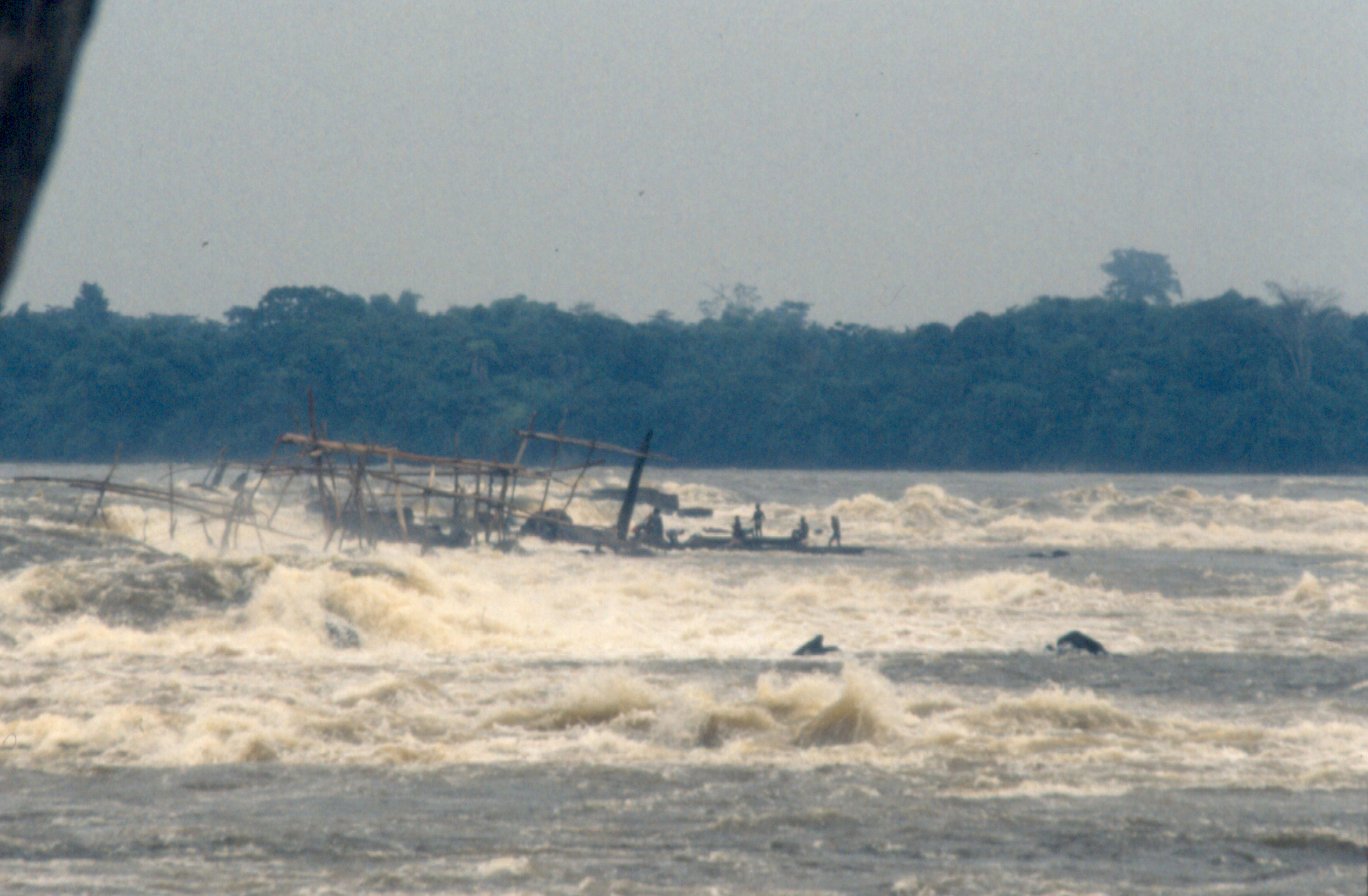
Wagenia Falls are one of the most striking and authentic sights on the Congo River: where the great river, after flowing down from the east, plunges over the last of a long staircase of rapids right next to the city of Kisangani, a community of fishermen keeps a unique ancestral technique alive. Over the rough water, the Wagenia men build huge scaffolds of tree trunks and lower large conical wooden baskets on ropes to catch the fish swept along by the current.
It is not a tall waterfall but a succession of powerful, foaming rapids —the old 'Stanley Falls'— that mark the end of large-vessel navigation on the river. What is extraordinary is the symbiosis between the Wagenia people and this stretch of the Congo: a way of life handed down from generation to generation, with family fishing rights over each structure and a whole initiation ritual before anyone can climb the slippery scaffolds.
This guide explains how to visit the falls and the Wagenia fishermen respectfully and practically: how to arrange things with the community, how much to pay, when to go to see them at work, what to expect from the experience and how to combine it with the rest of Kisangani. It is one of the great cultural treasures of the deep Congo, far removed from mass tourism.
The rapids we now call Wagenia Falls are the final stretch of Boyoma Falls, mapped and named 'Stanley Falls' by the explorer Henry Morton Stanley in 1877. Long before he arrived, the Wagenia people were already fishing these waters with their ingenious system of scaffolds and baskets, a technique that has remained almost unchanged for more than two centuries and is still practised today within sight of Kisangani. Its history is told in detail on our history page.
Read the full history ↓The green heart of the country: the second-largest tropical rainforest in the world, crossed by the Congo River, with Kisangani, the Wagenia fishermen and the vast Salonga park, a refuge for bonobos.
Read the history of The river and the great equatorial forest →No exact prices: a scale from $ (budget) to $$$$$ (luxury), with 2-3 options per category.
Origins, formation and what the sources say.
Wagenia Falls is the best-known part of Boyoma Falls, an impressive series of seven large rapids that the Congo River forms over more than a hundred kilometres between the towns of Ubundu and Kisangani, in the north-east of the country. In its upper course the river is called the Lualaba, and it flows down from the highlands of East Africa. On reaching this area it meets a rocky drop that forces it down a staircase of powerful rapids carrying an enormous flow: it is one of the stretches with the greatest volume of water of any waterfall in the world, even though its height is modest.
The seventh and last of these rapids sits right next to the city of Kisangani, and that is exactly where the Wagenia community lives and where the traditional fishing that made the place famous is practised. Downstream from this point the river suddenly calms and becomes navigable for more than one thousand seven hundred kilometres to the west. That is why this stretch marks a key natural boundary in the geography of the Congo: the end of upstream navigation and the start of the great waterway that crosses the country.
The rapids, with their rocky islands, their whirlpools and their constant roar, have shaped the lives of the riverside peoples for centuries. For the Wagenia they are not an obstacle but a resource: the place where the river, as it narrows and speeds up, concentrates the fish and makes possible a way of fishing that exists nowhere else on the planet.
Long before the Europeans arrived, the Wagenia people developed an extraordinary fishing system perfectly suited to the rapids. Over the rough water, the men build huge scaffolds of hardwood logs, lashed together with vines and wedged between the rocks, strong enough to withstand the brutal force of the current. From these structures hang large conical traps, made of wood and cane, which are lowered into the water at the points where the current is strongest.
Fish moving up or down the rapids get caught in the baskets, and the fishermen haul them up regularly to collect the catch. Climbing the wet, slippery scaffolds with the river roaring below takes strength, balance and a detailed knowledge of the currents, which is why only initiated men may work on them. The technique is passed down from father to son, and each tripod belongs to a specific family, with hereditary rights over that exact spot in the rapids.
This fishing is much more than a way of getting food: it is the backbone of Wagenia identity. It organises the community's social life, marks young men's passage into adulthood through initiation rites and supports an economy based on fish, which is smoked and sold in the markets of Kisangani. Anthropologists and travellers have been marvelling at this symbiosis between a people and a river for more than a century.
In 1877 the Welsh-American explorer Henry Morton Stanley completed one of the greatest journeys in the history of African exploration: he travelled down the Congo River from the interior of the continent to the Atlantic Ocean, solving the geographical riddle of the great river. When he reached these rapids he became the first European to map them, and he gave them his own surname: Stanley Falls. The settlement founded years later beside the last of the rapids, in 1883, would also take his name: Stanleyville.
For the Wagenia and the other river peoples, however, these waters had their own names and meanings, far older than Stanley's arrival. Fishing on the rapids had been practised for generations, and the system of scaffolds and baskets was a well-established tradition by the time the first Europeans described it in amazement. The 'novelty' Stanley believed he had discovered was in fact a human and natural landscape that had been working for centuries.
After the Congo's independence, and above all with the policy of African 'authenticity' promoted by Mobutu Sese Seko from 1971, many colonial names were replaced with African ones. Stanley Falls was officially renamed Boyoma Falls, and Stanleyville became Kisangani. The final stretch of the rapids, next to the city, is the one popularly known as Wagenia Falls, in honour of the fishermen who give it its unique character.
The most astonishing thing about Wagenia fishing is that it has survived almost intact through more than a century of drastic change: brutal colonial exploitation, the rebellions of the 1960s, Mobutu's long dictatorship, the devastating Congo wars of the late 20th and early 21st centuries, and the growing pressure of modern life. While Kisangani grew, was destroyed and was rebuilt beside them, the Wagenia kept raising their scaffolds and lowering their baskets into the rapids, generation after generation.
Today that continuity faces new challenges. Fewer fish in the river, the appeal of other jobs in the city, young people moving away, and the hardship and danger of the work mean that fewer and fewer men fish on the rapids. At the same time, the community has found in visitors an additional source of income: demonstrating the technique, guiding tourists and offering canoe trips have become a way of sustaining the tradition and giving it value.
For travellers, watching the Wagenia fish is a glimpse into one of the oldest and most accomplished relationships between an African people and their river. It is also a responsibility: visiting respectfully, paying the agreed access fee, asking permission before taking photos, and buying fish or crafts are concrete ways to help keep this extraordinary heritage of the Congo River alive. Wagenia Falls is not just an imposing natural landscape but a living cultural heritage at the heart of Africa.