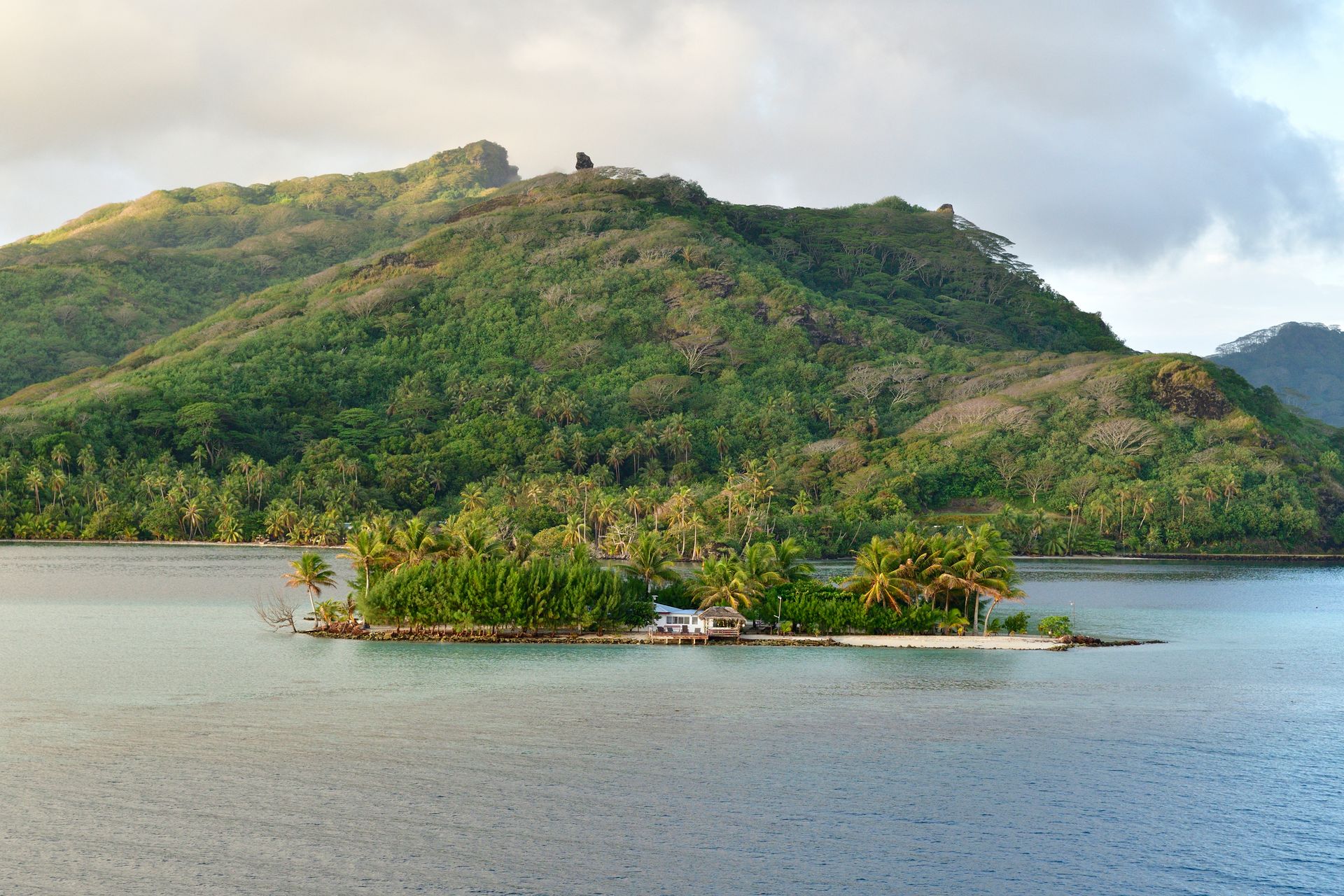
Huahine is the Polynesia many people are looking for without knowing it: a green, unhurried island, with horses grazing by the road, vanilla plantations, deep and empty bays, white-sand beaches that are almost deserted and a village, Fare, where life still moves to the rhythm of the boat's arrival. Less than an hour's flight from Tahiti, it is the archipelago's 'wild island', the one that skipped mass tourism and keeps a rural, authentic feel that is getting hard to find in Bora Bora or Moorea.
But Huahine is not just nature and calm: it is also the island with the most visible history in Polynesia. In Maeva, in the north, you'll find the most important and extensive group of marae (the stone temples of the ancient mā'ohi) in the Society Islands, seat of the island's eight great chiefs, next to the age-old stone fish traps of Lake Fauna Nui, a feat of engineering that still works after centuries. Walking among those stones is a glimpse of Polynesia before the Europeans.
This guide covers Huahine with a practical, warm eye: what to see on its two islands (Huahine Nui and Huahine Iti, joined by a bridge), how to get around by renting a car, scooter or bike, what visits, lagoon tours and accommodation really cost (in CFP francs, verified in July 2026), from the Maitai hotel to family guesthouses, and where to eat in Fare and at its roulottes. Huahine rewards those who come without hurrying.
Huahine was one of the first places settled in the Society Islands: the mā'ohi lived here from at least the 9th century, and in Maeva they left one of the densest groups of marae in all of Polynesia, seat of their eight great chiefs. Excavations by archaeologist Yosihiko Sinoto, from the 1960s onwards, uncovered a site with canoes, adzes and fishhooks that revealed its very rich past. Captain Cook first visited in 1769 and returned in 1774 and 1777; missionaries from the London Missionary Society arrived in the early 19th century. Huahine was a kingdom ruled by queens of the house of Teha'apapa, both ally and rival of the Pomare of Tahiti, and it resisted colonisation until France annexed the Windward Islands between 1888 and 1897; Queen Teha'apapa III was deposed when the island was annexed in 1895. Its full history is told on the history page.
Read the full history ↓The heart of French Polynesia: the archipelago of Tahiti and Bora Bora, cradle of the Pomare kingdom and the marae of Taputapuātea, home to the capital Papeete and the setting for the French annexation, the myth of paradise and the US base of the Second World War.
Read the history of Society Islands →They depart from Bora Bora, 83 km away. If you book from this link we earn a commission and you pay no more.
No exact prices: a scale from $ (budget) to $$$$$ (luxury), with 2-3 options per category.
Origins, formation and what the sources say.
Across most of Polynesia, the temples of the ancients were dismantled, swallowed by the jungle or erased by missionaries. Not in Huahine. On the shores of Lake Fauna Nui, in the village of Maeva, stands the largest concentration of marae (the stone sanctuaries of the mā'ohi) anywhere in the Society Islands. Dozens of platforms, walls and sacred enclosures are spread along the shore and climb the slope of Mata'ire'a hill. Walking among them is one of the few experiences in the Pacific where you can literally stand at the centre of power of a Polynesian society that existed before Europe arrived.
Huahine was one of the earliest settled places in the archipelago. Archaeologists estimate that the mā'ohi lived here at least from the 9th century, and some sites point to even earlier dates. Between 850 and 1100, the island already held one of the highest densities of archaeological structures in Polynesia. Those first inhabitants were descendants of the great navigators who, over centuries, crossed thousands of kilometres of ocean in double-hulled canoes, the va'a. They found their way by the stars, the swell, the clouds and the birds, in one of humanity's most astonishing feats of seafaring. From the nearby sanctuary of Taputapuatea, on Raiatea, the religious navel of central Polynesia, radiated a world in which Huahine was a key piece.
What makes Maeva unique is that it was home not to a single chief but to all eight great ari'i of Huahine together, each with his own marae. That is why the site gathers family, communal and 'national' temples in a small space: a stone map of the island's entire political and sacred hierarchy.
Mā'ohi society on Huahine was organised around the ari'i, chiefs of noble lineage whose right to rule came from their genealogy and their mana, the spiritual force that flowed from the gods and the ancestors. The marae was where that power became visible. On its platforms of stone and coral, chiefs were enthroned, sacrifices were offered, Ta'aroa, 'Oro and the other deities were invoked, and sacred objects were kept. The marae was tapu, sacred and forbidden, and violating it could cost you your life.
A sophisticated material culture flourished around this ritual life. On Huahine, excavations have uncovered stone adzes, mother-of-pearl fish hooks, tools, the remains of houses, and even wooden objects and canoes preserved in the damp ground, an extremely rare treasure in the tropics. The island lived off the lagoon and the land: fishing, taro, breadfruit, coconut, and a way of organising things that made the most of every resource.
The best example of that ingenuity is the stone fish traps of Lake Fauna Nui, next to Maeva. They are long, low walls laid out like funnels that use the flow of the tides to steer fish into pens they cannot escape. They are centuries old and still work today, harvested by the same families. Few structures show the continuity between ancient and modern Huahine so clearly. They are not a ruin but a living technology that visitors can watch at work.
The first European to anchor off Huahine was Captain James Cook, who arrived in 1769 on his first voyage to the Pacific and returned in 1774 and 1777. Huahine was one of his favourite stops. He described its fertility, its bays and the way its people were organised, and he built relationships with the local chiefs. It was also the starting point for one of the most remarkable figures in this meeting of worlds: Omai (Mai), a young Raiatean-Tahitian with ties to the region. He sailed with the British to London, was presented at the court of King George III and painted by the finest portraitists of the day. He returned to the Pacific with Cook in 1777 and was settled on Huahine itself.
Contact also brought disease, firearms and a slow reshuffling of power. But the deepest change came with religion. In the early 19th century, missionaries from the London Missionary Society (LMS), who had landed in Tahiti in 1797, extended their work to the Leeward Islands. On Huahine they set up a mission, translated the Bible into Tahitian, taught people to read and write, and preached against the ancestral cults. The island converted to Protestant Christianity. Many marae were abandoned as a result, and practices such as certain tattoos and dances were banned.
Ironically, that same abandonment helped preserve the stones of Maeva. Instead of being completely reused, they were left forgotten under the vegetation. Science only brought them back to light in the mid-20th century. From the 1960s, the Japanese-American archaeologist Yosihiko Sinoto, of the Bishop Museum in Honolulu, led excavations and restorations that rebuilt the marae complex and revealed the island's remarkably rich past. Sinoto is regarded as the 'father' of Polynesian archaeology, and much of what you can visit in Maeva today is thanks to his work.
In the 19th century, Huahine was an independent kingdom with a notable feature: queens of the Teha'apapa house shaped much of its political history. The island had a complicated relationship with the powerful Pomare dynasty of Tahiti, sometimes as an ally and sometimes as a rival. It was also tied to the other Leeward Islands (Raiatea, Bora Bora, Maupiti) through a game of marriages, wars and alliances that defined the balance of power in the region.
In 1842, under pressure from the French navy, Queen Pomare IV of Tahiti accepted a French protectorate over Tahiti and Moorea, but the Leeward Islands were left out. In 1847, the Jarnac Convention between France and the United Kingdom formally recognised the independence of these kingdoms, which remained sovereign under their own dynasties for decades. During that period Huahine, ruled by its queens, was an autonomous kingdom with its own court, missionary-inspired laws and flag.
That protected independence ended late in the century, when France decided to break the agreement and annex the Leeward Islands as part of the European colonial expansion across the Pacific. Queen Teha'apapa II, who reigned for much of the 19th century, and then her successor Teha'apapa III faced growing pressure from Paris as they tried to preserve the island's sovereignty. Theirs was an increasingly unequal diplomacy against French cannons and French administration.
France's takeover of the Leeward Islands (Îles Sous-le-Vent) between 1888 and 1897 was not a peaceful formality. It was a war. When Paris announced the annexation, fierce armed resistance broke out on several islands, as the mā'ohi fought against colonisation and against the chiefs who sided with France. The most violent centre of the fighting was Raiatea, where from 1887 the chief Teraupo'o led a rebellion that held off French troops for years. But Huahine saw conflict too. There were clashes, and on the island a French officer and French sailors were even shot at.
Huahine's society split. Against the pro-French faction led by Prince Marama Teururai, most of the population backed a rival royal government, headed by Queen Teuhe, to resist annexation. Fighting across the Leeward Islands only died down after chief Teraupo'o was captured in February 1897 and hundreds of islanders were deported. Queen Teha'apapa III of Huahine was deposed when the island was annexed in 1895, and the kingdom was absorbed into the colonial administration of the Établissements français de l'Océanie, the forerunner of French Polynesia.
Huahine's long independence ended in resistance, not resignation. The island entered the 20th century as part of the French empire, but the memory of its queens and of that war stayed alive locally, along with the stones of Maeva that no governor ever managed to erase.
The 20th century brought French Polynesia its most traumatic chapter, though far from Huahine. In 1958, the Tahitian leader Pouvanaa a Oopa, considered the father of Polynesian nationalism, campaigned for a vote for independence. He was arrested, convicted and exiled in a trial that the French courts only overturned in 2018, forty years after his death. Soon afterwards, France set up its Pacific Experimentation Centre on the atolls of Moruroa and Fangataufa, in the Tuamotus. Between 1966 and 1996 it carried out 193 nuclear tests there, 46 of them atmospheric, and the health, environmental and social damage is still the subject of claims today. The programme transformed the Polynesian economy, emptied the countryside and filled Papeete with migrants looking for work. It also fuelled a long struggle for autonomy that, through 1977, 1984 and the 2004 statute, turned the country into an overseas collectivity with broad self-government.
Huahine lived through these changes from the sidelines and largely skipped them. While Tahiti urbanised and Bora Bora and Moorea filled up with resorts and overwater bungalows, Huahine kept its rural, farming character: vanilla, melons, fishing, horses by the roadside, quiet bays. That earned it the nicknames 'the wild island' and 'the garden island', and a reputation as an authentic destination among travellers looking for the Polynesia that existed before mass tourism.
Today Huahine has around 6,000 inhabitants and lives off farming, fishing and slow, small-scale tourism. Its great treasure is still continuity. In Maeva, the marae and fish traps link directly to the mā'ohi of a thousand years ago. In Faie, the blue-eyed eels are still sacred. In the plantations, vanilla scents the air. In a Polynesia where paradise is sometimes sold as a package, Huahine offers something rarer and deeper: an island that never stopped being itself.