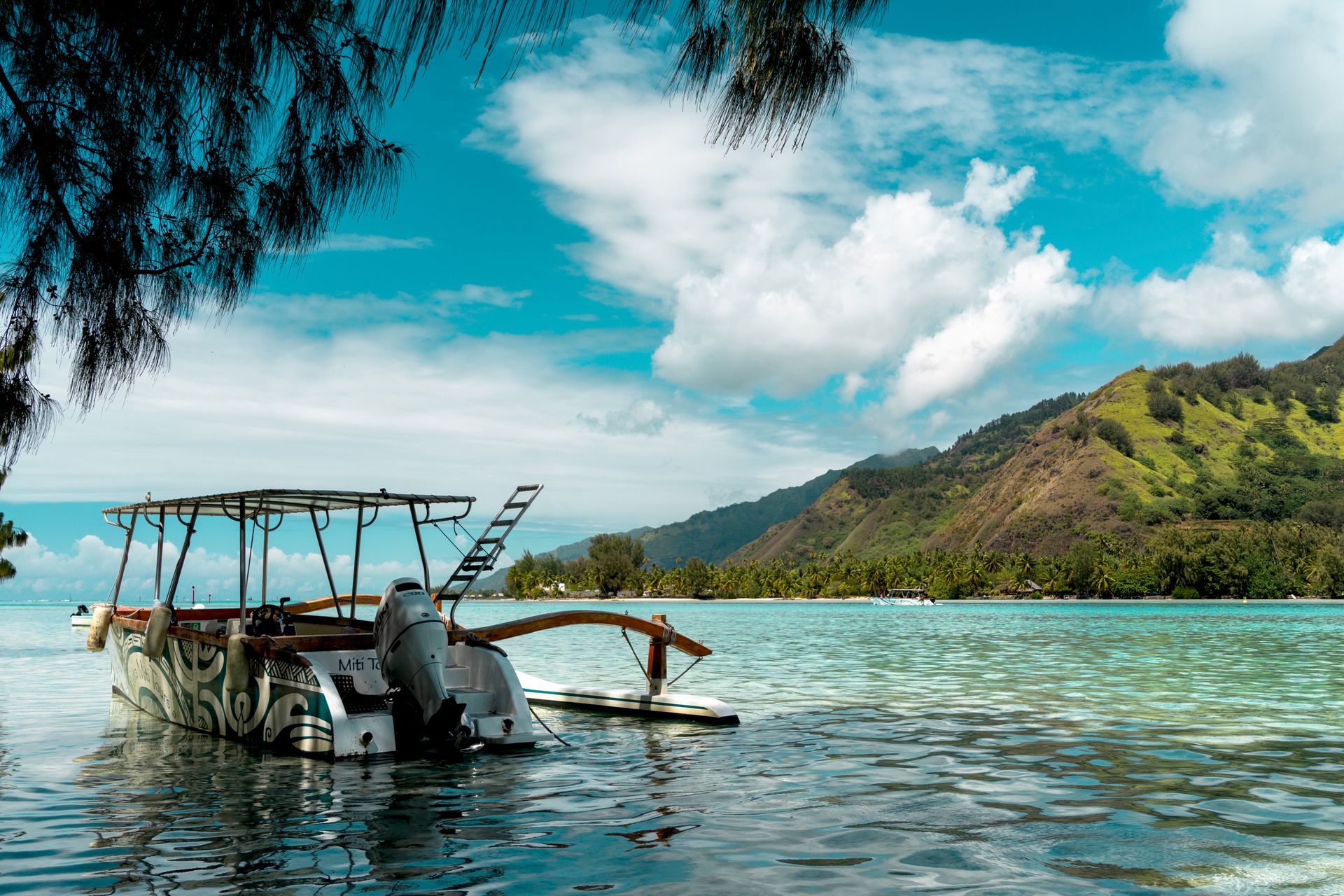
For many people, Moorea is the most beautiful island in French Polynesia, and it's just a short ferry hop from Tahiti. Its sharp, green, jagged mountains rise above two twin bays (Cook's Bay and Opunohu Bay) and a lagoon in a thousand shades of blue where you can swim with rays and reef sharks. It's the Tahitians' weekend escape and the first island paradise most travellers discover.
Unlike Bora Bora, Moorea combines the best of two worlds: the spectacular lagoon of the flat islands and the volcanic drama of the mountains. You can swim among rays in the morning, drive up to the Belvédère lookout through pineapple plantations in the afternoon and have dinner at a roulotte by the sea at nightfall. And all at more down-to-earth prices than its glamorous neighbour.
This guide covers Moorea with a practical, friendly eye: which lagoon tour to choose, how to take the ferry from Tahiti, what snorkelling with rays and sharks, swimming with whales in season and interior tours really cost (in CFP francs and verified in July 2026), and where to eat and sleep. It's the ideal island to start falling in love with the Polynesian Pacific.
Moorea (formerly 'Aimeho or Eimeo) was part of the Pomare kingdom and closely tied to Tahiti since mā'ohi times, when its valleys and bays were home to marae and villages of fishers and farmers. Important restored stone marae survive here in the Opunohu Valley. The London Missionary Society missionaries had one of their first big successes on Moorea: it was on this island that Pōmare II took refuge, converted to Christianity and from where he reconquered Tahiti in 1815, imposing Protestantism. The full story is told on the history page.
Read the full history ↓The heart of French Polynesia: the archipelago of Tahiti and Bora Bora, cradle of the Pomare kingdom and the marae of Taputapuātea, home to the capital Papeete and the setting for the French annexation, the myth of paradise and the US base of the Second World War.
Read the history of Society Islands →If you book from here we earn a commission and you pay no more. Prices and availability come from Civitatis.
No exact prices: a scale from $ (budget) to $$$$$ (luxury), with 2-3 options per category.
Origins, formation and what the sources say.
The ancients didn't call it Moorea. They knew it as 'Aimeho or Eimeo, and an old legend says its current name, Mo'orea, usually translated as 'yellow lizard', comes from a vision: a priest or a chief who dreamed of, or saw, a yellow lizard linked to the island. In Polynesia, names weren't labels: they were genealogy, they were myth, they were memory. And Moorea, that island of jagged mountains rising west of Tahiti like an impossible stage set, has been the setting for myths ever since the first mā'ohi paddled into its bays.
Like the rest of the Society Islands, Moorea was settled by the Polynesian navigators who colonised the central Pacific more than a thousand years ago. Its two great twin bays, 'Ōpūnohu and Cook's Bay (Pao Pao), sunk between walls of volcanic rock, offered shelter, fishing and fertile land. In its valleys, above all the broad green 'Ōpūnohu valley, people built villages, taro gardens and dozens of marae, the stone temples where mā'ohi society worshipped its gods and honoured its chiefs.
Just 17 km from Tahiti, separated only by a channel that today takes half an hour to cross by ferry, Moorea was always closely tied to its big neighbour and to its history. They shared gods, lineages and wars. And when the fate of the whole archipelago was decided, between old gods and a new faith, between rival chiefs and European ships, Moorea was no distant spectator: more than once, it was the very centre of the board.
Anyone driving up the 'Ōpūnohu valley road today, on the way to the Belvédère lookout, passes without knowing it through one of the most important archaeological sites in French Polynesia. Under the big trees, among ferns and plantations, lie more than a hundred stone structures: marae, platforms, enclosures, farming terraces and ceremonial archery platforms. They're proof that this valley, quiet and half-empty today, was densely populated before the Europeans arrived.
The marae were the heart of mā'ohi religious and political life: rectangular platforms of stone and coral, sometimes with upright slabs (the ahu), where ceremonies were held, the gods were invoked (Ta'aroa the creator, 'Oro the god of war) and the power of the ari'i, the chiefs of sacred lineage, was legitimised. Every family group and every chiefdom had its own marae, and its size and prestige spoke of the mana, the spiritual power, of those who built it.
Several of these temples in the 'Ōpūnohu valley have been restored so visitors can walk through them. The best known is the Titiroa marae, surrounded by banyan trees and rebuilt in the late 1960s by archaeologist Yosihiko Sinoto and his team, along with the Afareaito marae and others. Walking among those moss-covered stones, in the shade of centuries-old trees, is a glimpse of Moorea before the Cross: the Moorea of priests, drums and offerings, of a world that was about to change forever.
In the early 19th century, as European ships came and went around Tahiti, one ambitious chief was trying to dominate the whole archipelago: Pomare II, heir to the dynasty his father had begun building with the help of Western weapons and allies. But his rivals defeated him, and in December 1808 Pomare II had to flee Tahiti and take refuge in, of all places, Moorea.
In Moorea the fallen chief found more than refuge: he found the Protestant missionaries of the London Missionary Society, who had landed in the islands in 1797 and had also withdrawn there. During his exile on Moorea, Pomare II drew closer to the new religion and, in 1812, was baptised: a hugely symbolic step, because he was the first great chief to embrace Christianity. Moorea thus became the stronghold from which not only the reconquest of the kingdom was prepared, but the conversion of an entire people.
The outcome came on 12 November 1815, when Pomare II returned to Tahiti and decisively defeated his enemies at the battle of Te Fei Pī. His military victory was also a victory for Christianity: within a short time, the old idols were abandoned and burned. Tradition says that at the Papetoai marae, on Moorea's north coast, the chief priest of the god 'Oro himself converted and destroyed the temple's idols. On that sacred pagan site the octagonal Papetoai temple was later built, one of the oldest Christian churches in the South Pacific and a perfect symbol of the change of worlds that began in Moorea.
Pomare II's conversion secured his dynasty at the head of a Christian kingdom, the Kingdom of Tahiti, which also included Moorea and other islands. But it was a kingdom caught in the tug-of-war between the great powers. In 1842 the French admiral Abel Aubert du Petit-Thouars, seizing on an incident involving Catholic missionaries, pressured Queen Pomare IV into accepting a French protectorate over Tahiti and its dependencies, Moorea included. The queen and much of her people resisted for years (there was a Franco-Tahitian War between 1844 and 1847), but the protectorate prevailed.
In 1880 King Pomare V, son of Pomare IV, formally ceded sovereignty over Tahiti and its dependencies to France in exchange for a pension. The kingdom disappeared and the French Establishments of Oceania, a colony, were born. Moorea, so close to Tahiti, became part of that new colonial order, with its administration, its French-language schools and an economy geared towards exports: vanilla, copra (dried coconut flesh) and, later, coffee and fruit.
For much of the 19th and 20th centuries, Moorea was a quiet rural island of plantations and fishing villages, in Tahiti's shadow. Its valleys produced vanilla and, above all, the pineapple that is still its emblem today and is distilled at the juice and liqueur factory in the 'Ōpūnohu valley. The island kept its unhurried pace while, in the distant capital Papeete, the great changes that would shake all of Polynesia in the 20th century were brewing.
The 20th century transformed Moorea on two opposing fronts. On one side, the island became a pioneer of Polynesian tourism: in 1961 the legendary Bali Hai hotel, founded by three adventurous Americans (the 'Bali Hai Boys'), opened on Moorea some of the world's first overwater bungalows, the icon we now associate with all of Polynesia. With its picture-postcard bays and its closeness to Tahiti, Moorea became the dream destination for honeymooners and Pacific travellers.
On the other side, the shadow of the atomic bomb fell over all of French Polynesia. Between 1966 and 1996, France carried out 193 nuclear tests on the atolls of Moruroa and Fangataufa, in the Tuamotu archipelago: 46 in the atmosphere and the rest underground. The first was on 3 July 1966; the last, in January 1996. The Pacific Experimentation Centre transformed the territory's economy, attracting labour, money and rapid urbanisation in Papeete, but it also left serious health and environmental consequences, a legacy of contamination and illness whose compensation is still being fought over in the courts. The tests fuelled a strong pro-independence and anti-nuclear movement that shaped Polynesian politics in recent decades.
Meanwhile, French Polynesia gradually gained autonomy: it obtained ever broader statutes until, in 2004, it became an overseas collectivity with its own government, assembly and president, although France retains powers such as defence and justice. Moorea lived through all these ups and downs from up close, given its proximity to the capital, while remaining the quiet green garden Tahitians escape to at weekends.
Today's Moorea is much more than a landscape of bays and mountains. With about 17,000 inhabitants, it is the second most populous of the Leeward and Windward Islands after Tahiti, and to a large extent works as an extension of it: thousands of people cross daily or at weekends on the ferry from Papeete. It lives on tourism (resorts, family guesthouses and lagoon tours with rays and sharks), on pineapple farming and on lagoon fishing.
But Moorea is also, curiously, an island of science. The 'Ōpūnohu valley is home to a marine research station run by the University of California, Berkeley (the Gump Station), and the whole island is the subject of one of the most ambitious ecology projects in the world, the 'Moorea Biocode', which set out to genetically catalogue every species in an entire tropical ecosystem. Its reefs and lagoon are a natural laboratory studied by scientists from all over the planet, and every year, between July and November, its waters welcome humpback whales that come to give birth and raise their calves.
That mix is what gives Moorea its character: an island that keeps the marae of its ari'i in the 'Ōpūnohu valley and, a few metres away, a 21st-century biology lab; that was the refuge from which Pomare II changed the faith of an entire people and is now a weekend refuge for the people of Papeete; that produced vanilla for the colonial empire and now exports postcards of overwater bungalows. Heart-shaped when seen from the air, Moorea packs the whole history of Polynesia (mā'ohi settlement, the Cross, the colony, the bomb and autonomy) into just 134 km² of green mountains sunk in a turquoise lagoon.