Viajá con Gus
HomePeruArequipa
Arequipa
🇵🇪 Peru · The Highlands and the Andes

Arequipa

Jump to what you need
📍Region
Arequipa (capital of the region and of the province of the same name)
📌Service city
Arequipa itself (Rodríguez Ballón airport)
📌Best time to go
Dry season, April to November; clear skies bring out the sillar and the volcanoes
📌Suggested days
2 to 3 days in the city, plus 2 more if you add the Colca Canyon
💱 PEN exchange rate
Loading rate…
🌤️ Weather in Arequipa
Loading weather…

Arequipa is the 'White City', and the nickname makes sense the moment you see it: almost the whole historic center is built from sillar, a white volcanic stone that gleams under the high-altitude sun. Add the backdrop of three volcanoes -Misti, Chachani and Pichu Pichu- and you understand why its old quarter is a World Heritage Site. It's one of the most elegant and proud cities in Peru, with a strong character all its own.

It sits at around 2,300 meters above sea level, a good deal lower than Cusco or Puno, so the altitude is usually barely noticeable and it's a good place to acclimatize gradually before heading up to the altiplano. The climate is among the kindest in the country: sun nearly all year and clean skies, especially in the dry season. Walking its Plaza de Armas, going into the Monastery of Santa Catalina (a walled town inside the city) and getting lost in its sillar streets easily fill a couple of good days.

Arequipa is also the natural base for the Colca Canyon, one of the deepest in the world, where you can watch condors gliding at dawn. And it's a food capital in its own right: the picanterías of Arequipa, with their rocoto relleno, chupe de camarones and adobo, are an experience in themselves. Give yourself time to sit and eat slowly: here food is identity.

📖 History of Arequipa

The Chili valley was already inhabited by Collagua peoples and later by the Incas long before the Spanish arrived. The Spanish founding took place on 15 August 1540, under the name 'Villa Hermosa de Nuestra Señora de la Asunta', and the following year King Charles V granted it the title of city. Volcanic sillar shaped its architecture from the start and gave it the nickname of the White City; the full story is on the history page.

Read the full history ↓

🗺️ What to see

1
Plaza de Armas
One of the most beautiful squares in Peru, ringed by sillar arcades on three sides and presided over by the imposing Cathedral. With the volcanoes rising behind, it's the heart of the city.
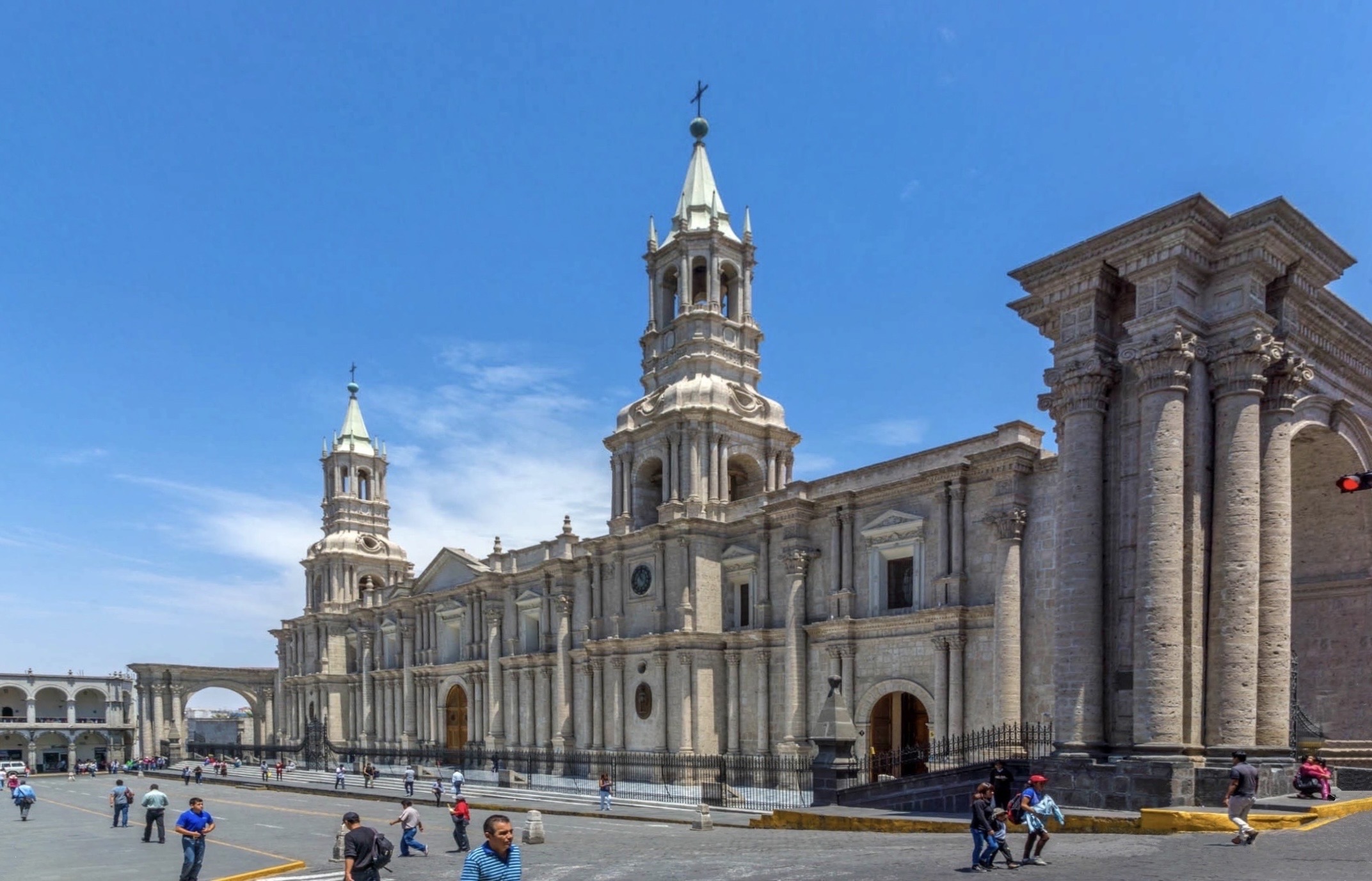
Arequipa's Plaza de Armas is, for many travelers, the most elegant in Peru, and you see why the moment you arrive. Three of its sides are framed by long two-storey sillar arcades (the portales of the Municipality, San Agustín and Flores), perfectly harmonious, while the fourth side is entirely taken up by the imposing façade of the Cathedral. In the center there's a bronze fountain crowned by a figure known as the 'tuturutu', and from the square, when the sky is clear, you can see the Misti volcano rising behind the Cathedral towers: an unforgettable picture. It's worth it because it's the very heart of the city and the best place to start getting to know it. The whole ensemble, built in white sillar that gleams under the Arequipa sun, is part of the historic center declared a Unesco World Heritage Site. Under the arcades you'll find cafés, balconies and restaurants; sitting at one of them at dusk, with the Cathedral lit up, is one of the classic things to do in Arequipa. It's right in the center; if you're staying in the old quarter, you'll walk here in minutes. It's the starting point for city tours and free walking tours. Practical note: go up to one of the terraces or balconies of the restaurants around the square for the best view of the whole ensemble with the Misti behind. Afternoon light is ideal for photographing the sillar. Combine it with a visit to the Cathedral, on the same square, and with the church of La Compañía, half a block away.
ℹ️ Material: Sillar arcades (white volcanic stone) · View: The Misti volcano rising behind the Cathedral · Location: Historic center (World Heritage Site)
2
Monastery of Santa Catalina
A religious walled town inside the city: more than 20,000 m2 of little streets, squares and cells painted indigo and ochre, where cloistered nuns lived from 1579. Arequipa's great must-see.
The Monastery of Santa Catalina is Arequipa's great treasure and one of the most surprising visits in Peru. It isn't a church or a conventional convent, but a genuine walled town inside the city: more than 20,000 square meters of little streets with names of their own, small squares, fountains, cloisters, kitchens and cells, where Dominican nuns lived in enclosure from 1579. For centuries it was a closed, self-sufficient world, inhabited by women from well-off families who entered as nuns. Only in the 20th century did it open to the public. What makes it magical is its atmosphere and its color: the inner streets are painted in intense indigo, ochre and red that contrast with the blue sky and the flowers, making it one of the most photogenic corners of the country. Each sector has its own character: the Cloister of the Orange Trees, Calle Sevilla, Calle Córdova, the communal laundry with its clay jars, the cells that show how the nuns lived. Getting lost in its passageways is like traveling back in time to a small Andalusian town set down in the Andes. It's barely a 5 minute walk from the Plaza de Armas, right in the center. Admission for foreigners is S/ 40 (verified 2026), with an optional guided visit at around S/ 20 that's well worth it given how much history is packed into every corner. Practical note: give it at least 1.5 to 2 hours. On certain dates there are candlelit night visits, an especially lovely experience; check the calendar when you buy. Bring a camera and, because of the altitude and the sun, a hat and water, though a good part of the route is in the shade.
ℹ️ Distance: 5 min walk from the Plaza de Armas · Admission: S/ 40 for foreigners (verified 2026); optional guide around S/ 20 · Duration: 1.5 to 2 h; there are candlelit night visits
3
Arequipa Cathedral
A neoclassical sillar church taking up one whole side of the square; you can climb its towers and visit a museum with vestments and a historic Belgian organ.
Arequipa Cathedral is one of the most unusual in Peru and completely dominates one side of the Plaza de Armas, with its long white sillar façade and its two towers. Unlike other colonial cathedrals, this one is neoclassical (its current look dates from the 19th century, after the earthquakes and fires that forced it to be rebuilt several times) and it has the distinction of taking up the entire front of the square, which is rare. It's one of the few cathedrals in the world you can tour 'inside its walls', climbing up to its towers and roofs. It's worth it for several reasons. Inside it holds a magnificent 19th-century Belgian organ, one of the largest in South America, and a carved wooden pulpit imported from France, with startling details. The cathedral museum displays vestments, monstrances, chalices and religious art. But the most memorable part is the walk through the towers and the roof: from up there you get a spectacular panorama of the Plaza de Armas, the city's rooftops and, behind, the Misti, Chachani and Pichu Pichu volcanoes. It's on the Plaza de Armas itself, so you walk there. Admission to the museum and the towers is charged separately (indicatively S/ 10-20); the tower visit is usually guided and at set times. Practical note: if you like views and photos, don't miss the climb up the towers, the best part of the visit. Combine it with the Plaza de Armas (it's part of it) and with the church of La Compañía, very close by. Confirm the tower hours, which are more limited than those of the church.
ℹ️ Style: Neoclassical, in sillar; takes up one whole side of the square · Don't miss: The 19th-century Belgian organ and the climb up the towers, with views of the volcanoes · Admission: Museum and towers charged (indicatively S/ 10-20); confirm hours
4
Yanahuara Viewpoint
A square and lookout with sillar arches carved with famous quotes, and one of the best views of the Misti framed by the arches. A sunset classic, in the Yanahuara neighborhood.
The Yanahuara Viewpoint is one of Arequipa's best-loved corners and the place where one of the city's most recognizable pictures is taken: the Misti volcano perfectly framed by a sillar arch. It's in the traditional neighborhood of Yanahuara, on the other side of the Chili river, a quiet residential area of cobbled streets and white houses that keeps a lot of old Arequipa. The viewpoint is a small square with a row of carved sillar arches, engraved with quotations from distinguished arequipeños, that frame the view toward the valley and the volcanoes. It's worth it for the view and for the walk. From the arches you see the Arequipa countryside, the river and, on clear days, the imposing outline of the snow-capped Misti and Chachani. It's a photogenic and charming spot, especially at sunset, when the light turns the sillar and the volcanoes golden. Beside the viewpoint stands the picturesque church of San Juan Bautista de Yanahuara, also in sillar, and around it are restaurants and traditional picanterías, including some of the most famous in the city. It's about 10-15 minutes by taxi from the Plaza de Armas, or you can walk there across the bridge over the Chili river (a 20-25 minute stroll). Access to the viewpoint is free. Practical note: combine sunset at the viewpoint with lunch or dinner at a picantería in the neighborhood (such as La Nueva Palomino), among the best in Arequipa. Bring a camera for the shot of the Misti between the arches. It's an ideal plan for your last afternoon in the city.
ℹ️ View: The Misti framed by sillar arches carved with quotations · Distance: 10-15 min by taxi or around 20-25 min on foot across the Chili river · Tip: Sunset + a traditional picantería in the Yanahuara neighborhood
5
Museo Santuarios Andinos (the mummy Juanita)
This is where 'Juanita' is displayed, the Inca mummy of a sacrificed girl found frozen on the Ampato volcano, one of the most important archaeological finds in the Andes.
The Museo Santuarios Andinos, run by the Universidad Católica de Santa María, holds one of the most striking archaeological finds in the Andes: 'Juanita', also known as the Lady of Ampato or the Ice Maiden. She is the mummy of an Inca girl, aged around 12 to 14, sacrificed in the 15th century on the summit of the Ampato volcano as an offering to the mountain gods (the capacocha, the Inca ritual of offerings to the apus). The body stayed frozen at more than 6,000 meters for centuries and was discovered in 1995 by the archaeologist Johan Reinhard and the mountaineer Miguel Zárate, when the melting of the volcano's ice, caused by the activity of a neighboring volcano, exposed the tomb. The extraordinary part is the state of preservation: the cold preserved not only the body but the exquisite textiles, the offerings and the objects that accompanied her, giving researchers a unique window onto Inca rituals and life. The visit, always guided, sets the discovery in context with a video and a display of pieces, and ends with Juanita herself, exhibited in a special cold chamber. It's an experience that is both moving and unsettling. It's in central Arequipa, a few blocks from the Plaza de Armas; you walk there. Admission is charged (indicatively S/ 20-40) and includes the guided visit. Practical note: importantly, Juanita isn't always on display: for some months of the year (generally part of the summer, for conservation reasons) another of the mummies found is shown instead. If seeing her specifically matters to you, check beforehand. The visit lasts around an hour.
ℹ️ What it is: The Inca mummy of a girl sacrificed on the Ampato volcano (15th c.) · Discovery: Found in 1995 by Johan Reinhard and Miguel Zárate · Note: Guided visit; Juanita isn't always on display (check first)
6
Church and Complex of La Compañía
A jewel of mestizo Baroque, with a finely carved sillar façade and cloisters that today house shops and cafés. The doorway is among the most photographed in the city.
The Church of La Compañía de Jesús is one of the jewels of mestizo Baroque in the Americas and one of the most impressive monuments in Arequipa. Built by the Jesuits in the 17th century, it stands out for its finely carved sillar doorway, one of the most beautiful and elaborate carved façades in Peru, where Indigenous stonemasons mixed European motifs (saints, columns) with elements of Andean flora, fauna and symbolism, in a fascinating artistic blend. Every centimeter of the main doorway is sculpted with a level of detail that invites you to stand and look for a long while. Inside, the Chapel of San Ignacio is worth seeing, a small room with a dome and walls entirely covered in polychrome murals, with tropical jungle motifs (birds, fruit, plants) whose color and exuberance come as a surprise. Next to the church are the Cloisters of La Compañía, a set of sillar courtyards with carved arcades that today house craft shops, jewelers and cafés, a pleasant place to wander and to buy. It's half a block from the Plaza de Armas, so you're there in a minute on foot. Entry to the church and the San Ignacio chapel usually carries a small charge; the cloisters are free to enter. Practical note: take your time looking at the doorway from outside, which is free and spectacular, and go in to see the San Ignacio chapel with its murals (usually charged separately). The cloisters are a good place to cool off, have a coffee and buy quality crafts. It pairs perfectly with a visit to the Plaza de Armas and the Cathedral.
ℹ️ Style: Mestizo Baroque; finely carved sillar doorway · Don't miss: The Chapel of San Ignacio with polychrome murals of jungle motifs · Distance: Half a block from the Plaza de Armas; cloisters free to enter
7
San Lázaro neighborhood
The oldest neighborhood in Arequipa, a maze of narrow lanes, white houses and quiet corners. The very origin of the city.
The San Lázaro neighborhood is the oldest and most endearing corner of Arequipa: here, tradition says, the city was born before its formal Spanish founding, around a small chapel. It's a maze of narrow, winding cobbled lanes, flanked by white sillar houses, arches, passageways and tiny squares. Unlike the bustle of the Plaza de Armas, San Lázaro is quiet, intimate and very photogenic: one of those places where you feel like wandering with no plan, turning corners and finding new nooks. It's worth it for its village-inside-a-city atmosphere and because it preserves the most authentic Arequipa, away from the crowds. Walking its little streets (some so narrow only one person fits) you come to small squares with sillar benches, to the church of San Lázaro and to lookouts over the valley and the volcanoes. It's also an area with charming cafés and restaurants set up in old mansions. It's a few minutes on foot from the Plaza de Armas, to the northeast; you wander freely, at no cost. The best approach is to go on foot and let the lanes take you where they will. Practical note: it's a short, quiet walk, perfect for an unhurried morning or afternoon. Wear comfortable shoes for the cobbles and bring a camera, because every corner asks for a photo. It connects with the Puente Grau area and the lookouts over the Chili river, so you can chain it with a walk toward the riverside.
ℹ️ What it is: The oldest neighborhood in Arequipa; the origin of the city · Distance: A few minutes on foot from the Plaza de Armas · Tip: Free to wander; ideal for getting lost with no plan
8
Sabandía Mill and the Mansión del Fundador
An old colonial sillar mill and the mansion of the city's founder, both on the outskirts, ideal for a quiet outing through the Arequipa countryside.
On the outskirts of Arequipa, toward the valley, there are two colonial gems usually visited together on a quiet outing through the countryside, away from the center. The Sabandía Mill is an old 17th-century grain mill, built in sillar, fully restored and surrounded by gardens, meadows and the sound of the water that still turns its stones. It's a bucolic place, with cows grazing, views of the volcanoes and the chance to see the mill working; perfect for breathing country air and understanding what rural life in Arequipa was once like. The Mansión del Fundador, meanwhile, is a manor house also built in sillar, linked to Garcí Manuel de Carbajal, the Spanish founder of the city. Restored and furnished with period pieces, it keeps its chapel, courtyards, colonial furniture and paintings, and offers a look at the life of well-off families in the viceroyalty. It sits above a small canyon of the Sabandía river, with lovely views. Both sites, surrounded by the green Arequipa countryside with the volcanoes behind, are a perfect contrast to the stone of the center. They're about 15-20 minutes by car from central Arequipa, in the Sabandía area. They're usually included in the city tour along with Yanahuara and the countryside, or you can go by taxi. Admission to each is charged separately. Practical note: a good option for a quiet half day, ideal if you want to escape the center and see the rural side of Arequipa. Bring a camera, sunscreen and some cash for the admissions. They go very well with lunch at a picantería out in the countryside.
ℹ️ Distance: 15-20 min by car from the center (Sabandía area) · What they are: A 17th-century colonial mill and the mansion of the city's founder · Tip: A half-day outing through the countryside; usually part of the city tour
9
Colca Canyon (day trip)
About 3-4 hours away, the famous canyon with the Cruz del Cóndor viewpoint; see the details on its own page (slug: colca).
The Colca Canyon is the big excursion almost everyone adds to their time in Arequipa, and rightly so: it's one of the deepest canyons in the world (over 3,400 meters of vertical drop) and it holds the Cruz del Cóndor viewpoint, one of the best places on the planet to watch the Andean condor glide very close, at eye level, riding the morning thermals. On top of that there's a living cultural landscape of pre-Inca terraces, colonial villages with churches and traditional dress, and hot springs to relax in. The trip is done from Arequipa in two formats. The full day is possible but very demanding: a pre-dawn start, many hours on the road and an exhausting return the same day. The most recommended format is 2 days / 1 night, which lets you sleep in Chivay, enjoy the hot springs, see the valley at an easy pace and reach the Cruz del Cóndor early and rested, at the best time for seeing the birds (between 8 and 10 in the morning). For walkers, there are 2-3 day treks that drop to the bottom of the canyon, to the Sangalle Oasis. Tours leave from Arequipa and pick you up at your hotel. The route crosses the Salinas y Aguada Blanca National Reserve, where you see vicuñas and a volcano viewpoint above 4,800 m. You need the Colca Tourist Ticket (S/ 70 for foreigners, verified 2026), which is almost never included in the tour and is paid separately, in cash and in soles. You'll find all the details (attractions, prices, how to get there, where to sleep and tips) on the Colca Canyon's own page (slug: colca).
ℹ️ Distance: 3 to 4 h from Arequipa to the valley · Recommended format: 2 days / 1 night with a night in Chivay (better than the full day) · Don't miss: Cruz del Cóndor, 8:00-10:00; bring money for the Colca Tourist Ticket, paid separately
Advertisements
What nobody tells you

💵 Prices

Tickets

TypePrice
Monastery of Santa Catalina - foreign adultS/ 40 (verified 2026; optional guided visit around S/ 20 extra)
Monastery of Santa Catalina - national adultS/ 30
Monastery of Santa Catalina - foreigner aged 7 to 21S/ 20
Museo Santuarios Andinos (the mummy Juanita) - foreigner, with guided visitaround S/ 25-30 per person (verified July 2026; compulsory guide included; check when visiting)
Arequipa Cathedral (museum, includes the tower climb)S/ 10 adult; S/ 5 university student; S/ 3 school student (verified July 2026; museum closed on Sundays; check when visiting)
Colca Tourist Ticket (BTC) - foreignerS/ 70 (verified 2026; bought in Chivay/Cabanaconde, bring cash in soles)
🔄 updated monthlyOfficial / reference values · double-check when buying

Activities and tours

ActivityPriceDurationOperator
Arequipa City Tour (center + Yanahuara + countryside)S/ 60-90 (about USD 16-24) per person, admissions not included (verified July 2026)Half day (4 h)Agencies in the center and sightseeing buses
Colca Canyon full-day tour (Cruz del Cóndor, tourist ticket not included)S/ 90-130 (about USD 24-35) per person, does not include the S/ 70 Colca Tourist Ticket (verified July 2026)Full day (very early start, 13-14 h)Arequipa agencies
Colca Canyon tour, 2 days / 1 night (without hotel / with basic guesthouse)S/ 105-155 (about USD 28-42) per person depending on whether accommodation is included; the S/ 70 ticket is separate (verified July 2026)2 daysArequipa agencies
Food tour of the picanteríasS/ 110-220 (about USD 30-60) per person, depending on the operator and whether drinks are included (verified July 2026; check when booking)3 to 4 hLocal food tours
Free walking tour of the historic centerTip-based2 to 3 hFree tours from the Plaza de Armas
🔄 updated monthlyOfficial / reference values · double-check when buying
Advertisements

🚌 How to get there and distances

Getting around

ModePriceDurationNotes
Walking around the historic centerFree-The old quarter is compact and flat and easy to cover on foot: almost all the sights are a few blocks from the Plaza de Armas.
Taxi / apps (Uber, inDriver, Cabify)City ride indicatively S/ 6-15; from Rodríguez Ballón airport to the center S/ 20-35 (source: app fares and aggregators, verified July 2026)VariableUber, inDriver and Cabify all operate in the city; agree the price if you hail a taxi in the street. The airport to the center takes about 15-20 min.
Urban bus / combi (flat fare S/ 1,30)S/ 1,30 flat adult fare; S/ 0,50 for school students (source: Municipalidad Provincial de Arequipa / El Búho, fare in force since March 2026, verified July 2026)VariableYou pay IN CASH as you board (Arequipa still has no rechargeable card and no widespread QR payment on the bus). It's cheap but designed for locals; not very practical with luggage.
Real-time route app (planning your bus)Free (the app)-To see routes, stops and where your bus is, people use 'Arequipa Bus', the official app of the Municipalidad Provincial de Arequipa, and also SmartBus; Google Maps has partial coverage of the lines (source: Municipalidad de Arequipa / SmartBus, verified July 2026).
Bus to Chivay / Cabanaconde (gateway to the Colca)Indicatively S/ 17-30 per leg (verified July 2026)3 to 4 hThey leave from the bus terminal; a cheap way to reach the Colca on your own. You pay in cash or, depending on the company, by card when buying the ticket.
🔄 updated monthlyOfficial / reference values · double-check when buying

How to get there

RouteAirlines / operatorsAvg. priceDuration
Lima → Arequipa (plane)LATAM, Sky, JetSmartUSD 50-110 one way (indicative)1 h 30 min
Lima → Arequipa (bus)Cruz del Sur, Oltursa, CivaIndicatively USD 30-7015 to 17 h
Cusco → Arequipa (bus)Cruz del Sur, OltursaUSD 23-45 approx. depending on the class of service (verified July 2026)10 to 11 h
Puno → Arequipa (bus)Cruz del Sur, Julsa, TranszelaUSD 19-30 approx. (from S/ 30 upward) depending on the class of service (verified July 2026)5 to 6 h 30 min
🔄 updated monthlyOfficial / reference values · double-check when buying

🏨 Where to stay

No exact prices: a scale from $ (budget) to $$$$$ (luxury), with 2-3 options per category.

CategoryPriceRecommended options
Luxury$$$$$Cirqa (sillar boutique), Casa Andina Premium, Katari Hotel facing the Cathedral, Libertador Arequipa
Mid-range$$$$$Tierra Viva, Casa Andina Standard, boutique hotels in sillar mansions in the center
Budget / backpacker$$$$$USD 10-25 a night in shared dorms and from USD 25-40 for private rooms; hostels such as Wild Rover, Friendly AQP and Selina in the center and San Lázaro (verified July 2026; check when booking)

🍴 Where to eat

TypePriceOptions / signature dish
High-end Arequipa / novoandina cooking$$$$$Chicha by Gastón Acurio, Zig Zag (meat on hot stone), Zingaro
Traditional picanterías (unmissable)$$$$$La Nueva Palomino (Yanahuara), Sol de Mayo (Cayma), La Capitana (Sachaca)
Home-style Arequipa cooking$$$$$Picantería La Benita, El Tío Darío, neighborhood diners with rocoto relleno and chupe de camarones
Cheap eats / market$$$$$San Camilo Market (juices and dishes of the day), set lunches in the center
Advertisements

📖 History of Arequipa

Origins, formation and what the sources say.

The Chili valley and the riddle of the name

Tradition says that an Inca, dazzled by the beauty and fertility of the valley of the Chili river at the foot of the volcanoes, answered his people with two Quechua words: 'Ari, qhipay' —'Yes, stay'—. From that permission the name Arequipa is said to have been born. It's the best-loved version and the one arequipeños repeat with pride, though linguists have never quite signed off on it.

Long before that scene, real or legendary, the valley was already inhabited. Collagua and Cabana peoples farmed this land with terraces, and later the area came within the orbit of the Inca Empire, which valued its temperate climate and generous soil at more than 2,300 meters, on the threshold between the desert coast and the altiplano. It was a place of passage and of cultivation, sheltered by the bulk of Misti, Chachani and Pichu Pichu.

Several hypotheses coexist about the origin of the name. Alongside the romantic 'Ari, qhipay', other researchers point to Aymara roots referring to 'the place behind the peak' or to the ceremonial trumpet 'ariqquepan'. There's no settled consensus, and perhaps that ambiguity, so Andean, is part of the charm: a city whose very name is disputed between Quechua and Aymara, the two great languages of southern Peru.

Ari, qhipay ('Yes, stay')
The most popular explanation: an Inca, on seeing the beauty and fertility of the valley, is said to have answered his people 'Ari, qhipay' ('Yes, stay'), giving rise to the name. It's the most romantic version and the one arequipeños usually tell with pride.
Source: Tradición local recogida en notas de Infobae y La República sobre la historia de Arequipa
Aymara root ('behind the peak' or 'ariqquepan')
Another hypothesis points to an Aymara origin, with words referring to a place set 'behind the peak' or the mountain, or to the ceremonial trumpet 'ariqquepan'. It reflects the strong Aymara presence in the nearby altiplano.
Source: Hipótesis lingüísticas citadas en estudios sobre toponimia andina y en Wikipedia
infobae.com · Arequipa esta de aniversario el 15 de agosto…en.wikipedia.org · Arequipa

The Spanish founding (1540)

The Spanish founding of Arequipa took place on 15 August 1540, led by captain Garcí Manuel de Carbajal on Francisco Pizarro's orders. The city was born under the name 'Villa Hermosa de Nuestra Señora de la Asunta', a reference to the feast of the Assumption of the Virgin, celebrated that same day. Like so many colonial cities it was laid out on a grid around a main square, on the site of an older settlement on the banks of the Chili.

Barely a year later, on 22 September 1541, King Charles V (Charles I of Spain) granted it by Royal Decree the title of 'Very Noble and Very Loyal City of Arequipa' and a coat of arms, recognizing its growing importance as a hinge between the coast and the southern highlands. Its strategic position soon made it a key trading center: much of the silver coming down from Potosí passed through Arequipa on its way to the port of Quilca and, later, of Mollendo and Matarani.

From the very beginning, builders turned to a material they had close at hand in abundance and that would define the city's face forever: sillar. That town founded by a handful of Spaniards would grow, over the colonial centuries, into one of the most prosperous, devout and proud cities in the Viceroyalty of Peru.

infobae.com · Arequipa cumple 485 anos historia de la…noticias.laiglesiadejesucristo.org · 15 de agosto fundaci oacute n de la ciudad…

Sillar and the White City

The nickname 'White City' has a very concrete root: sillar, a white, porous, lightweight volcanic stone quarried nearby and linked to the age-old activity of the volcanoes ringing the city, above all Chachani and Misti. The Añashuayco quarry, a canyon of white walls on the outskirts of Arequipa, is still one of the places where you can watch this material being cut by hand. Since the 16th century, churches, mansions, cloisters, walls and doorways have been raised in sillar, which gives the historic center its distinctive pale, luminous color, almost blinding under the high-altitude sun.

Sillar didn't only shape the look of the place: it shaped the city's survival. Arequipa sits in one of the most seismically active zones on the planet, and sillar architecture —with very thick walls, vaults and buttresses— developed earthquake-resistant solutions that helped much of the colonial layout stay standing through devastating quakes. On that stone the so-called 'mestizo Baroque' or 'Arequipa school' also flourished, with finely carved façades where Indigenous stonemasons mixed European saints and columns with flowers, fruit, birds and Andean symbols.

The doorway of the church of La Compañía, the cloister of Santa Catalina and the mansions of the center are the great examples of that art in stone. Carving sillar, soft when it comes out of the quarry and harder with the years, became a local trade passed down from one generation to the next. Which is why, more than a tourist nickname, 'White City' sums up Arequipa's deep identity: a city literally sculpted from the rock of its volcanoes.

infobae.com · Por que se le dice ciudad blanca el sillar y…amlq.org.pe · Centro historico de arequipa

Earthquakes: the city that rises from its own rubble

Arequipa's history can also be read in its tremors. Settled among volcanoes and above active faults, the city has been shaken again and again by major earthquakes that forced it to rebuild from the rubble, almost always with the same white stone. As early as the 16th and 17th centuries, quakes and eruptions marked the first inhabitants, who read those disasters as the 'anger of the gods' or divine punishment.

The great turning point was the earthquake of 13 August 1868, one of the most violent in Peru's history, which destroyed much of Arequipa and the southern Andes and was followed by a tsunami on the coast. The city was left in ruins, but it came back: many of the buildings and remodelings we admire today, including the rebuilding of the Cathedral in neoclassical style, date from the decades after that catastrophe. In the 20th century, two consecutive quakes struck again: that of 15 January 1958, which left around twenty dead and seriously damaged the oldest sillar houses, and that of 13 January 1960, which caused more than sixty deaths. Both accelerated changes in building techniques.

More recently, the earthquake of 23 June 2001, of magnitude close to 8.4, hit southern Peru and damaged emblematic Arequipa monuments, such as one of the Cathedral towers, which was restored. This centuries-long coexistence with earthquakes explains a lot about Arequipa: the solidity of its architecture, the thickness of its walls, the intense faith of its people and that resilient character of a city used to falling and getting back up, always in white.

larepublica.pe · Arequipa como fue el terremoto de 1868 el…repositorio.pucp.edu.pe · D49acb0f f092 4511 8fea 7b1b28e7f6daen.wikipedia.org · Arequipa

The 'Lion of the South': a city with a rebellious streak

If anything sets Arequipa apart within Peru, it's its strong personality and independent spirit, which earned it another nickname: the 'Lion of the South'. Through much of the republican era, the White City was a recurring focus of revolutions, uprisings and political movements that often challenged the centralist power of Lima. Revolts such as those of 1834, 1854-1856, or its backing of various caudillos turned Arequipa into a politically untameable place, proud of its autonomy.

That character showed itself forcefully again in the 20th century. In 1950, a popular uprising against the military government of the day, with strong student participation, left dead in the streets and was engraved in the city's civic memory. And in 1955, another Arequipa revolution helped bring about the end of Manuel Odría's dictatorship, confirming the city's political weight in national life. Arequipa prided itself on being the country's 'second city' and on having a voice of its own against the capital.

That regional pride runs through Arequipa's identity to this day: a dialect of its own with distinctive words and turns of phrase (the 'loncco'), a picantería food culture defended with passion, an anthem and even jokes about a supposed Arequipa 'passport'. Behind the humor there's something real: Arequipa feels different, a world apart made of sillar, volcanoes and character, in the heart of southern Peru.

en.wikipedia.org · Arequipaokdiario.com · Historia arequipa 15297281

World Heritage Site

In the year 2000, Unesco declared the historic center of Arequipa a World Cultural Heritage Site. The listing valued precisely that creative integration of European and native features, and considered its ornamental sillar architecture an exceptional example of artistic blending in Latin America. The protected area covers the founding grid around the Plaza de Armas, with the Cathedral, the Monastery of Santa Catalina, the church of La Compañía, dozens of mansions and churches, and traditional neighborhoods such as San Lázaro and Yanahuara.

The recognition reinforced the care of the old quarter and consolidated Arequipa as one of Peru's great cultural destinations, alongside Cusco and Lima. But beyond the title, the city keeps a very strong and proud regional character: arequipeños cultivate an identity of their own, with their picantería cooking —rocoto relleno, chupe de camarones, Sunday adobo—, their dialect and a deep sense of belonging.

That personality, added to the backdrop of the volcanoes, the gleam of the sillar and a history made of foundings, earthquakes and revolutions, makes Arequipa feel like a city unlike any other in Peru. Walking its Plaza de Armas today at dusk, with the Misti rising behind the Cathedral towers, is looking out onto almost five centuries of history carved, literally, in white stone.

infobae.com · Arequipa cumple 485 anos historia de la…whc.unesco.org

📚 Bibliography

  • UNESCO — Historical Centre of the City of Arequipa (ficha de Patrimonio de la Humanidad, 2000): https://whc.unesco.org/en/list/1016/
  • Wikipedia (EN) — «Arequipa»: https://en.wikipedia.org/wiki/Arequipa
  • Wikipedia (ES) — «Arequipa»: https://es.wikipedia.org/wiki/Arequipa
  • Infobae — «Arequipa cumple 485 años: historia de la Ciudad Blanca» (2025): https://www.infobae.com/peru/2025/08/13/arequipa-cumple-485-anos-historia-de-la-ciudad-blanca-y-por-que-fue-declarada-patrimonio-cultural-de-la-humanidad-por-la-unesco/
  • Infobae — «Por qué se le dice Ciudad Blanca: el sillar y la identidad arquitectónica arequipeña» (2025): https://www.infobae.com/peru/2025/08/14/por-que-se-le-dice-ciudad-blanca-el-sillar-y-la-identidad-arquitectonica-arequipena/
  • La República — «Arequipa: cómo fue el terremoto de 1868, el desastre que cambió la historia de la Ciudad Blanca» (2022): https://larepublica.pe/sociedad/2022/08/13/arequipa-como-fue-el-terremoto-de-1868-el-desastre-que-cambio-la-historia-de-la-ciudad-blanca-y-la-formo-desde-los-escombros-desastre-natural
  • PUCP (repositorio) — «El enojo de los dioses: terremotos y erupciones en Arequipa del siglo XVI»: https://repositorio.pucp.edu.pe/items/d49acb0f-f092-4511-8fea-7b1b28e7f6da
  • Academia Mayor de la Lengua Quechua — «Centro Histórico de Arequipa»: https://amlq.org.pe/centro-historico-de-arequipa/
  • OKDiario — «Historia de Arequipa: la Ciudad Blanca»: https://okdiario.com/historia/historia-arequipa-15297281
  • Noticias de La Iglesia de Jesucristo — «15 de agosto: fundación de la ciudad de Arequipa»: https://noticias.laiglesiadejesucristo.org/articulo/15-de-agosto--fundaci-oacute-n-de-la-ciudad-de-arequipa?country=peru

❓ Frequently asked questions

How many days should I give Arequipa?+
For the city, 2 days is enough: one for Santa Catalina, the Cathedral and the center, and another for Yanahuara, the mummy Juanita and a meal at a picantería. If you add the Colca Canyon, add 1 day (full day) or 2 (with a night in the valley), which makes a 3-4 day trip very complete.
Do you feel the altitude in Arequipa?+
Arequipa is at around 2,300 m, a good deal lower than Cusco (3,400) or Puno (3,800), so most people have no real trouble. It's a good place to acclimatize gradually. Note: the Colca Canyon and the Cruz del Cóndor are higher up (above 3,000-3,800 m).
How much does Santa Catalina cost and how do you visit it?+
Admission to the Monastery of Santa Catalina is S/ 40 for foreigners (verified 2026), with an optional guided visit at around S/ 20 that's well worth it given how much history there is. It's a 5 minute walk from the Plaza de Armas. There are special nights with extended hours and candlelight.
When is the best time to go?+
The dry season (April to November) offers sun and all but guaranteed clear skies, ideal for photographing the sillar and the volcanoes and for seeing condors in the Colca. From December to March it can rain in the Colca area, though the city remains pleasant. Arequipa's climate is among the kindest in the country.
Is the Colca Canyon worth doing from Arequipa?+
Very much so. It's one of the deepest canyons in the world, and the Cruz del Cóndor viewpoint, where you watch condors gliding at dawn, is unforgettable. You can do it as a full day (a long pre-dawn start) or, better, over 2 days with a night in Chivay and the hot springs. Details on the Colca page.
What do I absolutely have to eat in Arequipa?+
The picanterías are compulsory: rocoto relleno (a spicy rocoto pepper stuffed with meat and cheese, with potato pie), chupe de camarones (a thick creamy shrimp soup), adobo arequipeño (a Sunday classic) and solterito. La Nueva Palomino and Sol de Mayo are the benchmarks. Wash it down with chicha.
How do I get around and how do I pay for the bus in Arequipa?+
The historic center is compact and walkable. For longer distances, the easiest option is Uber, inDriver or Cabify (a city ride runs around S/ 6-15). The urban bus costs S/ 1,30 as a flat fare (in force since March 2026) and is paid IN CASH as you board: Arequipa still has no rechargeable card and no widespread QR payment on the bus, so carry small change. To see where each line runs and plan your route, download 'Arequipa Bus' (the city council's official app) or SmartBus; Google Maps has partial coverage.
Sources consulted (9)
Still planning?
Explore more destinations in Peru
See all destinations →
Advertisements
Image credits
Photos from Wikimedia Commons, each under its own licence (CC BY, CC BY-SA or public domain). Open each file to see its author and licence.
Catedral Arequipa, Peru