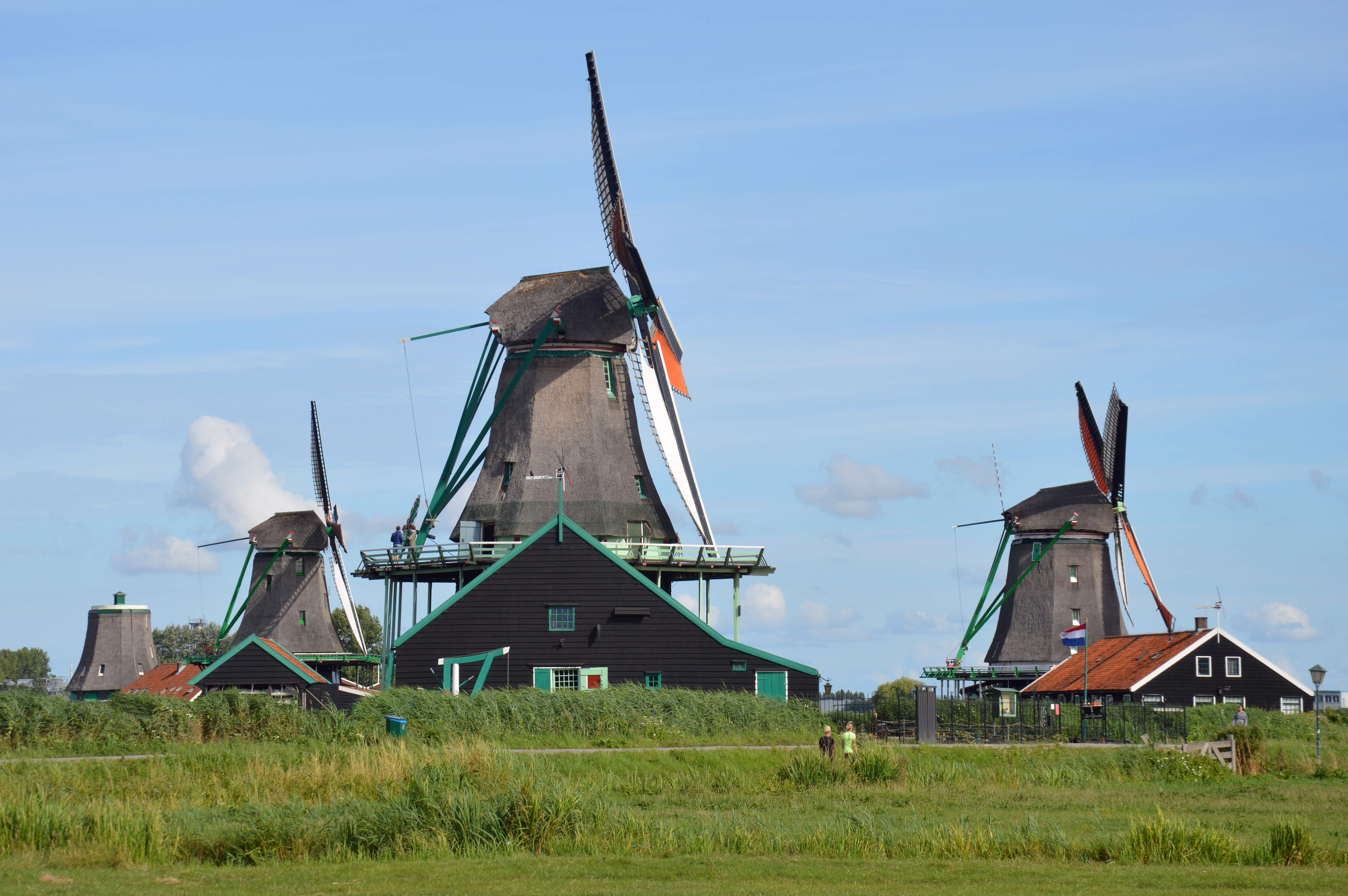
Few images sum up postcard Holland as well as Zaanse Schans: a row of green windmills turning their sails beside a quiet river, painted wooden houses, meadows with cows and the shifting northern sky reflected in the water. This small corner, barely twenty minutes from Amsterdam, is one of the most photographed places in the Netherlands, and with reason: it is the perfect showcase for the traditional landscape and culture of the Zaan region.
But Zaanse Schans is much more than a pretty photograph. The Zaan region (Zaanstreek) was, in the seventeenth and eighteenth centuries, one of the first industrial areas in the world, with hundreds of windmills that not only pumped water but sawed timber, ground spices, pressed oil and made paper and paint. What we see today is a museum village created from 1961 onwards, bringing together genuine historic windmills and houses, saved from demolition and moved here to preserve that unique heritage.
This guide covers the essentials of Zaanse Schans with a practical, warm eye: how to visit its working windmills, where to watch cheese and clogs being made, how to walk along the river Zaan and how to combine the visit with other picturesque villages in the area. A delightful escape into the most traditional Holland, the one of windmills and old trades, a step away from the big city.
The Zaan region (Zaanstreek) was, between the seventeenth and eighteenth centuries, one of the most active and advanced industrial areas in the world, thanks to wind power. At its peak there were more than 600 windmills working simultaneously in the area, devoted not only to draining land but to an enormous variety of industries: timber sawmills for the shipyards (key to the Dutch fleet of the Golden Age), spice mills, oil mills, pigment and paint mills, paper mills and mustard mills. It was, in a sense, one of the first industrialised regions on the planet. With the arrival of the steam engine and modern industrialisation in the nineteenth century, the windmills became obsolete and many were demolished. To save this endangered heritage, the Zaanse Schans museum neighbourhood was created from 1961 onwards: genuine historic windmills and wooden houses were moved here from various points around the region, reconstructing a typical eighteenth- and nineteenth-century Zaan village. Today it is at once an inhabited neighbourhood, an open-air museum and one of the most visited tourist destinations in the Netherlands, keeping the traditional trades alive. The full history is on our history page.
Read the full history ↓The heart of the Golden Age: the city born from a dam on the river Amstel, capital of world trade and seat of the VOC, with its UNESCO-listed canal belt, its Jewish history and the Anne Frank House, and around it the windmills of the Zaanse Schans, the Haarlem of Frans Hals and the old fishing villages of the Zuiderzee.
Read the history of Amsterdam and around →Some places make no sense on your own; with someone explaining them, they change completely. We look ours up on Civitatis: guided in Spanish and booked online with no fuss. They have over 30 activities in Amsterdam. And there are free tours here: you book without paying and tip the guide whatever you think at the end, so trying one costs you nothing. Three are below so you get the idea: tap any of them and they all open.
They depart from Amsterdam, 13 km away. If you book from this link we earn a commission and you pay no more.
No exact prices: a scale from $ (budget) to $$$$$ (luxury), with 2-3 options per category.
Origins, formation and what the sources say.
To understand Zaanse Schans you have to look at the region around it: the Zaanstreek, the area along the river Zaan, north of Amsterdam. Between the seventeenth and eighteenth centuries this zone led one of the first industrial revolutions in history, long before the age of coal and steam. Its engine was nothing other than the wind, harnessed through hundreds of mills.
At its absolute peak, during the eighteenth century, it is estimated that around 600 windmills were working simultaneously in the Zaan region (some sources put the cumulative historical figure at more than a thousand), which probably made it the largest wind-powered industrial concentration on the planet. What is remarkable is that these mills were not mainly used to drain land (as elsewhere in Holland) but for industrial production: they sawed timber, pressed seed oil, ground spices, made paper, paint pigments, mustard, tobacco and much more.
This extraordinary industrial capacity was closely tied to the rise of the Netherlands in the Golden Age. The Zaan's wind-powered sawmills, for example, cut at great speed the planks needed to build the enormous Dutch merchant and naval fleet, the basis of the commercial power of the VOC and of the country. The Zaan region was thus a fundamental cog in the economic machinery that made the Netherlands a world power.
What made the Zaan region unique was not only the number of mills but their astonishing diversity of functions. Each mill was, in essence, a wind-driven factory specialising in a particular trade. The sawmills (zaagmolens) revolutionised shipbuilding: one mill could cut planks far faster than a team of men with hand saws, which allowed Dutch shipyards to build vessels at unprecedented speed and cost.
The oil mills (oliemolens) pressed flax, rapeseed or hemp seeds to extract oils used in food, lighting, soaps and paints. The pigment and paint mills (verfmolens) ground minerals, dyewoods and other materials to produce the colours used by painters and craftsmen; De Kat, preserved at Zaanse Schans, is the last of its kind still working in the world. The spice and mustard mills (specerijmolens) crushed pepper, mustard, cinnamon and other spices arriving from Asia through the colonial trade. There were also mills for paper, tobacco, barley and many other products.
Besides the energy, the region developed an architecture of its own and instantly recognisable: wooden houses and barns painted in the characteristic Zaan green (a shade historically obtained with local pigments), with their decorative gables and pitched roofs. This combination of industrial mills and timber houses defined a singular cultural landscape, which is precisely what Zaanse Schans set out to preserve.
The reign of the Zaan windmills, which had seemed eternal, was broken in the nineteenth century by the arrival of a new source of power: the steam engine. Against the constant, controllable power of steam (and later of electricity and combustion engines), windmills, dependent on the whims of the weather, became progressively obsolete. Modern coal-fired factories could produce more, more consistently and at lower cost.
One after another, the hundreds of mills that had made the region prosperous closed, fell into disuse, burned down or were demolished for their timber and their land. Of the roughly 600 mills of the peak years, only a few dozen remained by the early twentieth century, and their number kept falling. The Zaan region did not deindustrialise, though: on the contrary, it turned into an important centre of modern industry (food, cocoa and chocolate — with brands such as Verkade — paper and others), but the windmill landscape that had characterised it for centuries was disappearing.
By the twentieth century this decline had produced a growing awareness that an irreplaceable heritage was being lost. The few surviving mills and the traditional wooden houses risked disappearing altogether, swept away by urban and industrial expansion. It was that threat that gave rise to the idea of creating a place to save and preserve them: the seed of Zaanse Schans.
Faced with the risk of losing the heritage of the Zaan mills and wooden houses for good, from 1961 onwards a pioneering conservation project was set in motion: the creation of Zaanse Schans. The idea was to bring together in a single place, on the bank of the Zaan in the Zaandijk area, a selection of genuine historic mills and buildings that were at risk in different parts of the region, physically moving them there to save them and show them to the public.
Over the following decades wooden houses, barns, warehouses and mills were carefully dismantled and rebuilt, recreating the look of a typical eighteenth- and nineteenth-century Zaan village. The result was not an empty stage set but a living whole: some houses were used as homes (Zaanse Schans is in fact an inhabited neighbourhood), others as working craft workshops, museums, shops and cafés. The mills turned and worked again, keeping the traditional trades alive.
Over time Zaanse Schans became one of the most visited tourist destinations in the Netherlands, receiving millions of visitors every year from all over the world, drawn by its scene of green mills, cheese dairies, clog workshops and storybook houses. The success has its flip side: the huge numbers now pose management and sustainability challenges for preserving the character of the place and the quality of life of its residents. Even so, Zaanse Schans still fulfils its original mission: to be an open window onto the fascinating industrial history of the Zaan, the region that once moved the world with wind power alone.