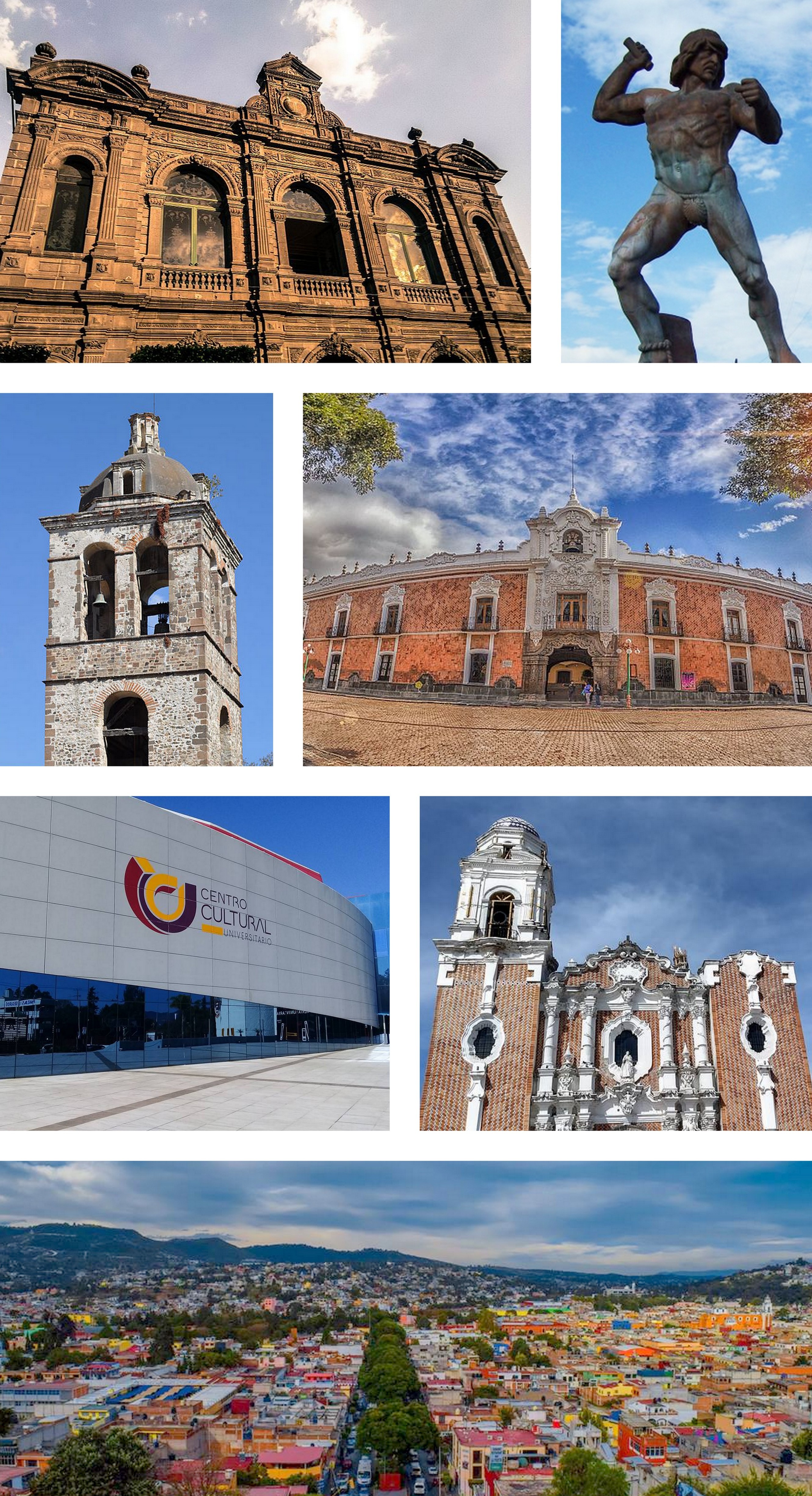
Tlaxcala de Xicohténcatl, capital of Mexico's smallest state, is a small, dapper colonial city on the Central Highlands, quiet, clean and full of charm, a little over an hour from Puebla and two from Mexico City. Despite its modest size it holds a surprising heritage and enormous historical weight: it was the territory of the Tlaxcalans, decisive allies of Hernán Cortés in the conquest of Tenochtitlan.
Its historic center, around a beautiful square, holds gems such as the Franciscan complex of La Asunción (one of the first monasteries in the Americas, with its singular Mudéjar timber ceiling) and, on the outskirts, the spectacular Basilica of Ocotlán, one of the country's great baroque churches, dazzling with its white facade and gilded interior. Nearby are also the archaeological sites of Cacaxtla and Xochitécatl, with pre-Hispanic murals of exceptional beauty.
This guide covers the essentials of Tlaxcala: its square and the Franciscan complex, the Basilica of Ocotlán, the ruins of Cacaxtla and Xochitécatl, the pulque haciendas and the local food. It's an ideal destination for anyone after an authentic, uncrowded colonial getaway, easy to combine with Puebla, and with a fascinating history to discover.
Tlaxcala was the territory of the Tlaxcalan lordship, a Nahua people who resisted Mexica rule and allied with Hernán Cortés, a decisive role in the fall of Tenochtitlan (1521). As a reward, the region enjoyed privileges in the colonial period and was one of the first centers of evangelization (the country's oldest Franciscan complex starts here). The capital added to its name that of Xicohténcatl, a Tlaxcalan leader. The full history is on our history page.
Read the full history ↓If you book from here we earn a commission and you pay no more. Prices and availability come from Civitatis.
No exact prices: a scale from $ (budget) to $$$$$ (luxury), with 2-3 options per category.
Origins, formation and what the sources say.
Picture a small territory hemmed in on every side by the most powerful empire in Mesoamerica, landlocked, cut off from salt, isolated from trade, and refusing to surrender for almost a century all the same. That was Tlaxcala. When Hernán Cortés landed in 1519, most of the Central Highlands paid tribute to the Mexica of Tenochtitlan; Tlaxcala did not. That historical stubbornness explains everything that followed.
Before the Spanish arrived, the territory of today's Tlaxcala was inhabited by the Tlaxcalans, a Nahuatl-speaking people organized into a confederation of four lordships or head towns: Tepeticpac, Ocotelulco, Tizatlán and Quiahuiztlan. Unlike almost every other people of central Mexico, the Tlaxcalans managed to keep their independence from the Triple Alliance (Tenochtitlan, Texcoco and Tlacopan), against whom they sustained a long, fierce hostility.
Rather than conquer Tlaxcala outright, the Mexica preferred to keep it encircled and commercially isolated —a blockade that deprived the Tlaxcalans of something as basic as salt— and waged against it the so-called 'flower wars' (xochiyáoyotl), partly ritualized clashes aimed at capturing prisoners for sacrifice and at training warriors. That state of permanent siege forged in the Tlaxcalans a deep resentment towards Tenochtitlan and a defensive pride that would prove decisive. Tlaxcalan society was warlike and complex, with its nobility, its collegial government across the four head towns and a rich Nahua culture. Figures such as Xicohténcatl the Elder, aged lord of Tizatlán, and his son Xicohténcatl Axayacatzin, the young captain, would remain forever tied to the events of the conquest.
The decisive episode in Tlaxcala's history was its role in the conquest of Mexico. When Cortés and his men entered Tlaxcalan territory in September 1519, they weren't welcomed as friends: the young Xicohténcatl Axayacatzin faced them at the head of the Tlaxcalan armies in brutal battles that came close to finishing off the Spanish expedition. Only after that fighting, and after intense debate among the four Tlaxcalan lords, did the confederation opt for a bold move: to ally with these foreigners in order to destroy the common enemy, the Mexica empire, once and for all.
The alliance proved fundamental, without exaggeration. Thousands of Tlaxcalan warriors went with the Spanish: they provided fighters, knowledge of the terrain, porters, food, shelter and, after the disaster of the Noche Triste (June-July 1520), when the Spanish fled Tenochtitlan badly wounded, it was Tlaxcala that took them in, healed them and rearmed them. It was there that the brigantines later launched on Lake Texcoco for the final assault were built. In the siege and fall of Tenochtitlan, in August 1521, the indigenous troops —mostly Tlaxcalan— far outnumbered the few hundred Spaniards. The conquest of Mexico was, to a large extent, a war between indigenous peoples in which Tlaxcala bet and won.
As a reward for its collaboration, the Spanish Crown granted Tlaxcala exceptional privileges that no other indigenous people received: a broad degree of autonomy, exemption from certain tributes, a ban on Spaniards settling as encomenderos in its territory, recognition of its nobility and a coat of arms granted by Charles V in 1535. That treatment set Tlaxcala apart from the territories subdued by force, though it didn't spare it the era's greatest scourge: the epidemics brought from Europe, which decimated its population through the 16th century.
Thanks to its alliance and its privileges, Tlaxcala became one of the first and most important centers of evangelization on the American continent. The Franciscan friars arrived very early —the celebrated 'twelve apostles' of New Spain landed in 1524— and in Tlaxcala they raised the La Asunción monastery complex, one of the first monasteries built on the American mainland, famous for its exceptional Mudéjar-style wooden ceiling (artesonado), unique in the country. In 1525 the diocese of Tlaxcala was created here, one of the first in the New World, and in 1527 the town received the title of 'Leal Ciudad de Tlaxcala'.
One of the founding stories of Mexican Catholicism also came from this soil: in 1541, according to tradition, the Virgin appeared to the indigenous man Juan Diego Bernardino in a grove of ocote pines that burned without being consumed, giving rise to the cult of Nuestra Señora de Ocotlán. On that devotion would rise, in the 18th century, the dazzling baroque basilica whose Camarín de la Virgen, the work of the indigenous master Francisco Miguel Tlayotehuanitzin, is one of the peaks of New Spanish baroque.
But Tlaxcala's role in building New Spain went further than faith. The Tlaxcalans, considered loyal, Christianized subjects, were sent as settlers to pacify and populate the north of the viceroyalty: in 1591, some 400 Tlaxcalan families set out to found and sustain settlements in Coahuila, Nuevo León, Zacatecas, San Luis Potosí and even present-day Saltillo (San Esteban de la Nueva Tlaxcala). They spread their language, their farming and their traditions across an immense territory, leaving a Tlaxcalan imprint that reaches into northern Mexico and the southwestern United States.
If the 16th century gave Tlaxcala its historical glory, the 19th century and the first decades of the 20th gave it its most recognizable rural face: that of the pulque haciendas. Pulque —the drink fermented from maguey sap, consumed by the peoples of the Highlands since pre-Hispanic times— became, during the Porfiriato, a colossal business. The arrival of the railway, linking the plains of Apan and Tlaxcala with a thirsty Mexico City, made it possible to deliver millions of liters of fresh pulque to the capital's pulquerías every day.
A whole world was built around that trade. Numerous haciendas in the state —San Antonio Tepetzala, Santa María Xalostoc, San Francisco Tecoac and many others— grew rich growing maguey in endless rows, with their tinacales (the halls where the sap fermented), their stately main houses, their chapels and their laborers. The 'pulque aristocracy' put up luxurious residences and sponsored an opulent social life, while the indigenous and mestizo majority worked the land in very hard conditions, a contrast that was one of the sparks of the discontent that erupted in the Mexican Revolution of 1910.
Today, after pulque's decline through the 20th century —displaced by beer and battered by smear campaigns— many of those haciendas survive as boutique hotels, event venues or sites open to visitors, where you can still taste plain pulque and its fruit 'curados'. Following the pulque hacienda route is a way into an economic and social chapter that marked Tlaxcala as much as its pre-Hispanic past.
After Independence and the organization of the country, Tlaxcala was constituted as Mexico's smallest state (barely some 4,000 km²), keeping its capital of the same name. The city officially added the name Xicohténcatl, in homage to the Tlaxcalan captain, becoming Tlaxcala de Xicohténcatl. Despite its small size, the state kept an extremely dense historical and cultural identity, packed into very few kilometers.
One visible landmark of that identity is the set of murals in the Palacio de Gobierno, painted over several decades by the Tlaxcalan artist Desiderio Hernández Xochitiotzin, which tell on the building's walls the entire history of Tlaxcala, from the pre-Hispanic world and the founding of the lordships to the conquest and the colonial period. They're one of Mexico's great mural cycles and a local history lesson painted in fresco, free to enter, right in the heart of the city.
Today Tlaxcala de Xicohténcatl is a quiet, clean and thoroughly charming capital that holds a heritage out of all proportion to its size: the country's oldest Franciscan complex, the Basilica of Ocotlán, the archaeological sites of Cacaxtla —with its astonishingly colorful pre-Hispanic murals— and Xochitécatl, the pulque haciendas and a cuisine with deep roots (mixiotes, escamoles, maguey worms, pit-cooked barbacoa). Its unique history —an independent people, a decisive ally of Cortés, cradle of evangelization and colonizer of the New Spanish north— makes it one of the most fascinating and least crowded destinations in central Mexico, ideal to combine with Puebla on a weekend getaway.