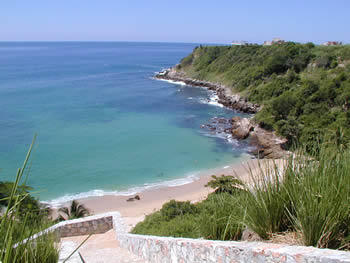
Puerto Escondido is proof that beach destinations with a soul still exist in Mexico. What was for decades a small, quiet port of fishermen and coffee growers on the Costa Chica of Oaxaca turned —first through the surfers who found its legendary waves, then through travelers looking for an authentic Pacific— into one of the country's best-loved and most fashionable destinations. But unlike the big resorts, 'Puerto' keeps a village charm, a relaxed rhythm and a warmth that get under your skin.
Its worldwide fame comes from surfing: Zicatela beach, with its powerful 'Mexican Pipeline', is one of the most respected waves on the planet and draws professional surfers from all over. But Puerto Escondido is far more than heavy waves: it has calm turquoise coves that are perfect for swimming (like Carrizalillo or Puerto Angelito), postcard sunsets, a food scene growing by leaps and bounds, a lively nightlife and, a short trip away, natural wonders like the bioluminescent lagoons and the idyllic Lagunas de Chacahua National Park.
This guide covers the essentials of Puerto Escondido with a practical, warm eye: which beach to pick depending on what you're after (surf, calm swimming or sunset), how to take a surf lesson, how to experience bioluminescence, how to organize the trip to Chacahua and how to get around. A destination for feeling the Oaxacan Pacific at its freest and most authentic: barefoot, hair full of salt and a coconut in hand.
The Costa Chica region of Oaxaca, where Puerto Escondido sits, was inhabited in pre-Hispanic times by peoples such as the Chatino and the Mixtec, and during the colonial period it was an area of haciendas, farming and, later, coffee production in the nearby mountains. Puerto Escondido as such was born in the 20th century, first as a small landing point for shipping out the coffee that came down from the mountains and the produce of the coast, and as a fishermen's cove. There are several versions of the origin of its name, all tied to its condition as a 'hidden' or sheltered bay. For much of the 20th century it remained a small, isolated town, hard to reach along the mountain roads. Everything began to change from the 1970s and 1980s, when surfers —first Americans and other foreigners, then people from all over the world— discovered the extraordinary waves of Zicatela beach, which soon gained international fame as one of the best and most dangerous in the world (the 'Mexican Pipeline'). Surfing put Puerto Escondido on the map, drawing a community of travelers, backpackers and sea lovers who shaped its relaxed, cosmopolitan character. In recent decades, and very much in recent years, the destination has seen a strong tourism boom, with the arrival of digital nomads, new hotels, restaurants and flights, turning it into one of the most popular beach spots in Mexico, while largely holding on to its essence as a coastal town. The full story is on our history page.
Read the full history ↓The state with the greatest Indigenous diversity in the country: Zapotec and Mixtec land of Monte Albán and Mitla, birthplace of Benito Juárez and Porfirio Díaz, capital of food, mezcal and Pacific beaches.
Read the history of Oaxaca →If you book from here we earn a commission and you pay no more. Prices and availability come from Civitatis.
No exact prices: a scale from $ (budget) to $$$$$ (luxury), with 2-3 options per category.
Origins, formation and what the sources say.
The strip of Oaxacan Pacific coast where Puerto Escondido stands today is part of what's known as the Costa Chica, a region stretching between the present-day states of Guerrero and Oaxaca. Long before the Spanish arrived, these lands were inhabited by Indigenous peoples such as the Chatino in the nearby mountains and, in different areas and periods, by Mixtecs and other groups, who lived off farming, fishing and trade between the coast and the mountains.
The Costa Chica was a region of passage and exchange: salt, fish, coastal produce and mountain goods circulated along routes connecting the shoreline with the inland valleys of Oaxaca. The rugged geography, with the Sierra Madre del Sur dropping almost into the sea, made this whole coast a relatively isolated and hard-to-reach area, a trait that would mark its history for centuries.
A distinctive feature of the Costa Chica, forged back in the colonial era, is its significant Afro-Mexican population, descended from enslaved Africans brought during the viceroyalty, who settled in the region and left a deep mark on its culture, its music and its traditions (visible, for example, in villages near Chacahua). That mix of Indigenous, Spanish and African roots is part of the identity of the Oaxacan coast, although Puerto Escondido as such would be a much later settlement.
Puerto Escondido, as a settlement, is relatively young: it was born and grew across the 20th century. Its origin is tied to two of the region's economic activities: fishing and, above all, coffee. In the mountains near the coast, in areas such as the Sierra Sur of Oaxaca, coffee was grown that needed an outlet to the sea to be exported, and the small, sheltered bay of Puerto Escondido served as a landing point for shipping that produce out, as well as working as a fishermen's cove.
For much of the 20th century, Puerto Escondido remained a small, quiet town, fairly cut off from the rest of the country. The difficult geography of the Sierra Madre del Sur, with slow and winding mountain roads, kept it away from the main circuits. That remoteness, far from being a problem, helped preserve its character as an authentic coastal town, very different from the large planned tourist developments that would spring up elsewhere in Mexico.
The name 'Puerto Escondido' ('hidden port') refers precisely to that condition of a sheltered, hidden or protected bay. There are several romantic versions of its origin, but they all evoke a tucked-away port, safe from the open sea. That small fishing and coffee port would be, without knowing it, the seed of one of the most famous beach destinations in the country.
The great turning point in the history of Puerto Escondido came with surfing. From the 1970s and 1980s, foreign surfers —mainly Americans, but also from other parts of the world— began arriving at this remote Oaxacan port, drawn by the extraordinary waves of Zicatela beach. What they found was one of the most powerful and demanding waves on the planet: a fast, powerful barreling wave that, for its resemblance to the famous Pipeline in Hawaii, was christened the 'Mexican Pipeline'.
Zicatela quickly became a pilgrimage site for surfers from all over the world, and Puerto Escondido started appearing on the maps of international surfing. The fame of the wave drew a community of travelers, backpackers and sea lovers who, attracted by the waves but also by the relaxed atmosphere, the affordable prices and the beauty of the place, shaped the cosmopolitan, bohemian character of the destination. The first guesthouses, restaurants and bars aimed at that community appeared.
Over time, Puerto Escondido cemented its place on the world surfing calendar, going as far as hosting international big-wave competitions. But unlike other destinations, that growth kept the spirit of a village for a long time: no towers, no mass resorts, life turning around the sea, the waves and the sunsets. Surfing was, in the end, what pulled Puerto Escondido out of its isolation and projected it to the world, defining its identity for good.
Beyond its waves, the Puerto Escondido region has extraordinary natural wealth, which has been part of its appeal and, in some cases, has driven protection measures. The Oaxacan coast holds systems of coastal lagoons ringed by mangroves, such as Manialtepec Lagoon, near town, and the extensive system of Lagunas de Chacahua National Park, declared a protected natural area to preserve its mangrove ecosystems, its lagoons and its wildlife. These mangroves are nurseries of life and a refuge for an enormous diversity of birds, as well as crocodiles and other species.
One of the most fascinating phenomena of these lagoons is bioluminescence: the presence of microorganisms that give off light when stirred, making the water glow in the dark. Manialtepec and Chacahua are among the best places in Mexico to experience this show, which has become one of the destination's star experiences.
The Oaxacan coast is also one of the most important in the world for sea turtles: several species nest on its beaches, and the region has sanctuaries and centers devoted to protecting them (the most famous in the area is the Centro Mexicano de la Tortuga, in nearby Mazunte). Dolphin watching and, in season, whale watching round out the marine wealth. That combination of wild sea and protected nature makes Puerto Escondido and its surroundings far more than a beach destination: a place where nature is still the lead character.
In recent decades, and very much in recent years, Puerto Escondido has gone through a rapid tourism boom that turned it from a destination for surfers and in-the-know backpackers into one of the most popular and fashionable beach spots in Mexico. Several factors combined: better connections (including more and better flights and the modernization of the roads from Oaxaca), the spread of its beaches and sunsets on social media, and the mass arrival of travelers, expats and digital nomads who found in the town a place to live by the sea.
That growth brought a boom of new boutique hotels, chef-driven restaurants, specialty coffee shops, coworking spaces and a food and nightlife scene in full expansion, alongside the marisquerías that have always been there and the original surf atmosphere. Zicatela, La Punta and the center filled with new places, and the destination began to appear regularly on lists of the country's 'hot' spots.
This boom has, as in many successful destinations, its tensions: pressure on prices, on services (such as water) and on local life, and the challenge of growing without losing the essence that made the place famous. Even so, Puerto Escondido largely keeps its character as a coastal town, its relaxed rhythm and its deep connection with the sea and the waves. Today it's a destination that combines the best of two worlds: the authenticity of its roots as a fishing and surfing port, and the vitality of a cosmopolitan place in full growth.