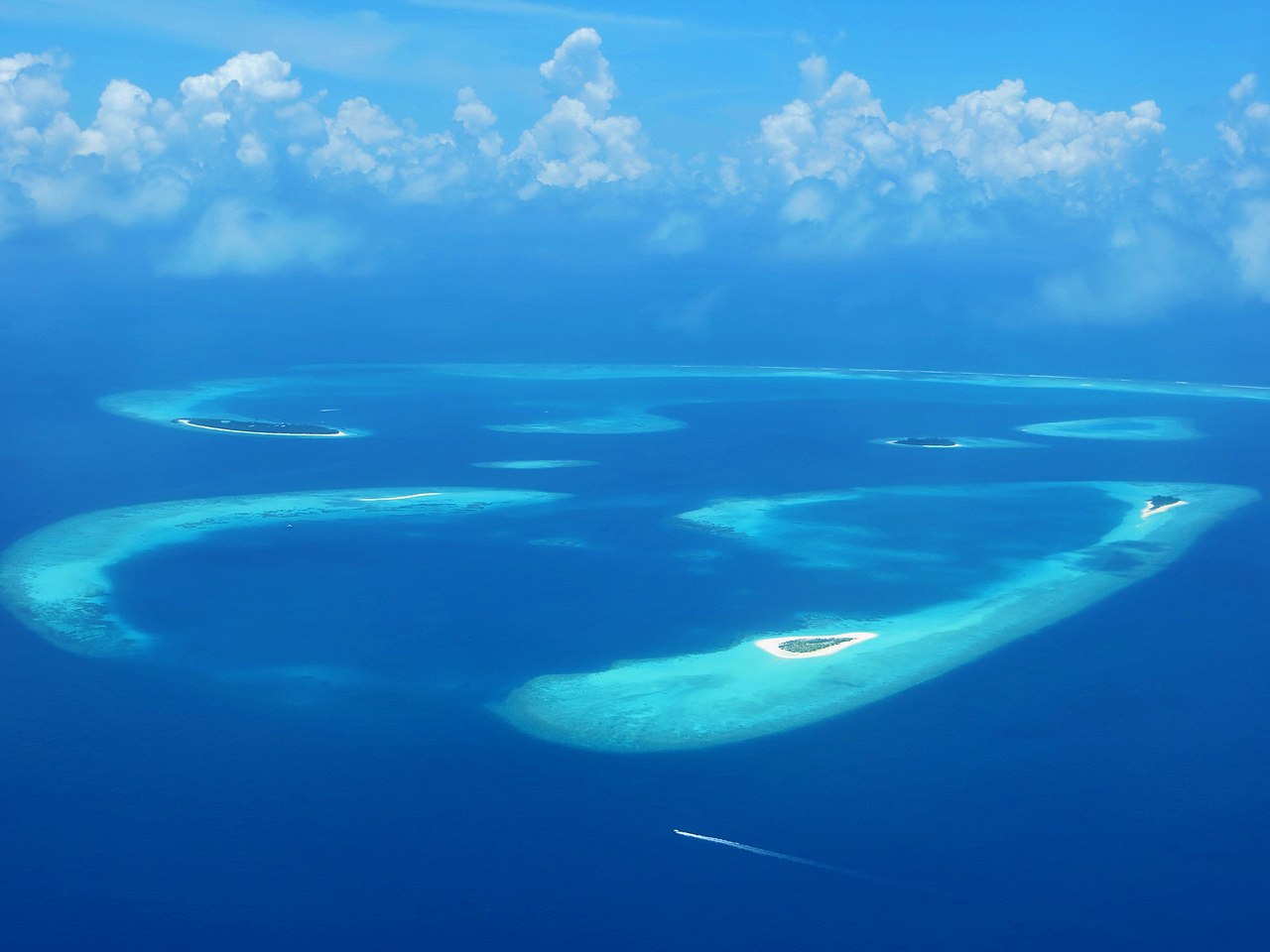
There is a place in the Maldives where the ocean does something it does almost nowhere else in the world: in Hanifaru Bay, a small bay in Baa Atoll, manta rays gather by the hundreds to feed. When the tide and current push thick clouds of plankton to the back of the bay, dozens and sometimes more than a hundred mantas arrive to filter the water, circling in chains in a hypnotic ballet that scientists call 'cyclone feeding'. Whale sharks, the biggest fish on the planet, often join in, drawn by the same feast. It is, without exaggeration, one of nature's great spectacles.
That miracle is no coincidence and isn't left to chance: the whole of Baa Atoll has been a UNESCO Biosphere Reserve since 2011, and Hanifaru is its protected core, where you can only enter snorkelling, with a guide and within a strict visitor cap enforced by rangers. No diving, no touching, no uncontrolled crowds. Around it, the atoll unfolds healthy reefs, local islands of craftspeople and fishermen, and some of the most exclusive resorts in the country. It's the Maldives at its most natural and best cared for.
This guide explains how Hanifaru Bay works -when the mantas come, what the rules are, how much it costs to get in-, how to reach Baa Atoll from Malé by plane or seaplane, where to stay to suit your budget (from luxury resort to a Dharavandhoo guesthouse), and what else to see in one of the most important marine reserves in the Indian Ocean. One tip up front: sightings depend on the day, so give yourself several chances and respect every rule. You're entering a sanctuary.
Baa Atoll shares the great history of the Maldives -a Buddhist past of more than a thousand years, buried after the conversion to Islam in 1153, and centuries of fishing and craft communities- but its modern fame was born from the sea. The bay of Hanifaru, off the island of Hanifaru, was always known to local fishermen for the mantas' strange habit of gathering there to feed. When science and tourism discovered the phenomenon -one of the largest manta ray aggregations in the world-, it became clear it had to be protected from too many visitors. In 2009 Hanifaru was declared a Marine Protected Area and in 2011 UNESCO recognised the whole of Baa Atoll as a Biosphere Reserve, the first in the country. Since then, Hanifaru has been visited under strict conservation rules. The full story, from the Buddhist past to the biosphere reserve, is on our history page.
Read the full history ↓They depart from Male, 119 km away. If you book from this link we earn a commission and you pay no more.
No exact prices: a scale from $ (budget) to $$$$$ (luxury), with 2-3 options per category.
Origins, formation and what the sources say.
Long before the snorkellers, underwater cameras and rangers arrived, the fishermen of Baa Atoll already knew that something unusual happened in a small bay on the east side. In certain months of the year, when the southwest monsoon was blowing, manta rays gathered in their dozens -sometimes in their hundreds- in that enclosed corner of the reef, wheeling through the water as if they were dancing. For the islanders it was a familiar, even everyday, event, tied to the tides and currents. It had no scientific name and no global fame. It was simply 'the place where the mantas gather'.
Today we know why. Hanifaru Bay is a cul-de-sac bay with no exit on the far side. It faces in such a way that, when the outgoing tide meets the monsoon current, plankton -the tiny organisms mantas feed on- gets trapped and concentrated into a thick soup inside the bay. That irresistible feast draws reef manta rays from across the atoll. They come to filter the water in a behaviour scientists have named 'cyclone feeding': dozens of mantas spiralling one above the other in a chain. And with them, quite often, comes the largest fish on the planet: the whale shark.
It is, quite simply, one of the largest manta ray aggregations in the world, a natural spectacle that happens in only a handful of places on Earth. What makes it remarkable is that it happens in a tiny bay, just metres below the surface, where anyone with a mask can watch it. That very privilege would also become its greatest threat.
Like the rest of the Maldives, Baa Atoll has a human history much longer than its marine fame, and it begins before Islam. For more than a thousand years the archipelago was Buddhist, settled by seafarers from southern India and Sri Lanka. That era left behind the 'hawitta' scattered across the islands -coral mounds that were once stupas- along with finds of Buddha images. In 1153, King Dhovemi converted to Islam and ordered the whole kingdom to convert. It became a Muslim sultanate and has stayed Muslim ever since.
Over the centuries of the sultanate -including a brief Portuguese occupation in the 16th century and a British protectorate from 1887 to 1965-, Baa Atoll developed a rich identity of its own. Its islands did not live on tuna fishing and coconuts alone: they became a centre of craftsmanship. Thulhaadhoo became famous throughout the country for its lacquerwork ('liye laa jehun'), the art of turning wooden bowls and boxes and coating them in layers of coloured lacquer decorated with very fine patterns, a tradition handed down from generation to generation. Other islands were known for weaving reed mats ('thundu kunaa'), another craft typical of the south of the archipelago.
So, long before the world knew about its mantas, Baa Atoll already had a respected craft culture of its own. It was a corner of the Maldives known for its craftsmen and fishermen, not for its marine life. That cultural side is still alive today, and it shows travellers a face of the atoll that goes far beyond the manta bay.
Hanifaru went from local knowledge to worldwide fame in the 2000s. Marine researchers -among them the local manta conservation project- began studying the bay systematically and documented what was happening there. It was not just a group of mantas. It was one of the largest feeding aggregations on the planet, with events bringing together more than a hundred animals at once. Documentaries, nature magazines and underwater photographers spread the images, and almost overnight Hanifaru became a magnet for tourists from all over the world.
That success brought an immediate danger. With no regulation, the bay began to fill with boats and with dozens of swimmers and divers chasing the mantas, touching them, blocking their path and stressing the animals at the most important moment of their cycle: feeding. The risk was clear. Tourist pressure could ruin the very thing people were coming to see. The answer was protection. In 2009, Hanifaru Bay was declared a Marine Protected Area with strict rules, and in 2011 UNESCO recognised the whole of Baa Atoll as a Biosphere Reserve, the first in the Maldives.
Since then, visits have been regulated in detail. Snorkelling only (no scuba diving inside the bay), access only with licensed operators and guides, and a cap on how many people and boats can be there at once, enforced by rangers. Sessions are limited to about 45 minutes, touching or chasing the mantas is forbidden, and an entry fee funds conservation. It was a change of mindset: from 'anything goes' to a model where the spectacle is looked after so that it lasts.
UNESCO's recognition was more than an honorary label. It turned Baa Atoll into a testing ground for sustainable tourism for the whole of the Maldives. A Biosphere Reserve aims to balance three goals -conserving biodiversity, allowing compatible economic development and supporting research and education-, and the atoll tries to live up to all three. Several of its luxury resorts employ resident marine biologists and fund programmes to study and protect manta rays and coral. The Hanifaru operators work under licence, and the local community shares in the benefits of tourism to varying degrees.
Not everything is perfect. Managing the crowds at Hanifaru in peak season is still a challenge. When the mantas appear, demand to get in is huge, and the balance between giving access and not overcrowding the bay is delicate. Conservation depends on the rules being followed and on there being resources to enforce them. At the same time the atoll, like the whole country, faces threats that go well beyond the local level.
The biggest is climate change. Warming oceans cause coral 'bleaching' events -the Maldives suffered mass bleaching in 1998 and 2016- that put at risk the reefs supporting the whole food chain, mantas included. And rising sea levels threaten a country whose islands barely rise one or two metres above the water. Whether the world's largest manta aggregation keeps happening at Hanifaru will depend, to a large extent, on decisions made very far from Baa Atoll.
Today Baa Atoll is one of the brightest sides of Maldivian tourism: proof that you can show off a natural wonder without destroying it. Every manta season, from May to November, travellers from all over the world come to Dharavandhoo or the luxury resorts hoping to meet the manta rays of Hanifaru, in a regulated format that protects the animals. Sightings are not guaranteed -they depend on the day, the tide and the plankton-, and that uncertainty adds to the excitement rather than taking away from it. When the bay fills with spiralling mantas, it feels like a reward you have earned.
But boiling the atoll down to Hanifaru would be a mistake. Baa is also the lacquer workshops of Thulhaadhoo, the local islands with their fishing life and their mosques, and healthy reefs for diving among turtles and sharks. It has castaway-style sandbanks and a sharp contrast between neighbourhood guesthouses and some of the most exclusive resorts in the country. It is an atoll where extraordinary nature lives alongside a living culture and a serious experiment in sustainability.
Knowing its history changes the visit: the bay the fishermen already knew, the Buddhist past beneath Islam, the lacquer masters, the shift from local secret to UNESCO-protected sanctuary. It is not just about swimming with mantas. It is about entering, respectfully, one of the best-protected ecosystems in the Indian Ocean. In Baa Atoll, the privilege of seeing comes with the duty to protect.