Viajá con Gus
Home › Maldives › Dhigurah
Dhigurah
🇲🇻 Maldives · Ari Atoll (Alifu): whale sharks and manta rays

Dhigurah

🪪 What do I need to enter Maldives?Pick your citizenship and we tell you the visa, the days and the paperwork, with the official source.

By leaving your email and citizenship you agree to receive the documents you asked for and weekly travel news. You can unsubscribe whenever you want. How we handle your data.
Jump to what you need
📍Region
Dhigurah is a local island in South Ari Atoll (Alifu Dhaalu), in the southwest of the Maldives, inside the South Ari Marine Protected Area (South Ari MPA). Its name literally means 'long island' in Dhivehi, and it fits perfectly: it is a strip of sand and palm trees almost 3 km long and barely 300 metres wide, with the village packed into one end and an endless stretch of untouched sandbank at the other. It is one of the few places on the planet where you can swim with whale sharks all year round, which is why it has become a mecca for travellers who want to see the giant of the sea without paying for a luxury resort.
📌Best time to go
You can visit all year round, but the dry season (December to April), with the northeast monsoon ('iruvai'), brings calmer seas, clear skies and better visibility for snorkelling and diving. The rainy season (May to November, the 'hulhangu' monsoon) is windier, with showers, but also has fewer people and lower prices. Dhigurah's big advantage is that whale sharks turn up in South Ari all 12 months of the year, so there is no 'bad' season for the main reason for the trip. Manta rays are seen more often between May and November.
📌Suggested days
3 to 4 nights is enough to make the most of it: one day for a whale shark safari, another for snorkelling on sandbanks and reefs, a dive or two, and time to walk the long island to its deserted tip. Divers usually stay 5 nights or more. Many people combine Dhigurah with Maafushi, Thoddoo or another local island, or with a stopover in Malé on arrival and departure.
📌Getting there
Two options from Malé. The budget one: a direct speedboat, about 2 hours, USD 60-70 each way (verified July 2026), with daily departures you book through your guesthouse. The fast, expensive one: a domestic flight Malé-Maamigili (Villa airport, about 20-25 min) with Maldivian/Manta Air, then 20-25 min by boat to Dhigurah (transfer package around USD 170-200 each way). The state-run public ferry is the cheapest but slow and infrequent.
📌Getting around
You can cover the whole island on foot: it is long but narrow, and walking from the village to the sandbank at the far end takes a good half hour along a path through the palms. You don't need a car (there are almost none). Some guesthouses lend bicycles. Everything else -whale sharks, mantas, snorkelling, sandbanks- is done on local operators' boats ('dhoni' and speedboats). There is no internal transport to book: you walk.
📌Language and currency
The language is Dhivehi; English is widely spoken in tourism. The currency is the Maldivian rufiyaa (MVR, Rf): in July 2026, 1 dollar is worth about 15.42 rufiyaa (a practically fixed exchange rate). In practice, at guesthouses and on local islands almost everything is quoted and paid in US dollars (USD), and many places accept cards with a surcharge. It's a good idea to carry cash dollars for excursions, tips and small purchases. Dhigurah is a Muslim local island: outside the 'bikini beach' you need to dress modestly, and alcohol is not sold (only on safari boats or nearby resorts).
💱 MVR exchange rate
Loading rate…
🌤️ Weather in Dhigurah
Loading weather…

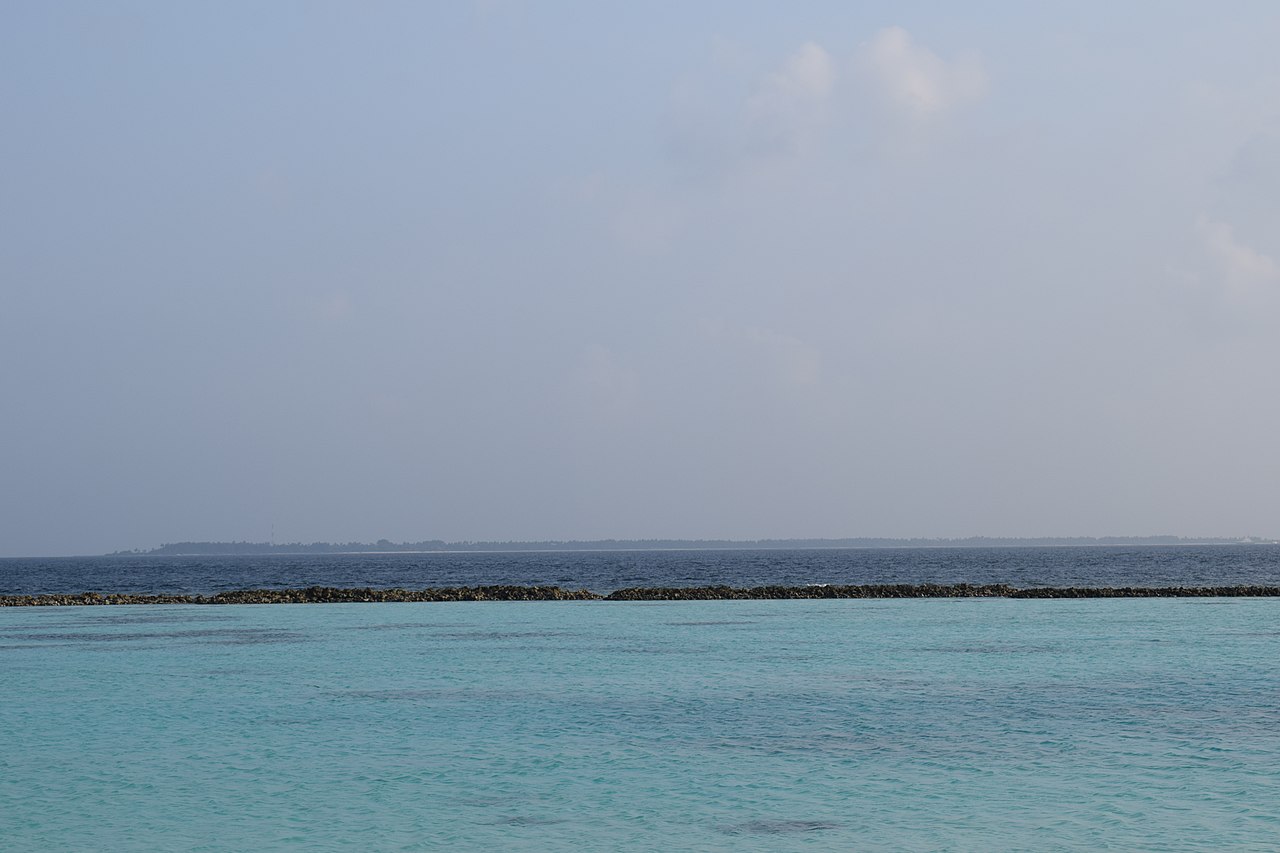
Dhigurah is a thin line of white sand in the middle of the Indian Ocean, in South Ari Atoll, and one of those places where a specific dream comes true almost guaranteed: swimming next to a whale shark, the largest fish in the world, a gentle giant up to 12 metres long gliding under the turquoise water while it filters plankton. Unlike almost anywhere else on the planet, here they appear all year round, because the waters of South Ari are one of their very few permanent refuges. That's why Dhigurah has become a pilgrimage for divers, snorkellers and ocean lovers.

But the island is much more than its giant. Its name means 'long island', and it is: almost 3 kilometres of palms and sand with the village squeezed into one tip and, at the other, a deserted sandbank straight out of a brochure, perfect for walking barefoot without running into anyone. All around are manta rays gliding over cleaning stations, reefs full of turtles and reef sharks, and lonely sandbanks where you can land for a picnic. All of this in the affordable format of local-island 'guesthouses', without the sky-high prices of private resorts.

This guide tells you how to get there from Malé by speedboat or with a domestic flight, when to go to see whale sharks and mantas, what the safaris and dives really cost, where to sleep and eat, and the golden rules for swimming with these animals without harming them. A useful heads-up: Dhigurah is a quiet, Muslim local island, with a bikini beach for tourists but no alcohol or partying. The luxury here is something else: the silence, the empty sand spit and the moment a huge shadow approaches through the blue.

📖 History of Dhigurah

Like almost every island in the Maldives, Dhigurah had a Buddhist past before the archipelago converted to Islam in 1153, and for centuries it was a fishing community in Ari Atoll that lived off the sea, coconuts and pole-and-line fishing for skipjack and tuna. What changed its destiny was the discovery, in the 20th century and above all in the 2000s, that neighbouring South Ari was unique in the world: its whale sharks didn't migrate but stayed around its reefs all year. In 2009 the government declared the South Ari Marine Protected Area to shield these giants, and scientific organisations such as the Maldives Whale Shark Research Programme (MWSRP) began studying them and identifying them one by one by their spots. With the opening of guesthouse tourism on local islands -only allowed by law in 2009-, Dhigurah went from fishing village to the world capital of budget whale shark encounters. The full story, from the Buddhist past to the ecotourism boom, is on our history page.

Read the full history ↓

🏛️ Dhigurah is in Ari Atoll (Alifu)

One of the great diving atolls of the Maldives, split administratively into Alifu Alifu and Alifu Dhaalu: the only place in the world with whale sharks present all year round, plus manta rays and famous dive sites such as Maaya Thila and Fish Head.

Read the history of Ari Atoll (Alifu) →

🗺️ What to see

Tours nearby, in Maafushi

If you only have one day, take a guided tour on the first one: it sets up the rest of your trip and saves you a lot of walking. We look ours up on Civitatis: guided in Spanish and booked online with no fuss. They have 17 activities in Maafushi. Three are below so you get the idea: tap any of them and they all open.

They depart from Maafushi, 80 km away. If you book from this link we earn a commission and you pay no more.

1
Swimming with whale sharks (South Ari safari)
The star experience: snorkelling next to the largest fish in the world, present all year round off Dhigurah.
Leer más ↓
It's the whole point of the trip. South Ari (South Ari MPA) is one of the few places on the planet where whale sharks -filter-feeding sharks, completely harmless, usually between 5 and 10 metres long- can be seen all 12 months of the year, because they don't migrate but live in the area. The typical excursion is a boat 'safari' that patrols the outer edge of the reef looking for the animal's shadow near the surface; when the guide spots it, the group gets in the water with mask and fins and swims alongside while the giant moves along filtering plankton. Dhigurah is the best base for it because it sits right next to the protected area, so transfers are short. The trip usually lasts half a day and includes, besides the whale shark, snorkelling stops on reefs and sometimes mantas and turtles. Getting there: safaris leave from Dhigurah harbour, organised by guesthouses and local operators. Best time: all year; mornings with calm seas and good light. Tips: don't touch or chase the animal, keep the 3-4 metres of distance required by law, don't block its path or use flash, and choose operators that follow the MWSRP code of conduct (maximum number of boats and swimmers per animal).
ℹ️ Distance: Outer edge of the South Ari reef, a few minutes from Dhigurah by boat · Best time to go: All year (whale sharks live in the area); early morning · Admission: Group whale shark safari from USD 65-100 per person depending on the operator (transfer, water, snacks and gear included). Verified July 2026. no rate published in an official source: the price is set by guesthouses and private dive centres. What the State does regulate is who can guide you: the trip takes place inside the South Ari Marine Protected Area (SAMPA) and, under clause 14 of its Management Plan, it must be led by a SAMPA-registered guide certified by the Environmental Regulatory Authority; the official list of licensed guides —published on 25/06/2026 at epa.gov.mv— is the only public source, and it includes no amounts. Bookings and permits on the national protected areas portal require eFaas digital ID (verified 10/08/2026). · Duration: Half a day (approx. 3-4 hours)
2
The sandbank and deserted tip of the 'long island'
Almost 3 km of white sand and palms ending in an untouched, empty sand spit.
Leer más ↓
Dhigurah lives up to its name ('long island'): the village takes up just one end, and the rest is a very thin strip of palms stretching almost 3 kilometres until it finishes in a long, lonely natural sandbank surrounded by turquoise water. Walking there along the inland path through the coconut palms, with the sea on both sides, is one of the loveliest -and free- things you can do on the island. At the end there's an untouched beach where often there's no one else. It's an ideal plan for sunset, for snorkelling from the shore or simply for switching off. Getting there: on foot from the village (30-45 minutes) or on a bike lent by your guesthouse. Best time: mid-afternoon into sunset, when the sun goes down. Tips: bring water and sunscreen (there are no services at the tip), footwear for the path, and respect the beach (don't leave rubbish). On the signposted 'bikini beach' you can wear swimwear; outside it, remember this is a Muslim local island.
ℹ️ Distance: The strip stretches almost 3 km from the village to the sand spit · Best time to go: Sunset; dry season (Dec-Apr) for better weather · Admission: Free (open access on foot). Verified July 2026. There's no rate to verify: the sandbank and the tip of the island are freely accessible on foot and nobody charges to get there (verified 10/08/2026). · Duration: 30-45 min walk each way; half a day with a swim
3
Snorkelling and diving with manta rays
Cleaning stations where mantas glide over the reef, reachable from Dhigurah.
Leer más ↓
South Ari isn't just whale sharks: it's also one of the world's great places to see reef manta rays, which come to 'cleaning stations' -spots on the reef where small fish clean their skin- and to feed on plankton. Watching them glide, with a wingspan of 3 or 4 metres, is as striking as the whale shark itself. You can see them both snorkelling (at the shallower stations) and diving. Guesthouses and dive centres in Dhigurah offer dedicated trips to manta points, often combined with the whale shark safari or reef snorkelling. Getting there: by boat from Dhigurah harbour to points around the atoll. Best time: manta season in South Ari runs mainly from May to November (southwest monsoon), although there are sightings all year. Tips: keep your distance, don't touch them or swim above them (respect their space), and don't use sunscreens that are toxic to coral.
ℹ️ Distance: South Ari manta points, a short boat ride from Dhigurah · Best time to go: May to November for more mantas; sightings all year · Admission: Manta snorkelling from USD 30-60 per person; scuba dive USD 50-75. Verified July 2026. no rate published in an official source: charged by private guesthouses and dive centres in Dhigurah, and no Maldivian authority sets a rate for it (verified 10/08/2026). · Duration: Half a day
4
Diving the reefs and 'thilas' of South Ari
One of the best atolls in the Maldives for diving, with reef sharks, turtles and schools of fish.
Leer más ↓
Ari Atoll is a world-famous diving destination, and Dhigurah is a budget base for exploring it. All around are reefs, 'thilas' (underwater pinnacles) and channels ('kandu') where the current draws life in abundance: whitetip and grey reef sharks, green and hawksbill turtles, moray eels, groupers, Napoleon wrasse, eagle rays and huge schools of fish. Add the whale sharks and mantas and South Ari becomes one of the most complete underwater spots in the country. There are dive centres on the island that run dives for all levels and PADI courses, at prices far below a resort's. For non-divers, many offer a try dive ('discover scuba'). Getting there: the dive centres are in Dhigurah; the sites are a short ride away by 'dhoni'. Best time: dry season (Dec-Apr) for better visibility and calm seas. Tips: don't dive and fly on the same day, choose a centre with good safety standards and respect the reef (no touching, good buoyancy).
ℹ️ Distance: South Ari reefs and thilas, around Dhigurah · Best time to go: Dry season (Dec-Apr) for better visibility · Admission: Single dive USD 50-75; multi-dive packages cheaper; PADI Open Water course approx. USD 500-750. Verified July 2026. no rate published in an official source: charged by private guesthouses and dive centres in Dhigurah, and no Maldivian authority sets a rate for it (verified 10/08/2026). · Duration: Half a day per trip (2 dives); courses of 3-4 days
5
Sandbank and picnic excursion ('sandbank')
Landing on a tiny sand island in the middle of the sea to swim, snorkel and have lunch.
Leer más ↓
One of the best-loved outings in the Maldives: the boat drops you on an untouched sandbank -sometimes just a crescent of white sand rising out of the turquoise water- in the middle of nowhere, to spend a few hours swimming, snorkelling on the nearby reef and having a picnic lunch. It's the ultimate postcard of the country and a castaway experience that in Dhigurah costs a fraction of what a resort would charge. It's usually combined with reef snorkelling and, depending on the trip, with dolphin watching at sunset or turtle spotting. Getting there: by boat from Dhigurah harbour, organised by the guesthouses. Best time: a clear day in the dry season; mid-morning. Tips: bring plenty of water, your own shade (sandbanks have no trees), reef-safe sunscreen and a bag so you leave no rubbish; some sandbanks change shape with the tide, so listen to the guide.
ℹ️ Distance: South Ari sandbanks, a short boat ride from Dhigurah · Best time to go: Dry season; clear days and the right tide · Admission: Sandbank excursion with snorkelling from USD 30-50 per person; picnic extra. Verified July 2026. no rate published in an official source: charged by private guesthouses and dive centres in Dhigurah, and no Maldivian authority sets a rate for it (verified 10/08/2026). · Duration: Half a day
6
Turtle tour and 'house reef' snorkelling
Snorkelling with sea turtles and colourful fish on the island's reef and nearby spots.
Leer más ↓
Besides the giants, South Ari is full of smaller, more accessible life. Green and hawksbill turtles are common on the reefs near Dhigurah, and seeing them graze on the coral or come up to breathe is almost guaranteed on snorkelling trips. Add clownfish, parrotfish, groupers, moray eels and shoals of fish in a thousand colours on a 'house reef' within reach of the shore or a few minutes away by boat. It's the perfect activity for non-divers or anyone travelling with kids, and it's usually included or very cheap. Getting there: from the island's beach or by boat to the snorkelling spots. Best time: morning, with better visibility; dry season. Tips: rent or bring your own gear, don't touch or chase the turtles, watch out for currents in the channels, and wear a T-shirt/rash guard instead of loads of sunscreen to protect the coral.
ℹ️ Distance: The island's reef and South Ari snorkelling spots · Best time to go: Morning; dry season (Dec-Apr) · Admission: Snorkelling from the shore free + gear; snorkelling tour to several spots USD 25-45 per person. Verified July 2026. no rate published in an official source: charged by private guesthouses and dive centres in Dhigurah, and no Maldivian authority sets a rate for it (verified 10/08/2026). · Duration: 2 to 4 hours
📶I have never landed without internet. I arrive and my phone connects to the strongest network in the country I am visiting: I can say I landed, sort out transport, book tours and keep posting, at a seriously good price. I always use the Maya eSIM — check their plans by clicking the banner.See plans →Maya Mobile eSIM — turn travel mode on
What nobody tells you

💵 Prices

Tickets

TypePrice
Caminar la isla, la playa y el banco de arenaFree (open access), verified July 2026. There's no rate to verify: the island, the beach and the sandbank are freely accessible and no authority or operator charges for entry (verified 10/08/2026).
Safari de tiburón ballena (grupo)USD 65-100 per person, verified July 2026. no rate published in an official source: the price is set by guesthouses and private dive centres. What the State does regulate is who can guide you: the trip takes place inside the South Ari Marine Protected Area (SAMPA) and, under clause 14 of its Management Plan, it must be led by a SAMPA-registered guide certified by the Environmental Regulatory Authority; the official list of licensed guides —published on 25/06/2026 at epa.gov.mv— is the only public source, and it includes no amounts. Bookings and permits on the national protected areas portal require eFaas digital ID (verified 10/08/2026).
Snorkel con mantarrayasUSD 30-60 per person, verified July 2026. no rate published in an official source: charged by private guesthouses and dive centres in Dhigurah, and no Maldivian authority sets a rate for it (verified 10/08/2026).
Inmersión de buceo sueltaUSD 50-75 (cheaper as a package), verified July 2026. no rate published in an official source: charged by private guesthouses and dive centres in Dhigurah, and no Maldivian authority sets a rate for it (verified 10/08/2026).
Excursión a banco de arena con snorkelUSD 30-50 per person, verified July 2026. no rate published in an official source: charged by private guesthouses and dive centres in Dhigurah, and no Maldivian authority sets a rate for it (verified 10/08/2026).
Curso PADI Open Water (3-4 días)USD 500-750 approx., verified July 2026. no rate published in an official source: charged by the private dive centres in Dhigurah; PADI is a private certification body and doesn't publish prices, which each centre sets (verified 10/08/2026).
🔄 updated monthlyOfficial / reference values · double-check when buying

Activities and tours

Whale shark safari
DurationHalf a day
OperatorDhigurah guesthouses and local operators (check)
Price
USD 65-100/person (group), 2025-2026. no rate published in an official source: the price is set by guesthouses and private dive centres. What the State does regulate is who can guide you: the trip takes place inside the South Ari Marine Protected Area (SAMPA) and, under clause 14 of its Management Plan, it must be led by a SAMPA-registered guide certified by the Environmental Regulatory Authority; the official list of licensed guides —published on 25/06/2026 at epa.gov.mv— is the only public source, and it includes no amounts. Bookings and permits on the national protected areas portal require eFaas digital ID (verified 10/08/2026).
Snorkelling with manta rays
DurationHalf a day
OperatorGuesthouses and dive centres (check)
Price
USD 30-60/person, 2025-2026. no rate published in an official source: charged by private guesthouses and dive centres in Dhigurah, and no Maldivian authority sets a rate for it (verified 10/08/2026).
Scuba dive or diving course
DurationHalf a day to 4 days
OperatorDhigurah dive centres (check)
Price
Dive USD 50-75; Open Water USD 500-750, 2025-2026. no rate published in an official source: charged by private guesthouses and dive centres in Dhigurah, and no Maldivian authority sets a rate for it (verified 10/08/2026).
Sandbank excursion with picnic
DurationHalf a day
OperatorLocal operators (check)
Price
USD 30-50/person, 2025-2026. no rate published in an official source: charged by private guesthouses and dive centres in Dhigurah, and no Maldivian authority sets a rate for it (verified 10/08/2026).
Turtle/reef snorkelling tour
Duration2-4 h
OperatorGuesthouses (check)
Price
USD 25-45/person, 2025-2026. no rate published in an official source: charged by private guesthouses and dive centres in Dhigurah, and no Maldivian authority sets a rate for it (verified 10/08/2026).
Night fishing or sunset dolphin watching
Duration2-3 h
OperatorLocal operators (check)
Price
USD 25-45/person, 2025-2026. no rate published in an official source: charged by private guesthouses and dive centres in Dhigurah, and no Maldivian authority sets a rate for it (verified 10/08/2026).
🔄 updated monthlyOfficial / reference values · double-check when buying

🚌 How to get there and distances

Getting around

On foot
Free
DurationVariable
Notes
The natural way to get around: the village is small and the island, though long, is walkable. From the village to the sandbank at the tip, 30-45 min along the path through the palms
Bicycle
DurationVariable
Price
Often lent by the guesthouse (free or about USD 5/day), 2025-2026. No official rate: the bike is lent or rented out by the guesthouse; no authority sets rates for bicycle rental on inhabited islands (verified 10/08/2026).
Notes
Handy for getting along the long island to the tip without so much walking. Not every guesthouse offers them
Excursion 'dhoni'/speedboat
DurationVariable
Price
Depends on the excursion (see activities), 2025-2026. No official rate: the boat is included in the excursion sold by the guesthouse or dive centre (verified 10/08/2026).
Notes
The real way to get to everything worth seeing: whale sharks, mantas, sandbanks, snorkelling and diving. Guesthouses and operators organise it
🔄 updated monthlyOfficial / reference values · double-check when buying

How to get there

Malé (airport/city) → Dhigurah by direct speedboat
Airlines / operatorsSpeedboats run by local operators (book through your guesthouse)
DurationAbout 2 hours
Avg. price
USD 60-70 per trip, 2025-2026. no rate published in an official source: the direct speedboat is run by private companies hired by the guesthouses; it is not public transport and no Maldivian authority publishes its fare (verified 10/08/2026).
Malé → Maamigili (Villa airport) by domestic flight + boat to Dhigurah
Duration20-25 min flight + 20-25 min by boat
Airlines / operators
Domestic airline + guesthouse boat transfer (⚠️ see the note on the price)
Avg. price
Package approx. USD 170-200 per trip, 2025-2026. no rate published in an official source: the airline sets the flight fare and the guesthouse sets the boat transfer. ⚠️ WARNING: as of 10/08/2026, neither Manta Air (mantaair.mv/destinations, which only lists Velana, Dhaalu and Dharavandhoo) nor Maldivian (maldivian.aero/destinations) includes Maamigili in its official list of destinations, and flyme.mv —the website of Villa Air, the airline based at Maamigili airport— does not serve a valid certificate. Check that the route exists before counting on it.
Malé → Dhigurah by state-run public ferry
Airlines / operatorsMTCC (state ferry)
DurationSeveral hours, only a few departures a week
Avg. price
Very cheap (around USD 5-10), 2025-2026. The public ferry DOES exist and MTCC publishes its timetable, but NOT its fare, and ⚠️ IT IS NOT DIRECT: it takes two ferries on the conventional network (CFN) with a change in Mahibadhoo. Route 305 «Adh. Mahibadhoo – Malé» leaves Malé on Saturdays, Mondays and Wednesdays at 08:30 and reaches Mahibadhoo at 12:40; there it connects with route 304 «Adh. Fenfushi – Adh. Mahibadhoo», which leaves Mahibadhoo at 13:30 and reaches Dhigurah at 15:05 (Saturday to Thursday). On the way back: Dhigurah 08:05 → Mahibadhoo 09:40 and Mahibadhoo 11:00 → Malé 15:20 on Sundays, Tuesdays and Thursdays. Official timetable: «CFN Ferry – All Atolls», version of 1 August 2026, at mtcc.mv/schedules-2/. MTCC does not publish the fare (verified 10/08/2026).
🔄 updated monthlyOfficial / reference values · double-check when buying

🏨 Where to stay

No exact prices: a scale from $ (budget) to $$$$$ (luxury), with 2-3 options per category.

Boutique guesthouses / dive resorts
Price$$$$$
Recommended options
USD 120-250 a night, 2025-2026; higher-end guesthouses and small 'dive resorts' with air conditioning, a pool or a beachfront setting (such as White Sand Dhigurah, Boutique Beach). Good for divers and couples
Mid-range guesthouses
Price$$$$$
Recommended options
USD 70-120 a night, 2025-2026; the most common option on Dhigurah: comfortable rooms with air conditioning and breakfast, many with excursion packages. Excellent value compared with the private resorts
Budget guesthouses
Price$$$$$
Recommended options
USD 45-70 a night, 2025-2026; simple, family-run places, comfortable and well located. The cheapest way to experience the Maldives and its whale sharks

🍴 Where to eat

Cafés y restaurantes de las guesthouses
Price$$$$$
Options / signature dish
USD 8-20 per meal, 2025-2026. Almost every guesthouse offers half or full board with Maldivian and international food: fresh fish, curry, rice and breakfast. The easiest choice on a local island with limited options
Cocina maldiva local (mas huni, curry de atún, roshi)
Price$$$$$
Options / signature dish
USD 5-15 per dish, 2025-2026. Traditional food revolves around tuna and skipjack: 'mas huni' (tuna, coconut and onion) for breakfast with 'roshi' (flatbread), fish curries, 'garudhiya' (tuna broth). Tasty and cheap
Comedores y cafés locales ('hotaa')
Price$$$$$
Options / signature dish
USD 3-10 per dish/snacks, 2025-2026. The local cafés ('hotaa') where islanders eat, serving 'hedhikaa' (fried fish snacks) and tea. The cheapest option; remember there is no alcohol on the island

📖 History of Dhigurah

Origins, formation and what the sources say.

The 'long island': coral, coconuts and fishermen in the middle of the Indian Ocean

Dhigurah is, above all, a geographical oddity: a very thin strip of sand and palm trees almost three kilometres long and barely three hundred metres wide, set on the southern edge of Ari Atoll, in the middle of the Indian Ocean. Its name in Dhivehi says it all -'dhigu' means long, 'rah' means island-: the 'long island'. Like each of the hundreds of islets in the Maldives, Dhigurah was born from the patience of coral: the reefs surrounding the atolls built up sand and limestone debris over thousands of years until they formed these tongues of land at water level, none more than two or three metres above the sea.

For centuries, life on Dhigurah was like life on almost every inhabited island in the archipelago: a small community of fishermen who lived from the sea and the coconut palm. Tuna and skipjack, caught one by one with pole and line -a selective method the Maldives still uses today-, were both livelihood and currency; the coconut gave food, oil, fibre and timber; and the reef provided fish, shellfish and protection from the waves. It was a simple, isolated existence, shaped by the rhythm of the two monsoons, the northeast 'iruvai' and the southwest 'hulhangu', which govern the winds, the rains and the fishing across the whole equatorial Indian Ocean.

Ari Atoll (officially Alifu, split into northern and southern administrations) is one of the country's large atolls, and Dhigurah, at its southern tip, lay far from the capital and from the routes of power. That remoteness kept it, for generations, an anonymous dot on the map: rich in fish, poor in everything else, and completely unaware that one day crowds would travel halfway around the world to see it.

Before the mosques: the Buddhist past of the Maldives

The deep history of Dhigurah can't be separated from that of the whole archipelago, and that history begins long before Islam. For more than a thousand years, from around the 3rd century BC, the Maldives was a Buddhist country (and before that, partly Hindu), settled by seafarers who came from southern India and Sri Lanka. From that era, scattered across the atolls, remain the ruins of stupas and temples the Maldivians call 'hawitta': mounds of coral and stone that were once Buddhist shrines and still rise on several islands today. The Norwegian explorer Thor Heyerdahl studied them in the 1980s and helped put that past on the map.

Everything changed in 1153, when King Dhovemi converted to Islam -according to tradition, persuaded by a traveller from the Maghreb or Persia- and ordered the conversion of the entire kingdom. The Maldives became a Muslim sultanate, and so it remains: today it is one of the most homogeneous Muslim-majority countries in the world. The stupas were abandoned or dismantled, and many images of the Buddha ended up buried. On nearby islands in the same Ari Atoll, such as Thoddoo, Buddha statues and even a Roman coin turned up centuries later, proof of how far the Indian Ocean trade routes that brushed these waters reached.

Dhigurah, like the rest, went through that religious and cultural transformation, and throughout the long period of the sultanate -dotted with brief occupations by the Portuguese and other powers, and a British protectorate between 1887 and 1965- it was always a peripheral, devout, fishing community. Nothing in those centuries hinted that the island's real treasure was not in its land or its history, but swimming in the sea next door.

The discovery of the giant that never leaves

The turning point in Dhigurah's story was not an event but a scientific finding: the whale sharks of South Ari Atoll don't migrate. Almost everywhere on the planet, these giants -the largest fish in the world, which can exceed twelve metres- are seasonal visitors that show up for a few weeks a year following the plankton and then vanish. But in the waters of southern Ari Atoll, between the islands of Dhigurah and Maamigili, researchers confirmed something exceptional: a population of whale sharks, mostly young males, present all twelve months of the year.

From 2006, the Maldives Whale Shark Research Programme (MWSRP), a research and conservation organisation, began studying them systematically. Its method is as simple as it is powerful: every whale shark has a unique pattern of white spots, like a fingerprint, which makes it possible to identify and track each one individually over the years through photographs. Thanks to that work, South Ari became one of the best-studied sites in the world for the species, and it became clear it needed protecting: in 2009, the Maldivian government declared the South Ari Marine Protected Area, one of the largest in the country, precisely to safeguard these animals' habitat.

The very animal that Dhigurah's fishermen had watched swim past for centuries without paying it much attention -a huge, harmless fish that was neither caught nor a nuisance- suddenly became the engine of a new economy. Without knowing it, the long island had a world-famous neighbour.

2009: the law that opened the local islands to the world

Dhigurah's shift from fishing village to international destination was no accident, but the result of a specific political change. For decades, the Maldives' tourism model was rigid and exclusive: 'one island, one resort'. Foreigners could only stay on private islands turned into luxury resorts, cut off from the local population, while inhabited islands were off-limits to tourism. It was the expensive bubble paradise that made the country famous, but one that ordinary Maldivians barely took part in.

That changed in 2009, when a legal reform pushed through under President Mohamed Nasheed allowed 'guesthouses' -lodgings for tourists- to open on inhabited local islands for the first time. The measure democratised tourism: suddenly, a traveller on a tight budget could sleep on a real Maldivian island, eat with the islanders and go swimming with whale sharks for a fraction of the price of a resort. Dhigurah, perfectly placed next to the Marine Protected Area, was one of the big winners: within a few years it filled up with guesthouses and dive centres, and earned the nickname of the budget whale shark capital.

That boom brought prosperity, but also the dilemmas of any nature destination that grows fast. Pressure on the whale sharks increased: too many boats and swimmers chasing the same animal can stress it or injure it with propellers, and scars have been recorded on several individuals. That's why the MWSRP and the authorities promote a code of conduct -minimum distance, a limit on boats and swimmers per shark, no touching- that responsible operators in Dhigurah follow. On top of that comes the underlying threat hanging over the whole country: climate change and rising sea levels, which for islands two metres high like this one are not a distant hypothesis but an existential risk.

Dhigurah today: the village and its giant

Today Dhigurah is an island with a double life. At one end is the village: a few hundred residents, the mosque, the school, the 'hotaa' eateries where the men drink tea, the vegetable plots and the unhurried pace of a fishing community that holds on to its customs and its faith. On the other side, guesthouses with English names, dive centres, jetties where boats loaded with snorkellers head out, and a signposted 'bikini beach' where tourists can swim in swimwear without disrespecting a Muslim island. The two Dhigurahs live side by side, with their tensions and their compromises, on the same strip of sand.

Visitors who come looking only for the giant usually find something more: the walk of almost three kilometres along the palm-lined path to the untouched sandbank at the tip, the silence of an island with no cars and no parties, manta rays gliding over the cleaning stations, the reef turtles, the lonely sandbanks to land on. And, of course, the moment that makes the trip worthwhile: the huge shadow appearing in the blue, the racing heart, and the privilege of swimming for a few minutes beside a ten-metre animal that barely notices you.

In three kilometres of sand, Dhigurah sums up much of what the Maldives is today: a Buddhist past buried under a thousand years of Islam, an economy that went from tuna to tourism in a single generation, the tension between conserving and exploiting an extraordinary natural world, and the shadow of the rising sea. Knowing this story -the long island, its fishermen, the giant that never leaves- turns a quick swim into more than a photo: it becomes an encounter with a place that, against all logic, ended up famous.

📚 Bibliography

  • Wikipedia (EN) — «Dhigurah (Alif Dhaal Atoll)»: https://en.wikipedia.org/wiki/Dhigurah_(Alif_Dhaal_Atoll)
  • Wikipedia (EN) — «Alif Dhaal Atoll»: https://en.wikipedia.org/wiki/Alif_Dhaal_Atoll
  • Wikipedia (EN) — «History of the Maldives»: https://en.wikipedia.org/wiki/History_of_the_Maldives
  • Wikipedia (EN) — «Whale shark»: https://en.wikipedia.org/wiki/Whale_shark
  • Wikipedia (EN) — «Tourism in the Maldives»: https://en.wikipedia.org/wiki/Tourism_in_the_Maldives
  • Maldives Whale Shark Research Programme (MWSRP): https://www.maldiveswhalesharkresearch.org/
  • Maldives Traveller — «Maldives' intriguing Buddhist era»: https://maldivestraveller.mv/en/news/maldives-stories/buddhist-era
  • Dreaming of Maldives — «A Guide to Maldives History»: https://www.dreamingofmaldives.com/maldives-blog/a-guide-to-maldives-history-in-search-of-the-past/
  • Maldives Nomad — «Dhigurah»: https://www.maldivesnomad.com/islands/local/dhigurah/
  • Maldives Online Guide — «Dhigurah Island Guide»: https://www.maldivesonlineguide.com/post/dhigurah-island-guide-whale-sharks-local-culture
  • Maldives Magazine — «Dhigurah on a Budget 2025»: https://maldives-magazine.com/budget/dhigurah.htm

❓ Frequently asked questions

Can you swim with whale sharks in Dhigurah, and when?+
Yes, it's the big draw and one of the safest places in the world to see them: South Ari (South Ari MPA), right next to Dhigurah, is one of the few places where whale sharks appear all year round, because they live in the area instead of migrating. It's done by snorkelling, on a half-day boat safari (USD 65-100 per person). They are filter feeders and completely harmless; keep your distance and don't touch them.
How do I get to Dhigurah from Malé airport?+
Two ways. The cheap one: a direct speedboat from Malé, about 2 hours, USD 60-70 per trip, booked through your guesthouse (daily departures, return trips on fixed schedules). The expensive, fast one: a domestic flight Malé-Maamigili (20-25 min) with Maldivian or Manta Air, then 20-25 min by boat (package around USD 170-200). The public ferry is very cheap but slow, with few departures.
Is Dhigurah a local island? Can I wear a bikini, and is there alcohol?+
Yes, it's an inhabited, Muslim local island, not a private resort. There is a signposted 'bikini beach' where tourists can wear swimwear; outside it, it's best to dress modestly (shoulders and knees covered) out of respect. Alcohol isn't sold on the island: you can only get it on safari boats or at nearby resorts. On the plus side, everything is much cheaper than at a resort.
How many days should I stay in Dhigurah?+
3 to 4 nights covers the essentials: a whale shark safari, snorkelling with mantas, a sandbank and some diving or turtles. Divers usually stay 5 nights or more to make the most of Ari Atoll. Many travellers combine Dhigurah with another local island such as Maafushi or Thoddoo, or with a stopover in Malé/Hulhumalé.
Besides whale sharks, what can you see underwater?+
Plenty: manta rays (especially from May to November), green and hawksbill turtles almost every day, whitetip and grey reef sharks (harmless), eagle rays, moray eels, Napoleon wrasse and huge schools of fish. Ari Atoll is one of the best in the Maldives for diving, with reefs, 'thilas' and channels full of life. You can snorkel from the shore or head out to the sites by boat.

More places in Maldives

FulidhooFuvahmulahGulhiHulhumaléMaafushiMalé
See every place in Maldives →The history of Maldives →
Sources consulted (13)
Still planning?
Explore more destinations in Maldives
See all destinations →