Viajá con Gus
HomeHondurasYuscarán
Yuscarán
🇭🇳 Honduras · Center

Yuscarán

Jump to what you need
📌Department
El Paraíso (central-eastern Honduras), of which Yuscarán is the capital. It's a colonial mining town set on the slope of Cerro Monserrat, at a good altitude, with a cool mountain climate. It is listed as a National Monument for its historic ensemble of colonial houses, cobbled streets and church, the legacy of its silver-mining past. It is also famous for its aguardiente (the 'guaro Yuscarán') and for being a short distance from Tegucigalpa, which makes it a classic getaway from the capital
📌Service town
Tegucigalpa, the country's capital, is the base and gateway: it has Toncontín International Airport (TGU), hotels, hospitals and all services, and is within easy reach of Yuscarán by road. Yuscarán itself offers charming lodgings, small eateries and basic services, enough for a one- or two-day visit. Danlí, another city in El Paraíso, is also relatively close
📌Best time to go
Because of its altitude, Yuscarán has a pleasant, cool climate for much of the year. The dry season (November to April) is the most comfortable for touring the town and its surroundings. Weekends and public holidays are the liveliest; the patron saint festivities and local celebrations add color. The mango fair (during the season of this fruit, typical of the area) and the town's festivities are especially lovely times to visit
📌Suggested days
Yuscarán is comfortably covered in a day, ideal as a full-day excursion from Tegucigalpa, or on a weekend getaway with a night in town to enjoy its colonial atmosphere at a slower pace. Anyone who wants to go deeper can add the visit to the aguardiente distillery, the museum, the Cueva de Ágalta or hikes on Cerro Monserrat, and combine it with other spots in El Paraíso
💱 HNL exchange rate
Loading rate…
🌤️ Weather in Yuscarán
Loading weather…

A little over an hour from Tegucigalpa, perched on the slope of Cerro Monserrat, Yuscarán seems frozen in time. This colonial mining town in the department of El Paraíso preserves a historic center of cobbled streets, adobe-and-tile houses, wooden balconies and a white church, the fruit of the centuries when the silver from its mines drew wealth and people. Its ensemble, declared a National Monument, is one of the best-preserved colonial towns in central Honduras.

Yuscarán is also famous for its aguardiente: the 'guaro Yuscarán' is one of the best-known drinks in the country, distilled at the historic El Buen Gusto distillery, which can be visited right in the center of town. Add to that its cool mountain climate, its mangoes, its traditions and a peaceful atmosphere that made it a classic getaway for people from the capital and a charming stop for anyone traveling through central-eastern Honduras.

This guide covers the essentials of Yuscarán with a practical eye: what to see in its colonial center, how to visit the aguardiente factory and the museum, what to do in the surroundings (the Cueva de Ágalta, Cerro Monserrat), how to get there from Tegucigalpa, where to sleep and eat, and how to enjoy this town of stopped time, silver and guaro in the heart of El Paraíso.

📖 History of Yuscarán

Yuscarán was born and grew thanks to silver mining. Founded in colonial times —its heyday was above all in the 18th century—, it was one of the main mining centers in Honduras: the silver mining on Cerro Monserrat and its surroundings attracted people and wealth and shaped the town, with its large houses, its church and its colonial layout. The name Yuscarán is of indigenous origin. Through the colonial centuries and the 19th century, mining set the rhythm of the town, which became the capital of the department of El Paraíso. Over time mining declined, but the town preserved its colonial architectural heritage, which earned it its designation as a National Monument. To its mining legacy was added another tradition that made it famous: the distilling of aguardiente, with the El Buen Gusto distillery (the factory of the 'guaro Yuscarán') as its emblem. Today Yuscarán lives on trade, agriculture, aguardiente and getaway tourism that values its colonial atmosphere and its mountain setting. The full history is on our history page.

Read the full history ↓

🏛️ Yuscarán is in el Paraíso

The mountainous east on the border with Nicaragua: land of high-altitude coffee and of the cigars of Danlí, of the colonial mining town of Yuscarán —famous for its 'guaro' aguardiente— and a key setting of the Nicaraguan Contras in the 1980s.

Read the history of El Paraíso →

🗺️ What to see

1
Colonial center and cobbled streets
The historic ensemble of adobe-and-tile houses, balconies and cobblestones that earned it National Monument status.
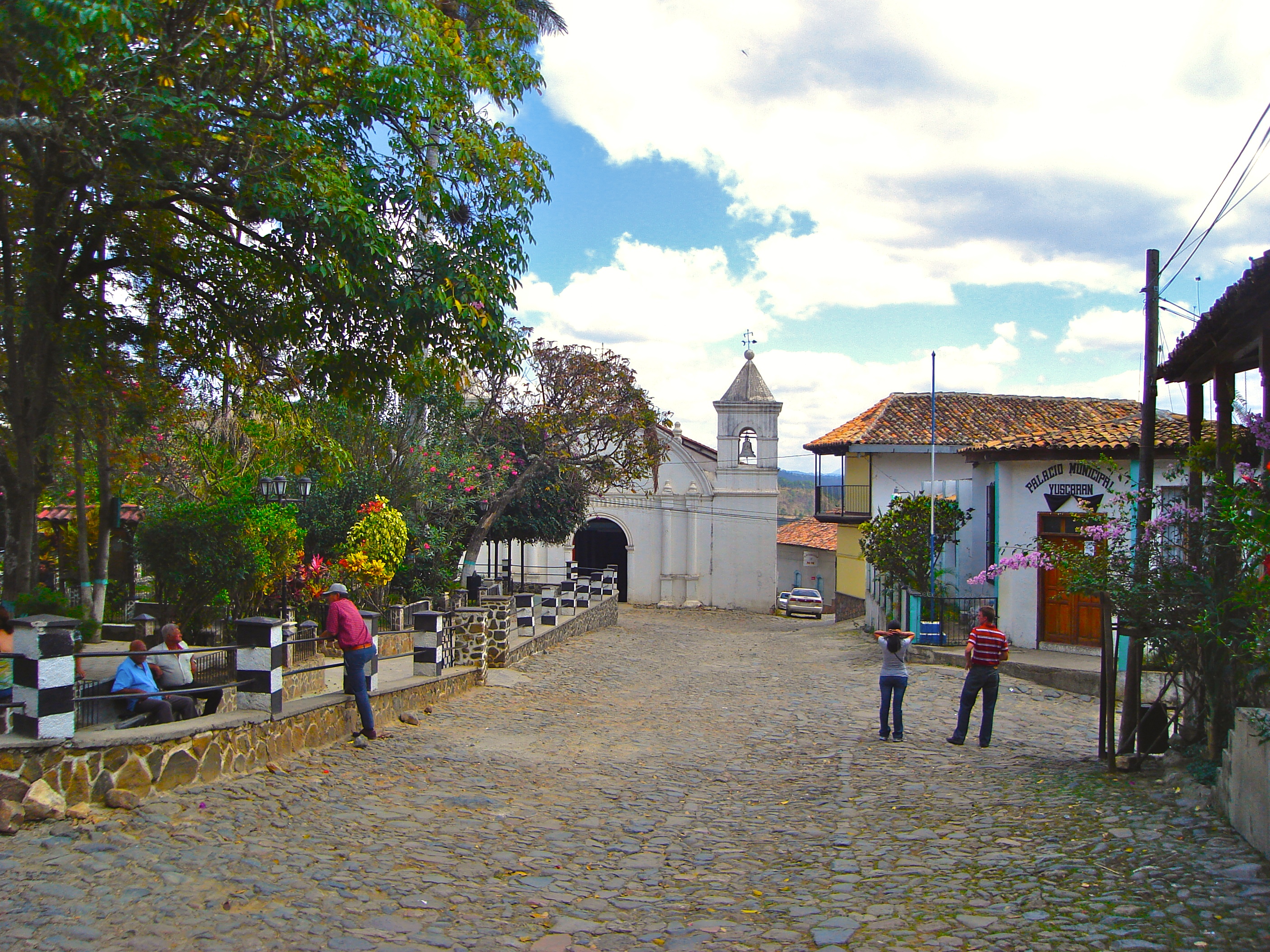
The great appeal of Yuscarán is, quite simply, walking its historic center. Declared a National Monument, the town center preserves a colonial ensemble of great charm: narrow cobbled streets that climb and drop along the slope of the hill, adobe houses with tile roofs, wooden balconies and doors, and corners that seem to come from another era. It's a pleasure to walk it slowly, photographing façades and discovering details. Among the standout buildings are the town's colonial church, the central square and several stately houses that recall the prosperous days of silver mining, when Yuscarán was one of the most important mining centers in Honduras. Some of those houses belonged to wealthy families of the period and preserve their original architecture. The atmosphere of the town is calm and welcoming, with a slow pace that invites you to sit in the square, chat with the locals and enjoy the cool mountain climate. It's one of the best-preserved colonial towns in central Honduras. How to get there: the center is explored on foot from the central square. Best time to go: dry season; weekends are livelier. Tips: comfortable footwear for the cobblestones and the slopes, a light jacket for the cool night, and time to get lost in the little streets.
ℹ️ Distance: Center of Yuscarán; explored on foot · Best time to go: Dry season; weekends are livelier · Entry: Free (open walk around the town) · Duration: 1 to 2 hours
2
El Buen Gusto Distillery (Yuscarán aguardiente factory)
The historic distillery of the famous 'guaro Yuscarán', emblem of the town, with a visit to its facilities.
Yuscarán is synonymous with aguardiente: the 'guaro Yuscarán' is one of the best-known and most popular drinks in Honduras, and it is distilled at the El Buen Gusto distillery, founded in 1939 by Doña María Viuda de Mondragón, in the San José neighborhood, within the town center itself. Visiting the distillery is one of the most characteristic experiences of the place: it lets you see the process of making the aguardiente, see the traditional facilities and understand why this product is so tied to Yuscarán's identity. The brand produces several labels —Yuscarán Original (the best-selling one), Premium, Oro, Extra Light, Mandarina and Amaretto— and provides work for around 150 families in the area. The factory, with a long history and recognition even outside Honduras, is part of the town's heritage and a source of local pride. You can tour it and learn the history of production, on a visit that combines the industrial with the cultural. Yuscarán aguardiente is drunk all over the country and is a typical souvenir to take home, available in supermarkets and shops in the area. It's an unmissable stop for understanding the town's economy and culture beyond its mining past, and a good chance to buy the local product straight from the source. How to get there: in the historic center of Yuscarán, a short distance from the entrance to the town. Best time to go: confirm the visiting days and hours, Monday to Saturday during business hours. Tips: ask beforehand whether there are guided tours; drink the aguardiente in moderation and responsibly.
ℹ️ Distance: In the center of Yuscarán, a short distance from the entrance to the town · Best time to go: Monday to Saturday during business hours; confirm the visiting days and hours · Entry: Plant tour free or with a symbolic contribution (L 20-50; check when you visit, verified July 2026); bottles from L 60-120 · Duration: 1 hour approx.
3
Casa Fortín (Museum)
A colonial mansion turned museum, which preserves the memory of the mining era and the life of the town.
Among the historic mansions of Yuscarán, Casa Fortín stands out, a colonial mansion that works as the town museum. Visiting it lets you peer into the life of the prosperous families of the mining era and learn the history of Yuscarán through objects, furniture, photographs and pieces that tell the local past of silver, trade and tradition. The building itself is already part of the appeal: a mansion representative of stately colonial architecture, with its rooms, courtyards and period details. The museum helps you understand why Yuscarán was an important center and what daily life was like when mining set the rhythm of the region. It's a short but rewarding visit, which complements the walk through the historic center and the visit to the aguardiente factory very well, completing the portrait of the town. How to get there: in the historic center of the town, steps from the square. Best time to go: confirm the opening days and hours. Tips: check the hours (museums in small towns sometimes have limited opening); combine it with the walking tour of the center.
ℹ️ Distance: Historic center of Yuscarán, near the square · Best time to go: All year round; confirm opening hours (it usually opens on weekdays) · Entry: L 20-40 (approx. US$ 1-2, symbolic admission; check when you visit (verified July 2026)) · Duration: 30 to 60 minutes
4
Cueva de Ágalta and surroundings
A natural cave in the surroundings of the town, tied to the mining history and to local legends.
In the surroundings of Yuscarán there are natural attractions that complement the colonial center, among them the well-known Cueva de Ágalta (also referred to as the town cave), a natural formation associated with the mining history of the area and with local legends and traditions. Visiting it adds a touch of adventure to the cultural outing. The Yuscarán area, on the slope of Cerro Monserrat, also offers mountain landscapes, lookouts and the chance to hike trails with views of the town and the valley. The green, cool setting contrasts with the heat of other regions of Honduras and is one of the charms of the place. To visit the cave and the trails it's best to ask in town about the state of the access routes and, if possible, to have a local guide who knows the area, especially for the caves. How to get there: in the surroundings of the town; ask locally about access. Best time to go: dry season, for the trails and the cave. Tips: proper footwear, a flashlight for the cave, a local guide recommended, water and caution on the mountain paths.
ℹ️ Distance: In the surroundings of Yuscarán, in the Cerro Monserrat area · Best time to go: Dry season (paths and cave more accessible) · Entry: Access free; local guide recommended US$ 15-25 (verified July 2026; check in town) · Duration: Half a day
5
Yuscarán Biological Reserve
A protected cloud-forest area on Cerro Monserrat, with trails and mountain biodiversity.
The Yuscarán Biological Reserve, which protects part of Cerro Monserrat and its wooded slopes, is one of the town's great natural secrets. It is an area of cloud forest and pine-oak forest that harbors remarkable biodiversity, with numerous bird species, orchids and mountain flora, in a cool, humid setting very different from the lowlands of Honduras. The reserve has trails that let you go into the forest, watch birds and enjoy lookouts with views over the town and the surrounding valley. It's a good nature complement for those who have already toured the colonial center and want to add an outdoor hike. It's best to ask in town about the condition of the trails and whether a guide is needed, since signposting can be limited. It's ideal for lovers of birdwatching and mountain landscapes. How to get there: access via the slopes of Cerro Monserrat, a short distance from the town; ask in Yuscarán about the starting point. Best time to go: morning, for the birds; dry season for the trails. Tips: trekking footwear, insect repellent, water, binoculars if you like birds.
ℹ️ Distance: On the slopes of Cerro Monserrat, a short distance from the town · Best time to go: Morning (birds); dry season (trails more accessible) · Entry: Free or symbolic contribution L 20-40 (verified July 2026; check locally) · Duration: Half a day
6
Central square and church of Yuscarán
The civic heart of the town, with its white colonial church and the quiet atmosphere of local life.
The central square of Yuscarán is the meeting point and the civic heart of the town, presided over by its colonial church with a white façade, one of the most photographed buildings in the historic center. Around the square are the eateries, a few shops and the daily life of the people of Yuscarán, in a serene atmosphere very different from the bustle of Tegucigalpa. The church, of colonial style, preserves religious elements of historical value and is a good starting point for the tour of the rest of the town. Sunsets in the square, with the mountain coolness and the golden light on the façades, are one of the loveliest moments to enjoy Yuscarán at a calm pace. It's common to sit on one of the benches in the square, chat with the neighbors and simply let time pass, something rare in the rhythm of big cities. It combines perfectly with a stop at a nearby eatery to try the local food. How to get there: in the center of the town, the natural starting point of the tour. Best time to go: any day; sunset is especially lovely. Tips: it's a good place to get your bearings and start the visit to the town.
ℹ️ Distance: Center of the town · Best time to go: Any day; sunset especially recommended · Entry: Free (open access to the square and the church) · Duration: 30 minutes to 1 hour
Advertisements
What nobody tells you

💵 Prices

Tickets

TypePrice
Tour of the colonial centerFree (open walk around the town)
Visit to the El Buen Gusto Distillery (Yuscarán aguardiente)Free or symbolic contribution L 20-50; confirm on arrival (source: visitor reports and local press, verified July 2026)
Casa Fortín (Museum)L 20-40 (approx. US$ 1-1,60), symbolic admission; confirm when you visit (verified July 2026)
Cueva de Ágalta / Cerro Monserrat trailsAccess free; local guide US$ 15-25 (verified July 2026)
Yuscarán Biological ReserveFree or symbolic contribution L 20-40 (verified July 2026)
Central square and churchFree (open access)
🔄 updated monthlyOfficial / reference values · double-check when buying

Activities and tours

ActivityPriceDurationOperator
Walking city tour of the colonial centerFree; optional local guide US$ 15-201-2 hOn your own or with local guides
Guided visit to the El Buen Gusto DistilleryFree or L 20-50 contribution; bottles from L 60-120 (verified July 2026)1 hYuscarán distillery (check hours)
Visit to the Casa Fortín museumL 20-40 (verified July 2026)30-60 minLocal museum (check hours)
Hike to Cerro Monserrat and the Cueva de ÁgaltaAccess free; local guide US$ 15-25Half a dayLocal guides (check)
Day excursion from Tegucigalpa to YuscaránUS$ 35-55 per person (organized tour, verified July 2026); in your own car, fuel onlyFull dayTegucigalpa operators (check)
🔄 updated monthlyOfficial / reference values · double-check when buying
Advertisements

🚌 How to get there and distances

Getting around

ModePriceDurationNotes
On footFreeVariableThe historic center of Yuscarán is small and is perfectly covered on foot, although there are slopes and cobblestones. It's a small town with no formal urban transport: almost everything is done on foot.
Mototaxi and taxiL 20-40 (approx. US$ 1-1,60) per trip within the town (source: local mototaxi fares in El Paraíso towns, verified July 2026)VariablePaid in cash directly to the driver; it's best to agree the fare before getting in. For short trips within the town and toward the surroundings. There's no payment app or card: in a town this size the mototaxi works the old-fashioned way.
Private or rental carRental from US$ 35-55/day in Tegucigalpa; fuel (regular gasoline) approx. L 110-125/gallon (source: official fuel prices published by the SEDE/government of Honduras and rental agencies in TGU, verified July 2026)VariableThe most comfortable way to get there from Tegucigalpa and to move around the surroundings and other spots in El Paraíso.
🔄 updated monthlyOfficial / reference values · double-check when buying

How to get there

RouteAirlines / operatorsAvg. priceDuration
Tegucigalpa → Yuscarán (intercity bus)Buses on the eastern route leaving from the Mercado Jacaleapa terminal (colonia Kennedy), bound for El Paraíso/Danlí/Yuscarán/Güinope; cash payment, no cardL 60-90 (approx. US$ 2,40-3,60) for the direct leg; the eastern route (Tegucigalpa–Yuscarán/Güinope/El Zamorano) had a fare increase of +L 5 due to the price of fuel (source: La Prensa and El Espectador on the fare increase in the eastern zone; Jacaleapa terminal, verified July 2026)Approx. 1,5 to 2 h
Tegucigalpa → Yuscarán (car)Private or rental vehicleFuel (gasoline) approx. L 110-125/gallon; direct taxi/private transfer US$ 120-170 (source: official fuel prices from the government of Honduras and private transfer fares, verified July 2026)Approx. 1 to 1,5 h (about 65-70 km via the road to Danlí and the turnoff to Yuscarán)
Danlí → YuscaránIntercity buses or car (cash payment)L 30-50 (approx. US$ 1,20-2, verified July 2026)Approx. 45 min to 1 h
Flights to Tegucigalpa (TGU) or Palmerola (XPL) and overland transferNational and international airlines + car/busFlight depending on origin + overland transfer (bus L 60-90 or private transfer US$ 120-170)Depending on origin + transfer to Yuscarán
🔄 updated monthlyOfficial / reference values · double-check when buying

🏨 Where to stay

No exact prices: a scale from $ (budget) to $$$$$ (luxury), with 2-3 options per category.

CategoryPriceRecommended options
Charming lodgings in Yuscarán$$$$$US$ 52-96 a night; small charming hotels and inns in colonial mansions in town, such as Casa Colibrí Hospedaje on the square, ideal for staying on to enjoy the historic atmosphere and the cool mountain climate
Budget lodgings in Yuscarán$$$$$US$ 20-40 a night; simple, cheap lodgings, such as Hotel Yuscarán in Barrio El Calvario, enough for a weekend getaway
Hotels in Tegucigalpa (base)$$$$$US$ 45-100 a night; a wide range of hotels of all categories in the capital, which many use as a base to visit Yuscarán on a day trip

🍴 Where to eat

TypePriceOptions / signature dish
Traditional Honduran food$$$$$L 60-180 (approx. US$ 2,50-7,50) per dish; eateries and fondas in Yuscarán with typical cooking: chicken with tajadas, soups, baleadas, mountain dishes and local coffee
Local products (mango, sweets, aguardiente)$$$$$L 30-120 (approx. US$ 1,50-5) per product; the area is known for its mangoes and mango products, homemade sweets and, of course, Yuscarán aguardiente (bottle from L 60-120) as the typical product to take home
Eateries and pulperías$$$$$L 20-80 (approx. US$ 1-3,50) per item; cheap home cooking, snacks and drinks at the town's eateries and pulperías
Advertisements

📖 History of Yuscarán

Origins, formation and what the sources say.

The origin of the name and the settlement of the area

Walk up a cobbled street on the slope of Cerro Monserrat, pass in front of an adobe mansion with a wooden balcony, and without realizing it you'll be walking over the reason this town exists: beneath these mountains there were, for centuries, veins of silver that made half of colonial Honduras rich. Yuscarán was not born of a fertile river or of a crossroads, but of a metal. That's the first key to understanding why a small town in El Paraíso came to be a departmental capital and a National Monument.

The name Yuscarán is of indigenous origin, a legacy of the peoples who inhabited central-eastern Honduras before the arrival of the Spanish. The region of today's department of El Paraíso, mountainous and with a temperate climate thanks to its altitude, was populated from pre-Hispanic times, and local place names preserve that original root, although its exact meaning is the subject of different interpretations that are best taken as approximations.

The area where Yuscarán sits, on the slope of Cerro Monserrat, offered resources and a pleasant climate, and it fell within the orbit of Spanish colonization as it advanced into the interior of the country. What would turn this place into an important settlement, however, was neither its climate nor its agriculture, but something the mountain was hiding: silver. As in so many other places in colonial America, the presence of mineral deposits was the engine that gave rise to the town as we know it. The history of Yuscarán is, above all, a mining history, tied to the silver wealth of Cerro Monserrat and its surroundings.

The indigenous place name
The name Yuscarán has a pre-Hispanic indigenous root; there are different interpretations of its meaning, with no single agreed version. The translations in circulation are best taken as approximations rather than as firm data.
Source: https://es.wikipedia.org/wiki/Yuscar%C3%A1n

The silver mining boom (18th century)

Yuscarán owes its existence and its splendor to silver mining. During the colonial era, and especially intensely in the 18th century, the exploitation of the silver deposits of Cerro Monserrat and its surroundings made Yuscarán one of the main mining centers in Honduras, a country for which silver mining was one of the most important economic activities in colonial times.

The mining wealth attracted people, capital and merchants. The town grew around the mines and filled up with the marks of prosperity: stately mansions of wealthy families, a church, a square and a layout of cobbled streets adapted to the relief of the mountain. Much of the architectural heritage that today makes Yuscarán a charming town dates from those years of mining bonanza.

The life of the town revolved around the rhythm of the mines: extraction, processing of the ore and the silver trade. As in other mining centers, the boom also had its social flip side, with hard work in the mines. Yuscarán came to be so important that, over time, it became the capital of the department of El Paraíso.

Yuscarán, a great silver mining center
The sources agree that Yuscarán was one of the main silver mining centers in Honduras in colonial times, with its heyday above all in the 18th century, and that this mining past explains its architectural heritage. Precise production figures and exact dates are best taken as indicative.
Source: https://es.wikipedia.org/wiki/Yuscar%C3%A1n

From colony to republic: capital of El Paraíso

After the independence of Central America (1821) and the consolidation of Honduras as a country, Yuscarán kept its regional importance. Mining activity remained present through the 19th century, and the town held on to its role as the administrative and commercial center of the central east, becoming the capital of the department of El Paraíso, one of the country's departments.

During this period, Yuscarán witnessed the swings of Honduran history, with its economy still largely tied to mining and to the agriculture of the area. The town kept its colonial appearance, with its historic center of cobbled streets and mansions, which withstood the passage of time.

The historical importance and architectural richness of Yuscarán led to its urban ensemble being recognized and protected as a National Monument, which helped preserve its colonial character against modernization. That protection is key to understanding why Yuscarán today keeps that air of stopped time that so appeals to visitors.

Yuscarán as a National Monument
The sources indicate that Yuscarán was declared a National Monument for the value of its colonial ensemble, which contributed to its preservation. The exact date of the decree and its scope are best verified in official Honduran sources.
Source: https://es.wikipedia.org/wiki/Yuscar%C3%A1n

The aguardiente: the tradition of 'guaro Yuscarán'

If silver gave rise to Yuscarán, another tradition made it famous across the country: the distilling of aguardiente. In 1939, Doña María Viuda de Mondragón got the El Buen Gusto distillery going in an artisanal way, in the town's San José neighborhood, and that year marks the birth of the 'guaro Yuscarán' as Honduras knows it. Out of that family venture came one of the most popular drinks in the country, to the point that the name of the town became inseparable from the aguardiente.

Production took root and became an economic and cultural emblem: the distillery came to employ around 150 families from Yuscarán and to modernize its technology over the decades, without losing the original label —today the Yuscarán Original (the best-selling one) coexists with Premium, Oro, Extra Light, Mandarina and Amaretto versions—. Over time, the fame of the guaro ended up outstripping even that of the old mining, and the factory became part of the local heritage and a characteristic visit for those who come to the town.

This tradition shows how Yuscarán managed to reinvent its economy: from colonial mining splendor it moved, over the centuries, to living on agriculture, trade, aguardiente and, more recently, tourism. The guaro is still today one of the town's great sources of pride and a typical souvenir for visitors.

Guaro Yuscarán as an emblem
The sources agree that Yuscarán aguardiente is one of the best-known drinks in Honduras and an emblem of the town, produced at a historic local factory. The details about the founding of the factory and its production are best verified in direct sources.
Source: https://www.hondurastips.hn/destino/el-paraiso/yuscaran/

Yuscarán today: colonial heritage and mountain getaway

With the decline of silver mining, Yuscarán could have become just another forgotten town, but its colonial architectural heritage, its aguardiente tradition and its cool mountain climate saved it from anonymity. Today it's one of the favorite getaways for the people of Tegucigalpa, who in a little over an hour reach a town with an air of stopped time.

The protection of its historic ensemble as a National Monument made it possible to preserve the cobbled streets, the adobe-and-tile mansions, the church and the corners that make Yuscarán a charming destination. Weekend and day-trip tourism feeds on that colonial atmosphere, on the visit to the aguardiente factory and the Casa Fortín museum, and on the natural attractions of the surroundings, such as Cerro Monserrat and the Cueva de Ágalta.

Yuscarán thus embodies the transformation of a colonial mining town into a cultural and nature destination: from the splendor of silver to the preserved charm of its streets, the taste of the guaro and the freshness of its mountain. Visiting it means traveling through several centuries of Honduran history in a small, peaceful town full of character, a step away from the capital.

From mining town to tourist destination
The sources present Yuscarán as a town that went from silver mining to living, among other things, on getaway tourism thanks to its preserved colonial heritage, its aguardiente and its natural setting. It's a reading widely shared in the tourist information about the place.
Source: https://www.honduras.travel/

📚 Bibliography

  • Wikipedia (ES) — «Yuscarán»: https://es.wikipedia.org/wiki/Yuscar%C3%A1n
  • Wikipedia (EN) — «Yuscarán»: https://en.wikipedia.org/wiki/Yuscar%C3%A1n
  • Wikipedia (ES) — «El Paraíso (departamento)»: https://es.wikipedia.org/wiki/El_Para%C3%ADso_(departamento)
  • Wikipedia (ES) — «Aguardiente»: https://es.wikipedia.org/wiki/Aguardiente
  • Honduras Tips — «Yuscarán»: https://www.hondurastips.hn/destino/el-paraiso/yuscaran/
  • XplorHonduras — «Yuscarán, El Paraíso»: https://www.xplorhonduras.com/yuscaran-el-paraiso/
  • Instituto Hondureño de Turismo — «Yuscarán»: https://www.honduras.travel/
  • El Heraldo — «Yuscarán te emborracha de amor»: https://www.elheraldo.hn/revistas/siempre/yuscaran-te-emborracha-de-amor-LC10303448
  • Paraíso HN (blog) — «Conociendo más de Yuscarán: Historia del municipio»: http://paraisohn.blogspot.com/2017/04/conociendo-mas-de-yuscaran-historia-del.html
  • Honduras en sus manos — «0701 Yuscarán»: https://hondurasensusmanos.com/0701-yuscaran/

❓ Frequently asked questions

What's special about Yuscarán?+
It's a colonial mining town declared a National Monument, one of the best preserved in central Honduras, with cobbled streets, adobe-and-tile mansions and a colonial church. To its historic heritage (inherited from the days of silver mining) are added its cool mountain climate and its famous aguardiente, the 'guaro Yuscarán', produced at the El Buen Gusto distillery. All of that, a little over an hour from Tegucigalpa, makes it a classic getaway.
How do I get there from Tegucigalpa?+
Yuscarán is about 65-70 km from the capital, roughly 1 to 1,5 hours by car via the road to Danlí with a turnoff to the town. A private or rental car is the most comfortable. By bus, the units leave from the Mercado Jacaleapa terminal (colonia Kennedy), on the eastern route that also serves El Paraíso, Danlí, Güinope and El Zamorano; the fare runs about L 60-90 and is paid in cash (there's still no card or QR on this rural route). A direct private transfer costs between US$ 120-170. Many visitors do it as a day trip.
How do you pay for the bus and is there an app to see the transport?+
For the intercity bus to Yuscarán you pay in cash (lempiras) to the assistant; there's no card or QR on that route. In the capital, by contrast, the modernization of urban transport began in 2025-2026 with a prepaid card (bought at banks and at Tigo/Claro) and real-time GPS, and the most used app for seeing Tegucigalpa's buses is Moovit (plus Google Maps). Inside Yuscarán you don't need an app: it's a walkable town, and for the surroundings you use a mototaxi or a car.
What is 'guaro Yuscarán'?+
It's the typical aguardiente distilled at the town's historic El Buen Gusto distillery, which became one of the best-known drinks in Honduras. Visiting the distillery to see how it's made is one of the most characteristic experiences in Yuscarán, and the aguardiente (from L 60-120 a bottle) is a classic souvenir to take home (always drink responsibly).
How much time do I need?+
The town is comfortably covered in a day, which makes it ideal as a full-day excursion from Tegucigalpa. If you want to enjoy it at a calmer pace and add the factory, the museum, the cave or hikes on Cerro Monserrat, a weekend getaway with a night in town (from US$ 20-96) is a great option.
When is the best time to go?+
Because of its altitude, the climate is pleasant and cool for much of the year; the dry season (November to April) is the most comfortable. Weekends and holidays are the liveliest. If it coincides, mango season and the patron saint festivities give it a special color. Bring a light jacket because the nights get cool.
What else can I see in the surroundings?+
Around Cerro Monserrat there are trails, lookouts, the Yuscarán Biological Reserve (cloud forest with birds and orchids) and the well-known Cueva de Ágalta, tied to the mining history. For the caves and hikes it's best to ask in town about the state of the access routes and, if possible, to go with a local guide (US$ 15-25). Yuscarán can also be combined with other spots in the department of El Paraíso, such as Danlí.
Sources consulted (17)
Still planning?
Explore more destinations in Honduras
See all destinations →
Advertisements
Image credits
Photos from Wikimedia Commons, each under its own licence (CC BY, CC BY-SA or public domain). Open each file to see its author and licence.
Yuscaran Honduras square