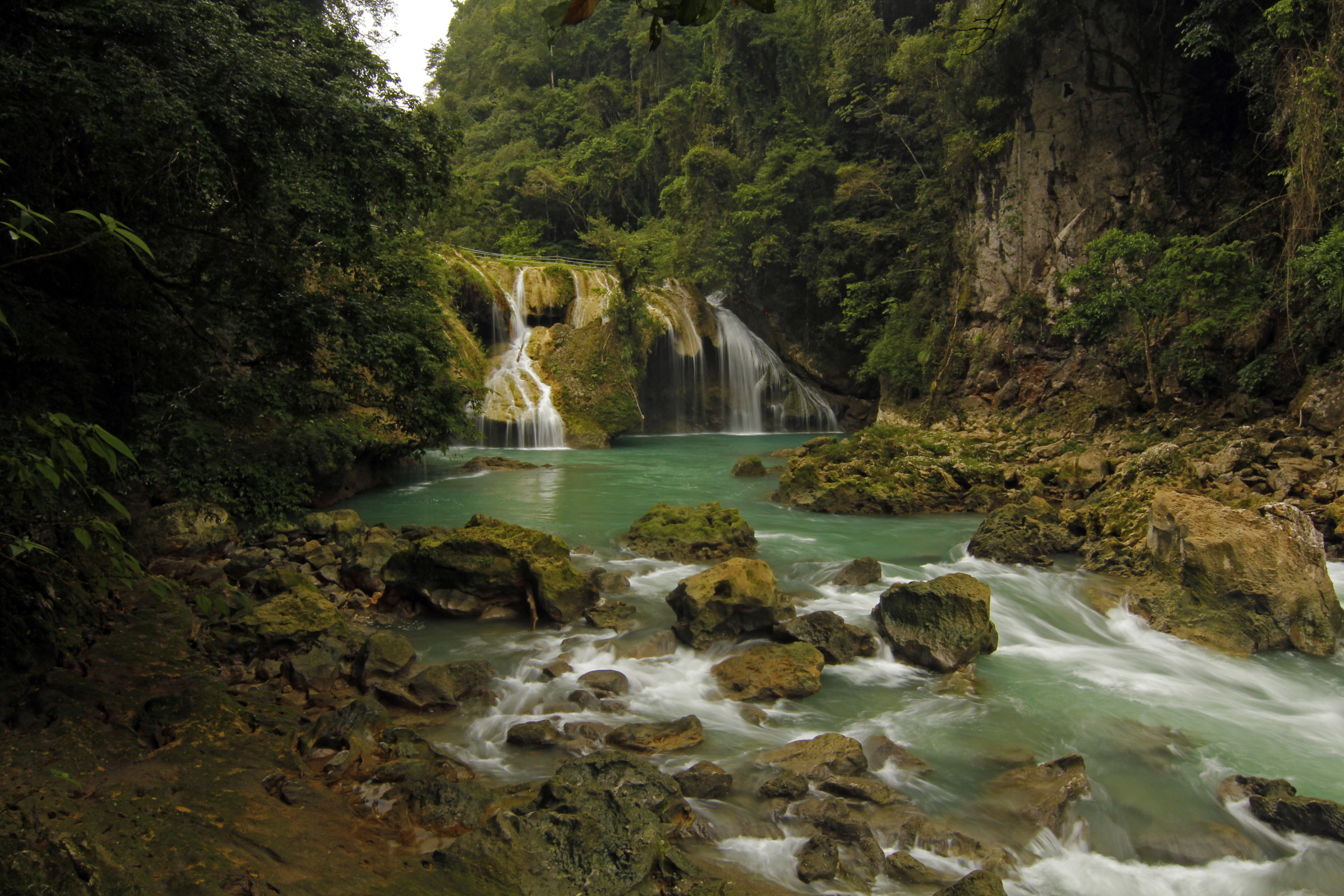
Semuc Champey is, for many, the most beautiful natural place in Guatemala, and one of those wonders that seem too perfect to be real. Deep in the jungle of Alta Verapaz, the powerful and wild Cahabón river suddenly disappears beneath a natural limestone bridge several hundred metres long. And on top of that bridge, fed by small springs and seepage, a series of stepped pools of turquoise and emerald-green water form, of a beauty and stillness that contrast with the roaring river running hidden below. The result is a natural paradise for swimming, ringed by jungle.
Getting to Semuc Champey isn't easy: it's in a remote region, and the access, along rough dirt roads, is part of the adventure. But the effort is more than repaid. Swimming in its warm, transparent pools, slipping from one to the next, watching the water fall in small cascades among the vegetation and, from the viewpoint above, taking in the whole series of turquoise pools winding through the green of the jungle, is an unforgettable experience. All around there are caves, rivers for tubing and a fascinating region to discover.
This guide covers Semuc Champey with a practical and warm eye: what to do at the natural monument (the pools, the viewpoint, the river bridge), what activities to add nearby (the Lanquín caves, tubing, the K'an Ba caves), how to reach this remote corner, where to sleep and eat, and how to do it safely and with respect for a fragile natural setting. Semuc is a destination of adventure and wild nature, a hidden gem in the green heart of Guatemala that's worth every kilometre of road.
Semuc Champey is a natural monument in the Verapaces region, in Alta Verapaz, in north-central Guatemala, an area historically inhabited by the Q'eqchi' Maya people. Its name comes precisely from the Q'eqchi' language and is usually translated as 'where the river hides' or 'where the water sinks beneath the earth', referring to the phenomenon that defines the place: the Cahabón river, powerful and fast-flowing, plunges beneath an enormous natural limestone bridge some 300 metres long, running hidden underneath, while on the surface of the bridge a series of stepped pools of turquoise water form. Geologically, the bridge and the pools are the result of the dissolution of the limestone by water over millennia (a karstic process), which created the natural bridge and the basins where spring water and seepage collect. The Verapaces region has a singular history: in the 16th century, the Dominicans —led by Friar Bartolomé de las Casas— achieved the peaceful evangelisation of the Q'eqchi' in an area the Spanish had failed to subdue by arms, which gave the region the name 'Verapaz' ('true peace'). For a long time, Semuc Champey was a place known mainly to local people. With the growth of adventure tourism, and despite its difficult access, it became one of the most sought-after natural destinations in Guatemala. Today it is protected as a natural monument. The full geological and cultural history is on our history page.
Read the full history ↓The department of cloud forest and Q'eqchi' lands: heart of the Tezulutlán evangelised by Las Casas, birthplace of the coffee grown by German settlers in Cobán, and home to the turquoise pools of Semuc Champey, the caves of Lanquín and the emerald lake of Lachuá.
Read the history of Alta Verapaz →If you only have one day, take a guided tour on the first one: it sets up the rest of your trip and saves you a lot of walking. We look ours up on Civitatis: guided in Spanish and booked online with no fuss. They have 10 activities in Ciudad De Guatemala. And there are free tours here: you book without paying and tip the guide whatever you think at the end, so trying one costs you nothing. Have a look below: tap any of them to see them all.
They depart from Ciudad De Guatemala, 116 km away. If you book from this link we earn a commission and you pay no more.
No exact prices: a scale from $ (budget) to $$$$$ (luxury), with 2-3 options per category.
Origins, formation and what the sources say.
Picture a furious river, able to drag whole trees along, that suddenly disappears: it swallows itself beneath the earth and goes on roaring, invisible, through a tunnel of stone. And directly above that hidden river, in total calm, a staircase of warm, transparent turquoise pools where you can float while, a few metres beneath your feet, the current races past unseen. That's Semuc Champey, and it's no trick: it's pure geology, one of those places that seem impossible until you're in the water. Semuc Champey is, first and foremost, a geological wonder, the product of water's patient work on rock over millennia. The protagonist is the Cahabón river, a powerful, fast-flowing river that runs down through the Verapaces region. At one point on its course, the river meets a limestone formation and, instead of continuing on the surface, plunges beneath it, running through a natural tunnel some 300 metres long. Above that tunnel remains a natural rock 'bridge', on top of which the miracle happens.
On that limestone bridge there have formed, over time, a series of stepped pools. These pools are not fed by the Cahabón (which runs hidden below), but by small springs, streams and water seepage that collect in the basins carved into the rock. The distinctive turquoise and emerald green of their water is due to dissolved minerals (especially calcium carbonate) and to the way light reflects off the still, shallow water over the pale limestone bottom.
This whole landscape is the result of karstic processes: the slow dissolution of limestone by slightly acidic water, which over thousands of years created the tunnel, the bridge and the pools. It's the same kind of process that forms the region's caves (such as those at Lanquín). Semuc Champey is thus a spectacular example of how water sculpts stone, creating one of the most beautiful and singular corners in all of Central America.
The name 'Semuc Champey' comes from Q'eqchi', the Maya language spoken in the Verapaces region, in north-central Guatemala. Although translations vary, it is usually interpreted as 'where the river hides' or 'where the water sinks beneath the earth', a perfect description of the natural phenomenon that defines the place: the disappearance of the Cahabón river beneath the rock bridge. The name itself reflects the attentive, poetic gaze of the Q'eqchi' on their natural surroundings.
The region of Alta Verapaz, where Semuc Champey lies, is one of the great territories of the Q'eqchi' people, one of the most numerous Maya peoples in Guatemala. The Q'eqchi' have inhabited these lands of jungle, mountains and rivers since pre-Hispanic times, developing a culture of their own, with their language, their traditions, their agriculture (maize, beans, cardamom, coffee) and a deep spiritual relationship with nature, in which hills, caves and water sources are sacred places.
For the Q'eqchi', places such as Semuc Champey and the region's caves (like those at Lanquín) were not mere geographical features, but sites charged with meaning, dwellings of spiritual forces and settings for ceremonies. That worldview, which survives to this day, gives Semuc Champey a dimension beyond its natural beauty: it is part of the sacred landscape of a Maya people who have inhabited and cared for these lands for centuries.
The region where Semuc Champey lies has a singular colonial history that explains its name: the Verapaces (Alta and Baja Verapaz). During the conquest of Guatemala in the 16th century, this mountainous, jungle-covered area, inhabited by fierce Maya peoples (the Q'eqchi' among them), proved impossible for the Spanish to subdue by arms; they called it the 'Land of War' (Tezulutlán) for the ferocity of indigenous resistance.
It was then that the Dominican friar Bartolomé de las Casas, the celebrated defender of indigenous rights, proposed a bold experiment: to conquer the region not with arms but through peaceful evangelisation. The Dominicans reached an agreement with the Crown that no encomenderos or soldiers would enter the area, and went in to preach Christianity peacefully, learning the local languages and teaching through song and persuasion.
The experiment, carried out from the 1530s and 1540s onwards, succeeded (though not without tensions and difficulties), and the region's peoples gradually accepted Christianity and colonial organisation without a military conquest. In recognition, the Spanish Crown changed the region's name: from 'Land of War' it became 'Verapaz', that is, 'true peace'. That episode, considered a remarkable case of peaceful conquest, left a deep Dominican imprint on the region and explains why today these lands of the Q'eqchi' people —where the wonder of Semuc Champey is hidden— bear the name of 'true peace'.
For centuries, the region of Alta Verapaz and, within it, Semuc Champey, remained relatively isolated and little known outside the local area. The zone, mountainous, jungle-clad and hard to reach, developed above all around agriculture: in the 19th and 20th centuries, Alta Verapaz became an important coffee-producing region (with a strong presence of German immigrants on the large estates) and, later, of cardamom, of which Guatemala is one of the world's leading exporters. But places like Semuc Champey remained known almost exclusively to the Q'eqchi' people living nearby.
Semuc Champey's transformation into a tourist destination is relatively recent, tied to the rise of adventure and nature tourism in Guatemala, especially since the late 20th and early 21st centuries. Despite its awkward access —or perhaps partly because of it, which gives it the air of a 'hidden treasure'— the spectacular beauty of its turquoise pools gained fame, first among backpackers and adventurous travellers, and later in guidebooks and on social media, until it became one of the iconic images of Guatemalan nature.
Today, Semuc Champey is protected as a natural monument, and around it has grown an infrastructure of hostels, lodges and activity operators who live from tourism. That success, however, raises challenges: the need to protect a fragile ecosystem from the pressure of growing visitor numbers, to manage waste and to ensure that tourism benefits the local Q'eqchi' communities without degrading the place. For the traveller, knowing this history is an invitation to enjoy Semuc Champey with respect and awareness, caring for a natural jewel that took millennia to form and that belongs, above all, to the region and its people.