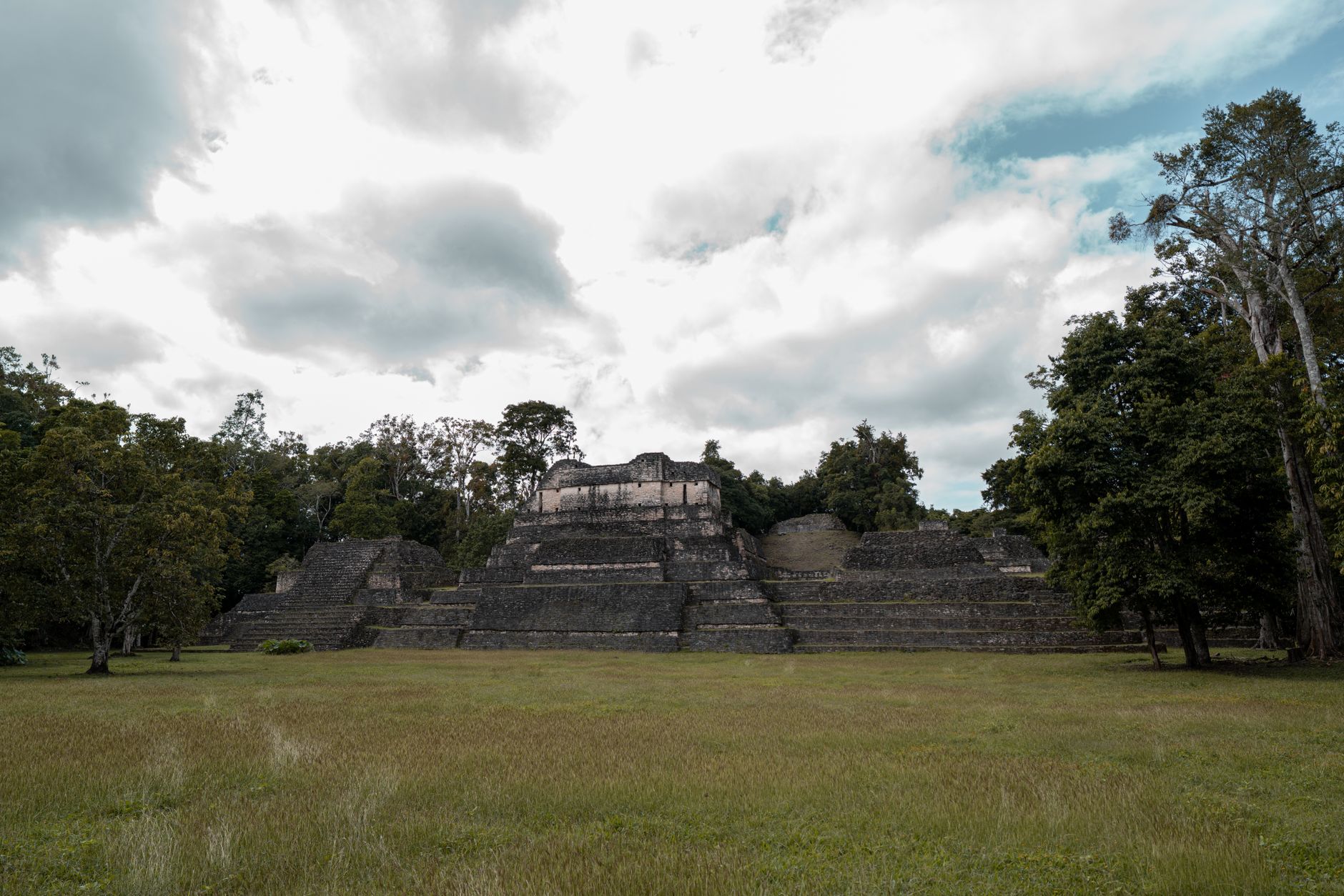
Copán is one of the great Maya sites in the world, a UNESCO World Heritage Site, famous for the quality and refinement of its sculpture and for its Hieroglyphic Stairway, the longest known Maya inscription in stone. Although it lies in Honduras, it appears in many Guatemala itineraries because it's very close to the eastern border, and from the Guatemalan side (Río Dulce, Esquipulas or Quiriguá) it's a classic cross-border excursion.
The site sits in a green, peaceful valley beside the likeable town of Copán Ruinas, which serves as a base with its hotels, restaurants and cobbled streets. Copán was one of the most cultivated and artistic cities of the Classic Maya world: here the sculptors reached heights of detail on stelae, altars and masks, and the astronomers refined the calendar. Above all, it's a destination for marvelling at Maya art and history.
This guide covers the practicalities of visiting Copán as an excursion from Guatemala: what the border crossing is like, what to see at the site (the Hieroglyphic Stairway, the Great Plaza, the Acropolis, the Rosalila tunnel), how much time to give it and how to organize the logistics. Important: this is a Honduran destination, not a Guatemalan one; we include it because of its proximity and because it's often combined with the Maya route of eastern Guatemala, especially with Quiriguá.
Copán was the capital of a powerful Maya kingdom at the far southeastern edge of the Maya world, at its height between the 5th and 9th centuries AD under a dynasty founded by K'inich Yax K'uk' Mo'. It became famous for the excellence of its sculpture and for the Hieroglyphic Stairway, the longest Maya inscription, commissioned by King K'ak' Joplaj Chan K'awiil after the humiliating capture of his predecessor '18 Rabbit' by subordinate Quiriguá in AD 738. A UNESCO World Heritage Site since 1980, it lies in Honduras, right by the Guatemalan border.
Read the full history ↓The only department with a Caribbean coast: Garífuna and Q'eqchi' country, home to the country's largest lake, to the Río Dulce and its colonial pirate castle, to United Fruit's bananas and Puerto Barrios, to jungle, to the giant stelae of Quiriguá and to the gateway to Copán.
Read the history of Izabal →They depart from Copan Ruinas, 1 km away. If you book from this link we earn a commission and you pay no more.
No exact prices: a scale from $ (budget) to $$$$$ (luxury), with 2-3 options per category.
Origins, formation and what the sources say.
Carved into a stone staircase at Copán are more than eighteen hundred hieroglyphs: it is the longest Maya text in existence, an entire library sculpted onto sixty-three steps. And yet the reason such a monster of propaganda was built was a catastrophe: the humiliating beheading of a Copán king at the hands of a city that owed him obedience. Copán condenses, as few sites do, both the grandeur and the fragility of the Maya world, and its history —four centuries of a single dynasty— begins with the arrival of an outsider in the valley.
Copán sits in a fertile valley in western Honduras, at the far southeastern edge of the Maya world, right by the Guatemalan border. The valley was inhabited from Preclassic times, but the history of the great Classic city begins with a founding event documented in its own monuments: in AD 426 a figure named K'inich Yax K'uk' Mo' ('Radiant First Quetzal Macaw') arrived in the valley and established a new royal dynasty. The inscriptions present him as a lord of foreign prestige, possibly tied to the influential political networks of Tikal and, beyond them, of Teotihuacan.
This founder, venerated by his successors as an almost divine ancestor, gave rise to a line of sixteen rulers that would reign for some four centuries. His tomb and a temple dedicated to his memory were found in the heart of the Acropolis, and his figure appears again and again in Copán's royal propaganda, especially on the famous Altar Q, which shows him handing power to the last of the line. The founding of this dynasty marked the beginning of the flowering of one of the most cultivated and artistic Maya kingdoms of the Classic period.
Between the 6th and 8th centuries AD, Copán reached its greatest splendor and became one of the most refined cultural centers in all of Mesoamerica. The city stood out above all for the excellence of its sculpture. While flat relief predominated in other Maya cities, Copán's artists developed an almost fully sculptural high relief, modelling figures of rulers with unmatched volume, depth and anatomical detail. The stelae of the Great Plaza, many raised by King Uaxaclajuun Ub'aah K'awiil ('18 Rabbit', who ruled around AD 695-738), are considered absolute masterpieces of Maya art.
Copán was also a leading center of astronomy and calendrical knowledge: its priest-astronomers made precise observations and calendar adjustments, and the city housed an important observatory. Copán's beautifully decorated Ball Court, along with its many altars and masks, completes a first-rank artistic heritage. Under the reign of '18 Rabbit' the city lived a genuine golden age of monument-building, with intense construction and sculptural activity that left the visual legacy that still amazes visitors today.
Copán's fortunes took a dramatic turn in AD 738. Its powerful king '18 Rabbit' was captured and beheaded by K'ak' Tiliw Chan Yopaat, ruler of Quiriguá, a city downriver in the Motagua valley that until then had been subordinate to Copán. That unexpected defeat at the hands of a former vassal was a grave humiliation and a crisis of prestige for the Copán dynasty, which lost control of the valley trade and saw its authority questioned.
Copán's response was, above all, propagandistic and monumental. His successor K'ak' Joplaj Chan K'awiil and, especially, his heir enlarged and completed the Hieroglyphic Stairway: a colossal staircase carved with more than eighteen hundred glyphs —the longest known Maya inscription in stone— recounting the glorious dynastic history of the city. It was a grandiose assertion of the legitimacy and lineage of Copán's kings, meant to restore lost prestige and reassert power before subjects and rivals alike. The stairway, today protected under a large canopy, is the site's most emblematic monument and an exceptional testimony to Maya writing.
One of the things that makes Copán unique is that the city was built, quite literally, on top of itself. For four centuries each generation of kings raised new temples over the earlier ones, so that the Acropolis today is an artificial mountain of superimposed buildings, like the layers of an onion. Tunnelling beneath those layers, archaeologists found in the 1990s an astonishing treasure: the Rosalila temple, a 6th-century structure that a later king, instead of demolishing, had wrapped and buried with extreme care. Thanks to that, its modelled stucco façade —masks of the sun god, birds and cosmological symbols— survived almost intact, still bearing its original reds, greens and yellows.
The discovery of Rosalila let specialists imagine what Maya temples really looked like: not the grey stone we see today, but buildings painted in vivid colors that must have blazed under the tropical sun. A full-size replica, with its polychromy reconstructed, is the star piece of Copán's Sculpture Museum. The same tunnels also revealed the tomb of the founder K'inich Yax K'uk' Mo' and that of a woman of very high rank, and confirmed the dynastic sequence the inscriptions had already suggested. Few places in the Maya world offer such a vivid lesson in how archaeology reconstructs, layer by layer, the life of a civilization.
After the reigns of its last sovereigns, Copán went into decline through the 9th century AD. Studies of the valley point to a combination of factors: excessive population growth, deforestation and soil exhaustion, food shortages and the general crisis of the Maya kingdom system. Altar Q, commemorating the dynasty's sixteen rulers, was raised by the last of the line, after whom the monarchy faded away and the city was gradually abandoned, until the jungle covered its temples and plazas.
Copán was brought to the attention of the Western world in the 19th century by the explorers John Lloyd Stephens and Frederick Catherwood, whose descriptions and illustrations caused a sensation. Since then, generations of archaeologists have investigated the site, with extraordinary finds such as the founder's tomb and the Rosalila temple, an earlier structure preserved almost intact and polychrome beneath the Acropolis. In 1980 UNESCO inscribed the Maya site of Copán on the World Heritage list for its outstanding universal value. Today, managed by Honduras's IHAH and complemented by the pleasant town of Copán Ruinas, it is one of the great archaeological destinations of Central America and an essential visit for anyone travelling the Maya route, easily reached from eastern Guatemala.