The Tafi Atome Monkey Sanctuary is one of the most endearing wildlife experiences in Ghana and a model example of how a community can protect its natural surroundings. In this Volta Region village, mona monkeys have been considered sacred for generations: tradition says it was the ancestors who brought the monkeys, and that is why hunting them has always been forbidden. That ancestral respect is what now lets the monkeys approach visitors without fear.
The visit is pure magic, especially for kids: accompanied by a guide from the village, you head into the forest, the guide calls the monkeys with a particular sound and, within a few minutes, the troops come down from the trees. With a banana in your hand, the monkeys climb up your arms, peel the fruit delicately and let you watch them from really close up. It is a respectful encounter, carefully managed so as not to harm the animals or make them too used to people.
This guide explains how to get the most out of a visit to Tafi Atome: what time to go to see more monkeys, how the community visit works, how much admission and bananas cost, how to get there from Hohoe or Accra and how to combine it with Wli Falls and other treasures of the Volta Region. A lovely example of how conserving nature and benefiting the community can go hand in hand.
Tafi Atome protects the mona monkeys that the village's Ewe community has considered sacred for more than two centuries, since — according to tradition — their ancestors arrived in the area accompanied by these animals, which they associated with their gods. That sacred status saved them from hunting. In the late 20th century, when spreading deforestation and the arrival of Christianity threatened that protection, a community eco-tourism project (with support from the Peace Corps and conservation organisations) turned the religious taboo into a formal sanctuary that today lives off responsible tourism.
Read the full history ↓Ghana's green, mountainous east: land of the Ewe people, with the highest waterfall in West Africa, the vast Lake Volta and the sacred monkeys of Tafi Atome.
Read the history of Volta Region: mountains and waterfalls →They depart from Magné, 122 km away. If you book from this link we earn a commission and you pay no more.
No exact prices: a scale from $ (budget) to $$$$$ (luxury), with 2-3 options per category.
Origins, formation and what the sources say.
The story of Tafi Atome doesn't begin with a park or a conservation law, but with a belief. The Ewe community that founded the village more than two centuries ago arrived in this part of today's Volta Region accompanied, according to their oral tradition, by mona monkeys. From then on they regarded the monkeys as messengers or incarnations of their deities. The monkeys became part of the village's spiritual world: they were sacred, and therefore untouchable.
That sacred status had a decisive practical consequence: hunting the monkeys was strictly forbidden on religious grounds. While in so many other places in West Africa wildlife was being wiped out by hunting, in Tafi Atome the monkeys lived under the protection of a taboo that no hunter's gun dared to break. Generation after generation, the animals lived alongside the villagers, losing their fear of humans and growing used to their presence.
So, long before the idea of a 'sanctuary' existed, Tafi Atome was already, in practice, a reserve protected by faith. This kind of conservation based on traditional beliefs, known as 'sacred groves' or 'taboo species', is common in many West African cultures and has saved countless corners of nature without ever setting out to. Tafi Atome's is one of the best known and most celebrated.
The traditional protection of the monkeys, which had worked for centuries, fell into crisis in the 20th century. The arrival of Christianity in the area weakened the ancestral beliefs that made the animals sacred, and for part of the community the monkeys stopped being untouchable. At the same time, the spread of farming and logging shrank the forest they lived in. Some monkeys came to be seen as pests that damaged crops, and there were cases of hunting that would once have been unthinkable.
The mona monkey population fell, and with it went a balance that had lasted for generations. The risk of the monkeys disappearing altogether was real. It was then, around the 1990s, that the idea arose of turning that religious taboo into a formal conservation project, one that would give the community a concrete reason to protect the monkeys again, both economic and a matter of pride.
With support from US Peace Corps volunteers and Ghanaian conservation organisations, the village launched a community ecotourism project: the forest was marked out as a sanctuary, local guides were trained, a visitor centre was built and the village began welcoming tourists willing to pay to see the monkeys up close. Conservation no longer depended on faith alone. It also rested on the tangible benefits tourism brought to the village.
That effort turned Tafi Atome into one of the most often cited examples of community conservation in Ghana and across West Africa. Today the sanctuary is run by the village itself. The guides are local, and the admission fee visitors pay funds both the protection of the forest and community improvements such as schools, water and healthcare. The mona monkey population has recovered to around a hundred or more animals, spread across several troops.
The arrangement works as a virtuous circle: the more monkeys there are and the better the forest is looked after, the more tourists come and the more income the community earns. And the more income there is, the more reason people have to care for the animals. In this way the old spiritual alliance between the village and the monkeys has been strengthened by a modern economic one. The monkeys are once again a treasure for the village, now also for what they bring to people's pockets and not only for what they mean to the spirit.
Tafi Atome is also part of the Volta Region tourist circuit, alongside Wli Falls and Mount Afadja, which ensures a steady flow of visitors. Its story shows that conserving nature and benefiting local communities are not opposing goals; they can reinforce each other. Thanks to its sacred monkeys and its people, a small forest in the Volta Region has become a lesson in hope for African conservation.
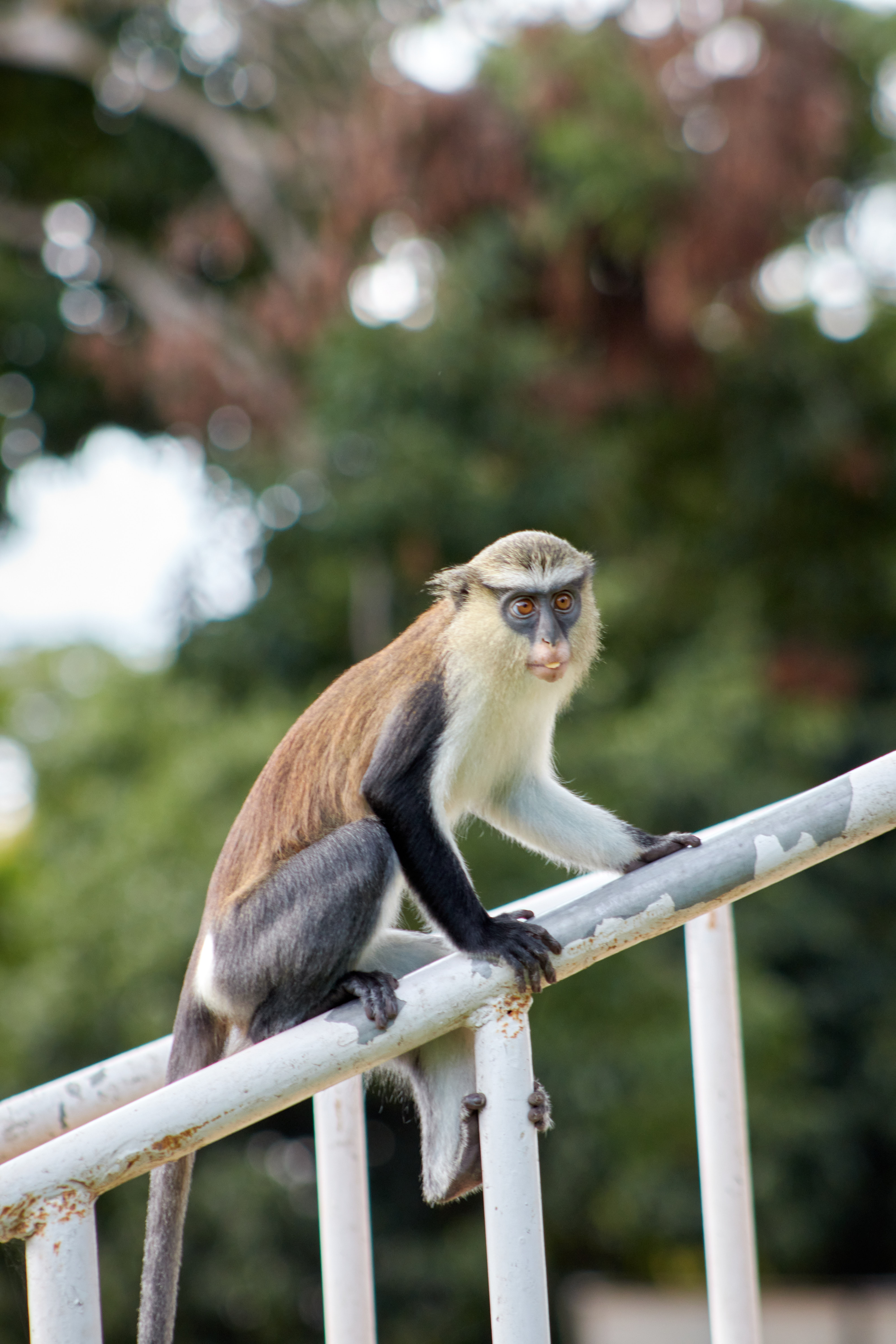
The star of Tafi Atome is the mona monkey (Cercopithecus mona), an agile and very striking medium-sized primate. It has brown fur with a pale belly, a dark face framed by yellowish cheeks, and two distinctive white patches on either side of the base of its tail. It is a tree-dwelling monkey that spends most of its time in the canopy, feeding on fruit, leaves, seeds and insects, and lives in family troops led by a dominant male.
The mona monkey is found in the forests of West Africa, but in many places hunting and habitat loss have wiped out much of its population. That makes protected, accessible populations like the one at Tafi Atome valuable for the conservation of the species, for science and for tourism. Seeing these monkeys up close, watching their social behaviour and how deftly they peel a banana, offers a window into the world of African primates.
At Tafi Atome the monkeys also play an important ecological role: by eating fruit and moving through the forest, they disperse seeds and help regenerate the woodland that shelters them. Protecting the monkeys therefore also means protecting the forest, and the birds and butterflies that share their habitat. The village, its beliefs and its monkeys form a single living fabric, in which nature and culture support each other.