Viajá con Gus
HomeUnited StatesMilwaukee
Milwaukee
🇺🇸 United States · Midwest and Great Lakes

Milwaukee

Jump to what you need
📌State
Wisconsin
📌Best time to go
Summer (June-September): ideal weather, festivals beside the lake and the Summerfest season. Winters are cold and snowy, with temperatures dropping below 0 °C
📌Suggested days
2 days
📌Currency
U.S. dollar (USD)
📌Language
English
📌Getting there
General Mitchell Airport (MKE), about 15 min from downtown. Milwaukee is 1,5 h from Chicago by car or train (Amtrak Hiawatha)
💱 USD exchange rate
Loading rate…
🌤️ Weather in Milwaukee
Loading weather…

Milwaukee, the largest city in Wisconsin, sits on the shore of Lake Michigan and is famous above all for its deep brewing tradition, the legacy of the many German immigrants who founded and populated it. Known as 'Brew City', it was home to great historic breweries such as Miller, Pabst and Schlitz, and keeps that culture alive with breweries you can visit. But the city is also a surprising center of art, festivals and life by the water.

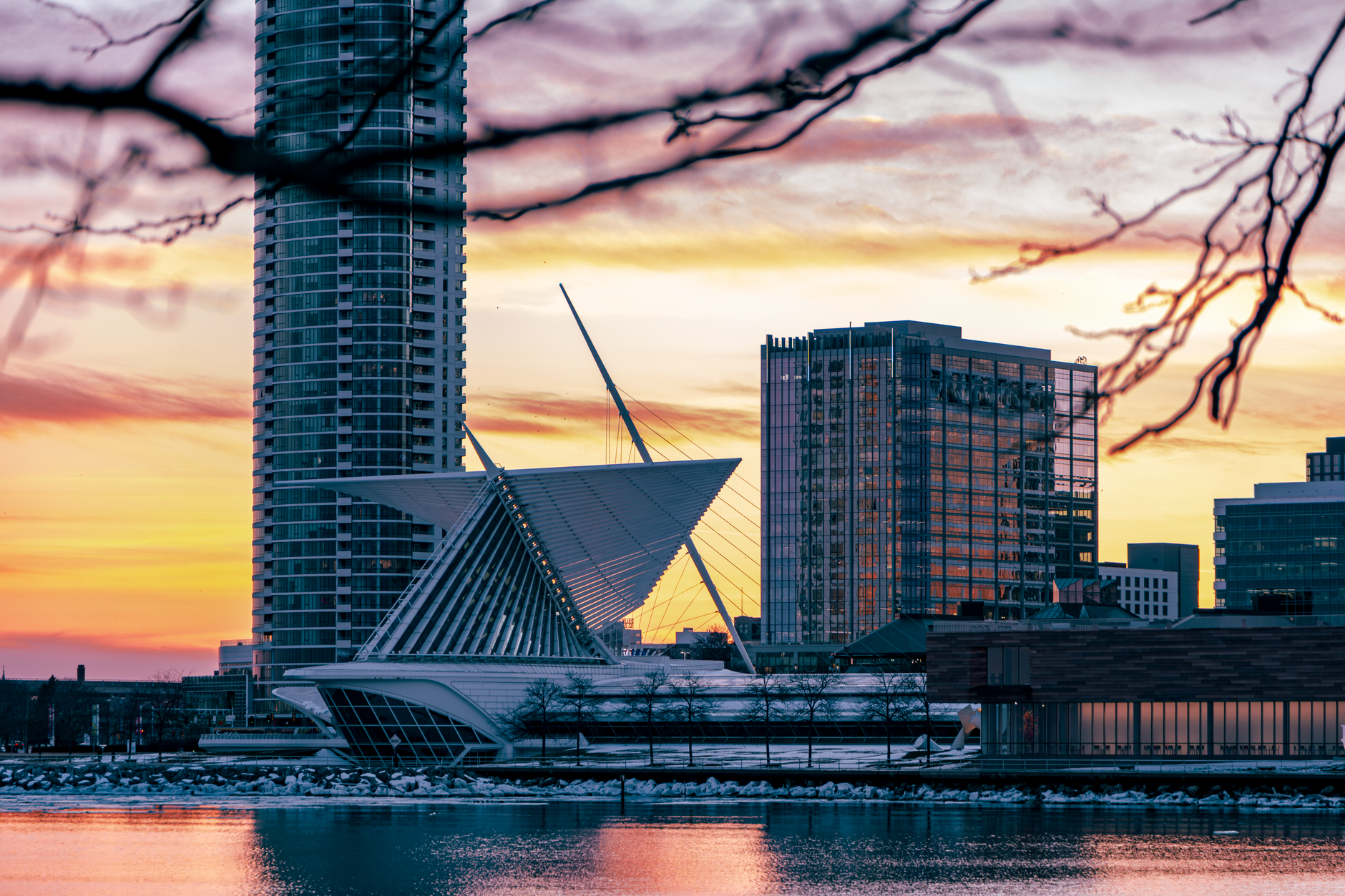
For the traveler, Milwaukee combines culture, festivals and a human-scale charm. Its great architectural icon is the Milwaukee Art Museum, with its spectacular Quadracci Pavilion designed by Santiago Calatrava, whose movable wings open and close like a bird beside the lake. In summer the city holds Summerfest, considered one of the biggest music festivals in the world, and a run of ethnic festivals in its lakefront park. Add to that the Harley-Davidson museum and factory, born here.

This guide covers the essentials of Milwaukee with a practical eye: the historic and craft breweries, Calatrava's dazzling art museum, the Harley-Davidson Museum, the Lake Michigan lakefront and its festivals, where to eat (from bratwurst to fish fry), and how to get around a friendly, compact and very enjoyable city, especially in summer.

📖 History of Milwaukee

Formally founded in 1846 through the merger of several settlements beside Lake Michigan, Milwaukee grew thanks to enormous German immigration that gave it its character and its famous brewing industry. By the end of the 19th century it had become an industrial and brewing powerhouse (Pabst, Schlitz, Miller), nicknamed 'Brew City'. It was also the birthplace of Harley-Davidson. Today it combines its industrial and brewing heritage with a vibrant cultural and festival scene.

Read the full history ↓

🏛️ Milwaukee is in Wisconsin

'America's Dairyland': land of the Ho-Chunk, Menominee and Ojibwe, of the French fur trade and lead mining, capital of cheese and beer, with Milwaukee on the shore of Lake Michigan and a strong German and Scandinavian heritage.

Read the history of Wisconsin →

🗺️ What to see

1
Milwaukee Art Museum (Calatrava pavilion)
A spectacular art museum with movable wings beside the lake, designed by Calatrava.
The Milwaukee Art Museum is the city's great architectural symbol and one of its essential visits. Its Quadracci Pavilion, designed by Spanish architect Santiago Calatrava and opened in 2001, is a sculptural work of white lines on the shore of Lake Michigan, crowned by the 'Burke Brise Soleil', a large movable sunscreen of 'wings' that open and close several times a day, like a giant bird, in a display that draws crowds. Inside, the museum holds a notable collection ranging from ancient to contemporary art, with outstanding folk and American art. The building itself, with its great glass gallery looking out over the lake, already justifies the visit.
ℹ️ Location: On the shore of Lake Michigan, next to downtown; on foot or with The Hop · Admission: US$ 27 adults; US$ 20 students, over-65s and military; free for under-12s; Thursdays from 4 to 8 p.m. 'pay what you wish'; closed Tuesdays (verified on the official site, August 2026) · Best time to go: The 'wings' of the Burke Brise Soleil open at the start of the day, at midday and at closing time (check the times) · Tips: Even if you do not go into the galleries, the display of the movable wings and the glass hall overlooking the lake are worth seeing
2
Milwaukee's breweries (Brew City)
The brewing capital of the U.S., with tours of historic and craft breweries.
Milwaukee is the quintessential 'Brew City', and touring its breweries is almost a rite. The tradition was brought by German immigrants in the 19th century, who founded giants such as Pabst, Schlitz and Miller. Today you can visit the Miller Brewing Company (Molson Coors), with tours of one of the largest breweries in the country and a tasting; the historic Pabst complex, converted into a district with a boutique brewery and events; and the pioneering Lakefront Brewery, one of the best-loved craft brewers, famous for its entertaining tours beside the river. Add to that dozens of microbreweries all over the city. The tours usually combine history, the brewing process and a tasting, in a festive atmosphere very typical of Milwaukee.
ℹ️ Location: Spread across the city (Miller Valley to the west, Pabst and Lakefront near downtown); car, Uber or The Hop depending which · Admission: Lakefront Brewery US$ 13 Monday to Thursday and US$ 16 Friday to Sunday (tasting and glass included); the Miller Brewery Tour site requires age verification and you have to check the current price there (verified on the official site, August 2026) · Requirement: Tasting only for those over 21 (bring ID) · Tips: Booking is advisable; the Lakefront tour beside the river is one of the most fun
3
Harley-Davidson Museum
The museum of the legendary motorcycle brand, born in Milwaukee.
Milwaukee is the birthplace of Harley-Davidson, the legendary motorcycle brand founded here in 1903, and its museum is a must for lovers of motorcycling and American culture. The Harley-Davidson Museum, in a modern complex on the banks of the Menomonee River, displays an enormous collection of motorcycles spanning the brand's entire history, from the earliest models of the early 20th century to the most recent and customized machines, along with engines, objects, advertising and the culture that surrounds the brand. It is a very well-staged tour that tells the story of an American industrial and cultural icon. It also has a shop, a restaurant and events for the biker community.
ℹ️ Location: On the banks of the Menomonee River, near downtown; by car, Uber or on foot from the Third Ward · Admission: US$ 24 adults online (US$ 26 at the box office); US$ 20 over-65s, students and military; US$ 8 children 5 to 17; under-5s free; audio guide extra (verified on the official site, August 2026) · Duration: 2 to 3 hours · Tips: Unmissable for motorcycling fans; it has a shop, a restaurant and biker community events
4
Lake Michigan lakefront and festivals
The lakefront park where Summerfest and the ethnic festivals are held.
The Lake Michigan lakefront is one of Milwaukee's great attractions, especially in summer. The waterfront has parks, beaches, promenades and Henry Maier Festival Park, known as the 'Summerfest grounds', home to some of the city's biggest festivals. Summerfest, held every summer, is considered one of the largest music festivals in the world, with hundreds of bands over several days on numerous stages. In addition, Milwaukee's celebrated ethnic festivals (German, Italian, Irish, Polish, Mexican and more) follow one another through the summer, celebrating the city's rich immigrant diversity with music, food and traditions.
ℹ️ Location: Facing downtown, on Lake Michigan (Henry Maier Festival Park); on foot or with The Hop · Admission: Lakefront free to access; for Summerfest check the year's price at store.summerfest.com, and look for the days with free or reduced admission in exchange for donations (verified on the official site, August 2026) · Best time to go: Summer; Summerfest in late June/early July; ethnic festivals throughout the summer · Tips: Take advantage of the cheap or free admission slots; combine it with a day on the lakefront and the beach
5
Historic Third Ward and Public Market
The historic warehouse district reborn, with its food market.
The Historic Third Ward is one of Milwaukee's most fashionable neighborhoods: a former area of late-19th-century warehouses and factories now converted into a district of art galleries, boutiques, restaurants, theaters and lofts, with a very photogenic industrial charm. Its heart is the Milwaukee Public Market, a lively covered food market where you can eat and buy just about anything: seafood, Wisconsin cheeses (the dairy state par excellence), cured meats, sweets, international food and artisan products. The neighborhood connects to the lakefront via the RiverWalk, a promenade along the Milwaukee River.
ℹ️ Location: Between downtown and the lakefront; on foot, connected by the RiverWalk and with a stop on The Hop · Admission: Neighborhood and market free to access (food and drink extra) (source: Milwaukee Public Market, verified July 2026) · Hours: Public Market open most days; check the hours · Tips: Try the Wisconsin cheeses and the cheese curds; walk the RiverWalk down to the lakefront
6
Milwaukee Public Museum
The city's great natural history and culture museum, with its celebrated dioramas.
The Milwaukee Public Museum is one of the best-loved natural history museums in the Midwest, famous for its immersive dioramas and for 'Streets of Old Milwaukee', a full-scale recreation of the city's streets in the early 20th century that lets you walk among period shops and houses. The museum covers anthropology, geology, zoology and world cultures, with sections devoted to Indigenous peoples, the rainforest and dinosaurs. It is an ideal visit for families and for winter days. The institution is building a new home that will open in the next few years, so it is worth checking the location and opening hours before you go.
ℹ️ Location: Downtown (new home under construction); on foot or with The Hop, check the current location · Admission: US$ 25 adults, US$ 21 over-65s and university students, US$ 19 children 4 to 13, free for under-3s; US$ 2 less for county residents (verified on the official site, August 2026) · Notice: The museum is building a new home opening in the next few years; check the location and hours before you go · Tips: 'Streets of Old Milwaukee' is unmissable; ideal for families and winter days
7
Mitchell Park Domes (The Domes)
Three dome-shaped conservatories with tropical, arid and show ecosystems.
The Mitchell Park Horticultural Conservatory, known as 'The Domes', is a set of three iconic glass domes from the 1960s housing themed gardens: a tropical dome with jungle and waterfall, a desert dome with cacti and arid plants, and a show dome that changes with the seasons and the holidays. They are a green refuge that is especially welcome in winter and an architectural landmark of the city. It is worth checking whether they are open, as the domes have had partial closures for maintenance in recent years.
ℹ️ Location: Mitchell Park, southwest of downtown; by car, Uber or MCTS bus · Admission: US$ 10 non-resident adults and US$ 9 county residents; US$ 6,50 students, veterans, people with disabilities and children 3 to 12; payment only at the door (verified on the official site, August 2026) · Notice: According to Milwaukee County Parks, it opens all year and closes only on Thanksgiving and Christmas; the floral dome closes for a few days between shows (verified on the official site, August 2026) · Tips: A very pleasant green refuge in winter; three domes (tropical, desert and show)
Advertisements
What nobody tells you

💵 Prices

Tickets

TypePrice
Milwaukee Art Museum (general admission)US$ 27 adults; US$ 20 students, over-65s and military; free for under-12s and Wisconsin school teachers. Every Thursday from 4 to 8 p.m. admission is 'pay what you wish'. The museum closes on Tuesdays (verified on the official site, August 2026)
Harley-Davidson Museum (general admission)Adults 18 to 64: US$ 24 online and US$ 26 at the box office; over-65s, students with ID and military US$ 20 online and US$ 22 at the box office; children 5 to 17 US$ 8 online and US$ 10 at the box office; under-5s free. It is worth buying online, which is cheaper (verified on the official site, August 2026)
Miller Brewery TourThe official site requires age verification to enter, so we could not read the price: check the current price at millerbrewerytour.com before you go
Lakefront Brewery TourUS$ 13 Monday to Thursday and US$ 16 Friday to Sunday, with tasting and souvenir glass included; under-12s do not pay but must be accompanied by a parent or legal guardian (verified on the official site, August 2026)
Summerfest (general admission per day)The organizer (Milwaukee World Festival, Inc., a non-profit) does not publish the price out of season: check the year's price at store.summerfest.com. Every year there are days with free or reduced admission in exchange for donating non-perishable food, hygiene items or books (verified on the official site, August 2026)
Milwaukee Public MuseumUS$ 25 adults 18 to 64; US$ 24 teens 14 to 17; US$ 21 over-65s, military and university students; US$ 19 children 4 to 13; free for under-3s. Milwaukee County residents get US$ 2 off with proof of address. It remains at 800 West Wells Street while the new home is built (verified on the official site, August 2026)
Mitchell Park DomesUS$ 10 non-resident adults 18 to 59 and US$ 9 Milwaukee County residents; US$ 6,50 resident over-60s, students, veterans and people with disabilities; US$ 6,50 children 3 to 12. Payment only at the door, there are no online sales. Open all year, closing only on Thanksgiving and Christmas (verified on the official site, August 2026)
Public Market and lakefrontFree (food and drink extra)
🔄 updated monthlyOfficial / reference values · double-check when buying

Activities and tours

ActivityPriceDurationOperator
Tour of historic and craft breweriesUS$ 10–20 per person depending on the brewery (Miller, Lakefront, Pabst)1–3 hThe breweries themselves (Molson Coors, Lakefront, Pabst)
Visit to the Harley-Davidson MuseumUS$ 24 adults buying online, US$ 26 at the box office; audio guide extra (verified on the official site, August 2026)2-3 hHarley-Davidson Museum (official)
Summerfest or an ethnic festival (summer)Check the year's price at store.summerfest.com; there are days with free or reduced admission in exchange for donations (verified on the official site, August 2026)Day / nightThe festivals themselves
Cruise or boat trip on Lake Michigan (in season)Approx. US$ 25–45 per person1-2 hMilwaukee Boat Line and local operators
Walk along the RiverWalk and the Third WardFree2-3 hOn your own
🔄 updated monthlyOfficial / reference values · double-check when buying
Advertisements

🚌 How to get there and distances

Getting around

ModePriceDurationNotes
The Hop (streetcar)FreeVariableA free streetcar running through downtown, connecting the station, the Third Ward and the lake
MCTS (bus)US$ 2,75 per ride; reduced fare US$ 1,25. With the WisGo card there is a spending cap: US$ 8,25 per day, US$ 33 per week and US$ 99 per month (the caps and transfers do not work if you pay cash on board) (verified on the official site, August 2026)VariableMilwaukee County's city bus network; fare-capping system
Rental carApprox. US$ 45–80 per day (2025), depending on season and categoryVariableUseful for the scattered breweries and for day trips (to Chicago or the lake, for example)
Uber / LyftUS$ 8–18 per trip within the city; approx. US$ 27 to the airportVariableConvenient for moving between attractions; very widely available
🔄 updated monthlyOfficial / reference values · double-check when buying

How to get there

RouteAirlines / operatorsAvg. priceDuration
Mitchell Airport (MKE) → downtownTaxi, Uber/Lyft, MCTS GreenLine bus, Amtrak trainTaxi/Uber approx. US$ 25–30; bus US$ 2,7515-20 min
Chicago → Milwaukee (train or car)Amtrak (Hiawatha), car, FlixBusHiawatha train approx. US$ 25–30 one way; FlixBus from US$ 15Train approx. 1,5 h; car approx. 1,5-2 h
Madison → Milwaukee (car or bus)Car, Badger BusBus approx. US$ 22–28 one wayApprox. 1,5 h
Minneapolis → Milwaukee (car or bus)Car, Megabus/FlixBusBus from approx. US$ 30–55 depending on how far ahead you bookApprox. 5,5 h by car
🔄 updated monthlyOfficial / reference values · double-check when buying

🏨 Where to stay

No exact prices: a scale from $ (budget) to $$$$$ (luxury), with 2-3 options per category.

CategoryPriceRecommended options
Luxury / boutique$$$$$US$ 200–350 a night; e.g. The Pfister Hotel (historic), Kimpton Journeyman Hotel, Saint Kate – The Arts Hotel
Mid-range / downtown chains$$$$$US$ 120–200 a night; chain hotels downtown and in the Third Ward (Hilton, Marriott, Hyatt Place)
Budget$$$$$US$ 70–120 a night; budget chains near the airport and on the outskirts (Holiday Inn Express, La Quinta)

🍴 Where to eat

TypePriceOptions / signature dish
Friday fish fry$$$$$US$ 12–22 a dish; a Wisconsin tradition: battered fish on Fridays, in local taverns and supper clubs
German cooking$$$$$US$ 15–30 a dish; Mader's, Old German Beer Hall; bratwurst, schnitzel and beer, the city's German heritage
Wisconsin cheeses and products$$$$$US$ 8–16 a portion; cheese curds, fried fresh cheese, at the Public Market and in restaurants
Custard and casual food$$$$$US$ 4–12; frozen custard is a local classic (Kopp's, Leon's); also burgers and festival food
Advertisements

📖 History of Milwaukee

Origins, formation and what the sources say.

Indigenous land and the founding beside the lake

The area where Milwaukee stands today, on the western shore of Lake Michigan, at the mouth of three rivers (the Milwaukee, the Menomonee and the Kinnickinnic), was for centuries the territory of Indigenous peoples such as the Potawatomi, Menominee and Ho-Chunk, who used it as a meeting and trading point. The name 'Milwaukee' itself derives from an Algonquian-language word usually translated as 'good land' or 'gathering place by the water'.

In the early 19th century came fur traders and the first settlers. The modern city was born from the merger, in 1846, of three rival settlements founded by different promoters (Juneautown, Kilbourntown and Walker's Point), which for a time competed and even fought over the bridges crossing the rivers. Unification gave rise to the city of Milwaukee, which soon began growing rapidly.

Its position beside Lake Michigan made it an important port and point of entry for immigrants and goods in the Great Lakes region. The city benefited from trade in wheat and other products from inland Wisconsin, laying the foundations for its transformation into a great industrial and commercial center through the 19th century.

The Germans and the beer capital

The feature that most deeply shaped Milwaukee's identity was the enormous German immigration of the 19th century. Drawn by the availability of land and work, tens of thousands of Germans settled in the city, to the point that for a long time Milwaukee was known as the most 'German' city in the United States, with their language, their newspapers, their cultural societies, their food and, above all, their brewing tradition present in everyday life.

German brewers founded the great companies that would make the city world famous: Pabst, Schlitz, Blatz and Miller, among others. By the end of the 19th century, Milwaukee had become the largest beer producer in the United States, earning the nickname 'Brew City'. The breweries were not only economic engines but also social centers, with their beer gardens and halls where the community gathered.

Milwaukee also industrialized in other sectors, such as machinery, metal products and heavy manufacturing. In 1903 another legendary brand was born in the city, Harley-Davidson, the motorcycle maker that would become an American cultural icon. German immigration was later joined by Poles, Italians, Irish and other groups, giving Milwaukee the ethnic diversity it still celebrates today in its famous summer festivals.

From industrial power to cultural city

For much of the 20th century, Milwaukee was a prosperous industrial, working-class city. It also had a singular political history: it was one of the few big cities in the United States to elect socialist mayors for decades, known as the 'sewer socialists' for their pragmatism in improving public services, infrastructure, parks and sanitation, which left the city a legacy of good administration and public spaces.

Like other cities in the industrial belt, Milwaukee suffered in the second half of the 20th century from deindustrialization, the loss of manufacturing jobs and suburbanization, as well as social and racial tensions. The brewing industry also consolidated: several of the historic brands closed or were absorbed, although Miller kept operating on a large scale and, more recently, a new generation of craft breweries has flourished.

In recent decades, Milwaukee has bet on revitalizing itself around culture, tourism and life beside the lake. Milestones such as the opening in 2001 of the spectacular Milwaukee Art Museum pavilion designed by Santiago Calatrava, the development of the lakefront and the RiverWalk, the conversion of industrial neighborhoods such as the Historic Third Ward, the success of festivals such as Summerfest and the Harley-Davidson Museum have redefined the image of the city, which today combines its proud brewing and industrial heritage with a vibrant cultural and festival scene.

Diversity, civil rights and the city today

Although German immigration defined its initial character, Milwaukee was also fed by waves of Poles, Italians, Irish, Greeks and other Europeans who left their mark on neighborhoods, churches and food. In the 20th century it also received significant African American migration from the American South during the Great Migration, drawn by industrial jobs, as well as Latino communities, above all Mexican and Puerto Rican, who concentrated on the South Side. It is that diversity that Milwaukee's famous summer ethnic festivals celebrate today.

In the 1960s, Milwaukee was the setting for a notable chapter of the civil rights movement. Between 1967 and 1968, activists led by Father James Groppi and the NAACP Youth Council staged 200 consecutive nights of marches for an open housing ordinance, confronting the residential segregation that affected the African American population. That pressure ultimately helped bring about laws against housing discrimination. The city, however, remains one of the most segregated metropolitan areas in the country, a legacy that marks much of its recent social history.

Since the late 20th century, Milwaukee has bet on reinventing itself around culture, tourism and life beside the lake. The opening in 2001 of the Milwaukee Art Museum's Calatrava pavilion, the development of the RiverWalk, the conversion of industrial neighborhoods such as the Historic Third Ward, the rise of festivals such as Summerfest and the opening of the Harley-Davidson Museum in 2008 redefined its image. Today the city combines its proud brewing and industrial heritage with a vibrant cultural, sporting (it is home to the NBA's Bucks, champions in 2021) and festival scene.

📚 Bibliography

  • Wikipedia (ES) — «Milwaukee»: https://es.wikipedia.org/wiki/Milwaukee
  • Wikipedia (EN) — «Milwaukee»: https://en.wikipedia.org/wiki/Milwaukee
  • Wikipedia (EN) — «History of Milwaukee»: https://en.wikipedia.org/wiki/History_of_Milwaukee
  • Wikipedia (EN) — «Sewer socialism»: https://en.wikipedia.org/wiki/Sewer_socialism
  • Visit Milwaukee (official): https://www.visitmilwaukee.org/
  • Milwaukee Art Museum (official): https://mam.org/

❓ Frequently asked questions

How many days should I spend in Milwaukee?+
Two days cover the main things: the Milwaukee Art Museum and the lakefront, one or two breweries, the Harley-Davidson Museum and the Historic Third Ward with its Public Market. In summer, if your visit coincides with Summerfest or an ethnic festival, you can add time to enjoy it.
Why is Milwaukee called 'Brew City'?+
For its deep brewing tradition, the legacy of the German immigrants who founded it. By the end of the 19th century it was the brewing capital of the U.S., home to giants such as Pabst, Schlitz and Miller. Today you can visit historic and craft breweries (Miller from about US$ 10, Lakefront US$ 13–16), with tours and tastings.
How much does it cost to get into the Milwaukee Art Museum?+
General admission is around US$ 22–25 (2025), and under-12s get in free. There are 'pay what you wish' slots in the afternoon. Even if you do not go into the galleries, the display of the movable 'wings' of the Calatrava pavilion, which open and close several times a day, is worth seeing. Check hours and prices when you visit.
What is Summerfest and how much does it cost?+
It is one of the largest music festivals in the world, held every summer on the Lake Michigan lakefront over several days, with hundreds of bands. General admission per day is around US$ 30 (2025), with cheaper deals (as low as US$ 5) in certain time slots and several ways to get in free. The city also hosts ethnic festivals (German, Italian, Polish, Mexican) through the summer.
When is the best time to visit Milwaukee?+
Summer (June to September) is the best time: pleasant weather, a busy lakefront and the festival season in full swing. Winter is cold and snowy, though the city still offers museums, breweries and a cozy atmosphere for anyone not put off by the cold.
Can it be combined with Chicago?+
Yes, very easily. Chicago is only an hour and a half away by car or on the Amtrak Hiawatha train (about US$ 25–30 one way), which makes Milwaukee an excellent one- or two-day escape from Chicago, or a complementary stop if you are touring the Great Lakes region.
Sources consulted (12)
Still planning?
Explore more destinations in United States
See all destinations →
Advertisements