Viajá con Gus
HomeUnited StatesDenali National Park
Denali National Park
🇺🇸 United States · Alaska

Denali National Park

Jump to what you need
📌Country
United States (state of Alaska). Denali National Park and Preserve sits in the interior of Alaska, halfway between Anchorage and Fairbanks. It protects more than 24.000 km² (some 6 million acres) of tundra, taiga, glaciers and mountains, dominated by Denali (formerly called Mount McKinley), 6.190 m high, the tallest mountain in North America. It is one of the continent's great wildlife sanctuaries.
📌Service town
The park entrance is on the Parks Highway (Route 3). Just outside it there is a cluster of tourist services known informally as 'Glitter Gulch' or the 'Canyon', with hotels, restaurants and operators. The reference towns are Healy (to the north) and, further away, Talkeetna (base for climbs of Denali), Cantwell (to the south), and the cities of Anchorage and Fairbanks as the big gateways.
📌Best time to go
From late May to mid-September is the operating season: the park buses run, services are open and wildlife is more active. Peak visitation is June-July. In late August and early September the tundra turns to fall colors (spectacular) and there is a better chance of seeing the mountain clear. In winter almost everything closes; you can only reach the first stretch of the park, for cross-country skiing, dog sledding and northern lights.
📌Getting there
By car along the Parks Highway from Anchorage (about 4-5 h) or Fairbanks (about 2 h), or on the scenic Alaska Railroad train, which stops at the park station. Inside the park, the only road (the Denali Park Road, 92 miles long) can only be traveled on the official park buses beyond mile 15 (Savage River); private cars cannot go further.
📌Language and currency
English. Currency: US dollar (US$). Alaska time zone (AKST/AKDT).
📌Suggested days
With 1 full day you can take a bus along the Park Road and do a short walk. Ideally 2 to 3 days, to combine a long bus trip (wildlife watching and, with luck, a clear Denali), trails, ranger talks and, if the budget allows, a scenic flight over the mountain.
💱 USD exchange rate
Loading rate…
🌤️ Weather in Denali National Park
Loading weather…

Denali National Park is wild Alaska in its purest form: six million acres of tundra, boreal forest, braided rivers and glaciers, presided over by Denali, the highest mountain in North America, rising 6.190 meters above the horizon. Its name, which means 'the high one' or 'the great one' in Athabascan, was officially restored in 2015, replacing the old 'Mount McKinley'. Seeing the summit clear is not guaranteed — it usually hides in the clouds — but when it appears, its sheer scale leaves you speechless.

What makes Denali unique is not only the mountain, but its philosophy. A single 92-mile road runs into the park, and beyond kilometer 24 private cars cannot drive: to go deeper you have to take the official buses. That system preserves the quiet and multiplies your chances of seeing wildlife from the window: grizzly bears, moose, caribou, Dall sheep and, with luck, wolves. Denali is one of the few places where you can watch the full set of the great subarctic mammals in their natural environment.

This guide organizes the visit with real data updated to 2026: the official NPS fee, how the buses work and what they cost (the key to getting around the park), what to see and do, where to sleep and eat, and when to go. One key planning fact: because of the work on the Pretty Rocks landslide, in the 2026 season the buses only go as far as mile 43 (East Fork River); full service to Eielson and Kantishna is expected for 2027. Denali demands planning — the buses are booked in advance — but it rewards you with one of the grandest nature experiences in the United States.

📖 History of Denali National Park

Denali and its surrounding lands are part of the ancestral territory of Athabascan peoples of interior Alaska, who hunted caribou and moose and gave the mountain its original name, 'Denali' ('the high one'). In 1896 a gold prospector renamed it 'McKinley' in honor of the then presidential candidate William McKinley, a name that would spark a long controversy. The naturalist Charles Sheldon campaigned to protect the area and its wildlife, and in 1917 Mount McKinley National Park was created, above all to shield the Dall sheep from hunting. In 1980 the Alaska lands act (ANILCA) hugely expanded the park and renamed it Denali National Park and Preserve. In 2015 the federal government officially restored the Indigenous name 'Denali' to the mountain. The full history is on our history page.

Read the full history ↓

🏛️ Denali National Park is in Alaska

The 'Last Frontier': the largest and wildest state in the country, land of the Iñupiat, Yup'ik, Aleuts and Tlingit, bought from Russia in 1867, forged by the gold rushes and by oil, crowned by Denali —the highest peak in North America—.

Read the history of Alaska →

🗺️ What to see

1
Denali (the mountain)
The highest summit in North America, 6.190 m. Because of its enormous rise above the surrounding terrain (one of the greatest 'reliefs' in the world) and its latitude, it generates its own weather and is usually shrouded in cloud. Seeing it clear is a memorable stroke of luck; several viewpoints in the area frame it on clear days.
2
Denali Park Road (on the official bus)
The park's only road, 92 miles (148 km) long, running deep into the wilderness. Beyond mile 15 (Savage River), only the park buses may drive it. The bus trip is the backbone of any visit: wildlife watching and landscapes that shift from forest to tundra.
3
Wildlife watching (Denali's 'Big Five')
From the bus you can see the five emblematic large mammals: grizzly bear, moose, caribou, Dall sheep and wolf. Also foxes, marmots and plenty of birdlife. Few places offer so many chances to see subarctic megafauna in the wild.
4
Savage River (mile 15, reachable by car)
The point private cars can reach (mile 15 of the Park Road). It has a loop trail along the river (Savage River Loop, easy and pretty), good views and often Dall sheep on the slopes. Ideal for anyone not taking the long bus.
5
Visitor center and Sled Dog Kennels
The Denali Visitor Center, near the entrance, introduces the park's history and ecology. Nearby are the official kennels: Denali is the only U.S. national park with working sled dogs, and in summer there are free demonstrations of the sled dogs in action.
6
Eielson Visitor Center (mile 66)
A visitor center built into the landscape, historically one of the best spots to contemplate Denali. IMPORTANT: in the 2026 season the buses do NOT reach Eielson: because of the work on the Pretty Rocks landslide, the route ends at the East Fork River (mile 43), and full service to Eielson, Wonder Lake and Kantishna is not expected back until 2027. Even so, the mile 0-43 stretch is spectacular and far less crowded than it used to be (verified July 2026).
7
Scenic flight / 'flightseeing' over Denali
Small planes and helicopters (mostly from Talkeetna, also from the park area) fly over the mountain and its glaciers, many with a glacier landing. Expensive but unforgettable; the best way to see Denali up close when the sky is overcast below.
8
Trails in the entrance area
Near the entrance there are several marked trails (Horseshoe Lake, Mount Healy Overlook, Triple Lakes, Savage River) for different levels, with forest, lakes and viewpoints. A good way to walk without depending on the long bus.
9
Talkeetna (base for the climbers)
A picturesque town south of the park, the historic base for expeditions climbing Denali and the departure point for the best scenic flights. Charming, with a bohemian air, good restaurants and views of the mountain.
10
Fall colors on the tundra
In late August and early September the park's tundra turns red, orange and gold, a display of color beneath the mountains, with fewer people and often better visibility of Denali. One of the most beautiful times to visit.
Advertisements
What nobody tells you

💵 Prices

Tickets

TypePrice
Park entrance (per person, 7 days)US$ 15 per person (valid 7 days; source: nps.gov, verified July 2026). Under 16, free
Denali Park annual passUS$ 45 (valid 12 months, covers up to 4 adults; source: nps.gov, verified July 2026)
'America the Beautiful' pass (all national parks)US$ 80 a year (access to all federal sites; source: nps.gov, verified July 2026). Free or discounted versions for seniors, military and fourth-grade students
Transit bus (non-narrated) — IMPORTANT: the entrance fee is NOT includedAdult US$ 33,50, under 16 free (source: reservedenali.com, verified July 2026). The fare does NOT include the US$ 15 park entrance fee, which is charged separately when you pick up the tickets at the Denali Bus Depot
Narrated tour bus (guided)From roughly US$ 100-130+ per adult depending on the tour (source: reservedenali.com, verified July 2026; on these tours the US$ 15 entrance fee is usually included)
Camping in the park (site per night)Roughly US$ 16-46 per site per night depending on the campground (source: nps.gov/recreation.gov, verified July 2026)
🔄 updated monthlyOfficial / reference values · double-check when buying

Activities and tours

ActivityPriceDurationOperator
Transit bus along the Park RoadAdult US$ 33,50 (plus the US$ 15 entrance fee); under 16 free (source: reservedenali.com, verified July 2026)4 to 8+ h depending on destinationOfficial park concessionaire (Doyon/Aramark, via reservedenali.com)
Narrated tour bus (Tundra Wilderness Tour, Natural History Tour)From roughly US$ 100-130+ per adult (source: reservedenali.com, verified July 2026)Half day to full dayOfficial park concessionaire
Sled dog demonstrationFree (included in the entrance fee; summer program)30-45 minNational Park Service (NPS)
Scenic flight over Denali (with/without glacier landing)From roughly US$ 250-500+ per person; more with a glacier landing (check)1-2 hAir taxi companies in Talkeetna and the park area (check)
Rafting on the Nenana RiverRoughly US$ 90-150 per person depending on the section (check)2-4 hRafting operators in the 'Canyon' (check)
Guided walks and ranger talksFree (included in the entrance fee; seasonal program)1-3 hNational Park Service (NPS)
🔄 updated monthlyOfficial / reference values · double-check when buying
Advertisements

🚌 How to get there and distances

Getting around

ModePriceDurationNotes
Park buses (transit and tour) — the key to the visitTransit adult US$ 33,50 + entrance fee; tours from US$ 100+ (source: reservedenali.com, verified July 2026)4 to 8+ hBeyond mile 15 of the Park Road, private cars may NOT drive: the only way to go deeper is on an official bus. The transits are 'hop-on/hop-off' (non-guided); the tours are guided. In 2026 they go as far as mile 43 (East Fork River). Book well in advance at reservedenali.com
Free shuttle in the entrance areaFreeVariableFree park buses connect the points in the entrance area (visitor center, kennels, campgrounds, train station) over the first few kilometers. No reservation needed
Private car (only as far as mile 15)Fuel only (plus the rental if applicable)VariableWith a car you can reach Savage River (mile 15) and explore the entrance area and its trails, but no further in. Useful for combining with walks and for getting around the hotel area
Hotel and operator shuttles (Canyon area)Usually free for guests (check)VariableThe hotels in the entrance area offer transfers to the train station, the visitor center and the restaurants
🔄 updated monthlyOfficial / reference values · double-check when buying

How to get there

RouteAirlines / operatorsAvg. priceDuration
Anchorage → Denali (park entrance)Car along the Parks Highway (Route 3) or Alaska RailroadTrain from US$ 150-250+ per person (check); by car, fuel only4 to 5 h
Fairbanks → DenaliCar along the Parks Highway or Alaska RailroadTrain from US$ 80-160+ per person (check); by car, fuel onlyAbout 2 to 2,5 h
Alaska Railroad scenic train (Denali Star)Alaska RailroadDepends on origin and class (Adventure or GoldStar); checkAnchorage-Denali about 7-8 scenic h; Fairbanks-Denali about 4 h
Park station → hotels and visitor centerHotel shuttles and free park busesFree or included (check)A few minutes
🔄 updated monthlyOfficial / reference values · double-check when buying

🏨 Where to stay

No exact prices: a scale from $ (budget) to $$$$$ (luxury), with 2-3 options per category.

CategoryPriceRecommended options
Remote lodges inside the park (backcountry)$$$$$US$ 600-1.000+ per person/night, all-inclusive with transfers. Lodges in the Kantishna area, at the end of the Park Road, reachable only by bus or small plane; a total, exclusive nature experience (subject to the state of the road)
Upmarket hotels in the entrance area$$$$$US$ 280-500+ a night in high season. Large lodges run by tourism chains in the 'Canyon' next to the entrance, with restaurants, river views and transfers; geared to cruise-train packages
Mid-range hotels and cabins (Healy and around)$$$$$Roughly US$ 150-280 a night in summer. Mid-range hotels and cabins in Healy and nearby, cheaper than those in the Canyon and well placed for the park
NPS campgrounds and hostels$$$$$Camping US$ 16-46 per site/night (source: nps.gov, verified July 2026); hostels and budget options from roughly US$ 40-110. Campgrounds such as Riley Creek, Savage River and Teklanika; some by reservation on Recreation.gov

🍴 Where to eat

TypePriceOptions / signature dish
Restaurants at the Canyon lodges$$$$$US$ 25-50 per dish. Dining rooms at the big hotels by the entrance, with Alaskan cooking (salmon, halibut, meats), local beers and views; tourist prices
Pubs, grills and casual food$$$$$US$ 14-30 per dish. Restaurants and brewpubs in the entrance area and in Healy, with burgers, pizza, fish and chips and Alaskan craft beer; relaxed atmosphere
Cafés and bakeries$$$$$US$ 6-18. Coffee shops and food trucks for breakfast, coffee and snacks before catching the bus; in Talkeetna there are charming bakeries and cafés
Supplies for the day (self-catering)$$$$$US$ 5-15. Since the long buses do not serve food (you have to bring water and a packed lunch), it is worth buying supplies at the stores in the entrance area or in Healy before heading into the park
Advertisements

📖 History of Denali National Park

Origins, formation and what the sources say.

Geology: how the highest mountain in North America was born

Measured from base to summit, Denali is taller than Everest. It sounds impossible, but it is true: while Everest rises from an already elevated Tibetan plateau, Denali shoots up some 5.500 meters from the lowlands around it, one of the greatest base-to-summit vertical differences on the planet. At 6.190 meters of absolute altitude it is also the highest mountain in North America, and its story — geological, human and even political — is as monumental as its silhouette.

The mountain is part of the Alaska Range, a curving chain that was pushed up (and is still rising) by the tectonic pressure between the Pacific plate and the North American plate, associated with the great Denali fault. Denali is formed in large part by an enormous granite batholith, a mass of igneous rock that solidified at depth and, being more resistant to erosion, was left standing out as the terrain rose and glaciers carved out the surroundings. The region remains seismically active.

Glaciers shape the landscape continuously: enormous rivers of ice descend from the massif, such as the Kahiltna Glacier (the longest in the Alaska Range, the usual route for climbers) and the Muldrow. The combination of extreme altitude and subarctic latitude gives Denali one of the harshest mountain climates in the world, with brutal temperatures and winds at its summit.

nps.gov · Geologyen.wikipedia.org · Denali

The Athabascans and the name 'Denali'

Denali and the lands that today make up the park are part of the ancestral territory of Athabascan peoples of interior Alaska, in particular the Koyukon and other Dene groups. For thousands of years they lived on these lands following the caribou migrations, hunting moose and drawing on the resources of the rivers and forests, in a semi-nomadic way of life adapted to the harsh subarctic climate.

They were the ones who gave the mountain its original name. In the Koyukon language, 'Deenaalee' (Denali) means something like 'the high one' or 'the great one', a name loaded with respect for the mountain that dominates their landscape. For the Athabascans, Denali holds a central place in their cultural and spiritual geography.

That Indigenous name, alive for centuries, was displaced by 'McKinley' in the late nineteenth century, which gave rise to a long dispute that was only settled in the twenty-first century with the official restoration of 'Denali'. Today the park works closely with Native communities to recognize and preserve their heritage and their knowledge of these lands.

nps.gov · Indexen.wikipedia.org · Denali

The dispute over the name: from McKinley to Denali

In 1896 a gold prospector named William Dickey, on returning from the area, christened the mountain 'Mount McKinley' in honor of William McKinley, then a candidate (and later president) of the United States, who defended the gold standard. The name caught on and became official, even though McKinley never had any connection with Alaska and never even saw the mountain.

Throughout the twentieth century the name was a source of controversy. Alaskans, and especially Indigenous peoples, laid claim to the ancestral name 'Denali'. In 1975 the state of Alaska formally asked the federal government to restore the Indigenous name, but the request was blocked for decades by the opposition of legislators from the state of Ohio (McKinley's home state).

The controversy was finally resolved in 2015, when the United States Department of the Interior officially announced that the mountain would again be called 'Denali', recognizing the name the Athabascans had given it for thousands of years. It is worth noting that the park had already been called 'Denali' since 1980; what changed in 2015 was the official name of the mountain itself.

en.wikipedia.org · Denalinps.gov · Index

Charles Sheldon, the creation of the park and the mountaineering era

In the early twentieth century the naturalist and sport hunter Charles Sheldon spent long seasons in the region studying the Dall sheep and, alarmed by the commercial hunting that threatened the wildlife, led a campaign to protect the area. His efforts bore fruit in 1917, when Mount McKinley National Park was created, conceived largely as a wildlife refuge rather than as a sanctuary for the mountain itself (which at first lay partly outside the park boundaries).

The mountain also drew climbers. The first ascent of Denali's main summit was achieved in 1913, led by Hudson Stuck and Walter Harper — the latter, of Athabascan descent, was the first to set foot on the top. Since then Denali has become one of the great challenges of world mountaineering: every year hundreds of climbers attempt its summit, most by the Kahiltna Glacier route, setting out from Talkeetna. Its extreme weather makes it a serious and dangerous mountain despite its 'modest' altitude compared with those of the Himalaya.

In 1980 the historic Alaska National Interest Lands Conservation Act (ANILCA) hugely expanded the park, taking in the mountain in its entirety and vast stretches of land, and renamed it Denali National Park and Preserve.

nps.gov · Indexen.wikipedia.org · Denali National Park and Preserve

The park today: wildlife, buses and challenges

Today Denali National Park and Preserve receives around half a million visitors a year, drawn by the combination of the continent's highest mountain and one of the best places in North America to watch wildlife. Its management model is distinctive: a single road runs into the park, and access beyond km 24 is reserved for the official buses, a system designed to minimize human impact and preserve the animals' natural behavior.

Thanks to that approach, Denali protects an almost intact subarctic ecosystem, with healthy populations of grizzly bears, wolves, caribou, moose and Dall sheep, and it is also a pioneering park in long-term research on these species. It is likewise the only national park in the U.S. that keeps a working sled dog team, used to patrol the park in winter.

The current challenges are significant. Climate change is hitting interior Alaska hard: the thawing of the permafrost caused, in recent years, a major landslide at a spot called Pretty Rocks, which cut the Park Road and kept the buses from reaching the end while a bypass bridge is built. On top of that come managing the growing flow of tourists and conserving the wildlife. Denali remains a symbol of Alaska's wilderness and a world-class adventure destination.

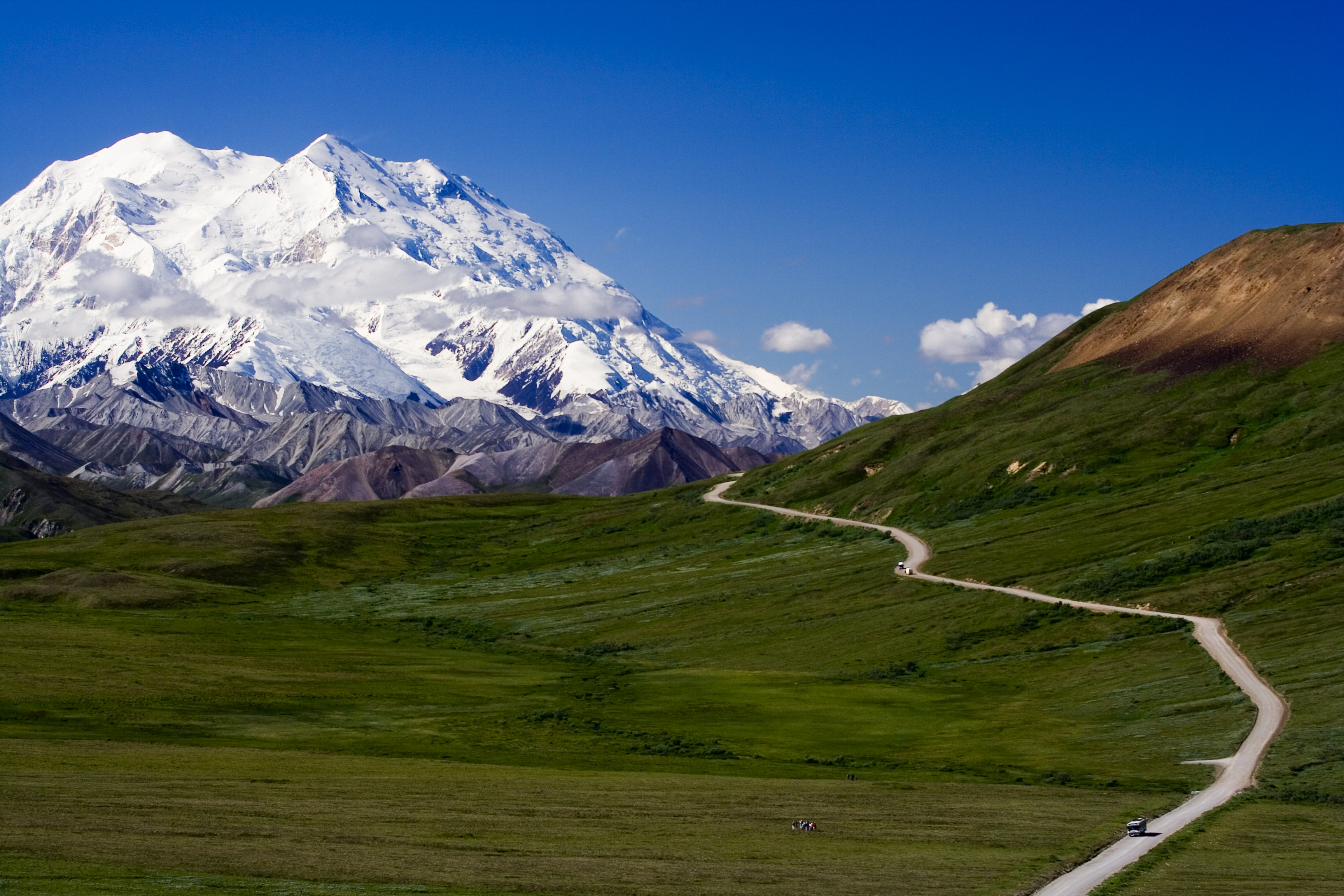
nps.gov · Indexnps.gov · Denali park road

📚 Bibliography

  • National Park Service — Denali National Park & Preserve (official site) — https://www.nps.gov/dena/index.htm
  • National Park Service — Denali, History & Culture — https://www.nps.gov/dena/learn/historyculture/index.htm
  • National Park Service — Denali Geology — https://www.nps.gov/dena/learn/nature/geology.htm
  • National Park Service — Denali Park Road status — https://www.nps.gov/dena/planyourvisit/denali-park-road.htm
  • National Park Service — Fees & Passes (Denali) — https://www.nps.gov/dena/planyourvisit/fees.htm
  • Reserve Denali — Transit & Tour Buses — https://www.reservedenali.com/tours-transits/
  • Wikipedia — Denali — https://en.wikipedia.org/wiki/Denali
  • Wikipedia — Denali National Park and Preserve — https://en.wikipedia.org/wiki/Denali_National_Park_and_Preserve
  • Wikipedia — Alaska National Interest Lands Conservation Act (ANILCA) — https://en.wikipedia.org/wiki/Alaska_National_Interest_Lands_Conservation_Act
  • Encyclopedia Britannica — Denali National Park and Preserve — https://www.britannica.com/place/Denali-National-Park-and-Preserve

❓ Frequently asked questions

How much does it cost to enter Denali National Park?+
The official NPS entrance fee is US$ 15 per person, valid 7 days; under 16s enter free. The park annual pass costs US$ 45 (covers up to 4 adults) and the 'America the Beautiful' pass (all parks) US$ 80. Important: the entrance fee is paid separately from the transit bus ticket (it is not included in that fare) and is charged when you pick up the tickets at the Denali Bus Depot; if you hold a valid national parks pass, you are exempt (verified July 2026).
Why can't I drive around the park in my own car?+
To preserve the wilderness and the wildlife, private cars may only drive the Park Road as far as mile 15 (Savage River). Further in, the only way to go on is on the official park buses (transit or tour). That is why the buses are the key to the visit and worth booking in advance.
What is the difference between the 'transit' bus and the 'tour' bus?+
The transit is a non-guided, 'hop-on/hop-off' style bus, cheaper (adult from roughly US$ 33,50, plus the US$ 15 entrance fee); ideal for hikers who get off and on wherever they like. The tour is guided, with a naturalist narrating the route, more expensive (from US$ 100-130+), and the entrance fee is usually included. Both are booked at reservedenali.com / Recreation.gov.
Will I get to see Denali, the mountain?+
It is not guaranteed. Because of its height and latitude, Denali generates its own weather and stays covered in cloud much of the time; only a share of visitors is estimated to see it fully clear. You improve your chances by going in late August/September, staying several days or taking a scenic flight that climbs above the clouds.
How far does the park road go in 2026?+
The Park Road is 92 miles long, but since the Pretty Rocks landslide (2021) it has been cut in the Polychrome area while a new bridge is built. In the 2026 season the transit buses leave from the Wilderness Access Center and go as far as the East Fork River, at mile 43; the new bridge opens in mid-summer 2026, but full service to Eielson (mile 66), Wonder Lake and Kantishna is not expected back until 2027. The stretch to mile 43 is magnificent all the same for wildlife and scenery. Always check conditions on the NPS website before traveling (verified July 2026).
Sources consulted (6)
Still planning?
Explore more destinations in United States
See all destinations →
Advertisements
Image credits
Photos from Wikimedia Commons, each under its own licence (CC BY, CC BY-SA or public domain). Open each file to see its author and licence.
Mount McKinley Alaska