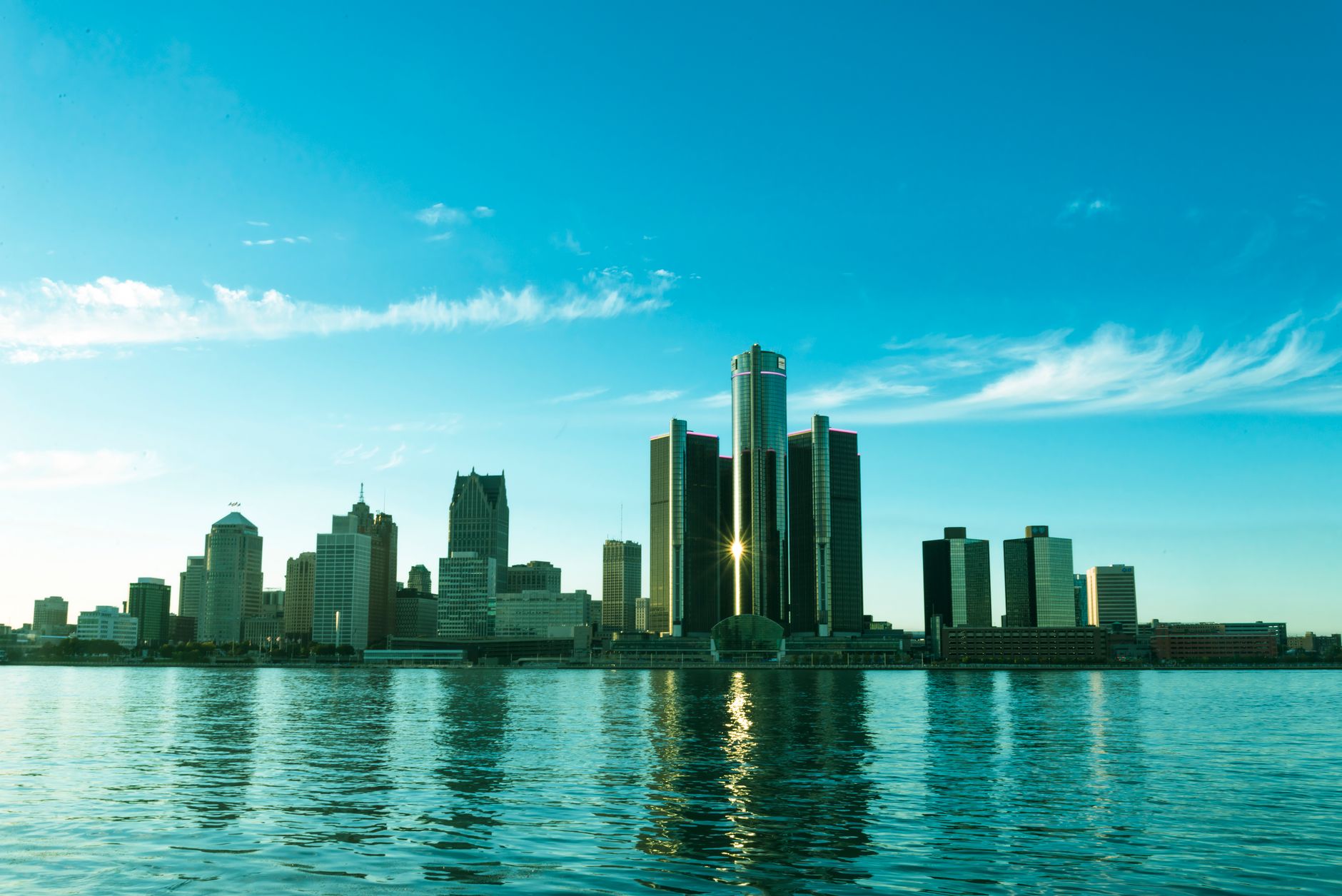
Detroit, the largest city in Michigan, is the cradle of the automobile and of the Motown sound, and one of the most fascinating stories of boom, collapse and rebirth in the United States. It was the industrial heart of the country, the 'Motor City' where Ford, General Motors and Chrysler built an empire, and where a record label was born that changed popular music around the world. After decades of decline and a headline-making bankruptcy in 2013, Detroit today is going through a remarkable reinvention, with revived neighborhoods, a bubbling cultural scene and a resilient pride.
For travelers, Detroit offers a powerful mix of industrial history, music and art. The giant Henry Ford museum complex, in neighboring Dearborn, is one of the best American history museums in the country; the Detroit Institute of Arts holds one of the great painting collections in the U.S.; and the small museum at Hitsville U.S.A., the house where Motown was born, moves any music lover. Add to that the renewed downtown by the river, the Eastern Market and the creative atmosphere of neighborhoods in full transformation.
This guide covers the essentials of Detroit with a practical eye: the unmissable museums, the Motown legacy, the waterfront along the Detroit River and neighboring Canada, the murals and street art, where to eat and feel the pulse of a city reinventing itself, and how to get around a sprawling city built for the car but with an increasingly walkable downtown.
Founded in 1701 by the Frenchman Antoine de la Mothe Cadillac as a fur trading post on the banks of the Detroit River (the 'détroit', French for strait), the city grew until in the twentieth century it became the automobile capital of the world, home to Ford, GM and Chrysler, and later the cradle of the Motown label. The decline of industry and population led to municipal bankruptcy in 2013, after which the city began a vigorous recovery. The full history is on our history page.
Read the full history ↓The state of the Great Lakes and the automobile: Ojibwe and Ottawa land, cradle of Detroit and of Ford, split into two peninsulas of forests, lighthouses and fresh water, with historic Mackinac Island.
Read the history of Michigan →If you book from here we earn a commission and you pay no more. Prices and availability come from Civitatis.
No exact prices: a scale from $ (budget) to $$$$$ (luxury), with 2-3 options per category.
Origins, formation and what the sources say.
Detroit was founded on July 24, 1701 by the French explorer and officer Antoine de la Mothe Cadillac, who established a fort and fur trading post called Fort Pontchartrain du Détroit, on the banks of the river that connects Lake Saint Clair and Lake Erie. The name comes from the French 'détroit', meaning 'strait', in reference to the river channel that joins the Great Lakes at this point, a strategic location for trade and for control of the territory.
The area was inhabited by Indigenous peoples, and the French post became an important center of the fur trade in the Great Lakes region. After the colonial wars, Detroit passed into British hands in 1760 and finally to the United States after independence, though the British did not hand it over until 1796. A great fire destroyed almost the entire city in 1805, after which it was rebuilt on a radial plan inspired by that of Washington D.C.
Through the nineteenth century, Detroit grew as a port and industrial city thanks to its position on the Great Lakes, with shipyards, foundries, and factories making stoves, carriages and assorted goods. That industrial and engineering base would set the conditions for the revolution that made it famous in the following century: the automobile.
At the start of the twentieth century, Detroit became the world epicenter of the emerging automobile industry. Here Henry Ford founded the Ford Motor Company in 1903 and, above all, perfected the moving assembly line at his Highland Park plant around 1913, an innovation that radically cut the cost of making cars (the famous Model T) and revolutionized industrial production worldwide. Ford also introduced the five-dollar-a-day wage, which drew workers from all over the country.
Around Ford, the other two great automakers emerged or consolidated: General Motors and Chrysler, forming the 'Big Three' that dominated the sector. Detroit became the 'Motor City', a magnet for millions of workers. Among them, during the Great Migration, hundreds of thousands of African Americans arrived from the South looking for factory jobs, transforming the makeup of the city. The population peaked around 1950 at close to 1,8 million inhabitants, making it the fourth largest city in the country.
That industrial prosperity also fertilized culture: in 1959 Berry Gordy founded the Motown Records label in Detroit, which took African American music to a mass audience worldwide and became one of the city's great cultural symbols, alongside its automotive might.
From the middle of the twentieth century, Detroit entered a long and painful decline. Automation, the relocation of industry, foreign competition and suburbanization (with people and companies fleeing to the outskirts) progressively emptied the city. Racial tensions exploded in the serious riots of 1967, which accelerated the outflow of residents. Over the following decades, Detroit lost more than half its population, leaving behind depopulated neighborhoods, closed factories and thousands of abandoned buildings, a symbol of the decline of the American industrial belt (the 'Rust Belt').
The lowest point came in 2013, when Detroit declared bankruptcy (municipal insolvency), the largest in the history of an American city, with debts of billions of dollars. During the process there was even fear that the Detroit Institute of Arts collection would have to be sold to pay creditors, but a historic agreement (the 'grand bargain') managed to save it.
After emerging from bankruptcy in 2014, Detroit has led a remarkable reinvention. Public and private investment has revitalized downtown and neighborhoods such as Midtown and Corktown, with new shops, restaurants, hotels, the QLINE streetcar and an award-winning riverside promenade (the RiverWalk). Street art, food and entrepreneurship are flourishing, against a backdrop of pride and resilience. Detroit still faces major challenges, but today it is one of the most talked-about urban recovery stories in the country.
If anything matches the auto industry for fame in Detroit's history, it is its music. In 1959, with a family loan of 800 dollars, Berry Gordy founded Motown Records in a modest house on Grand Boulevard that he named 'Hitsville U.S.A.'. From its legendary Studio A, and with a staff of songwriters, producers and session musicians (the Funk Brothers) who worked like an assembly line — hence the name Motown, a contraction of 'Motor Town' — the label produced an astonishing number of hits. Diana Ross & The Supremes, Stevie Wonder, Marvin Gaye, The Temptations, Smokey Robinson & The Miracles, Martha and the Vandellas and The Jackson 5 took African American soul and pop to number one and to a mass audience, breaking down racial barriers in the middle of the civil rights era.
Motown moved its headquarters to Los Angeles in 1972, but Detroit's musical legacy kept growing. The city produced figures of rock and punk (MC5, Iggy Pop and The Stooges), of hip hop (Eminem, J Dilla) and, above all, it was the cradle of techno: in the mid-1980s a group of young men from the suburbs (the 'Belleville Three': Juan Atkins, Derrick May and Kevin Saunderson) created a new genre of electronic music that would become a worldwide phenomenon. Today Detroit celebrates that heritage every year at the Movement electronic music festival.
Music is, along with the automobile and sport — with historic teams in the four major leagues — one of the pillars of Detroit's identity and of that resilient pride that characterizes the city and today fuels its cultural rebirth.
At the darkest moment of the 2013 bankruptcy, Detroit faced an unthinkable decision: to pay its creditors, there was talk of selling part of the collection of the Detroit Institute of Arts (DIA), one of the great museums of the United States. Its holdings included works by Van Gogh, Rembrandt, Bruegel and Matisse, as well as the celebrated Detroit Industry Murals that Diego Rivera painted in 1932-1933 as a tribute to the automakers' workers. An auction house went so far as to value the collection at several billion dollars, and creditors were pushing to liquidate it.
The solution was an agreement as creative as it was moving, known as the 'Grand Bargain'. A group of national and local philanthropic foundations, the state of Michigan and the DIA itself put together some 816 million dollars for two purposes: to protect the museum's collection forever — it passed to an independent trust and was shielded from any future city debt — and, above all, to cushion the cuts to the pensions of thousands of municipal retirees. Art and pensions were saved together, in a single move.
The Grand Bargain became a symbol of what Detroit stands for: a city that, even in ruin, decided that its cultural heritage and its people were worth more than its debt. Today, when a visitor stands in front of the Rivera murals at the DIA, they are looking not only at a masterpiece of muralism, but at the emblem of a city that refused to auction off its soul to settle its accounts.