Isla Española is the southernmost island in the Galápagos archipelago and one of the oldest, which makes it an exceptional wildlife sanctuary. It's famous worldwide as the only nesting site of the Galápagos albatross (waved albatross), a majestic seabird that returns here every year to breed. Watching them glide over the cliffs and perform their elaborate courtship is one of the great experiences of the archipelago.
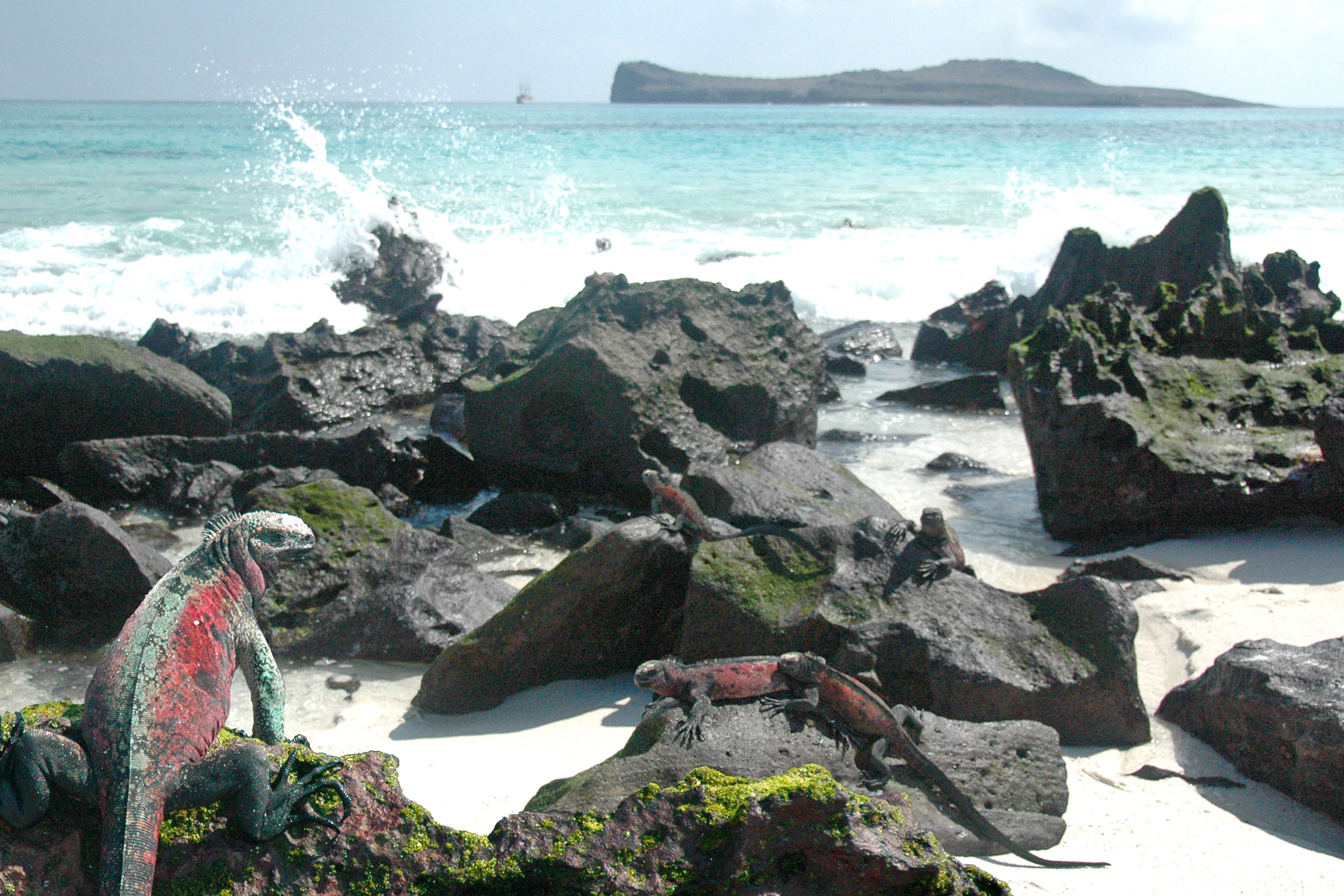
But Española is much more: it holds colonies of blue-footed and Nazca boobies, marine iguanas in bright reddish and greenish colors (unique to this island), sea lions, the famous soplador (a marine geyser that shoots water through a crack) and the beautiful white-sand beach of Gardner Bay, one of the best spots in the archipelago for snorkeling and relaxing. Its two visitor sites, Punta Suárez and Gardner Bay, concentrate an astonishing wealth of life.
This guide covers Española with a practical eye: how to get there (on a day trip or a cruise), what to see at Punta Suárez and Gardner Bay, the best time for the albatross and the National Park rules. It's an essential destination for anyone who loves birds and wildlife, one of the natural jewels of the Galápagos.
Isla Española is one of the oldest islands in the Galápagos, low-lying and eroded, and the furthest to the southeast of the archipelago. Its name honors Spain. World famous as the only nesting area of the Galápagos albatross, it was also the setting for one of conservation's great successes: the recovery of the Española giant tortoise, saved from extinction thanks to a captive breeding program. The full story is on our history page.
Read the full history ↓The enchanted archipelago of the Pacific: a living laboratory of evolution that inspired Charles Darwin, the first Natural World Heritage Site of Unesco (1978) and a National Park since 1959, home to giant tortoises, marine iguanas and blue-footed boobies.
Read the history of Galápagos →If you only have one day, take a guided tour on the first one: it sets up the rest of your trip and saves you a lot of walking. We look ours up on Civitatis: guided in Spanish and booked online with no fuss. They have 13 activities in Santa Cruz. Three are below so you get the idea: tap any of them and they all open.
They depart from Santa Cruz, 100 km away. If you book from this link we earn a commission and you pay no more.
No exact prices: a scale from $ (budget) to $$$$$ (luxury), with 2-3 options per category.
Origins, formation and what the sources say.
In 1976, when scientists combed Española looking for giant tortoises, they found only two males and twelve females scattered across an island stripped bare by goats. The species was, to all intents and purposes, doomed. Half a century later more than two thousand tortoises walk its parched slopes again, and Española has become the world's symbol that an extinction can be reversed. That story of resurrection runs beneath every visit to the southernmost island in the Galápagos.
Isla Española is one of the oldest islands in the Galápagos archipelago and the southernmost, out at the far southeast, away from the central islands. Because of its geological age —it's estimated to be several million years old— volcanic activity ceased long ago and the island has been shaped by erosion: hence its low, flattened, worn relief, very different from the young, rugged look of islands like Bartolomé or Fernandina.
That long existence and its isolation have allowed forms of life to evolve on Española that are endemic to the island. That's the case with its marine iguana, whose coloring is especially striking (with reddish and greenish tones, above all in the breeding season), and with several species and subspecies adapted to this environment. Its name pays tribute to Spain; in English it's also known as Hood Island, after a British viscount.
Uninhabited and protected, Española is today one of the great wildlife sanctuaries of the archipelago, with two visitor sites —Punta Suárez and Gardner Bay— that rank among the most spectacular in the Galápagos.
Española's greatest claim to fame is being the only nesting site of the Galápagos albatross, also called the waved albatross. This huge seabird, with a wingspan of over two meters, spends much of the year crossing the eastern Pacific, but every year it returns to Española to breed, gathering on its cliffs roughly between April and December.
Its courtship display is one of the most celebrated in the natural world: pairs perform an elaborate 'dance' in which they clack their beaks together, sway their heads and make characteristic sounds, a ritual that reinforces the pair bond. To take off, albatrosses use the cliffs and the wind, launching themselves out over the sea.
Because the species depends almost entirely on this one island, conserving Española is critical to its survival; it's considered threatened. The National Park's strict control over visitors, trails and seasons is meant to ensure the colonies can breed undisturbed, preserving one of the most singular natural phenomena in the Galápagos.
Española is also at the center of one of the most famous conservation stories in the world. The island's endemic giant tortoise came to the edge of extinction: by the middle of the 20th century only a handful of individuals were left, decimated by historical whaler exploitation and by introduced goats, which devastated the vegetation.
In the 1960s and 1970s the few survivors —a few females and a few males— were taken into a captive breeding program at the Charles Darwin Research Station on Santa Cruz. One male in particular, known as 'Diego', brought back from a zoo in the United States where he had lived for decades, turned out to be an extraordinarily prolific breeder and father of a good share of the new generations.
Over the decades, juveniles raised in captivity were returned to Española, and the vegetation recovered once the goats were eradicated. The program was a resounding success: the Española tortoise population recovered to the point that the breeding program was declared complete and the breeding animals, Diego included, were returned to their home island. It's one of the great conservation triumphs in the Galápagos and worldwide.
Like the rest of the archipelago, Española became known to Europeans after the accidental 'discovery' of the Galápagos in 1535, when the ship of the bishop of Panama, fray Tomás de Berlanga, was carried by the currents to the islands. Over the following centuries the islands appeared on nautical charts under Spanish and English names: Española was called Hood Island in English, after the British viscount Samuel Hood, while the Spanish place name honors the mother country.
Between the 17th and 19th centuries the Galápagos were a refuge for pirates and, above all, the scene of intensive hunting of whales and giant tortoises, which whalers took on board alive as a store of fresh meat. Española, with its tortoise population, was hit especially hard by that exploitation, which together with the introduced goats brought its endemic species to the brink of extinction. In 1835, during the famous voyage of HMS Beagle, Charles Darwin visited the Galápagos —though he did not land on Española— and his observations of the archipelago proved decisive for his theory of evolution by natural selection.
In 1959 Ecuador declared 97% of the archipelago's land area the Galápagos National Park, and in 1978 UNESCO placed the islands on the first World Heritage list. Española therefore came under strict protection: uninhabited, with no accommodation and with access restricted to two visitor sites (Punta Suárez and Gardner Bay), which can only be walked with authorized naturalist guides, in limited groups and along marked trails. That rigorous management, together with the success of the giant tortoise recovery program and the eradication of the goats, has allowed the island to keep one of the best-preserved island ecosystems in the world and to remain the only sanctuary of the Galápagos albatross.
Few places on the planet pack so much endemic life into so little ground as the two visitor sites of Española. Its long isolation at the far end of the archipelago worked like a closed evolutionary experiment: with no land predators and no contact with the other islands, its inhabitants developed traits that exist nowhere else in the world. The most striking example is its marine iguana, the only one in the archipelago that turns crimson red and emerald green in the breeding season, which has earned it the nickname 'Christmas iguana'. Like all Galápagos marine iguanas —the only lizards in the world that feed by diving into the sea— they graze on algae underwater and then warm up in the sun on the black lava, expelling the excess salt in loud sneezes.
Española also shaped its birds. The Española mockingbird (Mimus macdonaldi) is endemic to the island and has a longer, more curved beak than its relatives on other islands, an adaptation for drinking other animals' blood, stealing eggs and scavenging carrion: a textbook example of the adaptive radiation that inspired Darwin. Alongside it live the finch, the swallow-tailed gulls that nest on the cliffs, and the blue-footed and Nazca boobies, which nest almost at the edge of the trail because they never learned to fear a land predator that never existed.
That trust in the wildlife —the trait that most amazes anyone setting foot on Española for the first time— is precisely what makes it vulnerable. An albatross that doesn't flee, an iguana that doesn't hide and a booby that nests beside the path survive only as long as people scrupulously respect the rules: don't leave the trail, keep your distance, don't touch or feed, don't introduce species. That's why Española is walked in small groups, with controlled numbers and times and always with a National Park naturalist guide. In just two trails, the island teaches the same lesson that changed biology forever: that life is shaped by the place it inhabits, and that this balance, once broken, takes generations to rebuild.