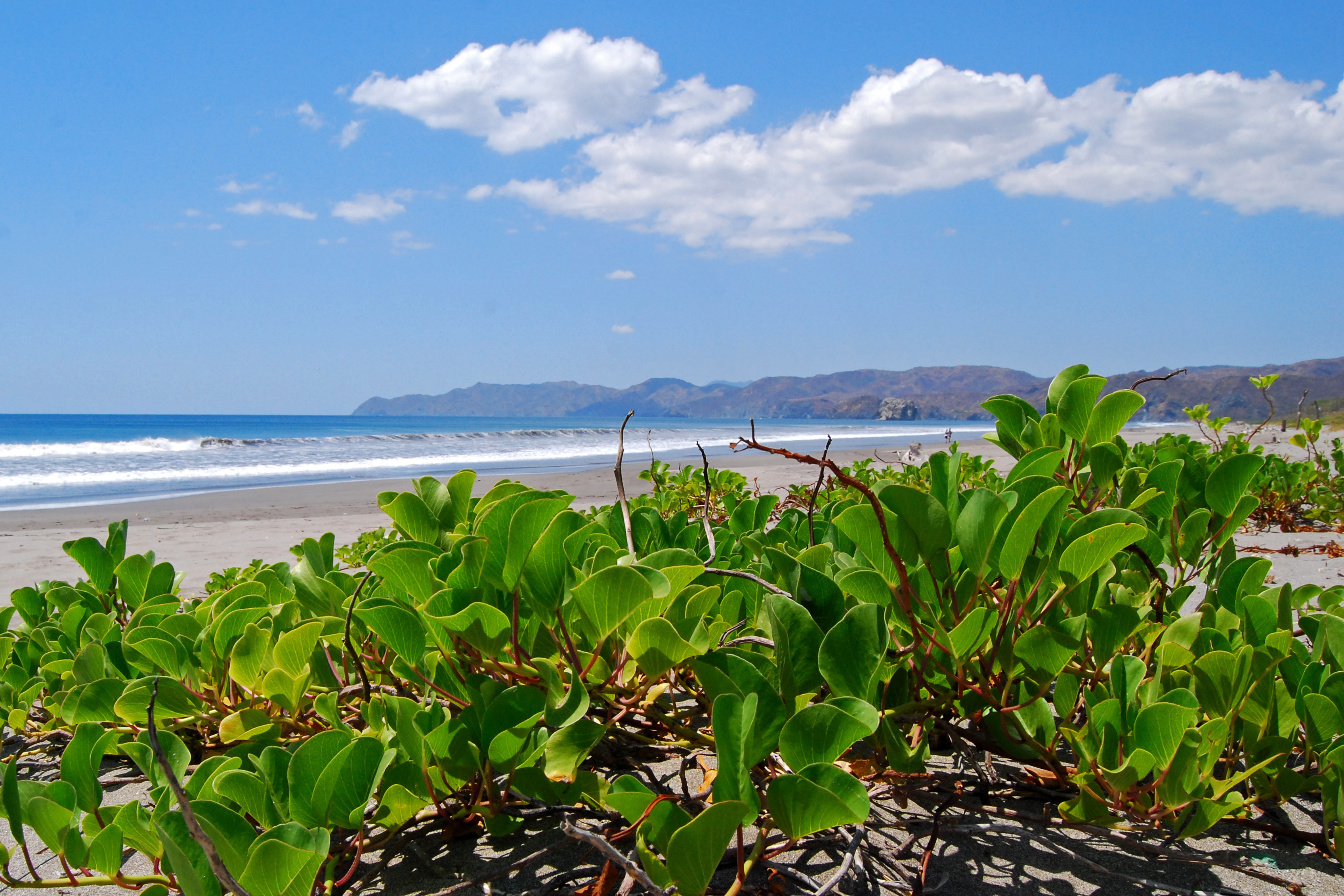
Santa Rosa National Park, in the far northwest of Costa Rica near the border with Nicaragua, is both a nature sanctuary and a sacred site of the national story. It was the country's first national park, created in 1971, and it protects one of the last great remnants of tropical dry forest in Central America, along with remote beaches where thousands of sea turtles nest.
Its historical heart is the Casona de Santa Rosa, where on 20 March 1856 the Costa Rican army defeated the filibusters of the American William Walker in a matter of minutes, in the battle that became a symbol of national sovereignty. The Casona, rebuilt after a fire, now houses a museum. On top of that historical weight come first-rate natural attractions: Playa Naranjo with its famous Witch's Rock (Roca Bruja), a surfing mecca, and Playa Nancite, one of the biggest arribada sites for the Pacific olive ridley turtle.
This guide runs through the essentials of Santa Rosa with a practical eye: the visit to the Casona and the historic sector, the surf beaches and the turtle nesting beaches, the dry forest trails and their wildlife, how to get there from Liberia or the Panamericana, and what to bear in mind in a large park with demanding access. Santa Rosa is one of the pillars of the Guanacaste Conservation Area, a World Heritage Site.
Santa Rosa was Costa Rica's first national park (1971) and it is, above all, the setting of the Battle of Santa Rosa of 20 March 1856, when Costa Rican troops drove out William Walker's filibusters in minutes. The historic Casona, now a museum, commemorates that founding moment of the national identity. The park is part of the Guanacaste Conservation Area, a UNESCO World Heritage Site. The full story is on our history page.
Read the full history ↓The North Pacific province that in 1824 voted to be Costa Rican: land of the sabanero and of tropical dry forest, cradle of the national folklore, home to steaming volcanoes and founding battles, and to the great sun, surf and longevity beaches of the Nicoya Peninsula.
Read the history of Guanacaste →They depart from Liberia, 30 km away. If you book from this link we earn a commission and you pay no more.
No exact prices: a scale from $ (budget) to $$$$$ (luxury), with 2-3 options per category.
Origins, formation and what the sources say.
Few places on the continent pack so many stories into a single point: an old adobe hacienda house where a country's sovereignty was settled in fourteen minutes, one of the most mythical surf beaches on the planet, an arribada of thousands of turtles and one of the last great dry forests in Central America. All of that is Santa Rosa National Park, the first place Costa Rica declared a national park. And it all began, oddly enough, with cattle.
Long before it was a national park, Santa Rosa was a large cattle hacienda in the heart of the tropical dry forest of Guanacaste. The region, originally inhabited by the Chorotega peoples, was folded into colonial and then republican life as a land of cattle haciendas, where the culture of the sabanero, the Guanacaste cowboy, was forged. The Casona de Santa Rosa, with its hacienda architecture, was the center of that rural operation.
The setting around the hacienda is one of the most singular ecosystems in Central America: tropical dry forest, which during the long dry season drops its foliage and looks almost desert-like, only to come back green and lush with the rains. This kind of forest, once widespread across the whole Pacific side of Mesoamerica, was among the most heavily cleared by cattle and farming, which in time would give Santa Rosa enormous conservation value.
The hacienda's location, on the natural route between the Pacific and the Nicaraguan depression, close to the border, also made it a strategic point. It's no accident that several battles were fought on this same site over the course of history: whoever controlled Santa Rosa controlled one of the passes into the northwest of the country. That double condition —nature reserve and strategic enclave— defines the identity of the place.
The episode that gave Santa Rosa its lasting fame happened on 20 March 1856. In the context of the National Campaign against the filibusters, the American adventurer William Walker —who had seized power in Nicaragua and intended to dominate Central America and, it was feared, extend slavery— sent troops toward Costa Rica. A filibuster column dug in at the Casona de Santa Rosa.
The Costa Rican army, commanded by president Juan Rafael Mora Porras and led in the field by his officers, attacked the position. The battle was lightning quick: in barely fourteen minutes, the Costa Rican troops drove out the filibusters, who fled toward Nicaragua. The victory at Santa Rosa lifted national morale and opened the way to the campaign that would culminate weeks later at Rivas, with the famous heroic act of Juan Santamaría. Santa Rosa was thus enshrined as a founding site of Costa Rican sovereignty and identity.
The place would become a battlefield again in the 20th century: in 1919, during the fall of the Tinoco dictatorship, and in 1955, in a border conflict. Three battles on the same historic site reinforced the symbolic character of Santa Rosa as a bastion of national defense, a meaning the park preserves and passes on to this day.
In 1971, Santa Rosa was declared a national park, becoming the first in Costa Rica and the cornerstone of what would be one of the most admired protected area systems in the world. The motivation was twofold: to protect the historic site of the Casona and the battles, and to conserve the tropical dry forest, a threatened and scarce ecosystem. The creation of the park marked the start of the conservation policy that would give Costa Rica its international ecological reputation.
From the eighties on, Santa Rosa was the setting for an ambitious ecological restoration project driven by scientists such as Daniel Janzen: instead of simply conserving what was left, the aim was to regenerate dry forest over old pastures, letting nature recolonize the degraded land. The experiment, pioneering on a world scale, showed that such a battered ecosystem could recover, and it was folded into what became the Guanacaste Conservation Area.
In 1999, UNESCO inscribed the Guanacaste Conservation Area —which includes Santa Rosa— on the World Heritage list, for its exceptional value to the conservation of dry forest and of the ecological processes that connect mountain, forest and sea. Today Santa Rosa is at once a museum of the nation, a turtle sanctuary, a surfing paradise and a laboratory of tropical restoration: a place where human and natural history intertwine as in few corners of the continent.
On top of its historical value and the richness of the dry forest, Santa Rosa adds an extraordinary marine heritage that sealed its fame. Playa Nancite is one of the main sites on the planet for the mass arribada of the olive ridley turtle (Lepidochelys olivacea): on certain nights of the nesting season, thousands of turtles emerge at the same time to lay their eggs. Because it's so fragile, access to Nancite stays strictly restricted and reserved for scientific research, which has made it possible to study the biology of these turtles for decades.
A few kilometers south, Playa Naranjo became a global surfing icon. Its wave, associated with the crag known as Witch's Rock (Roca Bruja), reached international fame from the seventies and eighties on and is part of global surf mythology. Since overland access is very hard, most surfers arrive by boat from Playas del Coco or Tamarindo, which turned Santa Rosa into one of the great surf pilgrimages in Central America.
The far north of the park, the Murciélago sector, adds another layer of recent history: part of that land belonged to the Somoza family, dictators of Nicaragua, and was expropriated by the Costa Rican state. Off the coast, the Murciélago islands (the Bat Islands) are a world-class diving destination for their bull sharks. So a single park holds the patriotic feat of 1856, the restoration of the dry forest, the turtle sanctuary, the surf mecca and the echoes of border geopolitics: few places in Costa Rica condense so many stories.