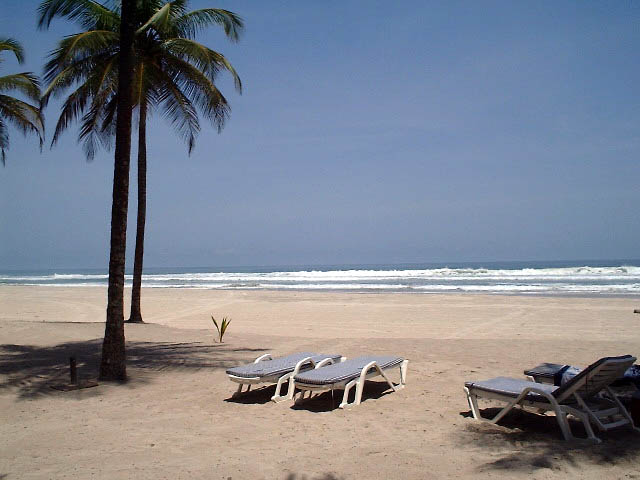
Assinie is Côte d'Ivoire's beach paradise: a narrow strip of fine sand between the Atlantic Ocean and the Aby Lagoon, lined with coconut palms, elegant resorts, lodges and private villas. An hour and a half from Abidjan, it is the favourite getaway for well-off Abidjan residents and expats, who come for sun, sea, lagoon and good food far from the bustle of the city.
What makes Assinie special is its double waterfront: on one side the open ocean, with its waves and golden sand; on the other, the Aby Lagoon, calm and navigable, perfect for boat trips, water sports or reaching spots like the Passe —where the sea and the lagoon meet to form a natural pool— and Bird Island. From here you can also reach the beautiful Ehotilé Islands National Park, an archipelago of six islands in the lagoon.
This practical guide takes a considered look at Assinie: when to go, how to get there from Abidjan, where to stay for every budget, what to do on the beach and on the lagoon, where to eat fresh fish and seafood and how to organise boat trips. Whether for a relaxing weekend or a day by the sea, Assinie is the laid-back, sunny face of Côte d'Ivoire.
Assinie has a much older history than its fame as a beach resort: it was one of the first points of contact between France and this coast of Africa. As early as the late 17th century the French set up a short-lived settlement here and took a young African to France, the famous 'Prince Aniaba', who was sponsored at the court of Louis XIV. Home to the N'zima and Éotilé peoples of the lagoon, the area lived from trade and fishing before becoming, in modern times, the country's great beach resort. We tell that story, from early colonial trade to lagoon tourism, on our history page.
Read the full history ↓Where colonisation began and where cocoa's journey ends today: old colonial ports, the great cocoa port of San-Pédro, unspoilt beaches and the chic resort of Assinie.
Read the history of The Atlantic coast →No exact prices: a scale from $ (budget) to $$$$$ (luxury), with 2-3 options per category.
Origins, formation and what the sources say.
Long before it became a fashionable beach resort, the Assinie region was home to peoples tied to the Aby Lagoon and the ocean. The Éotilé (also called Vetere or Beti) lived on the islands and shores of the lagoon, making a living from fishing, gathering and trade. Their territory included the islands now protected as the Ehotilé Islands National Park, which were, and still are, sacred places and burial grounds of their ancestors. Alongside them, the N'zima (Nzema), an Akan people related to those of the neighbouring Gold Coast (Ghana), settled on the coast as fishermen and traders.
These communities were part of a dense network of exchange along the coast and lagoons of the Gulf of Guinea, trading fish, salt, gold, ivory and goods from the interior. The Aby Lagoon, linked to the sea by a sandbar, was both a route for getting around and a source of livelihood, and the villages were spread along its shores and islands.
Like the rest of the Ivorian coast, the Assinie shoreline was hard for European ships to approach because of the dangerous surf bar. Its lagoon, however, offered some shelter, which made it one of the few places where local peoples could make contact with the sailors who travelled the region from the 15th century onwards.
Assinie holds a special place in the history of Côte d'Ivoire as one of the first spots where France tried to establish itself on this coast. In the late 17th century, in the time of Louis XIV, French traders and agents linked to the trading companies settled in Assinie and even built a small fort, hoping to get a share of the region's trade in gold, ivory and other goods.
Those contacts gave rise to one of the most famous and colourful stories of the period: that of the young African known as Aniaba, who was taken to France around 1687-1688 and presented at the court of Louis XIV as a 'prince' of Assinie. Aniaba was educated in France and baptised, reportedly with the king himself as his godfather. He may even have served in the French army before returning home years later. Somewhere between history and legend, he shaped the way the French imagined Africa and appears in accounts and works of the time.
However, that first French settlement in Assinie did not last long. Trade proved difficult, the climate was harsh and the venture did not pay, so the post was abandoned in the early 18th century. France would not establish itself firmly on the Ivorian coast again until the 19th century, but Assinie stayed in the memory as the place where the French crown and this part of Africa had met, long before anywhere else in the country.
France returned to the Ivorian coast for good in the 19th century. In 1842-1843, Admiral Bouët-Willaumez signed treaties with local chiefs and set up French posts along the coast, including at Grand-Bassam and at Assinie itself. This laid the foundations of the future colony of Côte d'Ivoire, officially established in 1893.
During this period, the Assinie region and the Aby Lagoon remained an area of trade and fishing within the colonial economy. Goods from the interior travelled these waters along with the lagoon's own resources: palm oil and rubber, and later coffee and cocoa. With the British colony of the Gold Coast (Ghana) just to the east, this border area was a place of trade and also of smuggling.
While Grand-Bassam and later Abidjan were home to the administration and the big trading houses, Assinie remained a more rural lagoon area of N'zima and Éotilé fishing villages. That relative calm and its untouched natural setting of beaches, coconut palms, lagoon and islands would become the basis for its reinvention as a tourist destination in the second half of the 20th century.
After Côte d'Ivoire became independent in 1960, during the economic boom known as the 'Ivorian miracle', Abidjan's growing wealthy class and its large expatriate community began looking for getaways near the capital. Assinie had fine sandy beaches, coconut palms, a navigable lagoon and was fairly close to Abidjan. It had everything it needed to become the country's beach resort.
Over the following decades, hotels, beach clubs, resorts and private villas went up along the sandy spit of Assinie-Mafia and neighbouring Assouindé. The place became known as a chic destination for stylish weekends, and filled up with second homes belonging to well-off Abidjan families. The Aby Lagoon became a major spot for water sports and boat trips, and la Passe, Bird Island and the Ehotilé Islands became classic excursions.
Tourism development has brought its share of problems: pressure from property development, coastal erosion and the environmental impact on the lagoon and its ecosystems are real challenges. The Ehotilé Islands National Park was created in 1974 partly in response to the need to protect the area's natural and cultural heritage from this expansion.
Today Assinie is easily the most famous and exclusive beach resort in Côte d'Ivoire. It is the go-to getaway for well-off Abidjan residents and expatriates, and it features more and more in the country's emerging international tourism offer. Its boutique lodges, resorts facing the sea and the lagoon, weekend clubs with music and seafood restaurants have turned the area into a small world of tropical pleasure.
Assinie has even become shorthand for an African paradise in French popular culture. For example, it was the setting of the famous French comedy 'Les Bronzés' (1978), which portrayed holidays at a resort club, and this helped make it well known in France. That mix of the exotic, the beach and social life still defines its character.
Behind the tourist glamour, the region keeps its older roots: the fishing villages, the living culture of the N'zima and Éotilé peoples, the sacred sites of the Ehotilé Islands and a history that goes back to the first contacts with France in the 17th century. So Assinie is much more than a beach resort. It is a place where the earliest colonial history, lagoon culture and modern tourism live side by side on the shores of one of the most beautiful lagoons in West Africa.