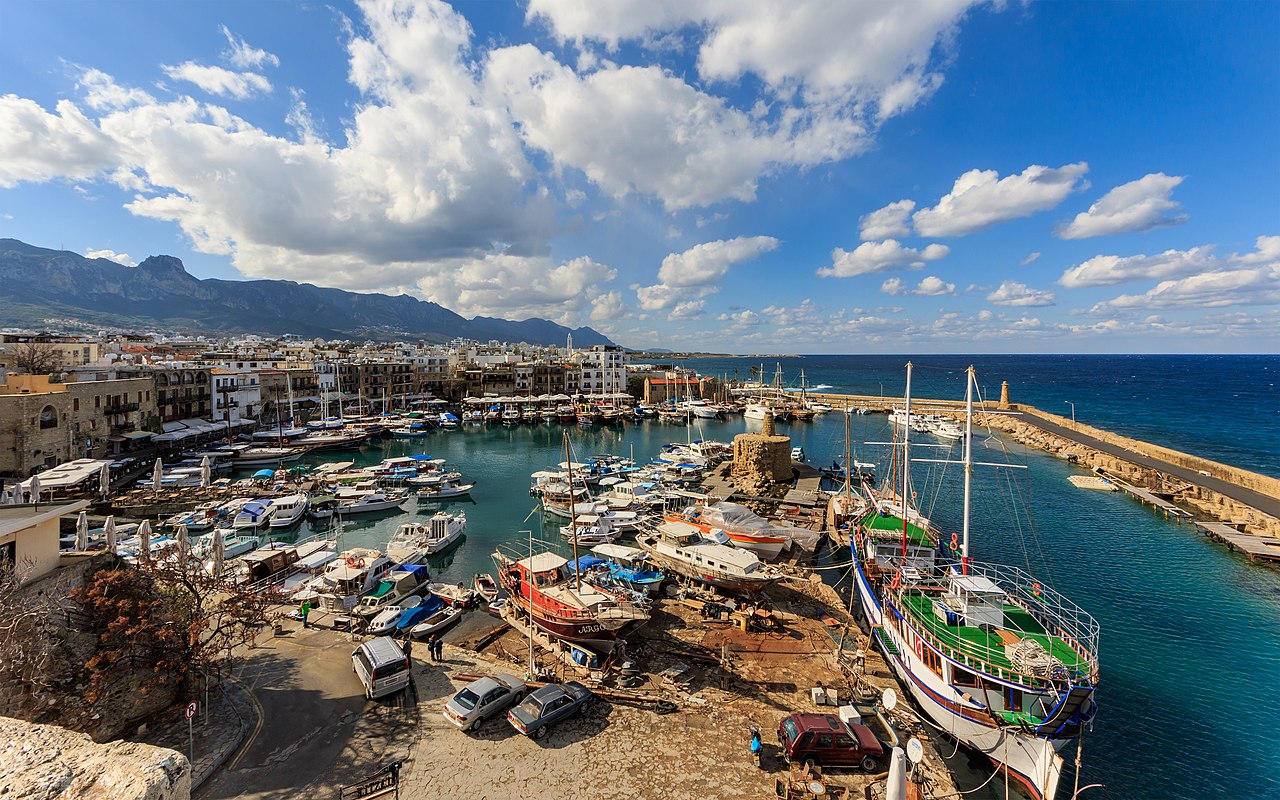
There's a harbour in Cyprus that seems frozen in time. It's a perfect horseshoe of calm water, lined with old golden-stone houses now turned into tavernas and cafés, with boats moored along the quay. Looming over it all is the bulk of a medieval castle. This is Kyrenia (Girne to Turkish Cypriots), on the island's north coast, which many consider the prettiest town in Cyprus. Its harbour is one of those places that stays with you. At sunset, with golden light on the stone and reflections in the water, it's a pure Mediterranean postcard.
Kyrenia is in the Turkish Cypriot north, so visiting from the south means crossing the Green Line, which has divided the island since 1974, at one of the crossing points. It's well worth it. Besides the harbour and its imposing castle, which houses the oldest Greek merchant ship ever recovered from the sea (more than 2,300 years old), the town is the gateway to two spectacular gems in the mountains above. One is the Gothic Bellapais Abbey, set among cypress trees. The other is St Hilarion Castle, a fairy-tale eagle's nest clinging to the crags that, legend has it, inspired the castle in Disney's Snow White.
This guide covers Kyrenia with a practical, warm approach, and with the restraint the context calls for. It explains how to cross from the south and the insurance you need for the car, what to see at the harbour and the castle, how to get to Bellapais and St Hilarion, what admissions cost (in Turkish lira) and where to eat by the water. On a divided island, Kyrenia is one of the strongest reasons to cross to the other side and discover northern Cyprus.
Kyrenia was founded by Greek settlers in antiquity and became one of the city-kingdoms of classical Cyprus. Its natural harbour made it important from Greek and Roman times. Around the 4th century BC a merchant ship sank in its waters, and the wreck (the 'Kyrenia ship') was recovered in the 20th century and is now the star attraction of the castle. The Byzantines, the Crusader Lusignan dynasty and the Venetians enlarged and strengthened the fortress to defend the coast against raids. In 1571 the town fell to the Ottomans along with the rest of Cyprus, and the harbour remained a fishing and trading post. Under British rule (from 1878) and after independence in 1960, Kyrenia was a quiet, beautiful coastal town with a mixed population. The Turkish invasion of 1974, whose troops landed on the beaches near Kyrenia itself, and the island's subsequent division left it in the Turkish Cypriot north, where it remains. The full story, from the ancient ship to the division, is on our history page.
Read the full history ↓The touristy east with its golden beaches, and the Turkish Cypriot north beyond the Green Line. Here you'll find ancient Salamis, Gothic Famagusta and its ghost quarter of Varosha, and the harbour of Kyrenia beneath its medieval castle.
Read the history of The east and the north (Ayia Napa, Kyrenia, Famagusta) →They depart from Larnaca, 55 km away. If you book from this link we earn a commission and you pay no more.
No exact prices: a scale from $ (budget) to $$$$$ (luxury), with 2-3 options per category.
Origins, formation and what the sources say.
Like so many Cypriot cities, Kyrenia's story begins with the Greek settlers who reached the island towards the end of the Bronze Age (12th-11th centuries BC) and Hellenised it. Tradition credits its founding to settlers from the Greek region of Achaea. Its magnificent natural harbour, one of the few safe shelters on the rugged north coast, soon made it a maritime stronghold, and Kyrenia became one of the city-kingdoms into which ancient Cyprus was divided, though a more modest one than giants such as Salamis or Kition.
Thanks to its position, Kyrenia took full part in the busy sea trade of the eastern Mediterranean, which brought Greeks, Phoenicians and Egyptians into contact, and later Greeks and Persians too. Its greatest treasure today comes from that period: the 'Kyrenia ship', a Greek merchant vessel loaded with wine amphorae and sacks of almonds that sank off this coast around the 4th century BC. It was raised from the seabed in the 1960s with much of its original wooden hull intact. It is one of the best-preserved ancient ships in the world and an extraordinary window onto trade more than 2,300 years ago.
After the Greek period, Kyrenia, like the rest of Cyprus, came under the rule of the Ptolemies of Egypt and then of the Roman Empire, becoming part of the prosperous Mediterranean world of Antiquity. Its harbour remained its reason for being, and the small town endured through the centuries, always facing the sea.
With the fall of the Roman Empire, Cyprus became part of the Byzantine Empire, and Kyrenia grew more and more important for defence. From the 7th century onwards, Arab raids repeatedly ravaged the Cypriot coast, and the Byzantines strengthened key strategic points. In Kyrenia they built a castle to protect the harbour, and in the mountains above the town they built fortresses such as St Hilarion, Buffavento and Kantara, which watched over the coast and served as places of refuge. St Hilarion, built over an old monastery, became an almost impregnable eagle's nest.
The big turning point came at the end of the 12th century. In 1191, during the Third Crusade, the English king Richard the Lionheart conquered Cyprus and sold it shortly afterwards. The island ended up in the hands of the French Lusignan dynasty, which founded a Latin crusader kingdom that would last almost three centuries (1192-1489). Under the Lusignans, Kyrenia and its castles were enlarged and embellished: the town castle was strengthened, St Hilarion became a royal mountain residence and a refuge in wartime, and the magnificent Gothic abbey of Bellapais was founded on the hillside.
This period left Kyrenia and its surroundings the architectural legacy that makes it so special today: a blend of Mediterranean fortress and Crusader Gothic. The mountain castles, with their towers clinging to the crags, and Bellapais Abbey, with its pointed arches facing the sea, are the most beautiful testimony to Lusignan Cyprus, when the island was a crossroads between East and West and a Latin bastion in the eastern Mediterranean.
In 1489 the Republic of Venice annexed Cyprus, ending the Lusignan kingdom. The Venetians, great military engineers, strengthened the island's defences against the growing threat of the Ottoman Empire. In Kyrenia they remodelled the harbour castle for the age of artillery, thickening its walls and adding round bastions able to withstand cannon fire. The fortress today largely has that massive, low-slung Venetian look. Even so, the Venetians focused their major defensive works on Nicosia and, above all, Famagusta.
The Ottoman threat became reality in 1570-1571. After the fall of Nicosia and the long, bloody siege of Famagusta, the whole of Cyprus passed to the Ottoman Empire. Kyrenia surrendered to the Ottomans without much resistance, and its castle no longer played a front-line military role. Under Ottoman rule, which would last three centuries (1571-1878), Kyrenia remained a quiet port town whose people lived from fishing, trade and farming in the surrounding area. Mosques and other buildings went up, and the town took on the mixed character, with Greek and Turkish communities, that it would keep until the 20th century.
Throughout these centuries the harbour remained the heart of Kyrenia. Its small size and relative distance from the major centres kept it a small, peaceful town, but its natural beauty, a horseshoe harbour at the foot of the mountains, was already starting to be recognised. Much later, that charm would become the basis of its role as a tourist destination.
In 1878, under its agreements with the weakened Ottoman Empire, the United Kingdom took administrative control of Cyprus, which became a formal British colony in 1925. Under British rule, Kyrenia enjoyed a calm period and grew increasingly attractive. Its picturesque harbour, mild climate and setting of mountains and castles made it a favourite with colonial officials, retired officers and British travellers, some of whom settled in the town and the surrounding area.
This cosmopolitan, literary atmosphere was captured by the writer Lawrence Durrell, who lived in the village of Bellapais, above Kyrenia, in the 1950s. He described that Cyprus, and its growing political conflict, in his famous book 'Bitter Lemons'. It was a portrait of a beautiful, peaceful island, but one riven by ever-greater tensions.
Indeed, the 1950s brought the Greek Cypriot struggle for union with Greece (enosis) and against British rule, with the emergence of the EOKA organisation. After years of conflict, Cyprus gained independence in 1960 as a bicommunal republic, with a delicate power-sharing arrangement between the island's Greek and Turkish communities. At that point Kyrenia, with its mixed population, was a beautiful, quiet coastal town. But the young republic's fragile balance would soon break down, and Kyrenia's history was about to take its most dramatic turn.
The balance of the Republic of Cyprus broke down in 1974. In July that year, a coup backed by the Greek military junta overthrew President Makarios with the aim of uniting the island with Greece. Turkey responded with a military intervention, and it was on the beaches near Kyrenia that Turkish troops landed on 20 July 1974. Over the following weeks, the Turkish army occupied the northern third of the island, including Kyrenia.
The consequences were dramatic and lasting. The island was divided by a ceasefire line, the 'Green Line', patrolled by the United Nations, which still separates it today. There were mass population movements in both directions: Greek Cypriots in the north, including many of Kyrenia's residents, fled or were expelled to the south, while Turkish Cypriots from the south moved north. In 1983 the north unilaterally declared the Turkish Republic of Northern Cyprus, recognised only by Turkey. The international community still considers the occupation illegal and regards the Republic of Cyprus (with its capital in Nicosia) as the only legitimate state for the whole island.
Since then, Kyrenia has been part of the Turkish Cypriot north. It has developed as a tourist destination, mainly for Turkish and European visitors, and its harbour, its castle and the nearby monuments still draw people in. Since 2003, the opening of several crossing points on the Green Line has made it possible to cross from one side to the other, and many visitors from the south, including displaced Greek Cypriots, can now see Kyrenia again. For everyone, the town remains one of the most beautiful in Cyprus, but also a symbol of the division the island has lived with since 1974. This is a sensitive subject that deserves to be approached with respect: here we stick to the historical facts without taking sides, aware that behind every monument there are also human stories of loss and memory.