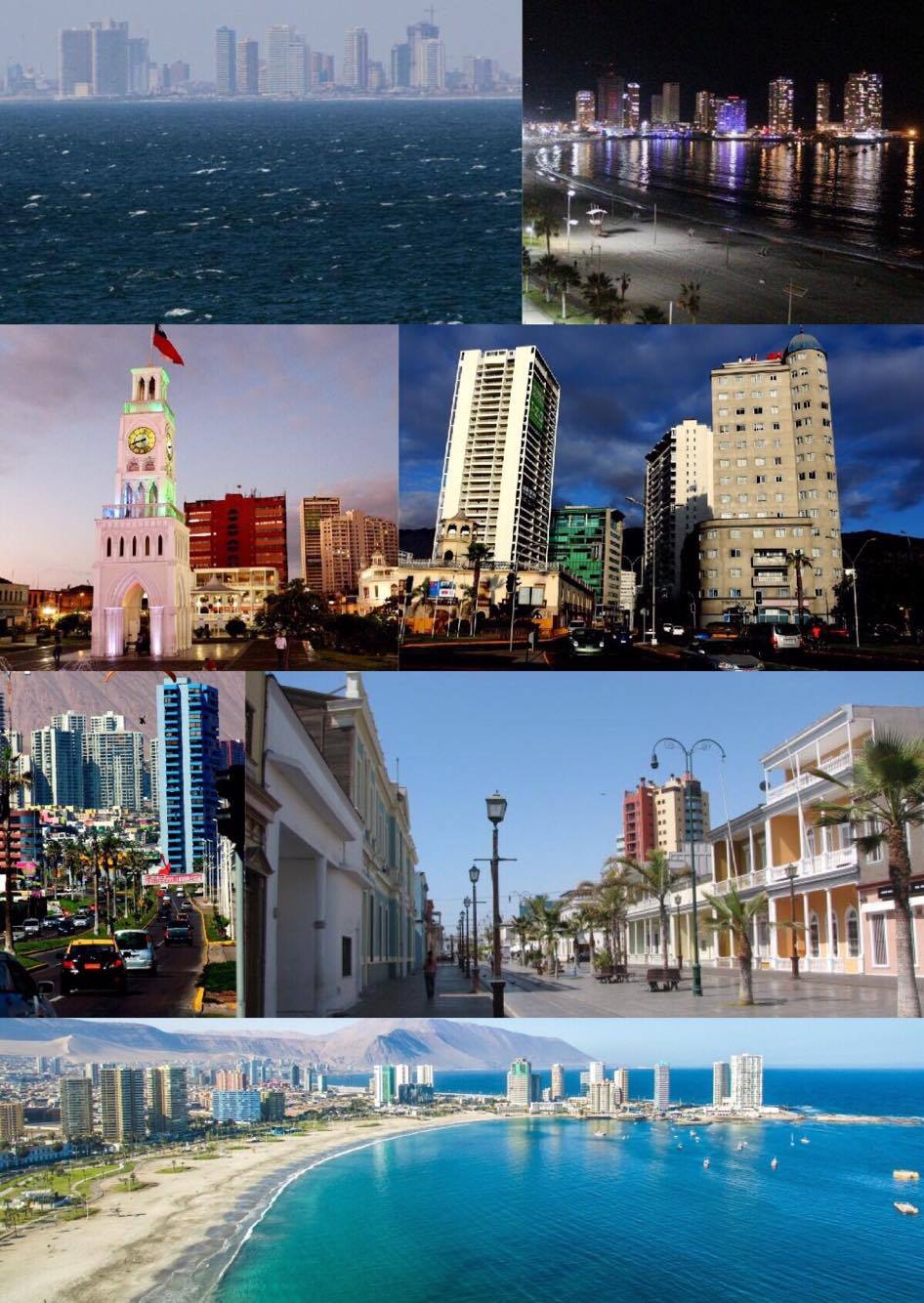
Iquique is one of those Chilean cities with a split personality, and that's where its charm lies. On one hand it's a proper seaside resort: long sandy beaches, palm trees, a casino, surf and the unmistakable outline of the Cerro Dragón, a gigantic sand dune from which paragliders launch to soar over the city and the sea. On the other, it's a city thick with history: it was the great port of the nitrate era, and from that age of dazzling fortunes it keeps a unique historic quarter, with mansions, a sumptuous theater and Georgian-style timber streets that make it feel stopped in time.
The country around Iquique is also an open book of Chilean history and of the peoples of the desert. A few kilometers away, out in the pampa, the Humberstone and Santa Laura nitrate works — today a UNESCO World Heritage Site — are ghost towns that tell the rise and fall of the 'white gold'. Further south and inland, the Pintados geoglyphs and the colossal Atacama Giant, carved centuries ago into the desert hillsides, recall the cultures that crossed these lands long before. And on the coast, the memory of the War of the Pacific, with the famous Naval Battle of Iquique in 1879, is still very much alive.
This guide covers Iquique with a practical, warm eye: where to enjoy its beaches, how to explore the nitrate-era historic quarter, how to take the plunge with paragliding, what to find at the Zofri and how to organize trips out to the nitrate works and the geoglyphs. It's a destination that combines sun, sea, shopping, adrenaline and history in generous measure, and it surprises anyone who arrives expecting nothing but a beach town.
Iquique began as a modest fishing cove and, during the colonial period and the 19th century, was a port tied first to the silver of Huantajaya and then, decisively, to nitrate. Until 1879 it was Peruvian territory. With the War of the Pacific (1879-1883) between Chile, Peru and Bolivia, the city was the setting for the famous Naval Battle of Iquique on 21 May 1879, in which the Chilean corvette Esmeralda, under Arturo Prat, was sunk by the Peruvian monitor Huáscar; Prat's sacrifice, dying as he boarded the enemy ship, made him a Chilean national hero. After the war Iquique passed to Chilean sovereignty and lived its golden age with the nitrate boom: the desert's 'white gold', exported worldwide as fertilizer and for explosives, filled the city with fortunes, mansions, theaters and a bustling port, in the full flush of the Belle Époque. The invention of synthetic nitrate after the First World War and the crash of 1929 sank the industry, leaving behind the nitrate works turned ghost towns, such as Humberstone and Santa Laura, today a UNESCO World Heritage Site. In the decades that followed, the creation of the Free Zone (1975) and the growth of tourism and fishing reinvented Iquique's economy, which today combines its nitrate past with its present as a beach and commercial city. The full story is on our history page.
Read the full history ↓The nitrate region par excellence: the beaches and dunes of Iquique beside the Atacama Desert, the ghost works of Humberstone and Santa Laura, the ancient geoglyphs of the Giant of Tarapacá and the tragic memory of the Santa María de Iquique massacre.
Read the history of Tarapacá Region →If you book from here we earn a commission and you pay no more. Prices and availability come from Civitatis.
No exact prices: a scale from $ (budget) to $$$$$ (luxury), with 2-3 options per category.
Origins, formation and what the sources say.
Few Chilean cities have changed skin as often as Iquique: it was an Indigenous cove, a Peruvian port, the stage of the country's most famous naval battle, the world capital of nitrate and, today, a beach resort and a paradise of duty-free trade. Long before it became the prosperous nitrate city, Iquique was a modest cove on the arid coast of the Tarapacá desert, inhabited and frequented by the Chango peoples, fishers and shore gatherers adapted to living between ocean and desert. The name 'Iquique' itself has roots in Indigenous languages, with various readings of its meaning. The setting, almost without fresh water or vegetation, made it an inhospitable place, dependent on the sea and on whatever arrived overland.
Through the colonial period and the first decades of the republic, the Tarapacá region belonged to Peru. What started to give Iquique importance was mining in its interior, in particular the silver of Cerro Huantajaya and other nearby deposits, which needed a port on the coast. Iquique grew slowly as a cove and minor port serving that mining activity and, increasingly, the resource that would end up defining its destiny: nitrate.
Nitrate, abundant in the pampas of the Tarapacá and Antofagasta deserts, began to be mined and exported in the 19th century as fertilizer for European agriculture and as a raw material for explosives. World demand grew fast, and the region's ports — Iquique among them — became the outlets for this 'white gold'. The city, still Peruvian, was starting to see growth that would soon be shaken by war.
In 1879 the War of the Pacific broke out, pitting Chile against the alliance of Peru and Bolivia, a conflict whose backdrop was largely control of the desert's nitrate wealth. Iquique, then a Peruvian port, found itself at the center of naval operations. On 21 May 1879, off its bay, came one of the most remembered battles in Chilean history: the Naval Battle of Iquique.
That day two old Chilean vessels blockading the port — the corvette Esmeralda, under Captain Arturo Prat, and the schooner Covadonga — were surprised by two modern Peruvian ironclads, the monitor Huáscar (commanded by Miguel Grau) and the frigate Independencia. The unequal fight between the aging Esmeralda and the powerful Huáscar dragged on for hours. When the Huáscar rammed the Esmeralda with its prow, Arturo Prat, in the gesture that immortalized him, leapt aboard the enemy ship sword in hand, followed by a few of his men, and died on the Huáscar's deck.
The Esmeralda finally sank in the bay of Iquique after a third ramming, taking much of her crew with her. In military terms it was a Chilean defeat, but the heroism and sacrifice of Prat and his men had an enormous effect on Chilean morale and national feeling: Arturo Prat became the country's great naval hero and 21 May was enshrined as one of its most important national dates, commemorated to this day.
The Naval Battle of Iquique was only the beginning of a war that would run until 1883 and change the map of northern South America forever. After the naval campaign, in which Chile eventually secured supremacy at sea (including the capture of the Huáscar at the battle of Angamos), Chilean forces advanced overland and occupied the Tarapacá region, until then Peruvian, and the Bolivian coastal territories of Antofagasta.
The war, fought in large part over control of the desert's nitrate wealth, ended in Chilean victory. As a result, Tarapacá — with Iquique as its main port — passed to Chilean sovereignty (ratified in the 1883 Treaty of Ancón with Peru), and Bolivia lost its outlet to the sea. Iquique thus ceased to be a Peruvian city and joined Chile, a change that reordered its population, its administration and its economy.
Incorporation into Chile coincided with the height of the nitrate boom, which sent Iquique's growth soaring. The city took in waves of Chilean and foreign workers and traders, filled with activity and prepared for its most brilliant era. Chilean control of the desert's 'white gold' would become, for decades, one of the country's chief sources of wealth.
Between the late 19th and early 20th centuries, Iquique lived its golden age on the back of nitrate. Nitrate from the Tarapacá desert was exported to Europe and the United States as fertilizer and for making explosives, and an enormous share of that wealth left through the port of Iquique. The city filled with capital — British, German, Spanish, Chilean — and became one of the richest and most cosmopolitan in the country.
That prosperity left a unique architectural mark. The nitrate fortunes built Georgian-style timber mansions, imported or modeled on foreign designs, that survive today along Calle Baquedano and in the historic quarter. Emblematic buildings went up: the sumptuous Teatro Municipal (1890), which hosted European opera and theater companies, the Moorish-inspired Casino Español, social clubs, and mansions like the Palacio Astoreca. Iquique had theaters, a racecourse, trams and a bustling port: a genuine Belle Époque in the middle of the desert.
But behind the glitter lay a harsh social reality. At the nitrate works out in the pampa, thousands of workers — Chilean, Peruvian, Bolivian — lived and worked in extremely difficult conditions, often paid in tokens redeemable only at the company store. Labor tensions led to tragic episodes, such as the massacre at the Santa María school in Iquique in 1907, when a strike by nitrate workers ended in a military crackdown that killed a great many people, an event seared into Chile's social memory.
The reign of Chilean natural nitrate seemed eternal, but it ended abruptly. During the First World War, German chemists — led by Fritz Haber and Carl Bosch — perfected the synthesis of ammonia and nitrate from atmospheric nitrogen (the Haber-Bosch process). Synthetic nitrate, far cheaper and producible anywhere in the world, rapidly displaced the natural nitrate of the desert, which lost its global monopoly.
The world economic crisis of 1929 dealt the final blow to an industry already in decline. The nitrate works out in the pampa began closing one after another, and the thousands of workers who lived in them had to move on, often to Iquique and other cities. The camps were abandoned and turned into 'ghost towns' out in the desert, their streets, houses, theaters and churches empty, frozen in time.
Two of those towns, the Humberstone and Santa Laura works, became the most eloquent testimony to that era: in 2005 they were declared a UNESCO World Heritage Site, as a memorial to nitrate culture and to the lives of the 'white gold' workers. For Iquique, the fall of nitrate meant decades of stagnation and reinvention as the city looked for new economic foundations after the end of the cycle that had made it rich.
After nitrate's decline, Iquique spent decades looking for a new economic direction. Industrial fishing, exploiting the richness of the sea off its coast, became an important activity through the 20th century, with processing plants and fishmeal. But the great engine of reinvention arrived in 1975 with the creation of the Iquique Free Zone, the Zofri.
The Zofri was conceived as a development hub for Chile's isolated far north: an enormous duty-free trading center that drew imports, commerce and jobs, and made Iquique a shopping magnet for the whole Chilean north and for the neighboring countries (Bolivia, Peru, Argentina, Paraguay). Free Zone trade energized the city and drew population and investment, transforming its physiognomy.
In parallel, Iquique rediscovered its enormous tourist potential: a mild climate all year, beaches such as Cavancha, the nitrate heritage of the historic quarter, the closeness of Humberstone, Santa Laura, the geoglyphs and the inland oases, and exceptional conditions for paragliding turned the city into a first-rate seaside and cultural destination. Today Iquique is a city of double identity: that of commerce and the modern beach resort, and that of nitrate memory and the history of Tarapacá, coexisting and giving it a character all its own in northern Chile.