Plzeň is one of those names almost everyone has drunk without knowing it: every time someone orders a 'pilsner' or 'pils' anywhere on the planet, they are naming this city in western Bohemia. Here, in 1842, Pilsner Urquell was born, the first pale golden bottom-fermented beer, which revolutionised the way beer is made and drunk around the world. Visiting its historic brewery, going down into the rock cellars where barrels still mature and tasting unfiltered beer straight from the wood is, for many, the heart of any trip to Plzeň.
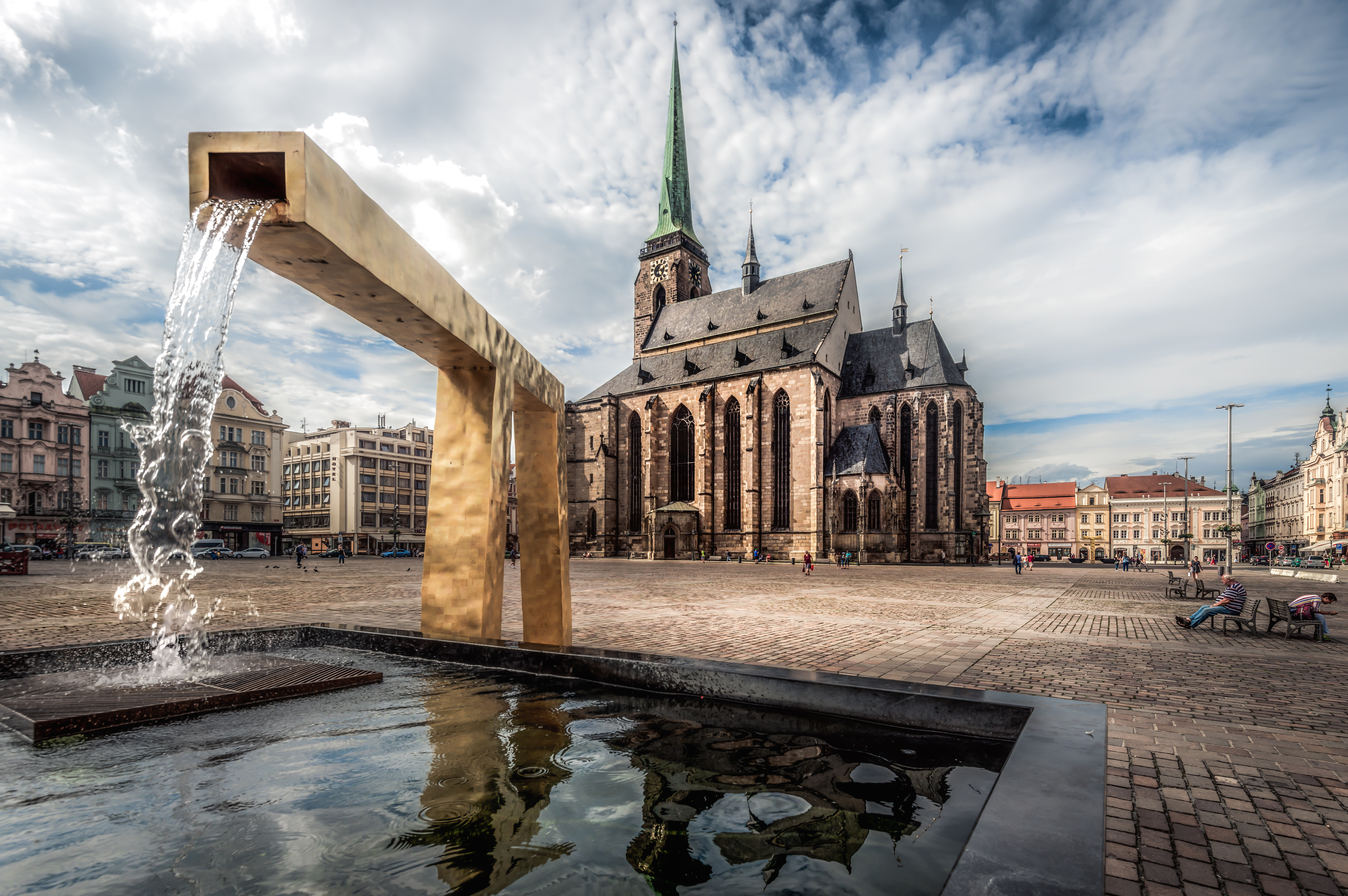
But the city is much more than its beer. Founded at the end of the thirteenth century, it keeps a medieval core laid out on a grid around one of the largest squares in Czechia, Republic Square, dominated by the very tall tower of the Gothic cathedral of St Bartholomew. A few steps away waits the imposing Great Synagogue, one of the largest in Europe, evidence of the significant Jewish community that lived here. And beneath the streets runs a labyrinth of historic tunnels, dug over centuries, that can be walked today.
This guide covers Plzeň with a practical, close-up eye: how to get there from Prague, how to organise the brewery tour, what to see in the historic centre, where to eat and drink well and how to use the city as a gateway to western Bohemia. Industrial and monumental, brewing and cultural, Plzeň combines the solidity of a working city with the pride of having given the world one of its most universal drinks.
Plzeň was founded in 1295 by King Wenceslas II of Bohemia as a royal 'new town', planned on a grid at a crossroads of trade routes in the west of the kingdom, to boost trade and replace an older settlement ('old Plzeň', today Starý Plzenec). Thanks to its position it prospered quickly as a market centre and, during the Hussite wars of the fifteenth century, it stayed loyal to the Catholic side, withstanding several sieges. In the following centuries it remained a prosperous commercial and craft town. Its great leap came in the nineteenth century: in 1842 the city's brewers — unhappy with the uneven quality of their beer — founded a municipal brewery and, with the Bavarian brewmaster Josef Groll, produced the first pale bottom-fermented beer, the future Pilsner Urquell ('Plzeňský Prazdroj'), which would give a whole style its name. Almost at the same time, in 1869, Emil Škoda bought a machinery works that would become the industrial giant Škoda, producer of armaments and heavy machinery that made Plzeň a key industrial hub and a target for bombing in the Second World War. Plzeň was liberated by General Patton's American army in May 1945, an event commemorated every year. In 2015 it was European Capital of Culture. The full history is on our history page.
Read the full history ↓The Bohemia of spa towns and heavy industry: Karlovy Vary and its spa tradition founded by Charles IV, and Plzeň, birthplace of pilsner beer in 1842 and of the Škoda works, on the Bavarian border liberated by Patton's army in 1945.
Read the history of Western Bohemia →They depart from Praga, 84 km away. If you book from this link we earn a commission and you pay no more.
No exact prices: a scale from $ (budget) to $$$$$ (luxury), with 2-3 options per category.
Origins, formation and what the sources say.
The history of Plzeň as a city begins with an act of deliberate planning. In 1295, King Wenceslas II of Bohemia (Václav II) founded a royal 'new town' at a crossroads of trade routes in the west of the kingdom, beside the confluence of several rivers. The aim was clear: to create a strong market and administrative centre that would control the roads towards Bavaria and the Holy Roman Empire and boost the region's economy. To distinguish it from the older settlement nearby — 'old Plzeň', today Starý Plzenec, which had already been important in the time of the first Přemyslids — the new foundation was laid out on a grid, with straight streets running from a large rectangular central square.
That medieval grid, still perfectly legible in today's historic centre, is one of the clearest examples of planned town planning in medieval Bohemia. The great square — today Republic Square — remained the commercial and civic heart, with the town hall and, in the middle, the church. The settlers received privileges and rights that favoured trade, fairs and crafts.
From its earliest days Plzeň also held brewing rights: like many royal cities of Bohemia, its burghers had the privilege of making beer, an activity that over the centuries would become part of the city's very identity. That royal decision at the end of the thirteenth century thus laid the foundations — urban and economic — on which everything else would grow.
During the Hussite wars of the fifteenth century, which set the reformist followers of Jan Hus against the Catholic Church and the emperor, Plzeň took a different path from much of Bohemia. While many towns joined the Hussite movement, Plzeň remained, in essence, faithful to the Catholic side and loyal to the king, becoming one of the kingdom's main Catholic bastions.
That loyalty cost it dearly in military terms. The city was besieged several times by Hussite armies over the decades of conflict, including by Jan Žižka himself, the legendary one-eyed commander, who laid siege to Plzeň without managing to take it. Its solid fortifications and the determination of its inhabitants allowed the city to hold out, which reinforced its prestige and earned it privileges and recognition from the Crown and the papacy.
This stance during the Hussite wars left a lasting mark on the identity of Plzeň, which took pride in its Catholic loyalty for centuries. Once the conflict was over, the city went on prospering as a commercial and craft centre of western Bohemia, benefiting from its strategic position on the routes to the west and from the rights and liberties accumulated through the late Middle Ages.
The event that gave Plzeň worldwide fame happened in the nineteenth century. Despite the city's long brewing tradition, by around 1830 the quality of the local beer was uneven and, as tradition tells it, it became so bad that on one occasion the townspeople poured whole barrels away in protest. Determined to produce beer of consistent quality, the burghers with the right to brew founded a new municipal brewery, the Bürgerliches Brauhaus ('Burghers' Brewery'), opened in 1842.
To run it they hired a Bavarian brewmaster, Josef Groll, who combined three key elements: the bottom-fermentation (lager) method brought from Bavaria, the exceptional softness of Plzeň's water, pale malt made in the English style and the aromatic hops of the nearby Žatec (Saaz) region. The result, presented in October 1842, was a completely new beer: golden, pale, clear, with a white head and a clean, refreshing taste. Until then most beers were cloudy and dark; that crystal-clear golden beer caused a sensation.
The new style spread quickly across Europe and the world, copied everywhere, until it became the most popular type of beer on the planet: the 'pilsner' or 'pils', named after the city. To protect itself from imitations, the original brand adopted the name 'Pilsner Urquell' / 'Plzeňský Prazdroj' ('original source'). So a local decision to improve the beer ended up giving Plzeň a permanent place in the world history of food and drink.
Almost at the same time as the pilsner was born, Plzeň took another leap that would define its modern profile: heavy industrialisation. In 1869 the engineer Emil Škoda bought a small machinery workshop in the city and, within a few decades, turned it into one of the largest industrial conglomerates in central Europe: the Škoda works (Škodovy závody). Under his direction the firm went on to produce heavy machinery, locomotives, boilers, industrial equipment and, decisively, armaments.
At the end of the nineteenth century and the beginning of the twentieth, Škoda became the great supplier of weapons and machinery to the Austro-Hungarian empire, and Plzeň an industrial, working-class city that grew enormously with the arrival of workers. The factory was central to both world wars: in the First it supplied the Austro-Hungarian army and, after the Nazi occupation, it was forced to produce armaments for Hitler's Germany, which made it a target for Allied bombing.
The city was liberated at the end of the Second World War by the American troops of General George Patton, in May 1945, a singular event in the central Europe of the time (most of Czechoslovakia was liberated by the Red Army) and one that Plzeň commemorates every year with liberation festivities. After the war, under the communist regime, Škoda industry continued as an economic pillar, though reorganised. The industrial mark is still an essential part of Plzeň's identity, alongside beer.
Through the nineteenth century, in the warmth of economic and industrial growth, Plzeň was home to a prosperous and numerous Jewish community that played a leading role in the city's trade, finance and cultural life. As evidence of that vigour, between 1888 and 1893 the Great Synagogue (Velká synagoga) was raised, a monumental building in Romantic style with marked Moorish features and two domed towers, considered one of the largest synagogues in Europe.
The community maintained schools, associations and an intense religious and social life into the first half of the twentieth century. Everything changed with the Nazi occupation and the Holocaust. After the Protectorate of Bohemia and Moravia was established in 1939, the Jews of Plzeň were persecuted, stripped of their property and, in 1942, deported in their great majority to ghettos and extermination camps, mainly via the Terezín ghetto-camp. The community, which had been one of the most important in Bohemia, was almost completely annihilated.
The Great Synagogue survived the war (it was not destroyed, partly because it was used as a store), but it was left without the community that gave it life. After decades of neglect under communism, it was restored after 1989 and today it works as an occasional place of worship, a concert hall and, above all, a place of memory for the Jewish population that disappeared. It is one of the most moving testimonies of Plzeň's multicultural past.
After the Second World War and the communist coup of 1948, Plzeň became part of socialist Czechoslovakia. As a large industrial, working-class city, it was one of the regime's centres, but also the scene of tensions: in 1953 a workers' revolt against a currency reform that cut their savings led to protests that were put down by the regime, one of the first workers' uprisings in the Soviet bloc. The economy went on turning around Škoda industry and, of course, around the brewery, whose Pilsner Urquell was exported as an emblematic national product.
With the Velvet Revolution of 1989 and the later creation of the Czech Republic in 1993, Plzeň entered a new stage. The brewery passed into private and international hands (today part of a large brewing group), while industry was restructured. The city invested in restoring its historic heritage, modernising its university and diversifying its economy.
Recognition of that transformation came in 2015, when Plzeň was designated European Capital of Culture, together with the Belgian city of Mons. During that year the city hosted an intense programme of festivals, exhibitions, concerts and artistic projects that renewed its cultural spaces and projected its image across Europe. Today Plzeň combines its double inheritance — the brewing one, with the worldwide pilgrimage to the birthplace of pilsner, and the industrial one, with the legacy of Škoda — with an active university and cultural life, establishing itself as the great city of the Czech west.