Viajá con Gus
HomeCanadaWaterton Lakes National Park
Waterton Lakes National Park
🇨🇦 Canada · The Prairies

Waterton Lakes National Park

Jump to what you need
📌Country
Canada. Waterton Lakes National Park sits in the far southwest of the province of Alberta, on the border with the United States (Montana), where the prairies run straight into the Rocky Mountains. Together with Glacier National Park on the American side, it forms the Waterton-Glacier International Peace Park.
📌Best time to go
Summer (June to September) is high season: long days, open trails, boats on the lake and every service running. Late June to August is the busiest stretch. Spring and fall bring active wildlife and color, but with reduced services; winter is quiet and snowy, with few activities open.
📌Language and currency
English (official alongside French at the federal level). Currency: Canadian dollar (CAD).
📌Getting there
By car: about 3 h south of Calgary (271 km) and around 132 km from Lethbridge. Public transport is very limited, so your own car or a rental is the way to go. The village of Waterton (the townsite) is where all the services are.
📌Suggested days
2 to 3 days to walk the classic trails (Bears Hump, Crypt Lake, Bertha Lake), cruise Upper Waterton Lake and enjoy the townsite and the wildlife.
📌Profile
A mountain-and-prairie national park, smaller and more intimate than Banff or Jasper, known for its deep lakes, the historic Prince of Wales Hotel and for being the world's first International Peace Park. A Unesco World Heritage Site.
💱 CAD exchange rate
Loading rate…
🌤️ Weather in Waterton Lakes National Park
Loading weather…

There is a place in the far southwest of Alberta where the endless prairie runs, with no transition at all, into the wall of the Rocky Mountains: that abrupt meeting of two worlds is Waterton Lakes National Park. There are no gentle foothills here; the mountains rise all at once out of the plain, and at their feet lie deep lakes of an intense blue, carved by ancient glaciers. It is one of the most unusual and photogenic landscapes in the Canadian Rockies.

Waterton is the small, intimate sibling of Alberta's big parks: far less crowded than Banff or Jasper, it keeps the charm of a mountain village and a compact, easy-to-reach kind of nature. Its most famous silhouette is the Prince of Wales Hotel, the historic alpine-style hotel crowning a wind-swept hill above Upper Waterton Lake. And its greatest pride is historical: in 1932, together with Glacier National Park in the United States, it formed the world's first International Peace Park, today a Unesco World Heritage Site.

This guide gathers the practical side of a visit: the official Parks Canada fee and the passes, how to get there from Calgary or Lethbridge, which trails to walk (from the short, panoramic Bears Hump to the legendary Crypt Lake), how to cruise the lake that crosses into the United States, and what to expect from lodging, food and wildlife. Waterton is proof that sometimes the most moving park is not the biggest one, but the one that packs prairie, mountain, lake and history into a few kilometers.

📖 History of Waterton Lakes National Park

Long before it was a park, this land was — and still is — traditional territory and a sacred place of the Siksikaitsitapi (the Blackfoot Confederacy) and of other Indigenous peoples such as the Ktunaxa (Kootenai). The first settler and the area's emblematic figure was John George 'Kootenai' Brown, who set up beside the lakes and would become the park's first officer. On May 30, 1895, the Canadian federal government protected an area of about 140 km² as a Dominion Forest Park, the origin of today's national park. In 1927 the Prince of Wales Hotel opened its doors, built by the American Great Northern Railway and now the icon of the place. The most famous milestone came in 1932, when Waterton Lakes (Canada) and Glacier (United States) joined forces to create the Waterton-Glacier International Peace Park, the world's first international peace park and a symbol of the friendship between the two countries. In 1979 Waterton was designated a Unesco biosphere reserve, and in 1995 the cross-border pair was declared a World Heritage Site. The full story is on our history page.

Read the full history ↓

🏛️ Waterton Lakes National Park is in Alberta

The province of the prairies and the Rockies: Blackfoot and Cree land, land of cattle ranching and oil, home of Banff —Canada's first national park—, of Lake Louise and of the dinosaurs of Drumheller.

Read the history of Alberta →

🗺️ What to see

1
Upper Waterton Lake and the boat cruise
The deepest lake in the Canadian Rockies, and one that crosses into the United States; a historic cruise runs its full length to Goat Haunt, in Montana, between mountains that drop sheer into the water.
Upper Waterton Lake is the heart of the park and the deepest lake in the Canadian Rockies (about 150 meters). It is a long, narrow glacial lake boxed in by mountain walls that plunge vertically into intensely blue water, and it has one peculiarity: it crosses the international border, so its southern end is already in the United States. The best way to see it is the historic cruise run by the Waterton Shoreline Cruise Co., which sails the lake end to end with commentary from a guide and stops for about 30 minutes at Goat Haunt, in the state of Montana (inside Glacier National Park on the American side). The wooden boat M.V. International, in service since 1927, is an attraction in itself. There is also a shorter version that reaches the border and turns back without landing, which does not require a passport.
ℹ️ Cruise to Goat Haunt: adult approx. CAD 85–91, ~2 h 15 min. Runs from June to mid-September. You need a passport to go ashore at Goat Haunt.
2
Prince of Wales Hotel
The iconic 1927 alpine hotel on a wind-swept hill, with one of the most famous views in the Rockies; worth going up even just for afternoon tea.
The Prince of Wales Hotel is Waterton's most recognizable image: a big Swiss alpine-style hotel with steep roofs and wooden balconies, planted in 1927 on a wind-swept hill looking straight out over Upper Waterton Lake and the mountains around it. It was built by the American Great Northern Railway to draw tourists to the newly created park, and named in honor of the Prince of Wales (the future Edward VIII). It is a National Historic Site of Canada. Even if you are not staying, it is worth going up to admire the building and the view from the lobby with its big windows, or to sit down for the classic afternoon tea. It opens in summer only.
ℹ️ Open in the summer season only. Afternoon tea: approx. CAD 55–75 per person. National Historic Site. Free panoramic views from the hotel.
3
Bears Hump (viewpoint trail)
A short but steep walk (about 2.8 km round trip, ~1 h) up to a lookout with a bird's-eye view over the townsite, the lake and the Prince of Wales Hotel; the classic Waterton postcard.
Bears Hump is the park's most popular and most accessible viewpoint trail, ideal for getting the lay of the land as soon as you arrive. It is about 2.8 km round trip with a steep climb, so even though it is short it demands a fair bit on the way up (figure around 1 hour). The payoff is huge: from the lookout, on a rocky outcrop, you take in the whole village of Waterton, Upper Waterton Lake stretching toward the United States and the Prince of Wales Hotel outlined on its hill. It is the classic Waterton postcard and a perfect spot for sunset. The trailhead is next to the visitor centre, steps from the townsite.
ℹ️ 2.8 km round trip, ~1 h. Steep but short. Trailhead next to the visitor centre. Best at sunset.
4
Crypt Lake Trail
One of Canada's great hikes: a demanding outing that combines a boat transfer, tunnels through the rock, cable-secured ledges and waterfalls, up to a lake hidden on the border.
The Crypt Lake Trail is considered one of the best (and most thrilling) hikes in Canada. It is a demanding outing of about 17–20 km round trip that starts in an unusual way: you have to cross the lake on a water shuttle to reach the trailhead, which cannot be reached by land. From there the trail climbs alongside a run of waterfalls, goes through a natural tunnel bored into the rock (you have to duck or crawl through it) and skirts a dizzying ledge secured with a steel cable, before reaching Crypt Lake, an alpine lake tucked into a glacial cirque right on the border with the United States. It is a full-day outing and not for anyone who suffers from vertigo. The boat shuttle runs on fixed times (one morning departure and one afternoon pickup), so you have to plan your timing carefully.
ℹ️ ~17–20 km, full day, demanding. Requires the boat shuttle (approx. CAD 30–40). Runs from late May to mid-October. Not suitable for anyone with vertigo.
5
Cameron Falls
A beautiful waterfall a few minutes' walk from the centre of the townsite, where the water drops over some of the oldest rock in the Canadian Rockies; very accessible.
Cameron Falls is one of the easiest and most rewarding sights in the park: a pretty waterfall inside the village of Waterton itself, a few minutes' walk from the centre. Its interest is not only scenic: the water falls over Precambrian rock more than 1.5 billion years old, considered among the oldest exposed in the Canadian Rockies. It is lit at night, and after storms or snowmelt it can run reddish with sediment. It is accessible to everyone, with viewpoints and benches, and a good place to open or close the day.
ℹ️ Right in the townsite, free access and open to everyone. Rock more than 1.5 billion years old. Lit at night.
6
Cameron Lake and the Akamina Parkway
An alpine lake at the end of the Akamina road, ringed by mountains, with canoe and kayak rental; the road runs through forest with good wildlife watching.
The Akamina Parkway is a scenic road of about 16 km that climbs from the townsite up a wooded valley to Cameron Lake, a serene alpine lake at the end of the road, ringed by mountains and also touching the border with the United States. In summer you can rent canoes, kayaks and rowboats to get out on the water, and there is a picnic area and short trails. The road itself is an attraction: it runs through forest and is one of the best places in the park to see bears (black bears and grizzlies) and other wildlife, especially at dawn and dusk. The Akamina also passes the site of the first oil well in western Canada (Oil City), a curious historical footnote.
ℹ️ At the end of the Akamina Parkway (~16 km from the townsite). Canoe/kayak rental CAD 40–55/h. Excellent for spotting bears from the road.
7
Red Rock Canyon and the Red Rock Parkway
A canyon of striking reddish rock (from its iron content) with a crystal-clear creek running through it and a short, accessible trail; the road is excellent for spotting bears and other wildlife.
Red Rock Canyon is a shallow canyon with intensely red walls, caused by the oxidation of the iron in the rock (argillite), with a creek of crystal-clear water running through it. A short, flat trail of less than 1 km follows the rim with small bridges, ideal for families and for photos thanks to the contrast of red against green and water. You get there on the Red Rock Parkway, another scenic road of about 15 km from the townsite which, like the Akamina, crosses prairie and forest and is one of the best places in the park to spot bears and other wildlife. Longer trails also start from the canyon, such as the one to Blakiston Falls, the park's highest-volume waterfall.
ℹ️ Canyon trail <1 km, flat and family-friendly. At the end of the Red Rock Parkway (~15 km). Excellent for wildlife watching from the road.
8
Bertha Lake Trail
A classic half-day walk up to an alpine lake, passing Bertha Falls along the way; moderate and very popular.
The Bertha Lake Trail is one of Waterton's best-loved walks, moderate in difficulty and easy to shorten. It leaves straight from the townsite and climbs through the forest, with views over Upper Waterton Lake, to Lower Bertha Falls (a waterfall you reach on a relatively short, easy stretch, a good option if you do not want the full hike). Anyone carrying on faces a series of tougher switchbacks up to Bertha Lake, a lovely alpine lake in a mountain cirque, perfect for a picnic. The full walk takes half a day. In spring and summer the trail fills with wildflowers.
ℹ️ To the falls, short and easy; to the lake, ~11 km round trip, half a day, moderate. Trailhead in the townsite.
9
Prairie and mountain wildlife
Waterton is one of the best places in the Rockies to see wildlife: black bears and grizzlies, deer, elk, bighorn sheep and a rich birdlife, thanks to the meeting of prairie and mountains.
Waterton has exceptional biodiversity because three ecosystems come together within very few kilometers: prairie, montane forest and high mountain. That makes it one of the best places in the Rockies to see wildlife. There are black bears and grizzlies (above all on the Akamina and Red Rock parkways, at dawn and dusk), mule deer and white-tailed deer (which wander through the townsite itself), elk, bighorn sheep, elusive cougars and a very rich birdlife. It matters to always keep your distance from wildlife, never feed it and, on the trails, carry bear spray and make noise. The best hours for sightings are the first and last of the day.
ℹ️ Black bears and grizzlies, deer, elk, bighorn sheep. Best hours: dawn and dusk. Carry bear spray on the trails.
10
Waterton townsite
The small, charming village on the lakeshore, with shops, cafes, restaurants and viewpoints; the ideal base for exploring, and a place where deer often stroll down the streets.
The Waterton townsite is the only village inside the park and the natural base for a visit: a small, charming settlement on the shore of Upper Waterton Lake, with quiet streets, shops, cafes, restaurants, gear rental, the marina the boats leave from and several viewpoints. It is common to see deer wandering between the houses as if it were nothing. Several of the classic trails start from the village on foot (Bears Hump, Cameron Falls, Bertha Lake), and the Parks Canada visitor centre is here. It is an ideal place to come back to at the end of the day, eat something with a lake view and take in the relaxed feel of a mountain village at the end of the world. In 2017 a big fire (the Kenow Fire) hit much of the park, but the townsite was spared and the vegetation has been recovering.
ℹ️ The park's only village, on the lakeshore. Base for the trails, the marina and the visitor centre. Walkable; deer on the streets.
Advertisements
What nobody tells you

💵 Prices

Tickets

TypePrice
Daily entry — adult (18–64), Parks Canada feeCAD 12.25 (source: Parks Canada, official park site, verified July 2026)
Daily entry — senior (65+)CAD 10.75 (source: Parks Canada, verified July 2026)
Daily entry — youth 17 and underFree (Parks Canada policy, verified July 2026)
Daily entry — family/group (up to 7 people in one vehicle)CAD 24.50 (source: Parks Canada, verified July 2026)
Parks Canada annual Discovery PassFamily/group CAD 167.50; single adult somewhat less (worth it if you visit several national parks in the same year) (source: Parks Canada, verified July 2026)
Note — Canada Strong PassFrom June 19 to September 7, 2026, free entry to Parks Canada national parks and 25% off camping (source: Parks Canada, verified July 2026)
🔄 updated monthlyOfficial / reference values · double-check when buying

Activities and tours

ActivityPriceDurationOperator
Interpretive cruise on Upper Waterton Lake with a stop at Goat Haunt (USA)Adult (13+) approx. CAD 85–91 round trip; children (3–12) approx. CAD 46; one way is cheaper. Runs approx. from June 3 to September 20, 2026 (source: Waterton Shoreline Cruise Co., verified July 2026)~2 h 15 minWaterton Inter-Nation Shoreline Cruise Co.
Canada–USA cruise with no landing (no passport required)Adult (13+) approx. CAD 61 (source: Waterton Shoreline Cruise Co., verified July 2026)~1 h 45 minWaterton Inter-Nation Shoreline Cruise Co.
Boat shuttle to the start of the Crypt Lake TrailCAD 30–40 per person (round trip by boat to the trailhead). Runs approx. from May 30 to October 12, 2026, one departure a day (source: Waterton Shoreline Cruise Co., verified July 2026)The full hiking dayWaterton Shoreline Cruise Co.
Canoe or kayak rental at Cameron LakeCAD 40–55 per hour approx. (source: the Cameron Lake concession, verified July 2026)1 h or moreRental concession at Cameron Lake
Afternoon tea at the Prince of Wales HotelCAD 55–75 per person approx. (source: Prince of Wales Hotel, verified July 2026)1–1.5 hPrince of Wales Hotel
🔄 updated monthlyOfficial / reference values · double-check when buying
Advertisements

🚌 How to get there and distances

Getting around

ModePriceDurationNotes
Your own car or a rentalRental from CAD 50–100 a day in Calgary/LethbridgeVariableEssential: public transport to the park is very limited. It lets you drive the parkways (Akamina, Red Rock) and reach the trailheads.
On foot inside the townsiteFreeVariableThe village of Waterton is small and easy to cover on foot; many trails (Bears Hump, Cameron Falls, Bertha) start nearby.
Boat / shuttle across the lakeDepends on the service (see activities)VariableThe cruise and the water shuttles connect the townsite with Goat Haunt (USA) and with the start of the Crypt Lake Trail.
BicycleRental from CAD 15–30 per hour/half dayVariableA good option for the townsite and some roads; there are mountain-bike-friendly trails in the park.
🔄 updated monthlyOfficial / reference values · double-check when buying

How to get there

RouteAirlines / operatorsAvg. priceDuration
Calgary → Waterton (by car)Your own car or a rentalFuel (about 271 km)Approx. 3 h
Lethbridge → Waterton (by car)Your own car or a rentalFuel (about 132 km)Approx. 1 h 30 min to 2 h
International flight to Calgary (YYC) + rental carInternational airlines to Calgary + car rental companiesDepends on the flight + car rentalFlight + 3 h of driving
From Glacier National Park (Montana, USA) by roadYour own car (Chief Mountain border crossing, seasonal)Fuel1–2 h depending on the route and the border (check the crossing's hours)
🔄 updated monthlyOfficial / reference values · double-check when buying

🏨 Where to stay

No exact prices: a scale from $ (budget) to $$$$$ (luxury), with 2-3 options per category.

CategoryPriceRecommended options
Parks Canada campgrounds$$$$$Campgrounds inside the park (such as the Townsite Campground): approx. CAD 30–45 a night depending on site type and services; book ahead in summer through Parks Canada.
Hostels and budget stays$$$$$Simple, budget options in the townsite and around it: approx. CAD 90–160 a night; in heavy demand in high season.
Mid-range hotels and lodges$$$$$Well-located hotels and motels in the townsite: approx. CAD 180–320 a night in summer.
Historic / iconic (Prince of Wales Hotel)$$$$$The historic Prince of Wales Hotel (1927) up on the hill, with legendary lake views: from CAD 350 to more than CAD 600 a night in high season; open in summer only.

🍴 Where to eat

TypePriceOptions / signature dish
Townsite cafes and quick food$$$$$CAD 8–18 a dish: coffee shops, bakeries, sandwiches and ice cream in the village; handy for lunch before or after a hike.
Pubs and casual restaurants$$$$$CAD 18–35 a dish: burgers, pizza, Canadian cooking and local beers in the townsite's pubs and bistros.
Hotel restaurants with lake views$$$$$CAD 30–55 a dish: more elaborate cooking in the lodges and hotels, several of them looking out over Upper Waterton Lake.
Afternoon tea / experience (Prince of Wales)$$$$$CAD 55–75 per person: the classic afternoon tea with a panoramic view at the Prince of Wales Hotel, an experience more than a meal.
Advertisements

📖 History of Waterton Lakes National Park

Origins, formation and what the sources say.

Geology: where the prairie slams into the mountains

Picture driving for hours across an absolutely flat prairie, all the way to the horizon, and then, with no warning at all, a wall of mountains more than a thousand meters high rising in front of you. That is exactly what happens when you arrive at Waterton Lakes: here the Rocky Mountains come up abruptly, almost vertically, straight out of the plain, without the gentle foothills that usually lead into big mountain ranges. That brutal transition, from prairie to high mountain in a matter of meters, is what gives Waterton its unmistakable profile and earned it the tag of the place 'where the mountains meet the prairie'.

Waterton's rocks are among the oldest in the Canadian Rockies: sediments more than a billion years old, formed in Precambrian seas and later pushed and folded by enormous tectonic forces. A key geological feature of the region is the so-called 'Lewis Overthrust', by which very old rock ended up sitting on top of much younger rock, something you can see in the park's cliffs.

On top of that ancient base, the glaciers of the last ice ages did the finishing work: they carved deep valleys and left behind, as they retreated, a chain of very deep lakes. Upper Waterton Lake is the deepest in the Canadian Rockies. That combination of age-old rock, spectacular faults, glacial lakes and the meeting of two ecosystems (prairie and mountain) explains the park's extraordinary biodiversity.

Blackfoot and Ktunaxa territory

Long before the park existed, the Waterton region was — and still is — traditional territory and a place of deep spiritual meaning for Indigenous peoples, above all the Siksikaitsitapi, the Blackfoot Confederacy, and also the Ktunaxa (Kootenai) and other nations. For these peoples, the mountains, the lakes and the prairies of the area had been part of their world since time immemorial.

The lakes and the valleys were places of passage, hunting, gathering and ceremony. The abundance of bison on the nearby prairies and of wildlife in the mountains made the region rich in resources, while certain spots held sacred value within their worldview. Indigenous presence in the area goes back thousands of years.

It is worth remembering that the creation of the national park, as happened in so many places in North America, took place on territories that already had owners and ancestral meanings. Today Parks Canada explicitly recognizes the ongoing connection of the Blackfoot and other Indigenous peoples with Waterton, and works to bring their perspectives into the park's management and interpretation.

Kootenai Brown and the birth of the park (1895)

The most emblematic figure in Waterton's colonial history is John George 'Kootenai' Brown, an Irish-born adventurer who led a novelistic life before settling beside the lakes in the late 19th century. Brown was the area's first settler, lived off hunting, fishing and trade, and developed a deep love for this corner of the Rockies, which he helped make known and protect.

On May 30, 1895, the Canadian federal government protected an area of about 140 km² as a 'Dominion Forest Park', the seed of today's Waterton Lakes National Park. Kootenai Brown became fisheries and game warden and, in 1911, the park's first official officer, a post he took on as an old man and that sealed his bond with the place. His figure has been tied to Waterton's origins ever since.

The name 'Waterton' comes from the British naturalist Charles Waterton, in whose honor the lakes were named in the 19th century, even before the park was created. Over the decades the protected area grew and settled into place as one of Canada's national parks, within the pioneering conservation system the country would build through the 20th century.

The park's founding date (1895)
Parks Canada sources agree that on May 30, 1895 an area of about 140 km² was protected as a Dominion Forest Park, the origin of the park. How the boundaries and categories evolved afterwards can vary in the details from source to source.
Source: https://parks.canada.ca/pn-np/ab/waterton/culture/histoire-history

The Prince of Wales, the Peace Park (1932) and Unesco

In the first decades of the 20th century, Waterton joined the mountain-tourism boom the Rockies were living through. The great symbol of that era is the Prince of Wales Hotel, opened on July 25, 1927. It was built by the American railway company Great Northern Railway — the only one of Canada's great railway hotels put up by a United States company — on a wind-swept hill, with a spectacular view over Upper Waterton Lake. Its alpine-style silhouette became the park's most recognizable image.

Waterton's most famous historical milestone came in 1932. That year, on the initiative of Rotary clubs in Alberta and Montana and with the backing of both governments, Waterton Lakes National Park (Canada) and Glacier National Park (United States) joined symbolically to create the Waterton-Glacier International Peace Park, the world's first international peace park. The aim was to celebrate and promote peace, goodwill and cooperation between the two neighboring countries, and to underline the international character of protecting nature.

International recognition kept growing. In 1979 Waterton became Canada's second biosphere reserve and the first Canadian national park to take part in that Unesco program. And in 1995 the cross-border Waterton-Glacier pair was declared a Unesco World Heritage Site, in recognition of its exceptional natural value, its biodiversity and its symbolism as a peace park. Today that triple stamp — peace park, biosphere reserve and World Heritage Site — makes Waterton a place unlike any other in the world.

The Kenow fire (2017) and the park's rebirth

On September 11, 2017 Waterton lived through the most dramatic chapter of its recent history. A lightning-caused fire, the Kenow Fire, which had been burning slowly since late August in the mountains of neighboring British Columbia, blew up all at once in conditions of extreme drought and wind: in a single night it went from about 12,000 to more than 40,000 hectares and jumped into the park. The townsite's residents and the visitors were evacuated while a wall of fire advanced on the village.

The fire burned around 19,300 hectares inside Waterton Lakes National Park — more than half of its vegetated area — and hit close to 80% of the trail network. The visitor centre, the Crandell Mountain campground, buildings, corrals and much of the water and power infrastructure were lost. It was, even so, a feat that the village of Waterton itself and the historic Prince of Wales Hotel came through almost miraculously, thanks to the huge effort of the firefighters who defended the townsite.

What came next was a lesson in resilience, from nature and from the community alike. The Canadian government invested more than 20 million dollars in the recovery: trails, services and a new operations centre were rebuilt, and the affected areas gradually reopened. Nature answered with force: with the forest canopy gone, light reached the ground and set off an explosion of wildflowers and new shoots, while bears, deer and elk kept thriving in the renewed landscape. Today, walking Waterton also means witnessing that rebirth: young, vigorous vegetation pushes up between the burned trunks, proof that these mountain ecosystems evolved alongside fire over millennia. The park that greets travelers today is at once one of the oldest and one of the newest corners of the Rockies.

📚 Bibliography

  • Parks Canada — Waterton Lakes, historia del parque (Park history): https://parks.canada.ca/pn-np/ab/waterton/culture/histoire-history
  • Parks Canada — «Our favourite Waterton facts»: https://parks.canada.ca/pn-np/ab/waterton/culture/histoire-history/faits-facts
  • Parks Canada — Waterton Lakes National Park: https://parks.canada.ca/pn-np/ab/waterton
  • Parks Canada — Waterton, «Kenow Wildfire»: https://parks.canada.ca/pn-np/ab/waterton/nature/environment/feu-fire/feu-fire-kenow
  • Unesco — «Waterton Glacier International Peace Park» (World Heritage): https://whc.unesco.org/en/list/354/
  • Wikipedia (EN) — «Waterton Lakes National Park»: https://en.wikipedia.org/wiki/Waterton_Lakes_National_Park
  • Wikipedia (EN) — «Prince of Wales Hotel»: https://en.wikipedia.org/wiki/Prince_of_Wales_Hotel
  • Wikipedia (EN) — «Charles Waterton»: https://en.wikipedia.org/wiki/Charles_Waterton
  • The Canadian Rockies — «Waterton Lakes National Park History»: https://thecanadianrockies.com/waterton-lakes-national-park-history/
  • National Park Reservations — «Waterton National Park: A Treasure of Natural Abundance»: https://www.nationalparkreservations.com/article/waterton-national-park-a-treasure-of-natural-abundance-throughout-history/

❓ Frequently asked questions

How much does it cost to get into Waterton Lakes National Park?+
The Parks Canada daily pass costs CAD 12.25 per adult (18–64), CAD 10.75 for seniors (65+) and is free for anyone under 18; the family/group pass (up to 7 people in one vehicle) is CAD 24.50 (verified July 2026). If you visit several national parks in the same year, the annual Discovery Pass usually pays off (family/group CAD 167.50). On top of that, between June 19 and September 7, 2026 entry is free thanks to the Canada Strong Pass.
How do you get to Waterton Lakes from Calgary?+
By car it is about 271 km (around 3 hours) south on Highway 2 and then the 5/6. From Lethbridge it is only 132 km (1.5 to 2 hours). There is no regular public transport to the park, so the usual thing is to drive your own car or a rental. Many visitors fly into Calgary (YYC), rent a car and combine Waterton with other Alberta parks.
How many days do you need for Waterton?+
2 to 3 days cover the essentials: climbing to the Bears Hump lookout, cruising Upper Waterton Lake to Goat Haunt, doing one of the classic hikes (Bertha Lake or the demanding Crypt Lake), driving the Akamina and Red Rock parkways looking for wildlife, seeing Cameron Falls and Red Rock Canyon and enjoying the townsite. It is a smaller, more intimate park than Banff or Jasper, so a few days go a long way.
Do I need a car to visit Waterton?+
Practically speaking, yes. Public transport to the park is very limited, so the usual thing is to arrive by your own car or a rental from Calgary or Lethbridge. Inside the townsite you walk, the parkways (Akamina, Red Rock) are driven and the lake is crossed by boat.
When is the best time to go to Waterton?+
Summer (June to September) is the best window: open trails, boats on the lake, the Goat Haunt cruise running and every service open. Late June to August is the busiest stretch. Off season there are fewer people and plenty of active wildlife, but several services, the cruise and the Prince of Wales Hotel shut down. In winter the park is quiet and snowy, with few activities.
Are there bears in Waterton? What precautions should I take?+
Yes, there are black bears and grizzlies, and Waterton is one of the best places in the Rockies to see them, above all on the Akamina and Red Rock parkways at dawn and dusk. On the trails it is worth carrying bear spray, making noise, not leaving food in open backpacks, always keeping your distance from wildlife and following Parks Canada's recommendations.
Can you cross into the United States from the park?+
Yes, in two ways: the cruise on Upper Waterton Lake reaches Goat Haunt (Montana), inside Glacier National Park on the American side (you need a passport to go ashore); and by road there is the Chief Mountain border crossing, which connects with Glacier National Park (it is seasonal; check its hours and the immigration requirements).
Sources consulted (8)
Still planning?
Explore more destinations in Canada
See all destinations →
Advertisements
Image credits
Photos from Wikimedia Commons, each under its own licence (CC BY, CC BY-SA or public domain). Open each file to see its author and licence.
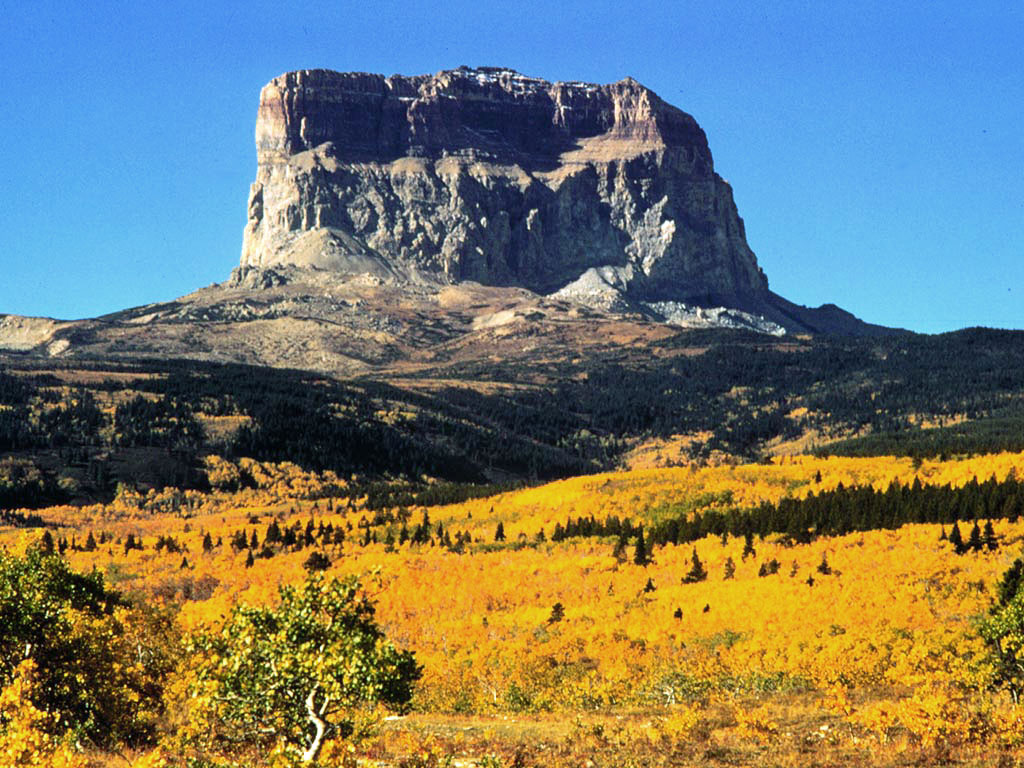
Chief Mountain